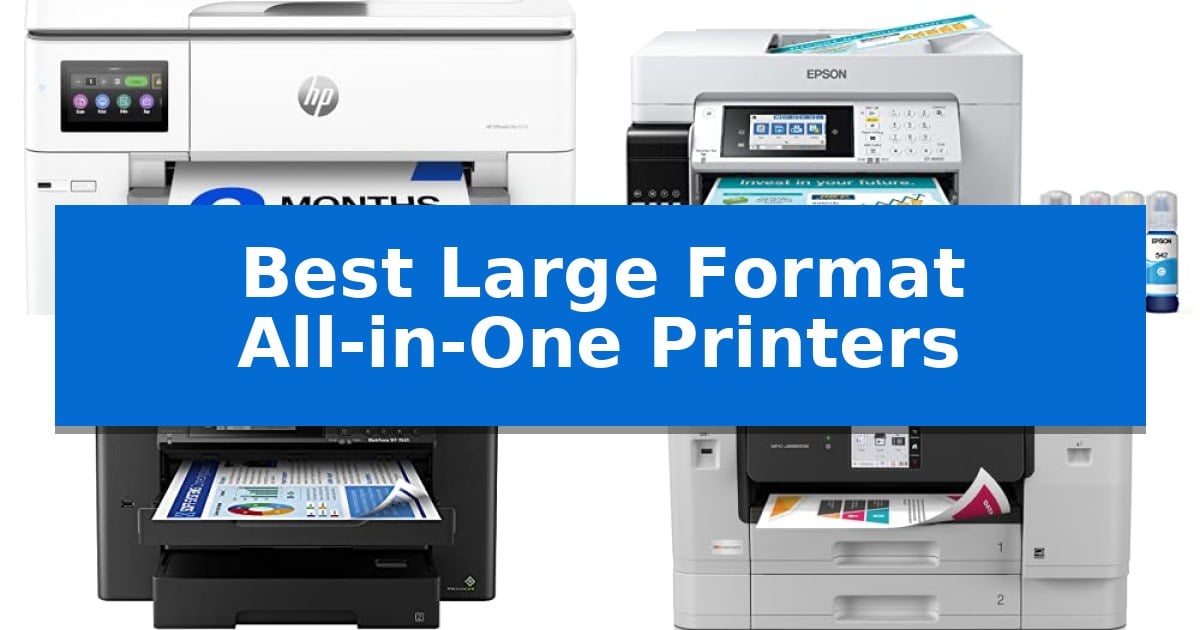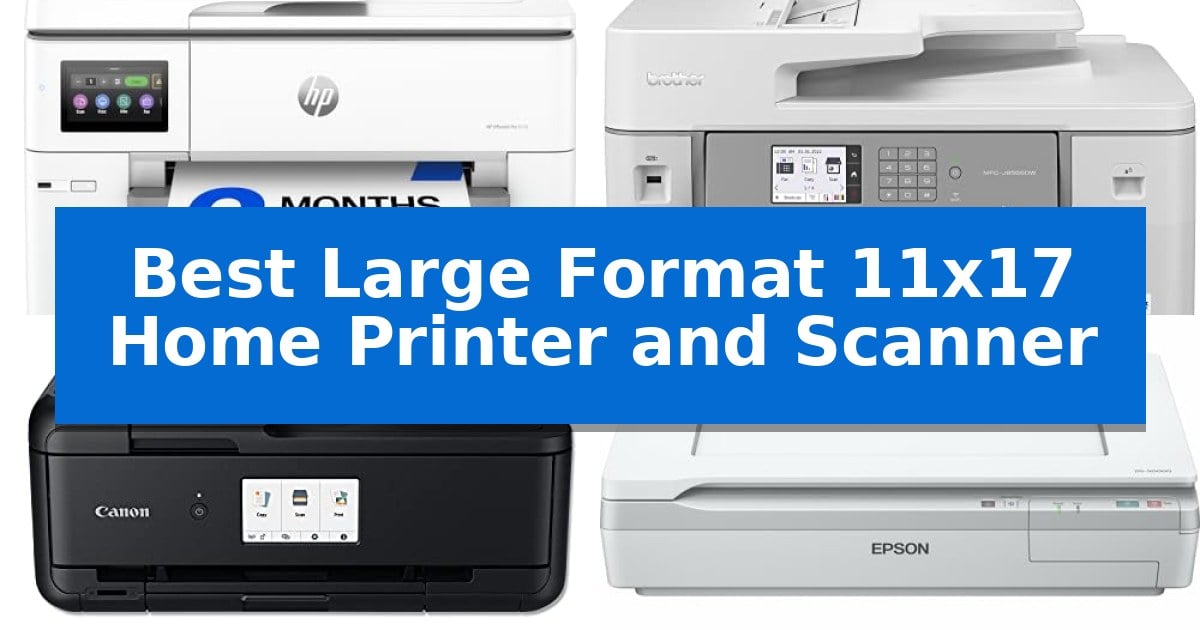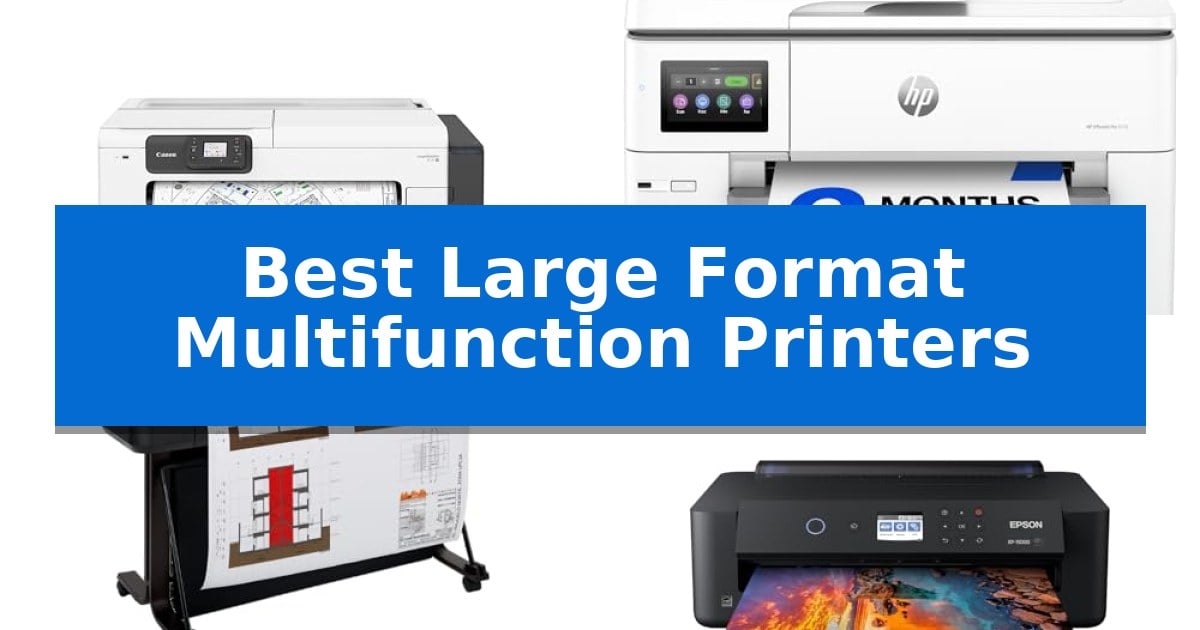
Best Large Format Multifunction Printers in 2026

Best Large Format Multifunction Printers

Managing large-scale documents requires specialized hardware that balances precision with everyday office utility. When your projects shift from standard letter-sized reports to architectural blueprints, posters, or wide-format spreadsheets, having the right equipment is essential to maintaining a seamless workflow.

We have evaluated the current market to identify the Best Large Format Multifunction Printers that offer the most reliable performance for professional environments. Whether you need automated media detection for technical drafting or high-quality photo reproduction, these units provide the versatility needed to handle diverse printing demands.
Best Large Format Multifunction Printers in 2026

Quick Comparison

Product Best For Key Strength Score
Canon imagePROGRAF TC-21M Multifunction Printer Best Overall Integrated flatbed scanner for direct enlargements 4.9
HP OfficeJet Pro 9730 All-in-One Printer Versatile Office Productivity Wide-format printing up to 11×17 inches for professional documents. 4.7
HP DesignJet T650 36-inch Plotter Printer Fast Technical Drafting Automatic sheet/roll switching for seamless multi-size project printing. 4.4
Epson Expression Photo HD XP-15000 Printer Superior Photo Quality 6-color Claria Photo HD ink including red and gray for superior color gamut. 4.3
Canon imagePROGRAF TM-340 36-inch Printer Automated Media Detection Automatic media detection for simplified operation 4.3

How We Chose

  • Media Handling Versatility: Evaluating the ability to switch between roll-fed large format media and standard cut-sheet paper.
  • Workflow Integration: Assessing connectivity options like Wi-Fi, LAN, and USB, alongside software tools that simplify file management.
  • Output Precision: Reviewing the technical capabilities for line accuracy, color gamut, and text clarity required for professional documents.
  • Operational Efficiency: Considering features like automatic media detection, touchscreen interfaces, and automated document feeders that reduce manual intervention.

1 Canon imagePROGRAF TC-21M Multifunction Printer — Best for Direct Enlargements

The Canon imagePROGRAF TC-21M streamlines large-format printing by integrating a flatbed scanner directly into the device, allowing users to create enlargements from smaller originals without needing a computer. This 24-inch multifunction printer is designed for environments that require both standard document handling and large-format output, offering a compact footprint of 38" x 21" x 10".

Equipped with an auto sheet feeder, the printer manages up to 100 sheets of letter-size paper or 50 sheets of 11" x 17" paper, providing versatility for mixed-media workflows. Users can navigate settings and tasks via a 2.7" tiltable touchscreen LCD, which simplifies operation for walk-up printing and scanning tasks.

Connectivity options include USB, Wi-Fi, and LAN, supporting flexible integration into existing office networks. The inclusion of a USB flash drive port allows for direct printing of large-format files, while cloud printing and scanning capabilities enable remote document management directly from the printer interface.

This system balances space efficiency with professional output capabilities, making it a practical choice for offices needing to produce posters or technical documents on-demand. The 1-year manufacturer warranty provides coverage for the unit, ensuring support for the hardware components.

Best for: Small offices or creative workspaces that require occasional large-format printing and direct enlargement of smaller documents.

Skip if: Users who require high-volume production printing or specialized media handling beyond the 24-inch width and sheet feeder capacity.

PROS

  • Integrated flatbed scanner for direct enlargements
  • Auto sheet feeder for flexible paper handling
  • Cloud and USB connectivity for convenient file access
  • Compact design suitable for limited office spaces

CONS

  • 24-inch maximum width limits output size for oversized projects

2 HP OfficeJet Pro 9730 All-in-One Printer — Versatile Office Productivity

The HP OfficeJet Pro 9730 All-in-One Printer streamlines professional workflows by offering wide-format printing up to 11×17 inches, making it a capable tool for handling floorplans, mood boards, and complex spreadsheets. This device integrates P3 color gamut support, which provides a wider range of colors compared to standard sRGB, allowing for screen-accurate prints that match digital designs.

Designed for high-volume office environments, the unit features two 250-sheet input trays to minimize paper reloading. It maintains efficiency with print speeds up to 22 ppm in black and 18 ppm in color, supported by an auto document feeder that enables single-pass, two-sided scanning. Users can manage tasks through a 4.3-inch color touchscreen that utilizes a phone-like interface for intuitive navigation.

Connectivity and security are prioritized through dual-band Wi-Fi that automatically detects and resolves connection issues, alongside HP Wolf Pro Security to protect network data. For mobile flexibility, the HP App allows for printing, scanning, and faxing directly from a smartphone. The printer also incorporates HP AI to optimize formatting for web pages and emails, ensuring layouts are precise and reducing wasted paper.

The printer is constructed with more than 30% recycled plastic content, reflecting a focus on sustainable design. It includes a 3-month trial of the Instant Ink delivery service, which automates supply replenishment to help prevent running out of ink during critical tasks. The unit is backed by a one-year limited hardware warranty.

Best for: Offices and creative professionals requiring wide-format printing, high-capacity paper handling, and screen-accurate color reproduction.

Skip if: Users with limited desk space or those who do not require wide-format 11×17 inch printing capabilities.

PROS

  • Wide-format printing up to 11×17 inches for professional documents.
  • P3 color gamut support for screen-accurate color output.
  • Dual-band Wi-Fi with automatic connection recovery.
  • HP Wolf Pro Security for network data protection.

CONS

  • Large physical footprint requiring significant desk or office space.
  • Monthly subscription fee required for Instant Ink after the initial trial period.

3 HP DesignJet T650 36-inch Plotter Printer — Fast Technical Drafting

Precision and efficiency define the HP DesignJet T650 36-inch Plotter Printer, a device engineered for architects, engineers, and construction professionals who require high-quality technical line-drawings and renders. This model streamlines complex workflows by utilizing HP Click Software, which enables users to drag and drop files like PDF, TIFF, and DWF directly into the print queue with automated error checking and nesting to minimize paper waste.

Designed for versatility, the printer handles a wide range of media, supporting 36-inch wide rolls for large format output and up to 13-inch by 19-inch sheets through an integrated automatic sheet feeder. The system features an automatic horizontal cutter and seamless switching between roll and sheet feeds, allowing for multi-size project printing without manual intervention.

Connectivity is robust, offering Gigabit Ethernet, Wi-Fi 802.11, and Hi-Speed USB 2.0 interfaces. Users can manage printing tasks remotely via the HP Smart app from mobile devices or desktops. With a print speed of up to 25 seconds per A1/D size page and 1GB of memory, it is built to maintain productivity in fast-paced professional environments.

The unit includes a 2-year HP Care Pack with onsite support, providing long-term maintenance coverage. By utilizing HP 712 Original Ink cartridges and the HP 713 Printhead, the system is optimized for crisp text and accurate line quality while maintaining cost-saving efficiencies that use significantly less ink for routine maintenance compared to standard plotter alternatives.

Best for: Architects, engineers, and construction professionals who need a reliable, high-speed solution for technical drawings and large format posters.

Skip if: Users who do not require large format capabilities or those who primarily print standard office documents rather than technical CAD-based files.

PROS

  • Automatic sheet/roll switching for seamless multi-size project printing.
  • HP Click Software integration simplifies file management and reduces material waste.
  • Includes a 2-year onsite warranty for reliable long-term support.
  • Versatile connectivity options including Wi-Fi and Gigabit Ethernet.

CONS

  • Large physical footprint requires significant dedicated office space.
  • Specialized ink and printhead requirements limit third-party supply options.

4 Epson Expression Photo HD XP-15000 Printer — Superior Photo Quality

Achieving professional-grade prints in a home studio requires a device that balances color accuracy with media versatility. The Epson Expression Photo HD XP-15000 Printer addresses this need by utilizing a specialized 6-color Claria Photo HD ink system, which incorporates dedicated gray and red inks to expand the color gamut and improve black-and-white tonal depth.

Designed for photographers who require large-format capabilities without sacrificing desk space, this ultra-compact wide-format A3+ printer is 30 percent smaller than its predecessor. It supports borderless printing for sizes ranging from 4 inches by 6 inches up to 13 inches by 19 inches, providing significant flexibility for diverse creative projects.

The unit features a 50-sheet rear tray specifically engineered for specialty media, including cardstock, while a 200-sheet front tray handles standard document needs with support for auto 2-sided printing. To streamline maintenance, the printer integrates with Dash Replenishment, allowing it to track ink usage and order replacements automatically.

Operating at a sound pressure level of 49 dB(A), the machine is built to fit into quiet working environments. Users should note that the system is designed to function exclusively with Epson Genuine Cartridges to maintain the integrity of the print system and ensure coverage under the manufacturer's limited warranty.

Best for: Photographers and home studio creators who require high-quality, wide-format borderless printing up to 13 x 19 inches in a compact footprint.

Skip if: Users who require high-volume office document production or integrated scanning and copying features, as this is a dedicated photo-focused printer.

PROS

  • 6-color Claria Photo HD ink including red and gray for superior color gamut.
  • Compact A3+ design that saves significant desktop space.
  • Specialized 50-sheet rear tray for handling cardstock and specialty media.
  • Auto 2-sided printing for increased document efficiency.

CONS

  • Exclusive reliance on Epson Genuine Cartridges to avoid potential system damage.
  • Limited to printing functions only, lacking integrated scanning or copying capabilities.

5 Canon imagePROGRAF TM-340 36-inch Printer — Automated Media Detection

The Canon imagePROGRAF TM-340 36-inch Printer streamlines large-format production through its advanced automatic media detection system, which identifies media type, width, and remaining length without manual input. This 36-inch wide output device is engineered for high-visibility posters and technical plots, utilizing a 5-color pigment ink system to produce sharp lines and vibrant, attention-grabbing graphics.

Designed for high-volume environments, the unit includes a printer stand and catch basket to manage output effectively. The integration of automatic color calibration ensures consistent output across print jobs, reducing the need for manual adjustments. Users interact with the system via an intuitive tiltable touchscreen control panel, which features animated installation guides to simplify initial setup and ongoing maintenance tasks.

Connectivity is handled through high-speed USB and Ethernet interfaces, supporting both wired and wireless network integration for reliable office productivity. The printer is ENERGY STAR and EPEAT Gold rated, reflecting its focus on power efficiency. With 300 ml of ink included in the box, the system is ready for immediate deployment in professional settings requiring consistent, high-quality large-format output.

While the Canon imagePROGRAF TM-340 36-inch Printer offers significant automation, its physical footprint of 57.6 inches in width and 130.5 pounds in weight requires dedicated floor space. It is an ideal solution for offices or design studios that prioritize automated media handling and consistent color output over extreme portability.

Best for: Professional environments requiring automated media detection and consistent, high-quality large-format poster or plotter output.

Skip if: Users with limited floor space or those who do not require 36-inch wide printing capabilities should consider more compact desktop alternatives.

PROS

  • Automatic media detection for simplified operation
  • 5-color pigment ink system for sharp and vibrant prints
  • Intuitive tiltable touchscreen with animated guides
  • ENERGY STAR and EPEAT Gold certified for efficiency

CONS

  • Large physical footprint requires significant dedicated space
  • Heavy unit weight limits mobility once installed

Best Large Format Multifunction Printers Buying Guide

Understanding Media Versatility

The primary advantage of a large format printer is its ability to handle media sizes beyond the standard A4 or letter format. Look for models that offer automatic roll and cut-sheet paper feeders, as these allow you to transition between printing posters or blueprints and standard office documents without manual reloading.

Consider the maximum width the printer can accommodate. While 24-inch models are often sufficient for posters and smaller technical drawings, a 36-inch printer is typically required for full-scale architectural plans and complex engineering layouts.

Connectivity and Software Integration

Modern office printers must function as part of a digital ecosystem. Features like cloud printing and scanning allow teams to access documents remotely, while high-speed USB and Ethernet connectivity ensure stable data transfer for large, high-resolution files.

Software tools, such as automated nesting or PDF error checking, can significantly reduce paper and ink waste. These utilities help optimize the layout of your prints, ensuring that you get the most out of every roll of media.

Print Quality and Color Accuracy

For technical drafting, sharp line quality and crisp text are non-negotiable. Printers utilizing pigment-based inks often provide better durability and resistance to environmental factors, which is critical for documents that will be handled on construction sites or in workshops.

If your work involves marketing materials or mood boards, prioritize models that support a wider color gamut. Some printers feature specialized ink configurations, such as red or gray inks, which help achieve more vibrant and screen-accurate color reproduction.

Operational Maintenance and Security

Large format printers require consistent maintenance to prevent clogs and ensure color consistency. Models with automatic color calibration and animated maintenance guides simplify these tasks, allowing users to keep the device in peak condition without needing specialized technical support.

Security is equally important in a networked office. Look for devices that include robust security protocols to protect your data from unauthorized access, especially when printing sensitive architectural designs or proprietary business documents.

Space and Ergonomics

Large format hardware can have a significant footprint. Before purchasing, verify the physical dimensions of the unit and ensure your workspace can accommodate the printer stand and the necessary clearance for the catch basket.

The user interface is another critical factor. A tiltable touchscreen LCD makes it easier to navigate settings, monitor ink levels, and manage print queues, even when the printer is placed in a corner or under a desk.

Frequently Asked Questions

What is the difference between a plotter and a standard large format printer?

A plotter is specifically designed for technical line drawings and vector graphics, often using specialized pens or ink systems to create precise, high-accuracy lines. Many modern large format printers now combine these capabilities with traditional inkjet printing to handle both posters and technical documents.

Can these printers handle standard office paper?

Yes, most multifunction large format printers include an auto sheet feeder that allows them to print on standard letter or 11×17 paper, making them versatile enough to replace a dedicated office printer.

How do I know if a printer supports my specific media size?

Check the printer's specifications for the maximum roll width. A 24-inch printer can handle media up to 24 inches wide, while a 36-inch model can handle larger blueprints and wide-format layouts.

Is wireless connectivity reliable for large files?

While Wi-Fi is convenient for everyday tasks, large high-resolution files are often transferred more reliably via Gigabit Ethernet or a direct USB connection to avoid potential network congestion or signal drops.

How often do I need to calibrate the colors?

Many modern printers feature automatic color calibration. If your work requires high color accuracy, it is best to run a calibration cycle whenever you change ink cartridges or switch to a new type of media.

Conclusion: Our Top Pick

Finding the right equipment for your large-scale projects requires balancing technical precision with daily usability. For those who need a versatile, space-efficient solution that handles both standard documents and large format enlargements, the Canon imagePROGRAF TC-21M Multifunction Printer stands out as a highly capable choice.

This printer simplifies complex tasks through its direct enlargement capabilities and intuitive touchscreen interface. While it is an excellent fit for small offices and creative studios, ensure your specific media width requirements align with its 24-inch capacity to get the most out of your investment.
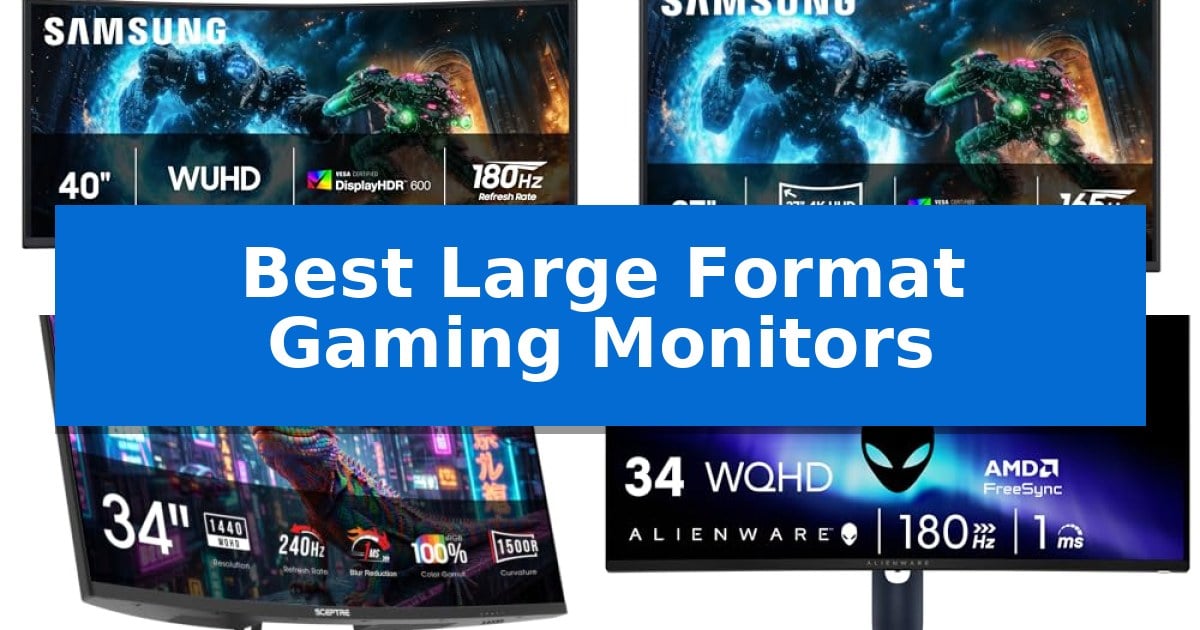
Best Large Format Gaming Monitors in 2026

Best Large Format Gaming Monitors

Finding the right display for a high-end gaming rig requires balancing screen real estate with technical performance. The Best Large Format Gaming Monitors offer expansive views that pull you deeper into virtual worlds, but choosing between ultrawide aspect ratios and high-resolution 4K panels depends heavily on your specific hardware and desk space.

Our guide focuses on the critical trade-offs between refresh rates, curvature, and resolution. Whether you prioritize peripheral immersion or pixel-dense clarity, we break down the essential specifications to help you select a display that complements your gaming style and hardware capabilities.

Best Large Format Gaming Monitors in 2026

Our Top Picks
  1. High-Speed Ultrawide Performance Sceptre 34-inch Curved Gaming Monitor
  2. Steep Curve for Peripheral Focus LG Ultragear 32-inch Curved Gaming Monitor

Quick Comparison

Product Best For Key Strength Score
Samsung Odyssey G7 40-inch Gaming Monitor Best Overall 1000R curvature provides an immersive, wrap-around viewing experience. 4.9
Samsung Odyssey G7 37-inch Gaming Monitor Spectacular 4K Realism 1000R curvature provides an immersive, wrap-around viewing experience. 4.7
Sceptre 34-inch Curved Gaming Monitor High-Speed Ultrawide Performance 240Hz refresh rate for fluid motion 4.6
Alienware 34-inch Curved Gaming Monitor Expansive WQHD Detail 180Hz refresh rate and 1ms response time for fluid motion 4.7
LG Ultragear 32-inch Curved Gaming Monitor Steep Curve for Peripheral Focus 1000R steep curve for enhanced immersion 4.6

How We Chose

  • Refresh rate and response time capabilities for motion clarity.
  • Resolution and panel technology for color accuracy and contrast.
  • Curvature radius and its impact on peripheral immersion.
  • Connectivity options for seamless device integration.
  • Physical footprint and adjustability for desk ergonomics.

1 Samsung Odyssey G7 40-inch Gaming Monitor — Ultrawide 4K Immersion

The Samsung 40” Odyssey G7 (G75F) Series WUHD Curved Gaming Monitor centers the visual experience around a massive 40-inch 1000R curved display, designed to wrap around the user's field of vision for heightened immersion. This ultrawide 21:9 format provides significant screen real estate, making it a distinctive choice for those prioritizing expansive, panoramic views during gameplay.

Engineered for fluid movement, the monitor features a 180Hz refresh rate paired with a 1ms (GtG) response time, which works to minimize lag and motion blur. The integration of AMD FreeSync™ Premium Pro technology further supports smooth performance by synchronizing the display with compatible hardware, reducing potential screen tearing during fast-paced action.

Visual fidelity is supported by the VESA DisplayHDR™ 600 certification, which enhances contrast by producing deeper blacks and brighter whites. This capability is intended to provide greater clarity in high-contrast scenes, ensuring details remain visible even in dark environments. The Ultrawide 4K resolution ensures that the large 40-inch panel maintains sharp image density.

The physical design includes a substantial footprint, measuring approximately 36.56 inches in width and weighing 24.9 pounds. This size requires a dedicated workspace, but the curvature is specifically calibrated to maintain consistent viewing distances across the entire screen surface, reducing the need for excessive head movement.

Best for: Gamers who prioritize high-resolution, ultrawide immersion and require a large, curved screen for a panoramic field of view.

Skip if: Users with limited desk space or those who prefer a standard 16:9 aspect ratio for traditional productivity and gaming setups.

PROS

  • 1000R curvature provides an immersive, wrap-around viewing experience.
  • 180Hz refresh rate and 1ms response time support smooth motion.
  • VESA DisplayHDR 600 enhances contrast and clarity in dark scenes.
  • Ultrawide 4K resolution delivers high-density visuals across the 40-inch panel.

CONS

  • Large 40-inch form factor requires significant desk space.
  • Heavy 24.9-pound weight necessitates a sturdy mounting surface or stand.

2 Samsung Odyssey G7 37-inch Gaming Monitor — Spectacular 4K Realism

The Samsung 37” Odyssey G7 (G75F) Series 4K UHD Curved Gaming Monitor centers on a massive 37-inch 1000R curved display, engineered to wrap around the user's field of vision for an immersive visual experience. This large-format display is designed for gamers who prioritize screen real estate and high-fidelity visuals, utilizing a 4K UHD resolution to maintain image clarity across its expansive surface.

Performance is driven by a 165Hz refresh rate paired with a 1ms (GtG) response time, which works to minimize lag during fast-paced sequences. The integration of AMD FreeSync Premium Pro technology helps synchronize the display with compatible hardware to support smooth gameplay. For visual depth, the monitor features VESA DisplayHDR 600, which enhances contrast by producing deeper blacks and brighter whites, aiding in visibility during dark in-game environments.

Measuring 32.1 inches in width and 26.6 inches in height, this monitor occupies a significant footprint on any desk. The curved design is a deliberate choice to maintain consistent viewing distances across the wide panel, reducing the need for excessive head movement. It is a specialized piece of hardware for those looking to maximize their visual immersion through a high-resolution, high-refresh-rate large-format setup.

Best for: Gamers seeking an immersive, high-resolution large-format display for 4K gaming.

Skip if: Users with limited desk space or those who prefer a flat panel display for professional color-critical work.

PROS

  • 1000R curvature provides an immersive, wrap-around viewing experience.
  • 4K UHD resolution ensures sharp, detailed visuals on a large 37-inch screen.
  • 165Hz refresh rate and 1ms response time support smooth, responsive gameplay.
  • VESA DisplayHDR 600 improves contrast and clarity in high-dynamic-range scenes.

CONS

  • Large physical footprint requires significant desk space for proper placement.
  • Curved form factor may not be ideal for users who prefer flat screens for non-gaming tasks.

3 Sceptre 34-inch Curved Gaming Monitor — High-Speed Ultrawide Performance

The Sceptre 34-inch Curved Gaming Monitor utilizes a 1500R curvature to wrap the display around your field of vision, creating a sense of depth that draws you into high-intensity gaming environments. This ultrawide form factor is designed to maximize screen real estate, providing a expansive canvas for both competitive titles and complex professional workflows.

Engineered for speed, the monitor features an ultra-smooth 240Hz refresh rate and a 1ms response time with blur reduction technology. These specifications are critical for fast-paced gaming, as they work in tandem to minimize motion artifacts and ensure that on-screen action remains fluid and responsive during rapid movements.

Visual fidelity is supported by 100% sRGB color gamut coverage, which ensures vibrant and accurate color reproduction for creative tasks. The 3440 x 1440 resolution provides a sharp, detailed image, while integrated Blue-Light Shift technology helps mitigate eye strain, making it a practical choice for users who spend extended hours in front of the screen.

Connectivity is streamlined through two HDMI ports and two DisplayPort inputs, allowing for versatile integration with multiple devices. The inclusion of integrated speakers and an audio-out jack further simplifies your workspace by reducing the need for external sound systems, helping to maintain a clean and organized desk setup.

Best for: Gamers and professionals who require a high-refresh-rate ultrawide display for immersive gaming and color-accurate creative work.

Skip if: Users with limited desk space or those who prefer a flat-panel display for specific professional design requirements.

PROS

  • 240Hz refresh rate for fluid motion
  • 1500R curvature for immersive viewing
  • 100% sRGB color gamut coverage
  • Versatile connectivity with dual HDMI and DisplayPort

CONS

  • Large 34-inch footprint requires significant desk space

4 Alienware 34-inch Curved Gaming Monitor — Expansive WQHD Detail

Immersive gaming requires more than just high frame rates; it demands a display that pulls you into the action. The Alienware 34 Curved Gaming Monitor – AW3425DWM achieves this through its expansive 34-inch ultrawide panel, which features a 1500R curve designed to wrap around your field of view for a more consistent visual experience across the entire screen.

Performance is anchored by a 180Hz refresh rate and a rapid 1ms gray-to-gray response time, ensuring that fast-paced motion remains fluid and clear. To eliminate screen tearing and stuttering, the monitor integrates AMD FreeSync Premium and VESA AdaptiveSync technology, which synchronize the display output with your graphics hardware.

Visual fidelity is prioritized with WQHD resolution, providing the pixel density necessary for sharp, detailed landscapes. The monitor covers 95% of the DCI-P3 color gamut and carries VESA DisplayHDR 400 certification, delivering a broad color range and enhanced contrast for high-dynamic-range content.

Designed for long-term comfort, the AW3425DWM includes a hardware-based low blue light solution that minimizes eye strain without sacrificing color accuracy. Additionally, a dedicated console mode ensures compatibility and optimal performance when connected to external gaming systems, making it a versatile hub for various gaming setups.

Best for: Gamers who prioritize immersion and fluid motion in open-world titles or competitive play using an ultrawide setup.

Skip if: Users who require a flat display for professional color-critical work or those with limited desk space who cannot accommodate a 34-inch curved footprint.

PROS

  • 180Hz refresh rate and 1ms response time for fluid motion
  • 1500R curvature for enhanced visual immersion
  • Hardware-based low blue light filter to reduce eye strain
  • AMD FreeSync Premium and VESA AdaptiveSync support

CONS

  • Large 34-inch footprint requires significant desk space
  • Curved panel design may not suit all productivity workflows

5 LG Ultragear 32-inch Curved Gaming Monitor — Steep Curve for Peripheral Focus

The LG Ultragear 32-inch Curved Gaming Monitor centers your visual experience around a steep 1000R curved screen, designed to extend your periphery and create a sense of immersion during fast-paced gameplay. This display is built for those who prioritize a wrap-around field of view to stay locked into the action.

Engineered for competitive responsiveness, the monitor features a 180Hz refresh rate paired with a 1ms GtG response time. These specifications work in tandem with AMD FreeSync to provide fluid, tear-free motion, ensuring that rapid movements remain clear. The inclusion of Dynamic Action Sync further assists by reducing input lag, allowing for near-instant reactions to on-screen events.

Visual fidelity is supported by 99% sRGB color gamut coverage and HDR10 compatibility, which help enhance color depth and contrast in dark scenes through the integrated Black Stabilizer. The monitor offers a practical, three-side borderless design that saves space on a desk while providing tilt adjustability for ergonomic positioning.

Connectivity is handled via two HDMI ports and a DisplayPort, giving you the flexibility to connect multiple devices. The Enhanced Gaming GUI allows you to toggle between specific modes like FPS or RTS, while a built-in FPS Counter provides real-time performance data directly on the screen, making it a functional tool for tracking your setup's output.

Best for: Gamers who want an immersive, high-refresh-rate experience with a steep curve for better peripheral focus.

Skip if: Users who require 4K resolution for professional creative work or those with limited desk space who prefer a flat panel display.

PROS

  • 1000R steep curve for enhanced immersion
  • 180Hz refresh rate and 1ms GtG for smooth motion
  • Black Stabilizer improves visibility in dark environments
  • 99% sRGB color gamut provides vibrant visuals

CONS

  • QHD resolution may not satisfy users seeking 4K clarity
  • Tilt-only stand offers limited ergonomic adjustment

Best Large Format Gaming Monitors Buying Guide

Understanding Display Curvature

The 1000R and 1500R curvature ratings indicate how tightly a screen wraps around your field of view. A 1000R curve is steeper, designed to match the natural shape of the human eye, which helps maintain consistent distance from the screen to the edges of your peripheral vision.

Choosing a steeper curve is often beneficial for large format monitors as it reduces the need to turn your head to see the corners of the display. However, users who also perform precision creative work may find that a flatter 1500R panel provides a more natural perspective for straight lines and design tasks.

Resolution vs. Refresh Rate

Balancing 4K UHD resolution with high refresh rates is the primary challenge for modern gaming hardware. While 4K provides superior pixel density for sharp textures, it requires significant GPU power to maintain high frame rates. Monitors offering 165Hz or 180Hz provide a middle ground that keeps motion fluid without demanding the extreme overhead of higher-refresh panels.

For competitive gaming, prioritize a higher refresh rate and a 1ms response time (GtG) to minimize ghosting and input lag. If your focus is on atmospheric, single-player titles, the visual impact of a wider color gamut and HDR certification will likely provide a more rewarding experience than raw frame rate alone.

Connectivity and Peripheral Integration

Modern gaming monitors should offer versatile connectivity, typically featuring a mix of HDMI and DisplayPort inputs. DisplayPort is generally preferred for high-refresh-rate gaming as it provides the necessary bandwidth for G-Sync or FreeSync compatibility, ensuring a tear-free experience.

Consider whether your monitor includes built-in features like Black Stabilizer or integrated speakers. These additions can help declutter your desk by reducing the need for external audio hardware or specific software adjustments to see enemies in dark game environments.

Ergonomics and Desk Space

A large format monitor demands a significant amount of desk depth. Before purchasing, verify the item dimensions and the stand's footprint to ensure it fits your workspace. Many of these monitors feature tilt-adjustable stands, but the sheer size of 37-inch or 40-inch panels may require a dedicated monitor arm if your desk space is limited.

Look for borderless or ultra-thin designs if you plan to use a multi-monitor setup. A thinner bezel minimizes the gap between screens, creating a more cohesive visual experience when spanning games or productivity applications across multiple displays.

Color Accuracy and HDR Standards

The VESA DisplayHDR certification is a key indicator of a monitor's ability to produce high-contrast imagery. HDR600, for instance, offers a noticeable improvement in brightness and black levels compared to standard panels, making it ideal for games with complex lighting and shadows.

Check for sRGB color gamut coverage if you intend to use your monitor for photo or video editing alongside gaming. A high percentage of sRGB coverage ensures that colors appear vibrant and accurate, preventing the washed-out look often found in lower-tier gaming displays.

Frequently Asked Questions

What is the benefit of a 21:9 aspect ratio?

A 21:9 ultrawide aspect ratio provides a wider field of view, which can be advantageous in racing, flight simulation, and open-world games by allowing you to see more of the environment without moving your camera.

Is 1ms response time necessary for all gamers?

A 1ms GtG response time is most beneficial for fast-paced competitive shooters where reducing motion blur is critical. For slower-paced strategy or RPG games, a slightly higher response time is often imperceptible.

Do I need a specific cable for high refresh rates?

Yes, ensure you are using a high-quality DisplayPort cable or a modern HDMI cable that supports the bandwidth required for your monitor's specific resolution and refresh rate to avoid capping your performance.

How does FreeSync improve my gaming experience?

AMD FreeSync synchronizes the monitor's refresh rate with your GPU's frame output, effectively eliminating screen tearing and stuttering during intense gameplay sequences.

Can I use a large gaming monitor for office work?

Absolutely. The increased screen real estate is excellent for multitasking, allowing you to snap multiple windows side-by-side, which can significantly improve productivity compared to a standard 24-inch or 27-inch monitor.

Conclusion: Our Top Pick

For those seeking the ultimate balance of immersion and performance, the Samsung Odyssey G7 40-inch Gaming Monitor stands out as our top recommendation. Its 40-inch 1000R curved panel combined with a 21:9 aspect ratio creates a uniquely wrap-around visual experience that is difficult to match with smaller or flatter displays.

While its size requires a substantial desk, the combination of 180Hz refresh rates, 1ms response time, and VESA DisplayHDR 600 makes it a versatile powerhouse for both competitive gaming and cinematic immersion. If you have the space, this monitor provides the most comprehensive feature set for a high-end gaming setup.

Best Large Format Flatbed Scanners in 2026

Best Large Format Flatbed Scanners

When your projects involve blueprints, fine art, or oversized historical archives, standard letter-sized scanners simply cannot handle the load. Finding the Best Large Format Flatbed Scanners requires balancing high-resolution optical sensors with a scanning surface large enough to capture your entire document in a single pass.

Whether you are an engineer working with CAD drawings or an archivist preserving delicate photos, the right hardware ensures your digital copies retain the detail and color accuracy of the original. We have analyzed the top-performing A3-sized flatbed scanners to help you choose the model that fits your specific workflow requirements.

Best Large Format Flatbed Scanners in 2026

Our Top Picks
  1. Best for Large Bound Books Plustek OpticPro A320E Flatbed Scanner
  2. Fastest High-Resolution Workflow VIISAN VF3240 A3 Flatbed Scanner
  3. Compact Design for Large Documents Plustek OpticSlim 1680 Flatbed Scanner
  4. Reliable Choice for Graphic Design Plustek OS1180 A3 Flatbed Scanner

Quick Comparison

Product Best For Key Strength Score
Epson Expression 13000XL Flatbed Scanner Best Overall Large 12.2" x 17.2" scanning area for oversized media 4.9
Plustek OpticPro A320E Flatbed Scanner Best for Large Bound Books Large 12" x 17" scan area for oversized materials. 4.9
VIISAN VF3240 A3 Flatbed Scanner Fastest High-Resolution Workflow Large A3 scanning area accommodates oversized documents up to 12" x 17". 4.5
Plustek OpticSlim 1680 Flatbed Scanner Compact Design for Large Documents High-speed scanning capabilities for large-format documents. 4.9
Plustek OS1180 A3 Flatbed Scanner Reliable Choice for Graphic Design Large format scanning capability up to 11.7" x 17". 4.6

How We Chose

  • Optical Resolution: We prioritized scanners offering at least 1200 DPI to ensure fine lines and textures are captured with precision.
  • Scanning Speed: We compared the time required to digitize A3-sized documents to identify units suitable for high-volume office environments.
  • Software Compatibility: We checked for TWAIN and ICA driver support to ensure seamless integration with existing design and archival software.
  • Build and Design: We assessed the physical dimensions and frameless designs to determine how easily each scanner accommodates oversized or bound materials.
  • Color Accuracy: We looked for advanced sensor technologies that maintain color fidelity for professional-grade photo and art reproduction.

1 Epson Expression 13000XL Flatbed Scanner — Professional Archival Color Accuracy

Preserving high-fidelity detail from oversized originals requires hardware designed specifically for expansive media. The Epson Expression 13000XL Large Format Flatbed Photo Scanner addresses this need with a generous 12.2" x 17.2" scanning area, allowing for the digitization of large-format photographs, documents, and artwork without the need for stitching smaller sections together.

Engineered for archival-grade results, this scanner utilizes Epson MatrixCCD and ReadyScan LED technologies to ensure color accuracy and clarity. It achieves a high 2400 x 4800 dpi resolution and a 3.8 Dmax, which provides the dynamic range necessary to capture subtle tonal transitions in both highlights and shadows. The inclusion of Epson Micro Step Drive technology further enhances the precision of the scan head movement.

Workflow efficiency is a primary focus, supported by batch scanning capabilities that allow users to process multiple images simultaneously. For legacy media, the Easy Photo Fix technology provides one-touch color restoration and automatic dust removal, streamlining the cleanup process for faded or damaged prints. The unit also includes LaserSoft Imaging SilverFast Ai software with calibration targets to maintain professional standards.

Integration into existing professional setups is straightforward due to the included TWAIN driver, which ensures compatibility with a wide range of imaging software. While the base unit is optimized for reflective media, it supports an optional Transparency Unit (sold separately) for those who need to digitize film up to 12" x 16.5". This modular approach allows the scanner to adapt to diverse archival requirements.

Best for: Professional archivists and photographers who require high-resolution, color-accurate digitization of large-format reflective media.

Skip if: Users who primarily scan standard letter-sized documents or those who lack the desk space for a large-format footprint.

PROS

  • Large 12.2" x 17.2" scanning area for oversized media
  • High 2400 x 4800 dpi resolution for detailed archival work
  • Easy Photo Fix technology for automated restoration of faded photos
  • Includes professional SilverFast Ai software with calibration targets

CONS

  • Transparency Unit for film scanning is sold separately
  • Large physical footprint requires significant workspace

2 Plustek OpticPro A320E Flatbed Scanner — Best for Large Bound Books

The Plustek OpticPro A320E is a specialized tool designed to handle oversized documents, featuring a generous 12" x 17" scan area. This large-format capability makes it a practical choice for digitizing maps, architectural drawings, and large bound books that exceed the capacity of standard letter-sized flatbed scanners.

Equipped with CCD sensors, this unit is engineered for high-quality color scanning. It offers a rapid 7.8-second scan speed for a full 12" x 17" area, which helps maintain efficiency when processing multiple pages. The inclusion of batch scanning functionality allows users to capture multiple images simultaneously and save them as separate PDF files, streamlining the workflow for larger projects.

The device integrates with Doc Action software, which provides direct access to various post-scan destinations such as email, FTP web folders, and local storage. It also includes an OCR function to create searchable PDF content, enhancing the utility of digitized documents for archival or research purposes.

Compatibility is addressed through TWAIN and WIA support, ensuring the scanner works with a wide range of industry-standard software applications. The Plustek OpticPro A320E is designed to operate across Windows, Mac, and Linux environments, providing flexibility for different workstation setups.

Best for: Professional users and archivists who need to digitize large-format documents, maps, or bound books up to A3 size.

Skip if: Users who only require standard letter-sized scanning and have limited desk space, as the 31.25-inch length of this unit requires a significant footprint.

PROS

  • Large 12" x 17" scan area for oversized materials.
  • CCD sensors optimized for color accuracy.
  • Batch scanning capability for increased productivity.
  • OCR functionality for creating searchable PDF files.

CONS

  • Large physical footprint may not fit on smaller desks.
  • Limited to 64-bit versions of Windows for full compatibility.

3 VIISAN VF3240 A3 Flatbed Scanner — Fastest High-Resolution Workflow

Digitizing oversized documents requires a specialized tool capable of handling dimensions that standard office equipment simply cannot accommodate. The VIISAN VF3240 A3 Flatbed Scanner is engineered specifically for this purpose, featuring a large scanning area that supports materials up to 12" x 17". This makes it a practical choice for architects, engineers, and businesses needing to archive blueprints, CAD drawings, or large-format legal records.

Efficiency is central to its design, highlighted by a 4-second scan speed at 200 DPI. For high-resolution requirements, the device supports up to 2400 x 2400 DPI optical resolution with 48-bit color depth, ensuring that fine details in technical drawings or artistic prints are captured with precision. The inclusion of a frameless glass design allows for edge-to-edge scanning, which is essential when dealing with bound materials or oversized sheets that might otherwise be obstructed by a scanner housing.

Operation is streamlined through an integrated four-button control panel that provides quick access to scan, email, print, and PDF functions. The unit also features an Intelligent Auto-Scan function, which initiates the capture process as soon as the lid is closed, facilitating a faster workflow for repetitive tasks. Because it utilizes a CIS sensor and LED light source, the scanner requires no warm-up time, allowing for immediate use upon activation.

Compatibility is broad, supporting Windows 7 through 11 and MacOS 10.15 or later. Users should note that while the hardware is capable of high-resolution output, software drivers—such as the WIA driver on Windows—may impose specific resolution limits. The scanner includes a universal power adapter, making it suitable for various international power environments without the need for additional converters.

Best for: Professionals and offices requiring high-speed, edge-to-edge digitization of large-format documents like blueprints, CAD drawings, and oversized reports.

Skip if: Users who need to scan 3D objects, thick books with uneven spines, or items that require a CCD sensor for depth of field, as this device is optimized specifically for flat paper documents.

PROS

  • Large A3 scanning area accommodates oversized documents up to 12" x 17".
  • Fast 4-second scan speed at 200 DPI improves productivity for high-volume tasks.
  • Frameless design enables easy placement and scanning of edge-to-edge materials.
  • No warm-up time required due to the efficient LED light source.

CONS

  • CIS sensor technology is limited to flat materials and is not suitable for 3D objects.
  • Software-dependent resolution limits may apply depending on the operating system and driver used.

4 Plustek OpticSlim 1680 Flatbed Scanner — Compact Design for Large Documents

Digitizing large-format documents requires a scanner capable of handling tabloid, ledger, and A3 sizes without compromising on efficiency. The Plustek OpticSlim 1680 addresses this need with a specialized design that processes 11.7×17-inch documents in as little as 3 seconds at 300 DPI in grayscale mode, or 5 seconds in color.

Designed for high-volume workflows, the device features a Dual View Design that allows users to quickly verify image adjustment effects before finalizing scans. This focus on intuitive operation is further supported by four pre-configured, one-touch buttons, which can be customized to handle specific destinations, file types, and naming conventions, streamlining repetitive tasks.

Compatibility is a core strength of this model, as it is both TWAIN and ICA compliant. This ensures seamless integration with a wide range of software applications and hardware systems across both Windows (7 through 11) and macOS (10.12 to 15.x).

With a compact footprint measuring 23 by 16 by 3 inches, the scanner is engineered to fit into professional environments where desk space is at a premium. The unit weighs 9.52 pounds, providing a stable base for scanning larger media without requiring an oversized footprint.

Best for: Professionals and offices requiring high-speed digitization of large-format documents like tabloid or A3 pages in a compact workspace.

Skip if: Users who require an Automatic Document Feeder (ADF) for multi-page scanning, as this is a flatbed-only device.

PROS

  • High-speed scanning capabilities for large-format documents.
  • One-key operation with four customizable buttons for efficient workflow.
  • Broad compatibility via TWAIN and ICA drivers for Windows and Mac.
  • Compact design that saves valuable desk space.

CONS

  • Flatbed-only design requires manual placement for every scan.
  • No automatic document feeder for batch processing of multiple pages.

5 Plustek OS1180 A3 Flatbed Scanner — Reliable Choice for Graphic Design

Digitizing large-scale documents, architectural plans, or artistic prints requires a specialized tool capable of capturing expansive surfaces without the need for stitching software. The Plustek OS1180 A3 Flatbed Scanner is engineered specifically for this purpose, offering a generous scan area of 11.7" x 17" to accommodate tabloid and A3-sized materials in a single pass.

Efficiency is central to the design of this unit, which utilizes an LED light source to eliminate warm-up time, allowing for immediate operation. This choice not only saves energy but also ensures that users can begin scanning tasks without delay. The device is built to handle diverse media, supporting 48-bit color and 16-bit gray-scale modes to maintain high fidelity for both detailed artwork and standard text documents.

Usability is streamlined through a one-touch button interface, which simplifies repetitive workflows by providing quick access to preset functions. For those managing large volumes of paperwork, the scanner includes a powerful software bundle featuring ABBYY for enhanced OCR accuracy and DocAction for efficient file sharing, making it a practical addition to libraries, schools, or professional design offices.

Measuring 23.18 inches in width and weighing approximately 9.52 pounds, the scanner maintains a relatively compact footprint for its large-format capability. Its design focuses on providing a straightforward, reliable interface for users who require consistent, high-quality digital captures of oversized media without the complexity of multi-step processing.

Best for: Graphic designers, librarians, and office professionals who need to digitize A3 or tabloid-sized documents and artwork efficiently.

Skip if: Users who require high-speed automatic document feeding for multi-page reports or those with limited desk space who do not need to scan large-format media.

PROS

  • Large format scanning capability up to 11.7" x 17".
  • No warm-up time due to the integrated LED light source.
  • One-touch button operation for streamlined workflows.
  • Includes comprehensive software for OCR and file management.

CONS

  • Manual feed design requires individual placement for each scan.
  • Large physical footprint may occupy significant desk space.

Best Large Format Flatbed Scanners Buying Guide

Understanding Optical Resolution

Optical resolution is the most critical factor when digitizing high-detail documents like architectural blueprints or fine art. A higher DPI (dots per inch) allows you to capture smaller details without pixelation, which is essential if you plan to enlarge your scans later.

Most professional applications require at least 1200 DPI, though some specialized photo scanners offer up to 2400 DPI. Always ensure your chosen scanner supports the resolution necessary for your specific output requirements, as software interpolation can often lead to loss of clarity.

The Importance of TWAIN and ICA Drivers

Compatibility with your existing computer setup is non-negotiable. TWAIN drivers are the industry standard for Windows, while ICA drivers are essential for macOS users to ensure the scanner communicates properly with your operating system.

Without proper driver support, you may find yourself unable to use your preferred scanning or editing software. Always verify that the manufacturer provides updated driver support for your specific operating system version before making a purchase.

Scanning Speed vs. Image Quality

There is often a trade-off between scanning speed and the final resolution of the image. While some scanners boast 4-second scan times, these speeds are usually achieved at lower resolutions like 200 DPI.

If your primary goal is high-volume document digitization, prioritize speed. However, if you are archiving rare photos or detailed illustrations, focus on the scanner's ability to maintain high resolution even at slower, more deliberate speeds.

Frameless Design for Bound Materials

A frameless design is a significant advantage when scanning large bound books, magazines, or odd-shaped items that do not lay perfectly flat. By removing the raised edge around the glass, you can place the spine of a book directly on the scanner surface.

This design feature prevents the gutter of a book from being obscured or distorted, leading to cleaner, more professional-looking digital copies of textbooks and historical records.

Color Restoration and Archival Tools

For those digitizing old family photos, look for scanners that include color restoration software. These tools can automatically remove dust, scratches, and faded tones from aging prints with a single touch.

These built-in software features can save hours of manual post-processing time, making them a valuable addition for anyone focused on long-term digital archiving.

Frequently Asked Questions

Can these scanners handle 3D objects?

Most flatbed scanners, especially those using CIS sensor technology, are designed specifically for flat documents. They are not recommended for scanning 3D objects, clothing, or items that do not lay completely flat against the glass.

Do I need a special driver for my Mac?

Yes, ensure your scanner supports ICA drivers for macOS. Most modern large-format scanners include support for both TWAIN (Windows) and ICA (macOS), but you should always check the manufacturer's website for the latest compatibility updates.

What is the maximum size these scanners can handle?

The scanners in this category typically support A3 or Tabloid-sized paper, which is approximately 11.7" x 17" or 12" x 17" depending on the specific model.

Can I scan film with these scanners?

Some models, like the Epson Expression 13000XL, offer optional transparency units that allow for film scanning. Always check if your specific model supports this feature or if it requires an additional accessory purchase.

How do I clean the scanner glass?

Use a soft, lint-free cloth and a non-abrasive glass cleaner. Avoid spraying liquid directly onto the scanner; instead, spray the cloth lightly to prevent moisture from seeping into the internal components.

Conclusion: Our Top Pick

For users requiring the highest level of detail and color accuracy, the Epson Expression 13000XL Flatbed Scanner stands out as the most capable option. Its combination of high 2400 x 4800 DPI resolution and specialized MatrixCCD technology makes it the ideal choice for professional archival work where preserving the integrity of the original is paramount.

While other models offer faster speeds for office documents, the Epson provides the necessary tools for high-end photo and art reproduction. If your priority is professional-grade results and long-term archival quality, this scanner is the most reliable investment for your workspace.

Best Large Format FDM 3D Printers in 2026

Best Large Format FDM 3D Printers

Finding the right machine for oversized parts can be a daunting task, especially when you need to balance build volume with high-speed precision. The Best Large Format FDM 3D Printers offer the necessary workspace to create industrial prototypes, complex molds, and large-scale models without the need for splitting designs into smaller, fragile segments.

Whether you are an engineer looking for a reliable batch production tool or a creator pushing the boundaries of scale, selecting a printer requires careful consideration of chamber heating, material support, and structural stability. We have analyzed the leading models to help you identify which system best fits your specific workflow and material requirements.

Best Large Format FDM 3D Printers in 2026

Our Top Picks
  1. Expansive build for multi-color projects Creality K2 Plus Combo 3D Printer
  2. Heated chamber for advanced materials Anycubic Kobra S1 Max Combo
  3. High-speed Klipper-powered large format LONGER LK10 Plus 3D Printer
  4. Reliable volume for batch production LONGER LK10 Plus High Speed 3D Printer

Quick Comparison

Product Best For Key Strength Score
QIDI Max4 Combo 3D Printer Best Overall Ultra-large 390×390×340mm build volume for single-piece printing. 4.9
Creality K2 Plus Combo 3D Printer Expansive build for multi-color projects Large 350x350x350mm build volume for expansive projects. 4.3
Anycubic Kobra S1 Max Combo Heated chamber for advanced materials 65°C active chamber heating for reliable advanced material printing 4.4
LONGER LK10 Plus 3D Printer High-speed Klipper-powered large format Large 320×320×400mm build volume for expansive projects. 4.5
LONGER LK10 Plus High Speed 3D Printer Reliable volume for batch production Spacious 320×320×400mm build volume for large models. 4.3

How We Chose

  • Build Volume Capacity: Assessing the actual usable printing area for large, single-piece objects.
  • Thermal Management: Evaluating the effectiveness of heated chambers and cooling systems for industrial materials.
  • Motion System Stability: Checking for high-speed performance features like closed-loop motors and rigid frame construction.
  • Material Versatility: Reviewing the hotend and extruder capabilities to handle standard and abrasive engineering filaments.
  • Automation and Monitoring: Identifying smart features that reduce failure rates during long, complex print jobs.

1 QIDI Max4 Combo 3D Printer — Industrial-grade volume for large parts

The QIDI Max4 Combo 3D Printer provides an expansive 390×390×340mm build volume, offering a significant 55% increase in printing area compared to its predecessor. This capacity allows for the production of large industrial parts, complex molds, and custom prototypes in a single print run, eliminating the need to split designs into smaller components.

Engineered for high-speed performance, the unit features closed-loop motors on the X and Y axes, supporting a maximum printing speed of 800mm/s and an acceleration of 30,000mm/s². Stability is further enhanced by a 2mm lead screw and anti-backlash nut on the Z-axis, which work to minimize vertical gaps and maintain precise surface quality during rapid movements.

The printer is built to handle a wide range of materials, including abrasive carbon fiber-reinforced filaments, thanks to its 40mm³/s high-flow hotend and 370℃ hardened steel nozzle. An active 65℃ heated chamber ensures the necessary thermal environment for high-temperature materials like PC and PPS-CF, while a full-surface silicone heated bed promotes strong first-layer adhesion.

Operational intelligence is integrated through a built-in AI camera that monitors for printing abnormalities, such as spaghetti-like failures, and pauses the process to prevent material waste. For users requiring multi-color or multi-material capabilities, the system connects with the QIDI BOX to enable 16-color printing and intelligent filament management, including real-time level monitoring and automatic pause functionality.

Best for: Professionals and enthusiasts requiring a large build volume and high-temperature material compatibility for industrial-grade prototypes.

Skip if: Users with limited workspace or those who do not require an active heated chamber for high-temperature engineering materials.

PROS

  • Ultra-large 390×390×340mm build volume for single-piece printing.
  • High-flow 370℃ hotend compatible with abrasive industrial materials.
  • Active 65℃ heated chamber for consistent high-temperature printing.
  • AI-powered monitoring to detect and pause failed prints.

CONS

  • Polar Cooler system must be purchased separately.
  • Large physical footprint requires significant dedicated workspace.

2 Creality K2 Plus Combo 3D Printer — Expansive build for multi-color projects

Scaling up 3D printing projects often requires balancing build volume with mechanical precision. The Creality K2 Plus Combo 3D Printer addresses this by offering a substantial 350x350x350mm build volume housed within an aerospace-grade aluminum alloy "Matrix" frame, designed to minimize resonance during high-speed operations.

Performance is driven by industry-grade FOC step-servo motors, enabling print speeds up to 600mm/s with 30000mm/s² acceleration. To maintain quality at these rates, the system includes dual AI cameras—one for chamber monitoring and another on the toolhead for real-time flow rate optimization—ensuring consistency across large-format prints.

Material versatility is a core strength, as the printer maintains a constant 60°C chamber temperature and features a high-temp nozzle capable of reaching 350°C. This setup allows for the reliable use of engineering filaments like ASA and PPA, while the hardened steel tip provides the necessary wear resistance for abrasive materials.

The integrated CFS (Creality Filament System) enables multi-color printing by supporting up to 16 colors when four units are linked. The system is fully automated, featuring RFID filament recognition, automatic switching, and relay capabilities, which simplifies the management of long-duration, multi-material print jobs.

Best for: Creators and engineers requiring a large-format, high-speed machine capable of multi-color printing and advanced material compatibility.

Skip if: Users with limited workspace or those who do not require multi-color capabilities or the specific large-format build volume provided by this unit.

PROS

  • Large 350x350x350mm build volume for expansive projects.
  • Multi-color printing support for up to 16 colors via the CFS system.
  • High-speed performance with 600mm/s printing and 30000mm/s² acceleration.
  • Advanced material support with a 350°C nozzle and 60°C heated chamber.

CONS

  • Large physical footprint requires significant dedicated workspace.
  • Complex multi-component system may involve a steeper learning curve for maintenance.

3 Anycubic Kobra S1 Max Combo — Heated chamber for advanced materials

Achieving consistent results on large-scale projects requires a machine capable of maintaining thermal stability across a generous build volume. The Anycubic Kobra S1 Max Combo addresses this by integrating a 65°C active chamber heating system, which minimizes warping and cracking when working with advanced materials like ABS, ASA, and PETG.

Engineered for speed and precision, this printer utilizes a fully enclosed CoreXY structure that supports print speeds up to 600mm/s. To maintain quality at these velocities, the system employs active vibration compensation, which effectively reduces ringing artifacts. The 350x350x350mm³ build volume offers significant space for printing large-scale models in a single piece or handling efficient batch production.

Versatility is a core strength of this system, particularly regarding material compatibility and color. The included ACE 2 Pro unit enables seamless 4-color printing, with the ability to scale up to 16 colors by connecting additional units. The 350°C hotend and hardened steel extruder gears ensure that the printer can handle abrasive filaments reliably, while the titanium alloy throat tube is designed to prevent common clogging issues.

Reliability during long-duration prints is supported by several smart features. The LeviQ 3.0 auto-leveling system ensures a precise first layer by compensating for bed unevenness, while filament runout detection and power-loss recovery provide necessary safeguards against interruptions. These components combine to create a robust environment for both professional engineering applications and complex creative projects.

Best for: Creators and engineers requiring a large-format, multi-color printing solution with active chamber heating for advanced material support.

Skip if: Users with limited workspace who do not require a 350mm build volume or those who primarily print with basic materials that do not benefit from an enclosed, heated chamber.

PROS

  • 65°C active chamber heating for reliable advanced material printing
  • Large 350x350x350mm³ build volume for expansive projects
  • High-speed CoreXY architecture capable of 600mm/s
  • Scalable multi-color support via ACE 2 Pro integration
  • Hardened steel components for abrasive filament durability

CONS

  • Large footprint may require significant dedicated workspace
  • Complexity of multi-unit setup for 16-color configurations

4 LONGER LK10 Plus 3D Printer — High-speed Klipper-powered large format

Scaling up your 3D printing projects requires a machine that balances a spacious build area with the precision needed for complex geometries. The LONGER LK10 Plus 3D Printer addresses this need with a substantial 320×320×400mm build volume, providing the room necessary for large-scale prototyping or batch production of multiple parts in a single print job.

Performance is driven by Klipper firmware, which enables high-speed printing up to 500mm/s and acceleration of 10000mm/s². To maintain consistency at these speeds, the printer utilizes a high-flow dual-gear direct drive extruder. This setup ensures reliable filament feeding across a wide range of materials, including PLA, PETG, ABS, TPU, and Nylon, making it a versatile tool for both functional engineering parts and creative designs.

Usability is enhanced through integrated smart features designed to simplify the workflow. The inclusion of auto bed leveling via an eddy current sensor and automatic Z offset calibration removes the manual guesswork from first-layer adhesion. For added reliability, the system incorporates filament runout detection and power-loss recovery, ensuring that long-duration prints are protected against common interruptions.

The hardware design focuses on stability and quiet operation. The unit features TMC2209 silent drivers to reduce noise during movement and a dual Z-axis design to support the large gantry. Connectivity is managed through dual-band WiFi (2.4GHz & 5GHz), allowing for stable remote management of print jobs without needing a physical connection to the workstation.

Best for: Makers and engineers who require a high-speed, large-format printer capable of handling diverse materials and remote management.

Skip if: Users with limited workspace or those who prioritize a compact footprint over large-scale build capacity.

PROS

  • Large 320×320×400mm build volume for expansive projects.
  • Klipper firmware support for high-speed printing up to 500mm/s.
  • Auto bed leveling and smart Z offset for consistent first layers.
  • Dual-band WiFi for convenient remote control.

CONS

  • Large physical footprint requires significant dedicated desk or workshop space.

5 LONGER LK10 Plus High Speed 3D Printer — Reliable volume for batch production

Scaling up your 3D printing projects requires hardware that balances a generous build area with the speed necessary to maintain efficiency. The LONGER LK10 Plus High Speed 3D Printer addresses this need with a substantial 320×320×400mm build volume, providing ample space for large-scale prototypes or batch production of multiple components in a single session.

Driven by Klipper firmware, this machine achieves printing speeds of up to 500mm/s and acceleration of 10000mm/s². These high-speed capabilities are supported by a high-flow direct drive extruder featuring a dual-gear design, which ensures reliable filament feeding across a wide range of materials, including PLA, PETG, ABS, TPU, and Nylon.

Precision is maintained through an automatic bed leveling system that utilizes eddy current sensors to detect surface conditions and compensate in real time. This is complemented by automatic Z offset calibration, which simplifies the setup process for the first layer. Stability during operation is further bolstered by a dual Z-axis design and TMC2209 silent drivers, which help minimize noise while ensuring smooth motion.

For added convenience, the printer includes dual-band WiFi (2.4GHz & 5GHz) for remote management, alongside safety features like filament runout detection and power-loss recovery. These smart integrations help protect long-duration prints from common interruptions, making the LONGER LK10 Plus High Speed 3D Printer a robust choice for users focused on consistent, large-format output.

Best for: Makers and engineers requiring a large build volume for batch production or oversized prototypes without sacrificing speed.

Skip if: Users with limited workspace or those who do not require a build volume exceeding standard 220mm or 250mm formats.

PROS

  • Spacious 320×320×400mm build volume for large models.
  • Klipper firmware enables high-speed printing up to 500mm/s.
  • Automatic bed leveling and Z offset calibration for easier setup.
  • Dual-band WiFi connectivity for remote monitoring and control.

CONS

  • Large physical footprint requires significant dedicated workbench space.

Best Large Format FDM 3D Printers Buying Guide

Understanding Build Volume and Structural Rigidity

The primary advantage of a large-format printer is the ability to print massive parts in one go, which significantly improves the mechanical strength of the final object. When evaluating machines, look for dual Z-axis lead screws or linear rod systems that ensure the print bed remains perfectly level and stable during vertical movement.

A larger build area also requires a more robust frame to prevent resonance and vibrations at higher speeds. Machines utilizing aerospace-grade aluminum or fully enclosed CoreXY structures are generally better equipped to maintain precision across the entire 350mm or larger printing surface.

Thermal Control for Engineering Materials

Printing with advanced materials like ABS-CF, PC, or nylon requires an environment that prevents warping and layer separation. An active heated chamber is a critical component, as it maintains a consistent temperature—often around 65°C—to ensure that high-melting-point filaments cool at a controlled rate.

Beyond the chamber, the hotend must be capable of high-flow extrusion to keep up with the demands of large models. A hardened steel nozzle is essential if you plan to use carbon-fiber-reinforced filaments, as standard brass nozzles will wear down rapidly under the abrasive nature of these materials.

High-Speed Printing and Motion Systems

Modern large-format printers are no longer limited by slow speeds. Many now leverage Klipper firmware and FOC step-servo motors to achieve print speeds of 500mm/s to 800mm/s. These systems allow for rapid prototyping without sacrificing the surface quality of the part.

When printing at these speeds, vibration compensation (input shaping) becomes vital. This technology detects and cancels out oscillations in the print head, ensuring that the edges of your large models remain crisp and accurate even when the machine is moving at maximum acceleration.

Automation and Smart Monitoring

Long print jobs are prone to failures, which is why integrated AI cameras and smart sensors are increasingly standard. These systems can detect common issues like spaghetti-like failures or filament runouts, allowing the printer to pause automatically and save your material and time.

Additionally, auto-leveling systems that use eddy current sensors or similar technology ensure that the first layer is perfectly adhered to the bed. This is particularly important for large prints, where even a slight deviation in the first layer can lead to warping or total failure hours into the job.

Multi-Material and Multi-Color Capabilities

For creators who need to combine different colors or materials, some systems offer multi-material units that connect directly to the printer. These units manage filament selection and switching, allowing for complex, multi-color prints that would otherwise require manual intervention or post-processing.

Intelligent filament management systems often include real-time monitoring and automatic relay features. If one spool runs out, the system can seamlessly switch to another, ensuring that your long-running batch jobs or large-scale prints continue uninterrupted.

Frequently Asked Questions

What is the main benefit of an active heated chamber?

An active heated chamber maintains a stable, elevated temperature around the print, which is crucial for preventing warping and cracking in high-temperature engineering filaments like ABS, PC, and carbon-fiber-reinforced materials.

Why is a hardened steel nozzle necessary for some filaments?

Abrasive materials like carbon-fiber-reinforced nylon contain particles that can quickly wear down standard brass nozzles. Hardened steel nozzles provide the durability required to print these materials consistently.

How do AI cameras help with large-format printing?

AI cameras monitor the print in real-time to detect common failures, such as spaghetti-like errors. If a failure is detected, the printer can pause automatically, preventing wasted material and saving the user from a failed long-duration print.

Does a larger build volume affect print speed?

While a larger volume allows for bigger parts, it does not inherently limit speed. Modern printers use high-performance motion systems, such as CoreXY structures and FOC step-servo motors, to maintain high speeds even when the print head has to travel across a large build plate.

What is the advantage of using Klipper firmware?

Klipper firmware is designed to offload complex calculations to a more powerful processor, enabling faster print speeds and higher acceleration while maintaining precise control over the motion system and vibration compensation.

Conclusion: Our Top Pick

For users prioritizing industrial-grade performance and massive build capacity, the QIDI Max4 Combo 3D Printer stands out as the most capable option. Its 390×390×340mm build volume, combined with an active 65°C heated chamber and high-flow hardened steel nozzle, makes it exceptionally well-suited for demanding engineering projects and large-scale prototypes.

While other models offer competitive speeds and multi-color capabilities, the QIDI system's focus on stability, material compatibility, and smart monitoring provides a reliable, all-in-one solution for professionals. If your workflow requires consistent, high-quality results for oversized parts, this printer offers the structural and thermal control necessary to succeed.

Best Large Format All-in-One Printers in 2026

Best Large Format All-in-One Printers

Finding the right equipment for large-scale document production can be a challenge when balancing office space and output requirements. Whether you are printing architectural floorplans, detailed mood boards, or high-volume spreadsheets, selecting from the Best Large Format All-in-One Printers requires a clear understanding of your specific workflow needs.

These versatile machines consolidate printing, scanning, and copying into a single footprint, helping to streamline operations without sacrificing quality. By focusing on essential specifications like color gamut, paper handling, and connectivity, you can choose a device that integrates seamlessly into your professional environment.

Best Large Format All-in-One Printers in 2026

Our Top Picks
  1. High-volume business workflow Epson WorkForce Pro WF-7840 Printer
  2. Fastest multi-tray productivity Brother INKvestment MFC-J6960DW Printer
  3. Superior creative photo quality Epson Expression Photo XP-980 Printer

Quick Comparison

Product Best For Key Strength Score
HP OfficeJet Pro 9730 All-in-One Printer Best Overall P3 color gamut support for screen-accurate color printing. 4.9
Epson EcoTank Pro ET-16650 Printer Lowest cost per page Wide-format versatility supporting prints up to 13" x 19". 4.7
Epson WorkForce Pro WF-7840 Printer High-volume business workflow Wide-format printing up to 13×19 inches for versatile document and graphic needs. 4.9
Brother INKvestment MFC-J6960DW Printer Fastest multi-tray productivity 11’’x17’’ large-format printing and scanning support. 4.6
Epson Expression Photo XP-980 Printer Superior creative photo quality Wide-format printing capability up to 11" x 17". 4.3

How We Chose

  • Maximum paper size and tray capacity for high-volume tasks.
  • Color accuracy and gamut support for design-focused projects.
  • Scanning and copying capabilities, specifically for large-format documents.
  • Connectivity options including wireless and mobile app integration.
  • Efficiency metrics such as pages per minute and ink management systems.

1 HP OfficeJet Pro 9730 All-in-One Printer — Best for screen-accurate color

The HP OfficeJet Pro 9730 All-in-One Printer distinguishes itself through its integration of P3 color gamut support, making it the first wide-format printer designed to deliver screen-accurate prints that match digital displays. This capability is particularly useful for professionals who need to produce high-fidelity floorplans, mood boards, and detailed spreadsheets directly from their office.

Engineered for high-volume workflows, the device features a robust automatic document feeder capable of single-pass, two-sided scanning, paired with two 250-sheet input trays to minimize paper refills. It maintains consistent output with print speeds reaching up to 22 ppm for black documents and 18 ppm for color, ensuring that large-format projects are completed efficiently.

Usability is centered around a 4.3-inch color touchscreen that utilizes a smartphone-like interface for intuitive navigation. Connectivity is managed through reliable dual-band Wi-Fi, while the HP App enables users to execute print, scan, copy, and fax commands remotely from mobile devices. The printer also incorporates HP AI to assist in formatting web pages and emails, automatically removing unwanted content to prevent layout errors.

Security and sustainability are integrated into the hardware design. The unit includes HP Wolf Pro Security to defend against network threats and is constructed using over 30% recycled plastic. Users can also leverage the included 3-month trial of the Instant Ink delivery service to automate supply management and reduce ink costs.

Best for: Professionals and office environments requiring high-fidelity, wide-format color printing with screen-accurate color reproduction.

Skip if: Users with limited desk space or those who do not require wide-format 11×17 printing capabilities will find the large footprint of this unit unnecessary.

PROS

  • P3 color gamut support for screen-accurate color printing.
  • Single-pass two-sided scanning via the automatic document feeder.
  • Dual-band Wi-Fi with automatic connection recovery.
  • HP Wolf Pro Security for network protection.

CONS

  • Large physical footprint requires significant desk or floor space.
  • Subscription-based ink service requires ongoing management after the trial period.

2 Epson EcoTank Pro ET-16650 Printer — Lowest cost per page

Managing high-volume document workflows requires hardware that balances speed with media versatility. The Epson EcoTank Pro ET-16650 Printer addresses this by offering wide-format printing up to 13" x 19" and scanning capabilities up to 11" x 17", making it a functional centerpiece for small offices that handle architectural prints, spreadsheets, or large-scale marketing materials.

Central to its design is the cartridge-free ink system, which utilizes high-yield bottles to significantly lower the cost per page compared to traditional laser toner. Powered by PrecisionCore Heat-Free Technology, the unit achieves print speeds of up to 25 ISO ppm for both black and color documents, ensuring that productivity remains high during demanding tasks.

The device is built for heavy-duty use, featuring a 500-sheet paper capacity distributed across two front trays and a dedicated rear feed for specialty media. Its pigment-based DURABrite inks provide instant-dry, borderless prints that resist smudging, which is essential for professional-grade output in a fast-paced business environment.

While the Epson EcoTank Pro ET-16650 Printer offers significant operational savings, it requires a commitment to genuine Epson supplies to maintain its performance standards and warranty coverage. The unit is specifically engineered for pigment inks, and users should avoid dye-based alternatives to prevent potential damage to the print head.

Best for: Small offices and businesses requiring high-volume, wide-format printing and scanning with a low cost per page.

Skip if: Home users with limited desk space or those who only require standard letter-sized printing, as the large footprint and wide-format capabilities may be unnecessary.

PROS

  • Wide-format versatility supporting prints up to 13" x 19".
  • Low cost per page through the cartridge-free ink tank system.
  • High-capacity 500-sheet paper handling with dual front trays.
  • Fast print speeds of up to 25 ISO ppm.

CONS

  • Large physical footprint requiring significant dedicated workspace.
  • Strict ink requirements necessitating the use of genuine pigment-based bottles.

3 Epson WorkForce Pro WF-7840 Printer — High-volume business workflow

Managing high-volume business documentation requires a reliable machine capable of handling diverse paper sizes and heavy workloads. The Epson WorkForce Pro WF-7840 Printer addresses this need by offering wide-format printing capabilities up to 13×19 inches, making it a versatile choice for presentations, marketing materials, and detailed graphics that standard office printers cannot accommodate.

Beyond its wide-format versatility, this all-in-one printer streamlines office workflows by integrating print, copy, scan, and fax functions into a single, efficient unit. It is built for productivity with a 500-sheet main paper capacity and an additional 50-sheet rear tray, ensuring you can handle large print jobs without the constant need to reload paper.

Connectivity is a core strength of this model, featuring built-in 802.11a/b/g/n/ac Wi-Fi for seamless wireless integration into any workspace. It also supports mobile printing through Apple AirPrint, Android printing, and Mopria Print Service, allowing users to print directly from smartphones and tablets without the need for additional software installations.

Designed for professional output, the device delivers crisp results with a 4800 x 2400 dpi resolution, suitable for both business documents and high-quality photo prints up to 8×10 inches. With its auto 2-sided printing and a 50-sheet automatic document feeder, the printer is engineered to reduce manual intervention during busy workdays.

Best for: Small businesses and home offices that require wide-format printing capabilities and high paper capacity for demanding document workflows.

Skip if: Users with limited desk space or those who only require standard letter-size printing will find the large footprint of this wide-format unit unnecessary.

PROS

  • Wide-format printing up to 13×19 inches for versatile document and graphic needs.
  • High-capacity paper handling with a 500-sheet main tray and 50-sheet rear tray.
  • Comprehensive mobile printing support including AirPrint and Mopria.
  • Integrated all-in-one functionality for print, scan, copy, and fax tasks.

CONS

  • Large physical footprint requires significant desk or floor space.
  • Heavy design at 45.4 pounds makes it less portable than standard inkjet printers.

4 Brother INKvestment MFC-J6960DW Printer — Fastest multi-tray productivity

Managing large-scale office documentation requires hardware that handles expansive paper sizes without sacrificing workflow efficiency. The Brother INKvestment MFC-J6960DW Printer addresses this by offering native 11’’x17’’ printing, copying, scanning, and faxing capabilities, making it a specialized tool for businesses dealing with blueprints, spreadsheets, or ledger-sized reports.

Productivity is supported by a robust 500-sheet total paper capacity split across two trays, complemented by a 100-sheet multipurpose tray for specialty media. The device features a 50-page single-pass duplex ADF, which allows for simultaneous scanning of both sides of a document, significantly reducing the time required for high-volume digitization tasks.

Driven by MAXIDRIVE Technology, this unit achieves print speeds of up to 31 ppm in black and 30 ppm in color. The PerfectPrint Auto Detection System is integrated to maintain consistent output quality, while the 2.7’’ color touchscreen provides a centralized interface for managing cloud-based workflows, including direct integration with services like Google Drive and Dropbox.

Connectivity options are versatile, supporting wireless networking, Ethernet, and USB connections. For environments without an existing network, Wi-Fi Direct enables local printing, and the Brother Mobile Connect app facilitates remote device management and scanning directly from mobile devices, ensuring the printer remains accessible in various office configurations.

Best for: Small businesses and professional offices that require frequent, high-volume printing and scanning of ledger-sized 11’’x17’’ documents.

Skip if: Home users or small offices with limited desk space who do not require large-format printing capabilities.

PROS

  • 11’’x17’’ large-format printing and scanning support.
  • 500-sheet capacity with dual trays for high-volume tasks.
  • Single-pass duplex scanning via the ADF.
  • Versatile connectivity including Wi-Fi Direct and cloud app integration.

CONS

  • Large physical footprint requires significant dedicated desk or floor space.

5 Epson Expression Photo XP-980 Printer — Superior creative photo quality

Achieving professional-grade prints at home requires a device that balances high-resolution output with versatile media handling. The Epson Expression Photo XP-980 Printer addresses this by utilizing a 6-color Claria Photo HD ink system, capable of producing borderless prints up to 11" x 17" at a resolution of 5760 x 1440 dpi, making it a specialized tool for creative projects.

Designed for creative workflows, this wide-format printer includes dedicated trays for plain and photo paper, alongside a rear feed for specialty media. It delivers 4" x 6" borderless photos in as fast as 11 seconds, ensuring that high-detail projects move efficiently from digital file to physical print.

Usability is centered around a 4.3" color touchscreen with an Easy Mode interface, simplifying navigation for routine tasks. The unit integrates seamlessly into modern setups via wireless connectivity, supporting printing from laptops, desktops, and mobile devices through the Epson Smart Panel app and Wi-Fi Direct.

Beyond printing, the device functions as a high-resolution flatbed scanner and copier. It includes built-in software tools for red-eye removal and photo restoration, providing a comprehensive solution for digitizing and enhancing legacy prints or creative documents.

Users should note that the system is designed to be used exclusively with Epson Genuine Cartridges. The use of non-genuine ink may result in damage not covered under the printer's limited warranty, which is a critical consideration for long-term maintenance and performance consistency.

Best for: Creative users and photographers who need a compact, wide-format printing solution for borderless photos and documents up to 11" x 17".

Skip if: High-volume office environments requiring rapid document printing, as this model is optimized for photo quality rather than high-speed text output.

PROS

  • Wide-format printing capability up to 11" x 17".
  • 6-color Claria Photo HD ink system for high-resolution photo output.
  • Versatile paper handling with separate trays and a rear specialty feed.
  • Wireless connectivity including Wi-Fi Direct and mobile app integration.

CONS

  • Proprietary ink requirement; performance is guaranteed only with Epson Genuine Cartridges.
  • Moderate print speed of up to 8.5 ppm, which may be slower than dedicated office-focused printers.

Best Large Format All-in-One Printers Buying Guide

Understanding Wide-Format Media Handling

The primary advantage of these devices is their ability to handle paper sizes beyond the standard letter format, typically up to 11×17 or 13×19 inches. When selecting a printer, verify that the paper trays and rear feed options support the specific media types you use most frequently, such as heavy cardstock or specialty presentation paper.

Consider the automatic document feeder (ADF) capacity if your workflow involves frequent scanning or copying of multi-page, large-format documents. A robust ADF reduces manual intervention, allowing you to process complex sets of blueprints or reports more efficiently.

Color Accuracy and Print Technology

For creative professionals, color gamut and pigment-based inks are critical factors. Printers that utilize advanced color profiles, such as P3, provide more vibrant and screen-accurate results compared to standard sRGB models. This is essential for mood boards and marketing materials where visual fidelity is paramount.

Evaluate whether the printer uses dye-based or pigment-based inks. Pigment inks are generally more durable and resistant to water and fading, making them the preferred choice for business documents and professional presentations that need to stand the test of time.

Connectivity and Workflow Integration

Modern office environments demand flexible connectivity. Look for dual-band Wi-Fi and Ethernet support to ensure a stable connection across your network. Many current models also offer mobile printing apps, which allow you to initiate print, scan, or fax jobs directly from your smartphone or tablet.

Integration with cloud services like Google Drive or Dropbox can further simplify your document management. Ensure the printer's interface, typically a color touchscreen, is intuitive enough for your team to navigate settings and maintenance tasks without extensive training.

Operational Costs and Maintenance

The long-term cost of ownership is often determined by the ink delivery system. Supertank or cartridge-free systems can significantly lower the cost per page, making them ideal for high-volume environments. Subscription-based ink delivery services are another option to consider, as they ensure you never run out of supplies during critical projects.

Check the warranty and support provided by the manufacturer. Since these are complex machines, having access to reliable technical support or a clear replacement policy for ink-related issues can save significant time and money over the life of the printer.

Security and Sustainability

Protecting sensitive business data is non-negotiable. Look for printers that include security protocols to safeguard your network from cyber threats. These features help ensure that your documents remain private, whether they are being sent over a wireless network or stored in the printer's memory.

Sustainability is also a growing priority. Many manufacturers now incorporate recycled plastic content into their designs and focus on energy-efficient operation. Choosing a model with a smaller environmental footprint can align your office equipment with your company's broader sustainability goals.

Frequently Asked Questions

What is the difference between standard and wide-format printers?

Standard printers typically handle letter or legal-sized paper, while wide-format printers are designed to accommodate larger media, such as 11×17 or 13×19 inches, which is necessary for architectural drawings and large presentations.

Are pigment-based inks better for all types of printing?

Pigment-based inks are generally better for business documents and professional prints because they are more resistant to moisture, smudging, and fading, though they may have different color characteristics than dye-based inks.

Can I print from my phone on these wide-format printers?

Yes, most modern wide-format printers include mobile printing support via dedicated apps, AirPrint, or Mopria, allowing you to print and scan directly from your mobile devices.

How do I reduce my printing costs with these machines?

You can reduce costs by choosing models with high-yield ink bottles, cartridge-free tank systems, or by enrolling in ink subscription services that offer lower costs per page compared to standard cartridges.

Do these printers require a special network setup?

While most support standard Wi-Fi and Ethernet connections, it is recommended to use a stable, secure network and ensure the printer's firmware is updated to maintain connectivity and security.

Conclusion: Our Top Pick

When selecting the best solution for your office, the HP OfficeJet Pro 9730 All-in-One Printer stands out for its unique combination of wide-format versatility and professional color accuracy. Its support for the P3 color gamut makes it an exceptional tool for design-heavy workflows, while the inclusion of dual-band Wi-Fi and HP Wolf Pro Security ensures both reliable connectivity and data protection.

For businesses prioritizing high-volume output and ease of use, this model offers a balanced feature set that justifies its place as a top choice. While other options may offer specific advantages in ink costs or specialized photo quality, the HP OfficeJet Pro 9730 provides the most comprehensive performance for a wide range of professional tasks.

Best Large Format 11×17 Home Printer and Scanner in 2026

Best Large Format 11x17 Home Printer and Scanner

Managing oversized documents like floorplans, spreadsheets, or creative mood boards requires hardware that goes beyond standard letter-size capabilities. Finding the Best Large Format 11×17 Home Printer and Scanner can transform your home office workflow, allowing you to handle ledger-size media without needing to outsource your printing or scanning tasks.

Whether you prioritize high-volume output, color accuracy, or a compact footprint, the right equipment makes a significant difference in your daily efficiency. We have evaluated the latest models on the market to help you identify which device best aligns with your specific professional or creative requirements.

Best Large Format 11×17 Home Printer and Scanner in 2026

Our Top Picks
  1. High-volume ledger size productivity Brother MFC-J6555DW Inkjet All-in-One Printer
  2. Versatile home office wide-format Canon PIXMA TS9520 Wireless All-in-One Printer
  3. Dedicated flatbed for oversized media Epson DS-50000 Large-Format Document Scanner
  4. Compact specialty paper handling Brother MFC-J5620DW Wireless Color Printer

Quick Comparison

Product Best For Key Strength Score
HP OfficeJet Pro 9730 All-in-One Printer Best Overall Wide-format 11×17 printing and scanning capability. 4.9
Brother MFC-J6555DW Inkjet All-in-One Printer High-volume ledger size productivity Native 11" x 17" ledger support for printing, scanning, and copying. 4.3
Canon PIXMA TS9520 Wireless All-in-One Printer Versatile home office wide-format Supports 11×17 inch printing and scanning for wide-format needs. 4.7
Epson DS-50000 Large-Format Document Scanner Dedicated flatbed for oversized media Large 11.7" x 17" scanning area for oversized media. 4.5
Brother MFC-J5620DW Wireless Color Printer Compact specialty paper handling Dedicated multipurpose tray for 11"x17" specialty paper 4.9

How We Chose

  • Media Handling: We assessed the ability of each unit to reliably feed and process 11×17 ledger-size paper through both printing and scanning paths.
  • Connectivity: We prioritized models offering versatile wireless, Ethernet, and mobile app integration for seamless document management.
  • Output Quality: We examined color gamut support and text clarity to ensure professional-grade results for complex documents.
  • Workflow Efficiency: We evaluated features such as automatic document feeders (ADF), duplexing, and touchscreen interfaces that reduce manual intervention.
  • Space and Design: We considered the physical footprint and paper tray configurations to ensure the units fit within typical home office environments.

1 HP OfficeJet Pro 9730 All-in-One Printer — Professional wide-format color accuracy

The HP OfficeJet Pro 9730 All-in-One Printer provides a specialized solution for environments requiring wide-format output, supporting media up to 11×17 inches. This device integrates an auto document feeder with single-pass 2-sided scanning, making it suitable for digitizing large-scale documents like floorplans or mood boards alongside standard office paperwork.

Engineered for color precision, this model is the first wide-format printer to feature P3 color gamut support, which aims for screen-accurate prints compared to standard sRGB. It is powered by a 4.3-inch touchscreen interface and includes dual-band Wi-Fi for reliable network connectivity, while HP Wolf Pro Security is integrated to help protect data from potential cyber threats.

Efficiency is supported through print speeds up to 22 ppm black and 18 ppm color, complemented by two 250-sheet input trays to reduce the frequency of paper refills. The printer also utilizes HP AI to optimize formatting for web pages and emails, helping to minimize wasted paper by removing unwanted content before printing.

Sustainability and maintenance are addressed through a design composed of over 30% recycled plastic and the inclusion of a 3-month trial of the Instant Ink delivery service. This service is designed to automate ink replenishment, ensuring supplies arrive before they are depleted.

Best for: Offices and creative professionals who require wide-format 11×17 printing and high-accuracy color reproduction for documents like floorplans and spreadsheets.

Skip if: Users with limited desk space or those who do not require wide-format printing capabilities, as the unit's 22.9 x 18.4 x 15.2-inch footprint is substantial.

PROS

  • Wide-format 11×17 printing and scanning capability.
  • P3 color gamut support for improved color accuracy.
  • Single-pass 2-sided scanning via the auto document feeder.
  • Dual-band Wi-Fi for stable wireless connectivity.

CONS

  • Large physical footprint requires significant desk or office space.
  • Ongoing subscription costs apply to the Instant Ink service after the trial period.

2 Brother MFC-J6555DW Inkjet All-in-One Printer — High-volume ledger size productivity

Managing large-scale documentation requires hardware capable of handling oversized media without sacrificing efficiency. The Brother MFC-J6555DW Inkjet All-in-One Printer provides native ledger-size print, copy, scan, and fax capabilities, enabling users to process documents up to 11" x 17" directly from their workspace. This large-format support is essential for architectural prints, multi-page ledger reports, and professional-grade layouts that standard letter-sized printers cannot accommodate.

Engineered for high-volume demands, this model utilizes Brother MAXIDRIVE Inkjet Technology, a durable print engine designed for consistent output during heavy project cycles. To minimize maintenance, the unit includes up to 1 year of ink in-box, offering a significant buffer against frequent supply replacements. This feature is particularly beneficial for small businesses that need to maintain productivity without constant oversight of ink levels.

Usability is centered around a 3.5" color touchscreen, which simplifies navigation across complex tasks such as scanning large-format documents or configuring network settings. The device also incorporates duplex printing and dedicated Eco and Ink Save Modes to help manage operational costs and reduce paper waste. These tools allow users to balance high-capacity output with long-term resource management.

Connectivity is handled through a versatile suite of options, including dual-band wireless, Wi-Fi Direct, Ethernet, and USB support, ensuring reliable integration into various office environments. Security is integrated via a triple-layer security system, designed to protect sensitive data whether printing from a mobile app or a networked desktop computer. This combination of connectivity and security makes it a robust choice for professional environments requiring flexible, secure document handling.

Best for: Home offices and small businesses that require frequent, high-volume printing and scanning of 11" x 17" ledger-sized documents.

Skip if: Users with limited desk space should consider a more compact printer, as this unit measures 22.7" in length and weighs 44.5 pounds.

PROS

  • Native 11" x 17" ledger support for printing, scanning, and copying.
  • Up to 1 year of ink included in the box for reduced initial maintenance.
  • Versatile connectivity including dual-band Wi-Fi, Ethernet, and mobile app support.
  • Triple-layer security features to safeguard sensitive data.

CONS

  • Large physical footprint requires significant desk or shelf space.
  • Substantial weight of 44.5 pounds makes it less portable than standard home printers.

3 Canon PIXMA TS9520 Wireless All-in-One Printer — Versatile home office wide-format

Handling oversized documents and high-volume scanning requires equipment that moves beyond standard letter-size limitations. The Canon PIXMA TS9520 Wireless All-in-One Printer addresses this by offering native support for paper sizes up to 11 inches by 17 inches, making it a functional choice for those who need to print or scan larger layouts without relying on external services.

This device utilizes a 5-Color Individual Ink System designed to balance sharp text reproduction with high-quality photo output. Its versatility is further supported by an Auto Document Feeder (ADF), which simplifies the process of digitizing multi-page documents. Whether scanning legal-sized papers via the ADF or flatbed-scanning standard documents, the unit provides a centralized hub for home office administrative tasks.

Connectivity is a primary focus, featuring Wi-Fi, Ethernet, Bluetooth, and USB options. It integrates with mobile workflows through AirPrint and Mopria Print Service, allowing for direct printing from smartphones, tablets, and computers. The inclusion of booklet layout copying and borderless printing up to 11×17 inches provides additional utility for creative projects or professional presentations.

Measuring 18.5 inches in width and 7.6 inches in height, the unit is designed to fit into home workspaces while maintaining a robust feature set. It includes a 1-year limited warranty with an InstantExchange program, providing a baseline of support for its hardware components.

Best for: Home office users who require a compact, versatile printer capable of handling 11×17 inch wide-format printing and multi-page scanning.

Skip if: Users who require high-speed, enterprise-grade laser printing or those who exclusively need to scan documents larger than legal size via a flatbed.

PROS

  • Supports 11×17 inch printing and scanning for wide-format needs.
  • Integrated Auto Document Feeder for efficient multi-page processing.
  • Comprehensive wireless and wired connectivity including AirPrint and Ethernet.
  • 5-Color Individual Ink System for versatile document and photo quality.

CONS

  • Flatbed scanner is limited to 8.5 x 11.7 inch document sizes.
  • Specific paper types like envelopes and T-shirt transfers are not supported for borderless printing.

4 Epson DS-50000 Large-Format Document Scanner — Dedicated flatbed for oversized media

Digitizing oversized media requires a specialized approach that standard letter-sized scanners cannot accommodate. The Epson DS-50000 Large-Format Document Scanner addresses this by providing a spacious 11.7" x 17" flatbed surface, allowing for the direct capture of architectural plans, large-format artwork, and oversized documents without the need for cumbersome digital stitching.

Engineered for high-fidelity image reproduction, the device utilizes a 4-line CCD sensor that processes RGB and black-and-white data to ensure vivid color accuracy and sharp, legible text. This hardware is supported by TWAIN and ISIS driver compatibility, which facilitates seamless integration into existing professional document management systems and scanning software workflows.

For offices that require centralized document processing, the scanner is network capable when paired with an optional Epson Network Scan module. This configuration transforms the unit into a secure workgroup scanner, enabling multiple users to access the device across a network environment.

To ensure long-term operational stability, the unit includes a 3-year limited warranty featuring Advance Exchange with free Next-Business-Day Replacement. This service model is specifically designed to minimize downtime, ensuring that professional scanning tasks remain productive even if hardware issues occur.

Best for: Professional environments and offices requiring high-resolution, large-format scanning for documents up to 11.7" x 17".

Skip if: Users seeking a compact, portable device or those who require an integrated printer alongside their scanning hardware.

PROS

  • Large 11.7" x 17" scanning area for oversized media.
  • 3-year warranty with next-business-day replacement.
  • TWAIN and ISIS driver support for broad software integration.
  • 4-line CCD sensor for high-fidelity color and text capture.

CONS

  • Network capability requires an optional module purchase.
  • Large physical footprint may occupy significant desk space.

5 Brother MFC-J5620DW Wireless Color Printer — Compact specialty paper handling

Managing large-format documents at home requires a specialized approach to paper handling, and the Brother MFC-J5620DW Wireless Color Printer addresses this with a dedicated multipurpose tray. This tray is engineered to accept specialty paper and larger formats, specifically accommodating up to 5 sheets of 11"x17" paper, making it a practical tool for those who occasionally need to print or scan oversized layouts without industrial-grade equipment.

Beyond its large-format capabilities, the unit functions as a versatile all-in-one device. It features a 250-sheet main paper tray for standard 8.5"x11" tasks and an Automatic Document Feeder (ADF) that holds up to 35 sheets, streamlining multi-page scanning and copying. The printer is designed for efficiency, boasting print speeds of up to 22 ppm in black and 20 ppm in color, adhering to ISO/IEC 24734 standards.

Connectivity is a central focus of this model, supporting wireless printing from mobile devices through AirPrint, Google Cloud Print, and Wi-Fi Direct. This allows for flexible placement within a home office environment, as the device does not need to be tethered directly to a computer to function. Additionally, the printer is compatible with Super High yield replacement ink cartridges, which are rated for approximately 2400 pages in black and 1200 pages in color, helping to manage ongoing supply costs.

The Brother MFC-J5620DW Wireless Color Printer balances its compact footprint—measuring 19.3" in length and 9.4" in height—with the ability to handle larger 11"x17" media. This trade-off makes it suitable for home users who prioritize space-saving design but require occasional wide-format functionality. The manufacturer includes a 2-year limited warranty and provides phone support for the life of the product.

Best for: Home users who need occasional 11"x17" printing and scanning capabilities without the bulk of a professional-grade wide-format machine.

Skip if: Users who require high-volume, continuous 11"x17" printing or those who need to scan large-format documents larger than the standard ADF or flatbed capacity.

PROS

  • Dedicated multipurpose tray for 11"x17" specialty paper
  • Wireless connectivity via AirPrint, Google Cloud Print, and Wi-Fi Direct
  • High-yield ink support for reduced replacement frequency
  • Compact dimensions suitable for home office setups

CONS

  • Limited 5-sheet capacity for 11"x17" media in the multipurpose tray

Best Large Format 11×17 Home Printer and Scanner Buying Guide

Understanding Media Capacity

The primary reason to invest in a large-format device is its ability to handle 11×17 ledger-size paper. When selecting a machine, ensure it supports this size in both the main paper tray and the scanner bed or automatic document feeder.

Some printers feature a multipurpose tray for specialty media, which is useful if you only occasionally print larger documents but want to keep the overall printer footprint smaller.

Connectivity and Mobile Integration

Modern home offices rely on wireless connectivity to print directly from smartphones, tablets, and laptops. Look for models that support dual-band Wi-Fi and dedicated mobile apps for scanning and faxing.

For more robust setups, Ethernet connectivity provides a more stable connection, which is often preferred in environments where multiple users need to access the same printer.

Scanning Versatility

Not all large-format printers include a large-format scanner. If your work involves digitizing oversized physical documents, verify that the scanner bed is at least 11×17 inches.

An automatic document feeder (ADF) with single-pass duplex scanning is a significant time-saver, as it allows you to scan both sides of a document without manually flipping the pages.

Ink and Toner Efficiency

Large-format printing can consume significant ink. Consider models that offer high-yield cartridges or subscription-based ink delivery services to manage long-term operational costs.

Some printers include Eco or Ink Save modes, which help reduce consumption for internal drafts or non-critical documents, extending the life of your ink supply.

Security and Data Protection

Protecting your network is essential when using connected office equipment. Look for printers that feature built-in security protocols to safeguard your data from unauthorized access.

Features like triple-layer security or advanced encryption help ensure that your documents remain private, whether they are stored on the printer or transmitted across your network.

Frequently Asked Questions

Can these printers handle standard letter-size paper as well?

Yes, all the large-format printers listed are designed to handle standard sizes like letter (8.5×11) and legal (8.5×14) in addition to 11×17 ledger paper.

Do I need a dedicated scanner if I have an all-in-one printer?

If your all-in-one printer has an 11×17 scanner bed, you likely do not need a separate scanner. However, a dedicated flatbed scanner like the Epson DS-50000 may offer superior image quality and specialized software for high-volume digitizing.

What is the benefit of P3 color gamut support?

P3 color gamut support allows for a wider range of colors compared to standard sRGB, resulting in more vibrant and screen-accurate prints, which is ideal for design work.

How much space do these large-format printers typically require?

These units are generally larger than standard home printers. You should account for the footprint of the device plus additional clearance for paper trays and the ADF.

Are these printers suitable for high-volume office work?

Yes, many of these models, such as the Brother MFC-J6555DW, are specifically engineered for high-volume productivity with durable print engines and large paper capacities.

Conclusion: Our Top Pick

For those seeking the most reliable and feature-rich solution, the HP OfficeJet Pro 9730 All-in-One Printer stands out as the top choice. Its combination of wide-format printing, P3 color accuracy, and intuitive 4.3-inch touchscreen interface makes it exceptionally well-suited for professional-quality documents like floorplans and mood boards.

While it offers robust performance and advanced security features, ensure your workspace can accommodate its dimensions. The inclusion of a 3-month trial of Instant Ink further adds value for users who want to manage their printing costs effectively from the start.

Best Large Format 3D Printers Under $1000 in 2026

Best Large Format 3D Printers Under $1000

Finding the Best Large Format 3D Printers Under $1000 requires balancing a massive build volume with the precision needed for complex, oversized parts. Whether you are printing functional prototypes, architectural models, or large-scale cosplay armor, having the right workspace is essential for reducing the number of assembly steps and improving overall structural integrity.

We have evaluated several high-capacity machines that offer professional-grade features without the industrial price tag. From high-speed CoreXY systems to specialized conveyor belt designs, these printers provide the necessary scale to bring your biggest ideas to life while maintaining reliable, consistent output for your creative or engineering projects.

Best Large Format 3D Printers Under $1000 in 2026

Our Top Picks
  1. Spacious Build for Batch Production Longer LK10 Plus 3D Printer
  2. Infinite Length for Continuous Prints IdeaFormer-3D IR3 V2 3D Printer
  3. Advanced Multi-Color Large Format Creality K2 Pro Combo 3D Printer
  4. High-Speed Farm-Ready Performance Creality Ender 5 Max 3D Printer

Quick Comparison

Product Best For Key Strength Score
Anycubic Kobra 3 Max V2 3D Printer Best Overall Massive 88L build volume for large-scale projects. 4.9
Longer LK10 Plus 3D Printer Spacious Build for Batch Production Large 320×320×400mm build volume for expansive projects. 4.4
IdeaFormer-3D IR3 V2 3D Printer Infinite Length for Continuous Prints Infinite Z-axis for continuous production and long-format parts. 4.4
Creality K2 Pro Combo 3D Printer Advanced Multi-Color Large Format 16-color and multi-material printing via the CFS Smart Filament System. 4.6
Creality Ender 5 Max 3D Printer High-Speed Farm-Ready Performance Expansive 400mm³ build volume for large-scale projects. 4.8

How We Chose

  • Build Volume: We prioritized machines offering significant X, Y, and Z dimensions to accommodate oversized models without needing to slice them into smaller, weaker components.
  • Extrusion Reliability: We evaluated the hotend and extruder systems, specifically looking for high-temperature capabilities and direct-drive configurations that handle various materials effectively.
  • Printing Speed and Acceleration: We assessed the motion systems and firmware, such as Klipper integration, to ensure that large prints do not take days to complete.
  • Calibration and Ease of Use: We examined the automated leveling and flow control features that minimize the risk of failed prints on large, time-consuming jobs.
  • Production Readiness: We looked for features like multi-printer control, filament runout detection, and chamber heating that support continuous, reliable operation.

1 Anycubic Kobra 3 Max V2 3D Printer — Massive Volume for Oversized Projects

Scaling up your 3D printing projects requires a machine capable of handling significant volume without sacrificing precision. The Anycubic Kobra 3 Max V2 3D Printer provides an expansive 88L build volume, measuring 420x420x500mm, which allows for the creation of large-scale props, reliefs, and functional components that would otherwise require assembly from smaller parts.

Engineered for efficiency, this model achieves print speeds of up to 600mm/s with 10,000mm/s² max acceleration. The 300°C high-temp full-metal hotend ensures compatibility with a variety of materials including PLA, PETG, and TPU. An optimized extrusion path is designed to maintain consistent filament feeding, which is critical for long-duration prints.

Usability is addressed through integrated smart features such as one-click calibration to mitigate vibration marks and uneven surfaces. The system also employs smart flow adjustment to regulate material output in real time, reducing gaps and excess material. Users can manage the printing process via the Anycubic App or utilize the Anycubic Slicer Next software, which includes preset parameters for streamlined slicing.

For those interested in aesthetic versatility, the printer supports expanded multicolor printing when paired with one or two Anycubic ACE 2 Pro units, enabling 4- or 8-color output. This capability allows for complex, vibrant designs with smooth color transitions, making it a robust tool for creators focused on detailed, multi-material projects.

Best for: Creators and hobbyists who need a large build volume for oversized functional parts or complex, multi-color models.

Skip if: Users with limited workspace or those who primarily print small-scale items may find the large footprint of this machine unnecessary.

PROS

  • Massive 88L build volume for large-scale projects.
  • High-speed printing up to 600mm/s to reduce production time.
  • 300°C high-temp hotend supports diverse filament types.
  • Smart flow and calibration features for improved surface quality.

CONS

  • Large physical footprint requires significant dedicated workspace.

2 Longer LK10 Plus 3D Printer — Spacious Build for Batch Production

Scaling up your production capacity often requires a machine that balances a generous build area with modern motion systems. The Longer LK10 Plus 3D Printer addresses this by offering a substantial 320×320×400mm build volume, providing enough room for large-scale prototypes or batch printing multiple parts in a single session.

Efficiency is central to this model's design, as it utilizes Klipper firmware to achieve print speeds of up to 500mm/s. This high-speed capability is supported by a high-flow direct drive extruder with a dual-gear system, ensuring consistent filament feeding across a variety of materials including PLA, PETG, ABS, TPU, and Nylon.

To simplify the setup process, the printer features automatic bed leveling powered by an eddy current sensor. This system works in tandem with smart Z-offset calibration to ensure the first layer adheres correctly, reducing the manual intervention typically required for large-format machines.

The printer is equipped with several utility features designed to protect long-duration prints, such as filament runout detection and power-loss recovery. For connectivity, it includes dual-band WiFi (2.4GHz & 5GHz) for remote management, while TMC2209 silent drivers and a dual Z-axis configuration aim to maintain stability during high-speed operation.

Best for: Makers and professionals who need a large build volume and high-speed performance for batch production or functional prototyping.

Skip if: Users who prioritize a compact footprint or those who do not require the specific large-format dimensions of this machine.

PROS

  • Large 320×320×400mm build volume for expansive projects.
  • Klipper firmware support for high-speed printing up to 500mm/s.
  • Dual-gear direct drive extruder for reliable material compatibility.
  • Auto bed leveling with eddy current sensors for consistent first layers.

CONS

  • Large physical footprint requires significant dedicated workspace.
  • High-speed operation may require more frequent maintenance of motion components.

3 IdeaFormer-3D IR3 V2 3D Printer — Infinite Length for Continuous Prints

Scaling up production or tackling long-form projects requires hardware that moves beyond the limitations of standard stationary build plates. The IdeaFormer-3D IR3 V2 3D Printer utilizes a unique rolling conveyor belt system to provide an infinite Z-axis, allowing for continuous printing of long parts or high-volume batches without the need for manual intervention between individual jobs.

Engineered for high-performance output, this machine is powered by the Klipper firmware and features an integrated roller gearbox. This combination enables rapid movement with speeds reaching up to 400mm/s, maintaining precision and stability during complex print operations. The system is designed to handle a wide variety of materials, including PLA, PETG, ABS, TPU, ASA, and PP, thanks to the durable PEI coating on the metal conveyor belt that promotes reliable layer adhesion.

Usability is streamlined through a one-click auto calibration system. By utilizing a Y-offset strain sensor and integrated auto-leveling, the printer removes the complexity of manual knobscrews and calibration cards, ensuring the bed is ready for production with minimal setup time. This focus on automation makes the unit well-suited for repetitive tasks like prototyping or creating large-scale items such as cosplay armor.

The IdeaFormer-3D IR3 V2 3D Printer offers a distinct advantage for those looking to move into continuous manufacturing or large-format creation within a desktop footprint. While it excels at long-axis geometry and batch production, users should consider the specific requirements of their workspace and the unique maintenance needs of a conveyor belt system compared to traditional static-bed printers.

Best for: Users requiring continuous production, long-part printing, or high-volume batch manufacturing in a compact footprint.

Skip if: Users who primarily print small, standard-sized objects and prefer the simplicity of a traditional, non-moving glass or magnetic build plate.

PROS

  • Infinite Z-axis for continuous production and long-format parts.
  • High-speed performance up to 400mm/s enabled by Klipper firmware.
  • One-click auto calibration eliminates manual leveling complexity.
  • Versatile material compatibility including flexible and engineering-grade filaments.

CONS

  • No manufacturer warranty provided.
  • Specialized maintenance required for the conveyor belt system.

4 Creality K2 Pro Combo 3D Printer — Advanced Multi-Color Large Format

Achieving professional-grade results with large-scale projects requires a machine that balances speed with material versatility. The Creality K2 Pro Combo 3D Printer distinguishes itself by integrating a CFS Smart Filament System, which facilitates 16-color and multi-material printing through intelligent filament identification and moisture-proof storage.

Designed for high-output environments, this printer features a generous 300x300x300mm build volume, allowing for large prototypes or efficient batch production. The system is engineered for rapid output, utilizing FOC step-servo motors and linear rails to reach 600mm/s print speeds with high acceleration, significantly reducing production wait times.

Precision is maintained through Active Chamber Heating, which stabilizes temperatures up to 60°C to prevent warping when working with advanced materials like ASA, PPA-CF, and PET-CF. The inclusion of Smart Dual AI Cameras provides real-time monitoring, failure detection, and automatic flow rate tuning, ensuring consistent quality across long print jobs.

Usability is enhanced by automatic bed leveling that probes specific print areas to guarantee first-layer adhesion. The high-performance direct drive extruder is equipped with hardened steel gears to handle abrasive carbon-fiber filaments, while the quick-swap hotend simplifies maintenance for users who prioritize uptime and reliable, high-speed performance.

Best for: Ambitious creators and professionals requiring high-speed, multi-material, and large-format printing capabilities.

Skip if: Users with limited workspace or those who do not require multi-color capabilities and advanced material compatibility.

PROS

  • 16-color and multi-material printing via the CFS Smart Filament System.
  • Large 300x300x300mm build volume for ambitious projects.
  • 600mm/s high-speed printing with FOC step-servo motors.
  • Active Chamber Heating for stable printing with professional materials.

CONS

  • Large physical footprint may require significant dedicated workspace.
  • Complex system integration may have a steeper learning curve for beginners.

5 Creality Ender 5 Max 3D Printer — High-Speed Farm-Ready Performance

Scaling production or creating oversized prototypes requires a machine that balances sheer volume with mechanical reliability. The Creality Ender 5 Max 3D Printer addresses this demand with an extra-large 400×400×400 mm build volume, allowing for the construction of massive components or high-throughput batch production without the need to split models into smaller segments.

Engineered for speed and precision, the unit utilizes a CoreXY system capable of reaching print speeds up to 700 mm/s. This high-speed output is supported by a rigid all-metal frame and a precision X-axis linear rail, which work together to minimize vibrations and maintain structural accuracy even when printing tall or heavy objects at rapid rates.

Operational efficiency is a primary focus for this model, evidenced by its fully automatic 64-point leveling and auto Z-offset system. These features ensure consistent first-layer adhesion, reducing the need for manual calibration. For continuous, long-term use, the direct-drive dual-gear extruder provides the necessary feeding force to minimize clogging, while the 1000W rapid-heating bed ensures the platform reaches operational temperatures quickly for materials like PLA, ABS, and PETG.

Designed specifically for studio environments and print farms, the Creality Ender 5 Max 3D Printer includes WLAN multi-printer control and grouped management tools. A tri-color status indicator provides visual feedback from a distance, allowing operators to monitor multiple machines simultaneously and maintain an organized, efficient workflow in high-demand production settings.

Best for: Professional creators and small-scale print farms requiring high-speed, large-format production with multi-printer management capabilities.

Skip if: Users with limited workspace or those who only require small-scale, desktop-sized prints will find the large footprint and industrial feature set of this machine unnecessary.

PROS

  • Expansive 400mm³ build volume for large-scale projects.
  • High-speed CoreXY architecture supporting up to 700 mm/s.
  • Advanced 64-point auto-leveling for simplified calibration.
  • WLAN-enabled multi-printer control for farm management.

CONS

  • Large physical footprint requires significant dedicated workspace.
  • High-speed operation may require specific material tuning for optimal quality.

Best Large Format 3D Printers Under $1000 Buying Guide

Understanding Build Volume Requirements

The primary reason to invest in a large format printer is the build volume. Before purchasing, measure the specific dimensions of the parts you intend to create most frequently. A printer with a 400mm cube volume offers significantly more flexibility than a standard 250mm machine, allowing you to print large props or functional housings in a single piece.

Consider the footprint of the printer itself. Large format machines occupy substantial desk or floor space. Ensure your workspace can accommodate not only the printer's dimensions but also the clearance needed for the bed to move and for you to access the build plate for maintenance and part removal.

Extrusion Systems and Material Compatibility

A full-metal hotend is a critical component for those working with engineering-grade filaments like PETG, ABS, or TPU. These materials require higher temperatures than standard PLA, and a robust hotend ensures consistent melting and flow without the risk of degrading internal components.

The direct-drive extruder configuration is generally preferred for its ability to handle flexible filaments and provide precise retraction. This reduces stringing and improves the surface finish of your prints, which is especially important when dealing with the long print times associated with large-format projects.

Motion Systems and Print Speed

Large prints take a long time, making high-speed printing capabilities a major advantage. Systems utilizing CoreXY architecture or Klipper firmware allow for faster travel speeds and higher acceleration without sacrificing the structural accuracy of the model.

Look for machines that incorporate linear rails or reinforced frames. These components minimize vibration during high-speed movements, which is essential for maintaining clean surfaces and precise dimensions on tall, heavy prints that might otherwise wobble.

Automation and Calibration

Manual bed leveling on a large build plate is time-consuming and prone to error. Auto-leveling systems, particularly those using strain sensors or eddy current technology, are vital for ensuring perfect first-layer adhesion across the entire surface area of the bed.

Features like automatic Z-offset calibration and smart flow adjustment further reduce the need for constant monitoring. These automated systems help ensure that your large, multi-hour prints have a high success rate, saving you both time and expensive filament.

Connectivity and Workflow Management

For users managing multiple printers or running long production cycles, WLAN connectivity and remote monitoring are essential. The ability to manage prints, adjust settings, and receive status updates via an app or web interface allows for a more efficient, hands-off workflow.

Advanced features such as filament runout detection and power-loss recovery are non-negotiable for large-format printing. These safety nets ensure that a minor issue, like a spool running out or a brief power flicker, does not ruin a print that has been running for dozens of hours.

Frequently Asked Questions

Can I print with flexible materials like TPU on these large format printers?

Yes, most of these printers feature direct-drive extruders, which are well-suited for flexible materials like TPU. Ensure your hotend is rated for the required temperature and that your slicer settings are optimized for flexible filament retraction.

What is the benefit of a conveyor belt 3D printer?

A conveyor belt printer, like the IdeaFormer-3D IR3 V2, allows for continuous Z-axis printing. This is ideal for batch production or printing extremely long parts that exceed the standard height limits of traditional printers.

Do I need a heated chamber for large prints?

While not strictly necessary for PLA, a heated chamber is highly beneficial for materials like ABS and ASA. It helps maintain a stable temperature, which prevents warping and cracking in large parts that are prone to thermal stress.

How do I manage the noise of these large machines?

Many modern large format printers come equipped with silent stepper motor drivers, such as the TMC2209. These significantly reduce operational noise, making them more suitable for use in home offices or shared workspaces.

Is assembly difficult for these large format printers?

Most large format printers arrive partially assembled. While they require more setup time than smaller plug-and-play models, they typically include clear instructions and the necessary tools to get the frame and electronics calibrated correctly.

Conclusion: Our Top Pick

When selecting the Best Large Format 3D Printers Under $1000, the Anycubic Kobra 3 Max V2 3D Printer stands out as the most versatile option. Its massive 88L build volume and high-speed capabilities make it a powerhouse for creators who need to produce large, complex models without the limitations of smaller machines.

While other models offer specialized features like conveyor belts or multi-color systems, the Kobra 3 Max V2 provides the best overall balance of volume, speed, and user-friendly automation. It is a reliable choice for anyone looking to scale their production capacity while maintaining high print quality.

Best Large Format 3D Printer Under $5,000 in 2026

Best Large Format 3D Printer Under $5,000

Finding the right machine for oversized projects requires balancing massive build volumes with the precision needed for complex geometries. Whether you are creating functional prototypes, large-scale props, or batch-producing components, the Best Large Format 3D Printer Under $5,000 must offer both structural stability and reliable extrusion systems to ensure your long-duration prints succeed without failure.

Our evaluation focuses on machines that provide significant workspace without sacrificing the speed or material versatility required by modern makers. We have analyzed the leading options to help you identify which printer best aligns with your specific production needs, from high-temperature material support to automated calibration features that simplify the workflow for large-scale additive manufacturing.

Best Large Format 3D Printer Under $5,000 in 2026

Our Top Picks
  1. Advanced Multi-Material Printing Creality K2 Pro Combo
  2. Stable Large-Scale FDM Longer LK5 Pro 3

Quick Comparison

Product Best For Key Strength Score
Anycubic Kobra 3 Max V2 Best Overall Expansive 88L build volume for large-format projects. 4.9
Creality K2 Pro Combo Advanced Multi-Material Printing Multi-color and multi-material support via the CFS Smart Filament System. 4.4
Longer LK5 Pro 3 Stable Large-Scale FDM Large 11.8 x 15.7-inch build volume for expansive projects. 4.8

How We Chose

  • Build Volume Capacity: Assessing the actual usable dimensions for large-scale prototyping.
  • Thermal Management: Evaluating the hotend and chamber capabilities for diverse material support.
  • Speed and Acceleration: Measuring the efficiency of motion systems during high-volume production.
  • Automation Features: Reviewing auto-leveling, flow control, and monitoring tools that minimize print failure.
  • Structural Rigidity: Analyzing the frame design and mechanical components for long-term stability.

1 Anycubic Kobra 3 Max V2 — Expansive 88L Build Volume

Scaling up your 3D printing projects requires a machine capable of handling massive volumes without sacrificing structural integrity. The Anycubic Kobra 3 Max V2 addresses this need with an expansive 88L build volume, measuring 420×420×500mm³, which allows for the creation of large-scale props and functional parts that previously required assembly from multiple smaller prints.

Performance is driven by a 300°C full-metal hotend, providing the thermal headroom necessary to work with a diverse range of materials including PLA, PETG, and TPU. This high-temperature capability is paired with an optimized extrusion path designed to maintain consistent filament flow, ensuring that even long-duration prints remain reliable throughout the process.

Speed and precision are central to the machine's design, featuring a maximum printing speed of 600mm/s and 10,000mm/s² max acceleration. To maintain surface quality at these velocities, the printer utilizes smart flow adjustment and one-click calibration to manage material output and minimize vibration artifacts, resulting in cleaner, more detailed final models.

For those looking to expand their creative output, the system supports multicolor printing when paired with one or two Anycubic ACE 2 Pro units, enabling up to 8-color prints. Users can manage the entire workflow through the Anycubic Slicer Next software, which includes preset parameters, or monitor and adjust settings remotely via the Anycubic App.

Best for: Makers and creators who need to print large-scale, high-volume models or complex multicolor parts in a single session.

Skip if: Users with limited workspace or those who only require small-scale, desktop-sized prints will find the large footprint of this machine unnecessary.

PROS

  • Expansive 88L build volume for large-format projects.
  • 300°C full-metal hotend supports a wide variety of materials.
  • High-speed printing up to 600mm/s to reduce project turnaround time.
  • Multicolor capability with optional ACE 2 Pro integration.

CONS

  • Large physical footprint requires a dedicated, spacious work area.

2 Creality K2 Pro Combo — Advanced Multi-Material Printing

The Creality K2 Pro Combo distinguishes itself through the integration of the CFS Smart Filament System, which enables multi-material and multi-color printing by supporting up to 16 colors. This system automates filament identification and feeding, providing a streamlined workflow for complex projects that require diverse material properties.

Designed for high-output environments, the printer features a 300x300x300mm build volume and is engineered for speed, reaching up to 600mm/s with 20,000mm/s² acceleration. It utilizes FOC step-servo motors and linear rails to maintain precision during high-speed operations, while the active chamber heating system maintains temperatures up to 60°C to minimize warping in professional-grade materials like ASA and PPA.

The unit incorporates a dual AI camera system for comprehensive oversight. The chamber camera provides 24-hour monitoring with failure detection and time-lapse capabilities, while the nozzle camera performs real-time flow rate tuning and pressure advance adjustments. These features are supported by a high-performance direct drive extruder with hardened steel gears, capable of handling abrasive filaments like carbon fiber.

Compatibility and management are handled through the Creality OS, which supports remote monitoring via WiFi/LAN and OTA updates. The printer includes automatic bed leveling that probes specific areas of the build plate to ensure consistent first-layer adhesion, making it a robust choice for users seeking a balance between industrial-grade material support and automated convenience.

Best for: Professional creators and industrial users requiring high-speed, multi-material, and multi-color printing capabilities with advanced automated monitoring.

Skip if: Users who primarily print small, simple objects and do not require the complexity of a multi-filament system or the space demands of a large-format printer.

PROS

  • Multi-color and multi-material support via the CFS Smart Filament System.
  • High-speed performance reaching 600mm/s with precision linear rails.
  • Active chamber heating up to 60°C for stable printing with professional materials.
  • Dual AI camera system for real-time flow tuning and print failure detection.

CONS

  • Large footprint requires significant dedicated workspace due to the 300x300x300mm build volume.
  • Complex setup involving multiple integrated systems may have a steeper learning curve for beginners.

3 Longer LK5 Pro 3 — Stable Large-Scale FDM

The Longer LK5 Pro 3 provides a substantial 11.8 x 11.8 x 15.7-inch build volume, making it a practical choice for those requiring a large-format FDM printer without exceeding a $5,000 budget. Its structural integrity is bolstered by a reinforced design featuring diagonal rods that form a stable triangular frame, intended to minimize vibration during operation.

Engineered for a balance of performance and accessibility, this printer arrives 90% pre-assembled. It incorporates a dual blower kit designed to facilitate rapid filament cooling, which helps maintain model precision and reduces the likelihood of deformation or wire drawing. The integration of a lattice glass plate provides a flat surface for the hotbed, while also simplifying the process of removing finished prints.

Operation is managed through a 4.3-inch full-color touch screen, which offers a larger interface than many standard 2.8-inch displays. The machine utilizes an open-source motherboard equipped with TMC2208 silent drivers to reduce motor noise. For added convenience, the system includes a filament detection sensor and a resume printing function that allows the device to continue a job following a power loss.

While the Longer LK5 Pro 3 is designed to be user-friendly, it remains a versatile tool for those interested in customization. The open-source firmware allows for G-code modifications, and the print head is pre-configured to support the installation of a BL Touch sensor for those who wish to add automatic bed leveling capabilities later.

Best for: Users who need a large-format 3D printer with a stable structure and silent operation at an accessible price point.

Skip if: Users who require advanced features like pre-installed automatic bed leveling or high-speed printing capabilities out of the box.

PROS

  • Large 11.8 x 15.7-inch build volume for expansive projects.
  • Stable triangular frame design to reduce vibration.
  • Silent TMC2208 drivers for quieter operation.
  • 90% pre-assembled for faster setup.

CONS

  • BL Touch sensor not included in the package.
  • Manual bed leveling required as standard.

Best Large Format 3D Printer Under $5,000 Buying Guide

Understanding Build Volume Requirements

The primary reason to invest in a large-format printer is the ability to print objects in a single piece rather than assembling multiple smaller parts. When selecting a machine, consider the maximum dimensions of your typical projects and ensure the build plate provides enough clearance for your designs.

Keep in mind that larger build volumes often require more robust bed leveling systems to ensure the first layer adheres consistently across the entire surface. Look for printers that feature advanced auto-leveling sensors to compensate for any minor unevenness in the print bed.

Material Versatility and Thermal Control

Different projects require different filaments, ranging from standard PLA to high-performance materials like PETG or carbon-fiber composites. A 300°C high-temp hotend is essential if you plan to work with engineering-grade filaments that require higher melting points for proper layer adhesion.

Active chamber heating is another critical factor for materials prone to warping, such as ASA or ABS. Maintaining a stable, elevated temperature within the build area prevents the edges of your model from curling during long print cycles, ensuring dimensional accuracy.

The Importance of Print Speed and Acceleration

Large prints can take days to complete, making print speed a significant factor in your overall productivity. High-speed printers utilize advanced motion systems and firmware to reduce the time required for complex geometries without sacrificing structural integrity.

High acceleration capabilities allow the print head to change direction quickly, which is vital for maintaining detail in intricate parts. However, ensure the printer's frame is rigid enough to handle these forces to avoid vibration artifacts on your finished models.

Automation and Monitoring Tools

Large-scale printing is inherently risky because a failure late in the process can waste significant time and material. Features like real-time flow adjustment and nozzle monitoring help detect issues such as clogs or under-extrusion before they ruin the entire print.

Remote monitoring via integrated cameras or mobile apps allows you to keep an eye on your progress from anywhere. This capability is particularly useful for long-duration prints that run overnight or while you are away from the workshop.

Structural Stability and Maintenance

A stable frame is the foundation of any reliable 3D printer. Look for machines that utilize reinforced structures, such as diagonal support rods or high-quality linear rails, to minimize wobble and ensure precise movement of the print head.

Ease of maintenance is also crucial for long-term ownership. Printers with quick-swap hotends and accessible components allow you to perform routine repairs or upgrades quickly, keeping your machine operational and reducing downtime between projects.

Frequently Asked Questions

What is the main advantage of a large format 3D printer?

The primary advantage is the ability to print large objects in a single piece, which improves structural integrity and reduces the time and effort required for post-processing and assembly.

Do I need a heated chamber for all materials?

No, a heated chamber is primarily necessary for materials that are prone to warping, such as ABS, ASA, or PPA. Standard materials like PLA generally do not require an enclosed, heated environment.

How does auto-leveling improve print quality?

Auto-leveling compensates for slight variations in the build plate surface, ensuring that the first layer is applied at the correct distance from the nozzle across the entire print area, which is vital for successful adhesion.

Can I print with multiple colors on these machines?

Some large format printers support multi-material or multi-color systems, such as filament switching units, which allow you to create complex, vibrant models with automated color transitions.

What should I look for in a printer frame?

Look for rigid, high-quality materials like metal or reinforced aluminum. Features like diagonal support rods or linear rails help maintain stability and precision, especially at higher print speeds.

Conclusion: Our Top Pick

For users prioritizing a massive build area combined with high-speed performance and ease of use, the Anycubic Kobra 3 Max V2 stands out as an exceptional choice. Its 88L build volume and 600mm/s speed capability make it highly efficient for large-scale production, while the smart flow control and one-click calibration simplify the setup process for complex prints.

While other models offer specific advantages like active chamber heating for industrial materials, the overall balance of features in the Anycubic Kobra 3 Max V2 provides the most versatile solution for a wide range of large-format applications. It is a reliable workhorse for creators who need to bring expansive ideas to life without the complexity of more expensive industrial systems.

Best Large Format 3D Printer in 2026: Scale Your Industrial Prototyping

Best Large Format 3D Printer

Scaling up production or creating full-scale prototypes requires more than just a standard desktop machine. When your project demands significant dimensions, finding the Best Large Format 3D Printer becomes a critical step in your workflow, as it allows you to print complex parts in one piece rather than relying on time-consuming assembly.

Whether you are producing industrial components or oversized collectibles, the right hardware must balance massive build volumes with reliable thermal management and structural stability. We have analyzed the leading models to help you identify which system aligns with your specific production requirements and material needs.

Best Large Format 3D Printer in 2026: Scale Your Industrial Prototyping

Our Top Picks
  1. High-Speed Large Format Production Creality Ender 3 V3 Mega 3D Printer
  2. Heated Chamber for Engineering Materials QIDI Max4 Combo 3D Printer
  3. Professional Multi-Material Tool Changing Original Prusa XL 5-Toolhead 3D Printer
  4. Automated Multi-Color Large Builds Creality K2 Plus Combo 3D Printer

Quick Comparison

Product Best For Key Strength Score
Sovol SV08 Max 3D Printer Best Overall Massive 500x500x500mm build volume for large-scale projects. 4.9
Creality Ender 3 V3 Mega 3D Printer High-Speed Large Format Production 420mm³ build volume reduces the need for splitting large models. 4.9
QIDI Max4 Combo 3D Printer Heated Chamber for Engineering Materials Ultra-large build volume for printing complex, single-piece industrial parts. 4.5
Original Prusa XL 5-Toolhead 3D Printer Professional Multi-Material Tool Changing Five-tool multi-material system for complex, multi-color prints. 4.8
Creality K2 Plus Combo 3D Printer Automated Multi-Color Large Builds 16-color printing capability via the CFS multi-filament system. 4.3

How We Chose

  • Build Volume: Assessing the actual printable dimensions to ensure they meet your specific project requirements.
  • Material Versatility: Evaluating the hotend temperature and chamber heating capabilities for engineering-grade filaments.
  • Motion System Stability: Reviewing the kinematics and frame construction for precision during long, high-speed prints.
  • Automation Features: Considering the inclusion of auto-leveling, remote monitoring, and multi-material capabilities.
  • Reliability Systems: Checking for filament management and failure detection sensors that protect long-duration builds.

1 Sovol SV08 Max 3D Printer — Massive Volume for Industrial Prototypes

The Sovol SV08 Max 3D Printer distinguishes itself with a massive 500x500x500mm build volume, engineered to handle industrial-scale prototypes and oversized props in a single print cycle. By utilizing a high-flow 50mm³/s nozzle and CoreXY kinematics, this machine is capable of reaching speeds up to 700mm/s, significantly reducing production time for large-format projects.

Precision is maintained through an advanced Eddy Current Sensor system, which performs automated, contactless bed leveling to ensure a consistent first layer across the expansive print surface. The printer features a rigid design with XYZ full linear rails, minimizing vibration and enhancing motion accuracy during high-speed operations.

For versatility in material selection, the hotend supports temperatures up to 300°C, making it compatible with a wide range of filaments including PLA, TPU, PETG, ABS, ASA, PA, PC, and carbon-fiber-reinforced variants. Users can also integrate a separately purchased heated chamber module via a reserved interface to further optimize high-temperature printing.

Monitoring and management are streamlined through an integrated 1280×720 HD camera. This setup supports remote observation and time-lapse recording, with compatibility for Obico cloud-based control and intelligent print failure detection to assist in managing long-duration, large-scale prints.

Best for: Professional creators and engineers requiring a large-format printer for industrial parts, full-scale prototypes, and oversized models.

Skip if: Users with limited workspace or those who primarily print small, high-detail miniatures that do not benefit from a 500mm build volume.

PROS

  • Massive 500x500x500mm build volume for large-scale projects.
  • High-speed 700mm/s performance with CoreXY kinematics.
  • Contactless Eddy Current leveling for precise first-layer calibration.
  • 300°C high-temperature nozzle supports a wide range of advanced filaments.

CONS

  • Heated chamber module must be purchased separately for advanced high-temp applications.
  • Large physical footprint requires significant dedicated workspace.

2 Creality Ender 3 V3 Mega 3D Printer — High-Speed Large Format Production

Scaling up production requires a machine capable of handling substantial geometry without the constant need for post-processing or assembly. The Creality Ender 3 V3 Mega 3D Printer addresses this by offering a massive 420 × 420 × 420mm build volume, allowing users to print large-scale prototypes, cosplay armor, and functional components in a single piece.

Speed and precision are balanced through a high-performance motion system that supports printing at speeds up to 500mm/s with 8,000mm/s² acceleration. To maintain surface quality at these velocities, the printer utilizes integrated vibration compensation, which helps stabilize the print head during rapid movements.

Versatility is a core design choice, as the machine is engineered to handle 85A–95A TPU flexible filaments alongside standard materials like PLA and PETG. This capability is supported by an optimized extrusion system, making it a viable tool for creating custom footwear, seals, and flexible prototypes that require specific material properties.

Operational efficiency is managed through several automated features designed for long-duration projects. The 81-point auto leveling system ensures a consistent first layer across the expansive platform, while the automatic filament relay and runout/tangle detection allow the printer to switch spools mid-print, minimizing the risk of failure during unattended operation.

Maintenance is streamlined for workshop environments with a quick-swap hotend design. This allows for rapid nozzle changes or repairs, reducing downtime for users focused on small-batch production or daily iterative design cycles.

Best for: Makers and small-batch production workshops requiring a large build volume for single-piece functional parts and flexible TPU components.

Skip if: Users with limited workspace or those who only print small, standard-sized objects will find the large footprint and specialized volume unnecessary.

PROS

  • 420mm³ build volume reduces the need for splitting large models.
  • High-speed printing up to 500mm/s with vibration compensation.
  • Flexible filament support for 85A–95A TPU materials.
  • Smart filament management with automatic relay and tangle detection.

CONS

  • Large physical footprint requires significant dedicated bench space.

3 QIDI Max4 Combo 3D Printer — Heated Chamber for Engineering Materials

The QIDI Max4 Combo 3D Printer distinguishes itself with a substantial 390×390×340mm build volume, providing a 55% increase in printing area compared to its predecessor. This expansive space allows for the production of large-scale industrial parts, complex molds, and custom prototypes in a single print, eliminating the need for splitting designs into smaller components.

Engineered for high-speed output, the printer utilizes closed-loop motors on the X and Y axes to achieve a maximum printing speed of 800mm/s and an acceleration of 30,000mm/s². Stability is further reinforced by dual Z lead screws with anti-backlash nuts, which work to minimize vertical gaps and maintain consistent surface quality during rapid movements.

The system is designed to handle a wide range of materials, from standard PLA and ABS to industrial-grade abrasive filaments like carbon fiber-reinforced nylon. This versatility is supported by a 40mm³/s high-flow hotend featuring a hardened steel nozzle and a 65℃ active heated chamber, which creates the necessary environment for high-temperature materials such as PC and PPS-CF.

Integrated smart features enhance operational reliability, including a built-in AI camera that monitors for printing abnormalities like spaghetti failures, triggering an automatic pause to prevent material waste. Users can also expand functionality by connecting to the QIDI BOX for multi-color and multi-material printing, supported by intelligent filament management systems that provide real-time level monitoring.

Best for: Professionals and enthusiasts requiring a large-format printer capable of handling high-temperature industrial materials.

Skip if: Users with limited workspace or those who only require small-scale, standard material printing will find the large footprint and industrial feature set unnecessary.

PROS

  • Ultra-large build volume for printing complex, single-piece industrial parts.
  • High-speed performance with 800mm/s capability and closed-loop motor stability.
  • Active 65℃ heated chamber for reliable printing with advanced engineering materials.
  • AI-powered monitoring to detect and pause failed prints automatically.

CONS

  • Polar Cooler system is not included and must be purchased as a separate accessory.
  • Large physical footprint requires significant dedicated workspace.

4 Original Prusa XL 5-Toolhead 3D Printer — Professional Multi-Material Tool Changing

Achieving complex, multi-material prints at scale requires a platform that balances precision with volume. The Original Prusa XL 5-Toolhead 3D Printer distinguishes itself through its five-tool multi-material system, allowing for the integration of five distinct colors or materials within a single print job. This capability is engineered for professional environments, providing the flexibility needed for intricate visual models and functional industrial prototypes without the need for manual filament swaps.

At the core of this machine is a high-end CoreXY performance architecture, which maintains consistent speed and precision even when the toolhead undergoes frequent changes. The printer features a generous build volume of 14.17 x 14.17 x 14.17 inches, supported by a segmented heated bed system. This intelligent heating design improves energy efficiency and helps mitigate warping, ensuring reliable first-layer adhesion across the entire surface area of large-scale prints.

Efficiency is managed through smart tool management, which reduces material waste during transitions between different filaments. The Original Prusa XL 5-Toolhead 3D Printer integrates seamlessly into the broader Prusa ecosystem, including their software tools and the Printables.com model library. The package includes a Satin print sheet and a 1kg spool of Prusament PLA to facilitate immediate setup.

While the printer is designed for professional use, it arrives with some components—such as the LCD, extruder assembly, Wi-Fi antenna, and spool holder—packed separately for safe transport. These parts are designed for straightforward installation, allowing users to transition from unboxing to printing quickly. The manufacturer provides lifetime technical assistance and 24-hour professional support to ensure long-term operational reliability.

Best for: Professional users and industrial designers who require high-volume, multi-material, or full-color additive manufacturing capabilities.

Skip if: Users with limited workspace or those who only require single-material printing, as the tool-changing system and large footprint may be unnecessary for simpler projects.

PROS

  • Five-tool multi-material system for complex, multi-color prints.
  • Large 14.17-inch cubic build volume suitable for industrial prototyping.
  • Segmented heated bed for improved energy efficiency and reduced warping.
  • High-end CoreXY performance ensures precision during frequent tool changes.

CONS

  • Requires assembly of several components upon arrival due to transport safety measures.
  • Large physical footprint may be restrictive for smaller workspaces.

5 Creality K2 Plus Combo 3D Printer — Automated Multi-Color Large Builds

The Creality K2 Plus Combo 3D Printer differentiates itself through an expansive 350x350x350mm build volume and an integrated CFS (Creality Filament System) that enables sophisticated 16-color 3D printing. This system manages automatic filament selection, switching, and relaying, while using RFID to instantly identify material types and colors, streamlining the workflow for complex, multi-material projects.

Engineered for high-speed production, the unit utilizes industry-grade FOC step-servo motors on the XYZ axes to achieve print speeds of 600mm/s and accelerations up to 30000mm/s². The machine maintains a constant chamber temperature of up to 60°C, which, combined with a 350°C high-temp nozzle featuring a hardened steel tip, allows for the reliable processing of engineering-grade filaments like ASA and PPA.

Precision is managed by an innovative Matrix frame structure made from aerospace-grade aluminum alloy, designed to eliminate resonance. The printer incorporates dual AI cameras—one for spaghetti failure detection and another for flow rate optimization—alongside 18 smart sensors that monitor the printing process. A dual Z-axis system with four linear rods ensures steady bed movement and improved success rates through automated bed tilt adjustment.

This system is built for users who require a large-format machine capable of handling both oversized models and high-volume batch production without the need for partitioning. The combination of automated material management and high-rigidity construction makes it a robust choice for those focusing on complex, multi-color, or high-strength engineering applications.

Best for: Creators and engineers who need a large-format, high-speed printer capable of automated multi-color output and high-temperature material compatibility.

Skip if: Users with limited workspace or those who only require small-scale, single-material printing may find the large footprint and multi-unit complexity unnecessary.

PROS

  • 16-color printing capability via the CFS multi-filament system.
  • Extra-large 350mm cubic build volume for oversized or batch prints.
  • High-speed 600mm/s performance supported by FOC step-servo motors.
  • Active chamber heating up to 60°C for warp-resistant engineering materials.
  • Dual AI cameras for automated monitoring and flow rate optimization.

CONS

  • Large physical footprint requires significant dedicated workspace.
  • Complex system architecture may have a steeper learning curve for beginners.

Best Large Format 3D Printer Buying Guide

Understanding Build Volume Requirements

The primary reason to invest in a large-format system is to eliminate the need for splitting models into smaller, printable sections. A larger build volume allows you to print functional parts, cosplay props, or industrial prototypes in a single pass, which significantly improves structural strength and reduces post-processing time.

When selecting a machine, consider the maximum dimensions of your intended projects. Ensure the printer's footprint fits your workspace while providing enough clearance for the gantry movement and any external filament management systems.

Thermal Management and Material Compatibility

Printing with engineering-grade materials like ABS, ASA, or carbon-fiber-reinforced filaments requires precise thermal control. A heated chamber is essential to prevent warping and layer separation in large prints, as it maintains a stable environment throughout the entire build process.

Check the maximum nozzle temperature and chamber heating capabilities of the printer. Machines that support higher temperatures offer greater flexibility, allowing you to work with advanced polymers that provide superior mechanical properties for functional parts.

Motion Systems and Print Speed

Large prints can take days to complete, making print speed and motion stability vital. CoreXY kinematics are commonly used in high-performance printers to reduce moving mass, which allows for faster acceleration and higher print speeds without sacrificing accuracy.

Look for machines that utilize robust linear rails and high-quality motors. These components minimize vibration, ensuring that the surface finish remains clean even when the print head is moving at high velocities across a large build plate.

Automation and Monitoring

Long-duration prints carry a higher risk of failure. Features like AI-powered cameras and filament runout sensors provide peace of mind by monitoring the print in real-time and pausing the process if an error is detected, saving both time and expensive material.

Automatic bed leveling is another non-negotiable feature for large-format machines. A perfectly leveled bed across a wide surface area is difficult to achieve manually, so systems that use advanced sensors to calibrate the first layer are essential for successful, repeatable results.

Multi-Material and Color Capabilities

For projects that require multiple colors or a combination of rigid and flexible materials, look for systems with multi-tool changing or filament switching capabilities. These systems automate the transition between different materials, enabling complex designs that would otherwise be impossible.

Consider the efficiency of the filament management system. Some printers use intelligent relay systems that automatically switch to a new spool when one runs out, ensuring that your long-running prints continue without manual intervention.

Frequently Asked Questions

What is the main advantage of a CoreXY motion system?

A CoreXY system uses a stationary motor configuration that reduces the moving mass of the print head, allowing for faster acceleration and higher speeds while maintaining better precision and reducing vibration.

Why is a heated chamber important for large prints?

A heated chamber maintains a consistent ambient temperature, which prevents large parts from cooling too quickly and warping or cracking during the printing process.

Do I need an AI camera for my 3D printer?

While not strictly required, an AI camera is highly beneficial for large-format printing as it can detect common failures like spaghetti-like messes and pause the print, potentially saving you from wasting large amounts of filament.

How does automatic bed leveling work on large printers?

Large printers often use advanced sensors, such as eddy current or pressure-sensing probes, to map the surface of the bed and compensate for any minor deviations, ensuring a perfect first layer across the entire build area.

Can I print flexible materials on a large format printer?

Yes, provided the printer has an optimized extrusion system designed to handle flexible filaments like TPU. Check the manufacturer's specifications for the supported Shore hardness range.

Conclusion: Our Top Pick

For those seeking the most capable machine for industrial-scale projects, the Sovol SV08 Max 3D Printer stands out as the top choice. Its massive 500mm build volume, combined with high-speed CoreXY performance and advanced eddy current leveling, provides a robust platform for demanding production tasks.

While other options offer specialized multi-material or multi-color features, the Sovol SV08 Max delivers the best balance of raw capacity and technical reliability for users who prioritize large-format output. It is a highly effective solution for anyone needing to scale their prototyping workflow without compromising on precision or speed.

Best Large External Hard Drives for Mac and PC in 2026

Best Large External Hard Drives for Mac and PC

Managing massive digital libraries requires reliable, high-capacity storage that integrates seamlessly with your existing workflow. Whether you are archiving professional projects or backing up personal media, finding the Best Large External Hard Drives for Mac and PC involves balancing raw storage space with interface compatibility and ease of use.

Our guide evaluates top-tier external storage options to help you determine which drive fits your specific data needs. By focusing on essential hardware specifications and cross-platform functionality, we provide the clarity needed to secure your files without the frustration of complex setup processes.

Best Large External Hard Drives for Mac and PC in 2026

Our Top Picks
  1. Secure Storage for Mac Users Western Digital My Passport Ultra
  2. Simple Plug and Play Portability Seagate Portable Hard Drive
  3. Fast Speeds for Creative Files SanDisk Portable Drive
  4. Ultra Slim Design for Travel UnionSine Portable Hard Drive

Quick Comparison

Product Best For Key Strength Score
Western Digital Elements Desktop Hard Drive Best Overall Massive 20TB storage capacity for extensive file consolidation. 4.9
Western Digital My Passport Ultra Secure Storage for Mac Users Generous 5TB capacity in a portable design. 4.4
Seagate Portable Hard Drive Simple Plug and Play Portability 5TB high-capacity storage in a portable design 4.5
SanDisk Portable Drive Fast Speeds for Creative Files Up to 2-meter drop protection ensures data safety during travel. 4.9
UnionSine Portable Hard Drive Ultra Slim Design for Travel Ultra-slim 0.5-inch profile for maximum portability. 4.7

How We Chose

  • Storage Capacity: Evaluating the total available space for high-volume data archiving.
  • Interface Compatibility: Assessing USB 3.0, USB-C, and cross-platform file system requirements.
  • Transfer Performance: Reviewing rated read and write speeds for efficient file management.
  • Physical Design: Considering form factor, portability, and build durability for different work environments.
  • Ease of Use: Identifying plug-and-play capabilities versus software-dependent features.

1 Western Digital Elements Desktop Hard Drive — Massive Capacity for Desktop Backups

Managing massive digital libraries requires reliable, high-capacity storage that integrates into your existing workflow. The Western Digital Elements Desktop External Hard Drive provides a substantial 20TB of space, offering a straightforward solution for users needing to consolidate large volumes of files, backups, or media archives in a single location.

Designed for simplicity, this drive features a plug-and-play setup for Windows PCs, allowing for immediate use upon connection. While it is formatted for Windows 10 and above, the drive remains a viable option for Mac users, provided the unit is reformatted to meet macOS requirements. Its physical design measures 6.53 inches in height and 5.31 inches in length, housing the drive within a compact desktop-oriented chassis.

The Western Digital Elements Desktop External Hard Drive utilizes a USB 3.0 interface to facilitate data transfers. Western Digital emphasizes its internal quality and build, backing the hardware with a 2-year limited manufacture warranty. This model serves as a dedicated add-on storage solution, prioritizing capacity and ease of use for desktop environments where portability is not the primary concern.

When integrating this drive into your setup, consider that it requires an external power source, which is standard for high-capacity desktop units. Its 20TB capacity is well-suited for users who need to store extensive datasets, high-resolution media, or comprehensive system backups without the need for multiple smaller drives.

Best for: Users requiring massive, centralized storage capacity for desktop backups and large file archives on Windows or Mac systems.

Skip if: Users who require a portable, bus-powered drive for travel or those who prefer a drive pre-formatted for macOS out of the box.

PROS

  • Massive 20TB storage capacity for extensive file consolidation.
  • Simple plug-and-play connectivity for Windows environments.
  • Includes a 2-year limited manufacture warranty for added peace of mind.

CONS

  • Requires reformatting for use with macOS systems.
  • Desktop form factor necessitates an external power source.

2 Western Digital My Passport Ultra — Secure Storage for Mac Users

Managing large volumes of data requires a balance of capacity and security, which is where the Western Digital My Passport Ultra enters the equation. This drive provides a substantial 5TB of storage space within a compact, portable form factor, making it an efficient choice for users who need to carry extensive digital libraries between Mac and PC environments.

The device features an innovative metal cover that offers a refined aesthetic while maintaining a durable exterior for travel. Connectivity is handled via USB-C and USB 3.1, ensuring compatibility with a wide range of modern computing hardware. Out of the box, it is formatted for Mac, though it remains versatile enough for cross-platform use with appropriate reformatting.

Security is a primary focus for this model, as it includes password protection with 256-bit AES hardware encryption. This feature allows users to secure their sensitive files against unauthorized access. Additionally, the drive comes equipped with backup software that includes specific defenses against ransomware, adding a layer of protection for critical business or personal documents.

With a 3-year limited warranty, the drive provides a degree of long-term support for your storage needs. Measuring approximately 4.33 inches in length and 3.21 inches in width, it fits easily into most laptop bags or desk organizers without occupying significant space.

Best for: Users who require high-capacity, portable storage with integrated hardware-level security and ransomware protection.

Skip if: Users who primarily need a ruggedized drive for extreme outdoor conditions or those who require high-speed SSD performance for active video editing.

PROS

  • Generous 5TB capacity in a portable design.
  • Integrated 256-bit AES hardware encryption for data security.
  • Includes ransomware-protected backup software.
  • Modern USB-C and USB 3.1 connectivity.

CONS

  • Requires reformatting for optimal use on Windows PCs.
  • Mechanical hard drive architecture is slower than solid-state alternatives.

3 Seagate Portable Hard Drive — Simple Plug and Play Portability

Managing large digital libraries requires reliable storage that integrates seamlessly with your existing hardware. The Seagate Portable 5TB External Hard Drive offers a substantial 5TB capacity in a compact form factor, making it a practical solution for users who need to consolidate files from both Mac and PC environments without complex configuration.

Designed for plug and play simplicity, this drive eliminates the need for additional software during setup. By utilizing the included 18-inch USB 3.0 cable, users can establish a connection immediately upon plugging the device into a computer. This interface choice ensures compatibility across a wide range of systems, including Windows and Mac computers, as well as gaming consoles like the PS4 and Xbox.

The drive features a streamlined design that supports drag and drop file transfers, simplifying the backup process for documents, media, and system files. Its portable nature allows for easy transport, while the 2-year limited warranty provides a baseline of support for the hardware.

While the drive provides significant storage, it is important to note that actual available capacity may vary based on system formatting. The device is optimized for straightforward, high-capacity storage rather than specialized high-speed performance, making it a functional choice for general data management and routine backups.

Best for: Users needing a high-capacity, plug-and-play storage solution for routine backups across multiple platforms including Mac, PC, and gaming consoles.

Skip if: Users who require high-speed data transfer rates for professional video editing or those who prefer solid-state drive (SSD) technology for increased durability.

PROS

  • 5TB high-capacity storage in a portable design
  • Plug and play setup with no software required
  • Broad cross-platform compatibility with Mac, PC, and consoles
  • Simple drag and drop file management

CONS

  • USB 3.0 interface may be slower than newer connection standards
  • HDD technology is more susceptible to physical damage than SSDs

4 SanDisk Portable Drive — Fast Speeds for Creative Files

Managing large media libraries or AI-generated assets requires reliable storage that balances speed with physical resilience. The SanDisk Portable Drive addresses this need by utilizing a design with no moving parts, which provides up to 2-meter drop protection for users who frequently transport their data between workstations.

Engineered for efficiency, this drive delivers up to 600MB/s read speeds, offering a significant performance advantage over traditional portable hard drives. This throughput is particularly beneficial for those who need to quickly download AI edits, clips, or high-resolution files without experiencing long wait times during data transfers.

The SanDisk Portable Drive is built for portability, featuring a pocket-sized form factor that fits easily into small bags or pockets. Its USB-C ready interface ensures immediate compatibility with modern Mac and PC setups, allowing users to plug in and begin working instantly without complex configuration.

With a 3-year Limited Manufacturer Warranty, this drive offers a secure solution for those prioritizing data accessibility and hardware durability. Its compact dimensions of 2.95 x 1.77 x 0.39 inches make it an unobtrusive addition to any mobile creative workflow.

Best for: Creative professionals and mobile users who need a durable, high-speed storage solution for transferring large files between Mac and PC devices.

Skip if: Users requiring multi-terabyte capacity or specialized high-speed interfaces like Thunderbolt 3/4 may find the 1TB limit and 600MB/s speed insufficient for their professional workflows.

PROS

  • Up to 2-meter drop protection ensures data safety during travel.
  • 600MB/s read speeds provide faster file access than standard HDDs.
  • Pocket-sized design maximizes portability for on-the-go use.
  • USB-C ready connectivity allows for quick, universal integration.

CONS

  • 1TB capacity may be limiting for users with massive archival storage needs.

5 UnionSine Portable Hard Drive — Ultra Slim Design for Travel

Managing large digital libraries requires reliable hardware, and the UnionSine 1TB Ultra Slim Portable External Hard Drive offers a compact solution for users needing extra space on their Mac or PC. Designed with a focus on portability, this drive measures just 0.5 inches in height, making it easy to slip into a pocket or laptop bag for travel.

The drive utilizes a JMicron 578 noise-free solution to maintain a quiet working environment while in use. Its exterior features a striped non-slip design combined with a mirror logo strip, which serves both an aesthetic purpose and a functional one by aiding in heat dissipation. To further protect your data, the internal chip is wrapped in an aluminum anti-interference layer.

Connectivity is straightforward with a Plug and Play setup, requiring no additional software installation to function across PC, Mac, and various gaming consoles including the PS4 and Xbox series. The included USB 3.0 interface supports theoretical data transfer speeds of up to 125MB/s for reading and 103MB/s for writing, providing a balance of speed and convenience for everyday file management.

This external drive is a practical choice for those who prioritize a slim, travel-ready design without complex setup requirements. It comes with a USB 3.0 cable and is backed by a three-year manufacturer's warranty, ensuring long-term support for your storage needs.

Best for: Users who need a slim, portable, and quiet storage solution for quick file transfers between computers and gaming consoles.

Skip if: Users who require high-capacity storage beyond 1TB or those needing specialized high-speed interfaces like USB-C or Thunderbolt.

PROS

  • Ultra-slim 0.5-inch profile for maximum portability.
  • Plug and Play functionality requires no software installation.
  • Aluminum anti-interference layer for improved heat dissipation and data protection.
  • Quiet operation via the JMicron 578 solution.

CONS

  • Limited to 1TB capacity, which may not suit users with massive media libraries.
  • USB 3.0 interface may be slower than modern SSD-based external drives.

Best Large External Hard Drives for Mac and PC Buying Guide

Understanding Storage Capacity and File Systems

When selecting a drive, the total capacity is the primary factor. For desktop backups, high-capacity units like 20TB models provide extensive room for long-term archiving. However, ensure your operating system supports the drive's native format or be prepared to reformat the disk to work across both macOS and Windows environments.

Most drives come pre-formatted for specific systems. While some are plug-and-play ready for Windows, Mac users may need to adjust the file system settings. Always verify the compatibility requirements before transferring sensitive data to avoid potential access issues.

Interface Standards and Transfer Speeds

The connection type—such as USB 3.0 or USB-C—directly impacts how quickly you can move files. Drives utilizing modern interfaces often offer significantly faster transfer speeds, which is critical for creative professionals working with large video or AI-generated files.

If you prioritize speed for active projects, look for drives that support USB-C connectivity. For simple, static backups where speed is less critical, standard USB 3.0 interfaces remain a reliable and cost-effective choice for most users.

Portability vs. Desktop Stability

Your choice should depend on whether you need a stationary backup or a mobile solution. Desktop hard drives are typically larger and require an external power source, but they offer the massive storage capacity necessary for comprehensive system backups.

Conversely, portable external drives are designed for travel. These units are often pocket-sized and powered directly through the USB cable, making them ideal for users who need to carry their data between different workstations or locations.

Durability and Data Protection

Physical protection is vital for portable drives. Features like drop protection and the absence of moving parts—common in solid-state portable drives—significantly increase the longevity of your hardware when used in mobile environments.

For stationary drives, look for robust builds that offer heat dissipation features. Proper cooling ensures the drive remains stable during long data transfer sessions, protecting your files from potential corruption caused by overheating.

Security and Software Features

Some external drives include built-in security measures such as password protection and hardware encryption. These features are essential if you are storing sensitive business documents or private personal information that must remain secure.

While some drives include proprietary backup software, others rely on the native backup tools built into Windows or macOS. Choose based on whether you prefer a simplified, automated software suite or the flexibility of manual, system-level file management.

Frequently Asked Questions

Can I use a Windows-formatted drive on a Mac?

Yes, but you may need to reformat the drive to a file system compatible with macOS, such as ExFAT, to allow for both reading and writing files on both platforms.

What is the difference between a desktop and a portable drive?

Desktop drives are larger, offer higher storage capacities, and require an external power outlet. Portable drives are compact, powered by the computer's USB port, and designed for travel.

Do I need special software to use these drives?

Most modern external hard drives are plug-and-play, meaning they work immediately upon connection. Some drives include optional security or backup software, but it is rarely required for basic file storage.

How do I protect my data on an external drive?

Look for drives that offer hardware-based encryption and password protection. Additionally, always keep a secondary backup of your most critical files in a separate location.

Why is my transfer speed slower than advertised?

Transfer speeds depend on the USB port version on your computer, the file size, and the type of drive. Using a USB 2.0 port instead of a USB 3.0 or USB-C port will significantly limit performance.

Conclusion: Our Top Pick

For those seeking the most robust storage solution for extensive data archiving, the Western Digital Elements Desktop Hard Drive stands out as our top recommendation. Its massive capacity and reliable performance make it an excellent choice for users who need a permanent, high-volume backup solution for their desktop environment.

While it requires reformatting for macOS users, the trade-off is a high-capacity, plug-and-play device that provides the stability needed for long-term data storage. It remains a dependable, no-nonsense option for anyone looking to secure large amounts of digital content efficiently.