
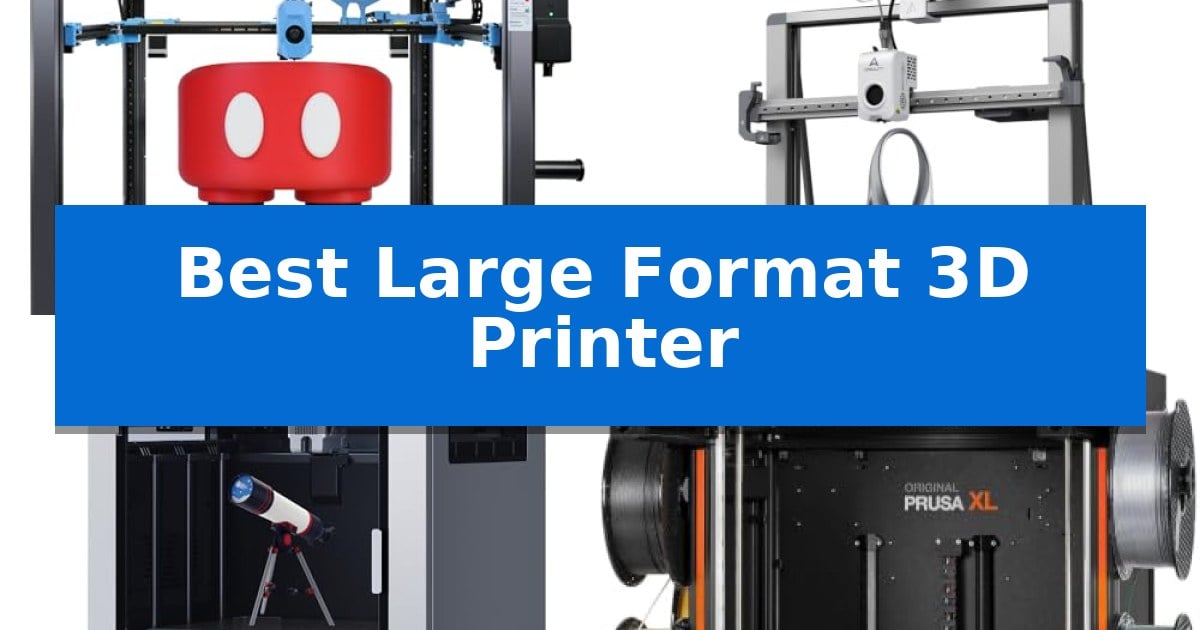
Scaling up production or creating full-scale prototypes requires more than just a standard desktop machine. When your project demands significant dimensions, finding the Best Large Format 3D Printer becomes a critical step in your workflow, as it allows you to print complex parts in one piece rather than relying on time-consuming assembly.
Whether you are producing industrial components or oversized collectibles, the right hardware must balance massive build volumes with reliable thermal management and structural stability. We have analyzed the leading models to help you identify which system aligns with your specific production requirements and material needs.
Best Large Format 3D Printer in 2026: Scale Your Industrial Prototyping
Quick Comparison
| Product | Best For | Key Strength | Score |
|---|---|---|---|
| Sovol SV08 Max 3D Printer | Best Overall | Massive 500x500x500mm build volume for large-scale projects. | 4.9 |
| Creality Ender 3 V3 Mega 3D Printer | High-Speed Large Format Production | 420mm³ build volume reduces the need for splitting large models. | 4.9 |
| QIDI Max4 Combo 3D Printer | Heated Chamber for Engineering Materials | Ultra-large build volume for printing complex, single-piece industrial parts. | 4.5 |
| Original Prusa XL 5-Toolhead 3D Printer | Professional Multi-Material Tool Changing | Five-tool multi-material system for complex, multi-color prints. | 4.8 |
| Creality K2 Plus Combo 3D Printer | Automated Multi-Color Large Builds | 16-color printing capability via the CFS multi-filament system. | 4.3 |
How We Chose
- Build Volume: Assessing the actual printable dimensions to ensure they meet your specific project requirements.
- Material Versatility: Evaluating the hotend temperature and chamber heating capabilities for engineering-grade filaments.
- Motion System Stability: Reviewing the kinematics and frame construction for precision during long, high-speed prints.
- Automation Features: Considering the inclusion of auto-leveling, remote monitoring, and multi-material capabilities.
- Reliability Systems: Checking for filament management and failure detection sensors that protect long-duration builds.
1 Sovol SV08 Max 3D Printer — Massive Volume for Industrial Prototypes
The Sovol SV08 Max 3D Printer distinguishes itself with a massive 500x500x500mm build volume, engineered to handle industrial-scale prototypes and oversized props in a single print cycle. By utilizing a high-flow 50mm³/s nozzle and CoreXY kinematics, this machine is capable of reaching speeds up to 700mm/s, significantly reducing production time for large-format projects.
Precision is maintained through an advanced Eddy Current Sensor system, which performs automated, contactless bed leveling to ensure a consistent first layer across the expansive print surface. The printer features a rigid design with XYZ full linear rails, minimizing vibration and enhancing motion accuracy during high-speed operations.
For versatility in material selection, the hotend supports temperatures up to 300°C, making it compatible with a wide range of filaments including PLA, TPU, PETG, ABS, ASA, PA, PC, and carbon-fiber-reinforced variants. Users can also integrate a separately purchased heated chamber module via a reserved interface to further optimize high-temperature printing.
Monitoring and management are streamlined through an integrated 1280×720 HD camera. This setup supports remote observation and time-lapse recording, with compatibility for Obico cloud-based control and intelligent print failure detection to assist in managing long-duration, large-scale prints.
Best for: Professional creators and engineers requiring a large-format printer for industrial parts, full-scale prototypes, and oversized models.
Skip if: Users with limited workspace or those who primarily print small, high-detail miniatures that do not benefit from a 500mm build volume.
PROS
- Massive 500x500x500mm build volume for large-scale projects.
- High-speed 700mm/s performance with CoreXY kinematics.
- Contactless Eddy Current leveling for precise first-layer calibration.
- 300°C high-temperature nozzle supports a wide range of advanced filaments.
CONS
- Heated chamber module must be purchased separately for advanced high-temp applications.
- Large physical footprint requires significant dedicated workspace.
2 Creality Ender 3 V3 Mega 3D Printer — High-Speed Large Format Production
Scaling up production requires a machine capable of handling substantial geometry without the constant need for post-processing or assembly. The Creality Ender 3 V3 Mega 3D Printer addresses this by offering a massive 420 × 420 × 420mm build volume, allowing users to print large-scale prototypes, cosplay armor, and functional components in a single piece.
Speed and precision are balanced through a high-performance motion system that supports printing at speeds up to 500mm/s with 8,000mm/s² acceleration. To maintain surface quality at these velocities, the printer utilizes integrated vibration compensation, which helps stabilize the print head during rapid movements.
Versatility is a core design choice, as the machine is engineered to handle 85A–95A TPU flexible filaments alongside standard materials like PLA and PETG. This capability is supported by an optimized extrusion system, making it a viable tool for creating custom footwear, seals, and flexible prototypes that require specific material properties.
Operational efficiency is managed through several automated features designed for long-duration projects. The 81-point auto leveling system ensures a consistent first layer across the expansive platform, while the automatic filament relay and runout/tangle detection allow the printer to switch spools mid-print, minimizing the risk of failure during unattended operation.
Maintenance is streamlined for workshop environments with a quick-swap hotend design. This allows for rapid nozzle changes or repairs, reducing downtime for users focused on small-batch production or daily iterative design cycles.
Best for: Makers and small-batch production workshops requiring a large build volume for single-piece functional parts and flexible TPU components.
Skip if: Users with limited workspace or those who only print small, standard-sized objects will find the large footprint and specialized volume unnecessary.
PROS
- 420mm³ build volume reduces the need for splitting large models.
- High-speed printing up to 500mm/s with vibration compensation.
- Flexible filament support for 85A–95A TPU materials.
- Smart filament management with automatic relay and tangle detection.
CONS
- Large physical footprint requires significant dedicated bench space.
3 QIDI Max4 Combo 3D Printer — Heated Chamber for Engineering Materials
The QIDI Max4 Combo 3D Printer distinguishes itself with a substantial 390×390×340mm build volume, providing a 55% increase in printing area compared to its predecessor. This expansive space allows for the production of large-scale industrial parts, complex molds, and custom prototypes in a single print, eliminating the need for splitting designs into smaller components.
Engineered for high-speed output, the printer utilizes closed-loop motors on the X and Y axes to achieve a maximum printing speed of 800mm/s and an acceleration of 30,000mm/s². Stability is further reinforced by dual Z lead screws with anti-backlash nuts, which work to minimize vertical gaps and maintain consistent surface quality during rapid movements.
The system is designed to handle a wide range of materials, from standard PLA and ABS to industrial-grade abrasive filaments like carbon fiber-reinforced nylon. This versatility is supported by a 40mm³/s high-flow hotend featuring a hardened steel nozzle and a 65℃ active heated chamber, which creates the necessary environment for high-temperature materials such as PC and PPS-CF.
Integrated smart features enhance operational reliability, including a built-in AI camera that monitors for printing abnormalities like spaghetti failures, triggering an automatic pause to prevent material waste. Users can also expand functionality by connecting to the QIDI BOX for multi-color and multi-material printing, supported by intelligent filament management systems that provide real-time level monitoring.
Best for: Professionals and enthusiasts requiring a large-format printer capable of handling high-temperature industrial materials.
Skip if: Users with limited workspace or those who only require small-scale, standard material printing will find the large footprint and industrial feature set unnecessary.
PROS
- Ultra-large build volume for printing complex, single-piece industrial parts.
- High-speed performance with 800mm/s capability and closed-loop motor stability.
- Active 65℃ heated chamber for reliable printing with advanced engineering materials.
- AI-powered monitoring to detect and pause failed prints automatically.
CONS
- Polar Cooler system is not included and must be purchased as a separate accessory.
- Large physical footprint requires significant dedicated workspace.
4 Original Prusa XL 5-Toolhead 3D Printer — Professional Multi-Material Tool Changing
Achieving complex, multi-material prints at scale requires a platform that balances precision with volume. The Original Prusa XL 5-Toolhead 3D Printer distinguishes itself through its five-tool multi-material system, allowing for the integration of five distinct colors or materials within a single print job. This capability is engineered for professional environments, providing the flexibility needed for intricate visual models and functional industrial prototypes without the need for manual filament swaps.
At the core of this machine is a high-end CoreXY performance architecture, which maintains consistent speed and precision even when the toolhead undergoes frequent changes. The printer features a generous build volume of 14.17 x 14.17 x 14.17 inches, supported by a segmented heated bed system. This intelligent heating design improves energy efficiency and helps mitigate warping, ensuring reliable first-layer adhesion across the entire surface area of large-scale prints.
Efficiency is managed through smart tool management, which reduces material waste during transitions between different filaments. The Original Prusa XL 5-Toolhead 3D Printer integrates seamlessly into the broader Prusa ecosystem, including their software tools and the Printables.com model library. The package includes a Satin print sheet and a 1kg spool of Prusament PLA to facilitate immediate setup.
While the printer is designed for professional use, it arrives with some components—such as the LCD, extruder assembly, Wi-Fi antenna, and spool holder—packed separately for safe transport. These parts are designed for straightforward installation, allowing users to transition from unboxing to printing quickly. The manufacturer provides lifetime technical assistance and 24-hour professional support to ensure long-term operational reliability.
Best for: Professional users and industrial designers who require high-volume, multi-material, or full-color additive manufacturing capabilities.
Skip if: Users with limited workspace or those who only require single-material printing, as the tool-changing system and large footprint may be unnecessary for simpler projects.
PROS
- Five-tool multi-material system for complex, multi-color prints.
- Large 14.17-inch cubic build volume suitable for industrial prototyping.
- Segmented heated bed for improved energy efficiency and reduced warping.
- High-end CoreXY performance ensures precision during frequent tool changes.
CONS
- Requires assembly of several components upon arrival due to transport safety measures.
- Large physical footprint may be restrictive for smaller workspaces.
5 Creality K2 Plus Combo 3D Printer — Automated Multi-Color Large Builds
The Creality K2 Plus Combo 3D Printer differentiates itself through an expansive 350x350x350mm build volume and an integrated CFS (Creality Filament System) that enables sophisticated 16-color 3D printing. This system manages automatic filament selection, switching, and relaying, while using RFID to instantly identify material types and colors, streamlining the workflow for complex, multi-material projects.
Engineered for high-speed production, the unit utilizes industry-grade FOC step-servo motors on the XYZ axes to achieve print speeds of 600mm/s and accelerations up to 30000mm/s². The machine maintains a constant chamber temperature of up to 60°C, which, combined with a 350°C high-temp nozzle featuring a hardened steel tip, allows for the reliable processing of engineering-grade filaments like ASA and PPA.
Precision is managed by an innovative Matrix frame structure made from aerospace-grade aluminum alloy, designed to eliminate resonance. The printer incorporates dual AI cameras—one for spaghetti failure detection and another for flow rate optimization—alongside 18 smart sensors that monitor the printing process. A dual Z-axis system with four linear rods ensures steady bed movement and improved success rates through automated bed tilt adjustment.
This system is built for users who require a large-format machine capable of handling both oversized models and high-volume batch production without the need for partitioning. The combination of automated material management and high-rigidity construction makes it a robust choice for those focusing on complex, multi-color, or high-strength engineering applications.
Best for: Creators and engineers who need a large-format, high-speed printer capable of automated multi-color output and high-temperature material compatibility.
Skip if: Users with limited workspace or those who only require small-scale, single-material printing may find the large footprint and multi-unit complexity unnecessary.
PROS
- 16-color printing capability via the CFS multi-filament system.
- Extra-large 350mm cubic build volume for oversized or batch prints.
- High-speed 600mm/s performance supported by FOC step-servo motors.
- Active chamber heating up to 60°C for warp-resistant engineering materials.
- Dual AI cameras for automated monitoring and flow rate optimization.
CONS
- Large physical footprint requires significant dedicated workspace.
- Complex system architecture may have a steeper learning curve for beginners.
Best Large Format 3D Printer Buying Guide
Understanding Build Volume Requirements
The primary reason to invest in a large-format system is to eliminate the need for splitting models into smaller, printable sections. A larger build volume allows you to print functional parts, cosplay props, or industrial prototypes in a single pass, which significantly improves structural strength and reduces post-processing time.
When selecting a machine, consider the maximum dimensions of your intended projects. Ensure the printer's footprint fits your workspace while providing enough clearance for the gantry movement and any external filament management systems.
Thermal Management and Material Compatibility
Printing with engineering-grade materials like ABS, ASA, or carbon-fiber-reinforced filaments requires precise thermal control. A heated chamber is essential to prevent warping and layer separation in large prints, as it maintains a stable environment throughout the entire build process.
Check the maximum nozzle temperature and chamber heating capabilities of the printer. Machines that support higher temperatures offer greater flexibility, allowing you to work with advanced polymers that provide superior mechanical properties for functional parts.
Motion Systems and Print Speed
Large prints can take days to complete, making print speed and motion stability vital. CoreXY kinematics are commonly used in high-performance printers to reduce moving mass, which allows for faster acceleration and higher print speeds without sacrificing accuracy.
Look for machines that utilize robust linear rails and high-quality motors. These components minimize vibration, ensuring that the surface finish remains clean even when the print head is moving at high velocities across a large build plate.
Automation and Monitoring
Long-duration prints carry a higher risk of failure. Features like AI-powered cameras and filament runout sensors provide peace of mind by monitoring the print in real-time and pausing the process if an error is detected, saving both time and expensive material.
Automatic bed leveling is another non-negotiable feature for large-format machines. A perfectly leveled bed across a wide surface area is difficult to achieve manually, so systems that use advanced sensors to calibrate the first layer are essential for successful, repeatable results.
Multi-Material and Color Capabilities
For projects that require multiple colors or a combination of rigid and flexible materials, look for systems with multi-tool changing or filament switching capabilities. These systems automate the transition between different materials, enabling complex designs that would otherwise be impossible.
Consider the efficiency of the filament management system. Some printers use intelligent relay systems that automatically switch to a new spool when one runs out, ensuring that your long-running prints continue without manual intervention.
Frequently Asked Questions
What is the main advantage of a CoreXY motion system?
A CoreXY system uses a stationary motor configuration that reduces the moving mass of the print head, allowing for faster acceleration and higher speeds while maintaining better precision and reducing vibration.
Why is a heated chamber important for large prints?
A heated chamber maintains a consistent ambient temperature, which prevents large parts from cooling too quickly and warping or cracking during the printing process.
Do I need an AI camera for my 3D printer?
While not strictly required, an AI camera is highly beneficial for large-format printing as it can detect common failures like spaghetti-like messes and pause the print, potentially saving you from wasting large amounts of filament.
How does automatic bed leveling work on large printers?
Large printers often use advanced sensors, such as eddy current or pressure-sensing probes, to map the surface of the bed and compensate for any minor deviations, ensuring a perfect first layer across the entire build area.
Can I print flexible materials on a large format printer?
Yes, provided the printer has an optimized extrusion system designed to handle flexible filaments like TPU. Check the manufacturer's specifications for the supported Shore hardness range.
Conclusion: Our Top Pick
For those seeking the most capable machine for industrial-scale projects, the Sovol SV08 Max 3D Printer stands out as the top choice. Its massive 500mm build volume, combined with high-speed CoreXY performance and advanced eddy current leveling, provides a robust platform for demanding production tasks.
While other options offer specialized multi-material or multi-color features, the Sovol SV08 Max delivers the best balance of raw capacity and technical reliability for users who prioritize large-format output. It is a highly effective solution for anyone needing to scale their prototyping workflow without compromising on precision or speed.