
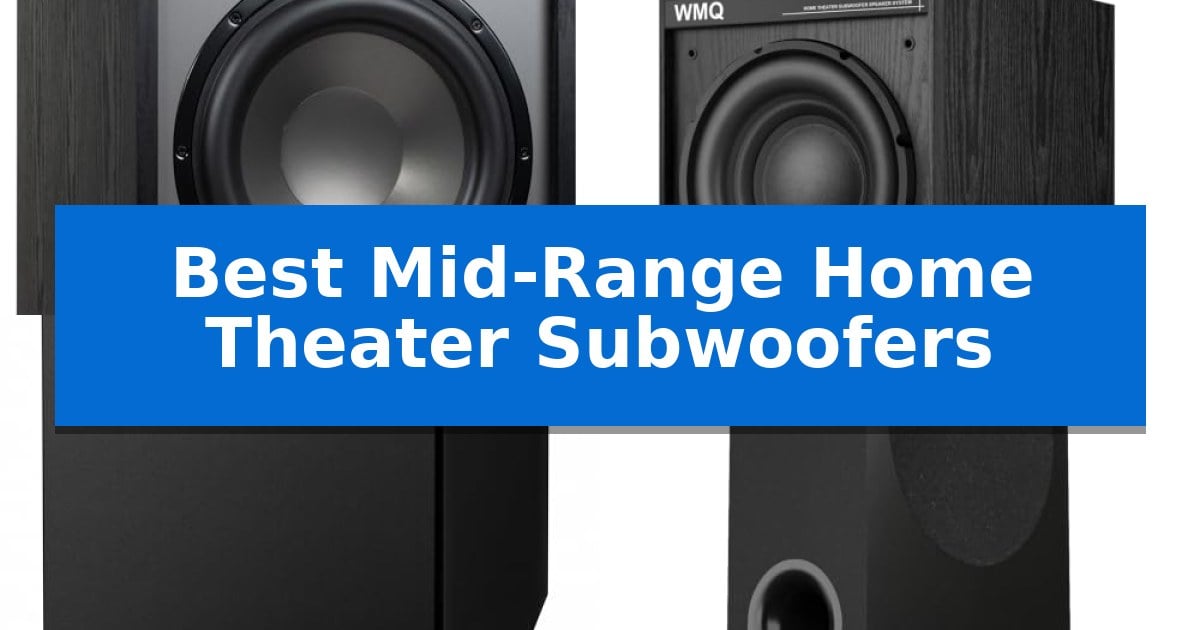
Finding the right low-frequency foundation for your audio setup can be challenging, especially when balancing power with physical footprint. The Best Mid-Range Home Theater Subwoofers offer a critical upgrade for listeners who want to feel the impact of movies and music without the extreme cost of high-end professional gear.
Whether you are looking to pair a unit with existing bookshelf speakers or need a compact solution for a smaller living area, selecting the right subwoofer requires attention to amplifier power, driver size, and connectivity options. We have analyzed current market offerings to help you identify which model fits your specific acoustic requirements and space constraints.
You may also want to compare Best Mid-Range Home Theater Receivers, Best Mid-Range Home Theater Projectors, and Best Mid-Range Home Subwoofers.
Best Mid-Range Home Theater Subwoofers
Quick Comparison
| Product | Best For | Key Strength | Score |
|---|---|---|---|
| Dayton Audio Classic CS1200 Subwoofer | Best Overall | 200W Class-D amplifier for efficient and powerful low-end performance. | 4.9 |
| WMQ 12-Inch Active Subwoofer | Dual-Subwoofer Pairing Capability | Dual-subwoofer pairing capability via dedicated output port. | 4.8 |
| Sony SA-CS9M2 10-Inch Subwoofer | Compact Pick for Tight Spaces | Compact footprint ideal for installation in tight spaces. | 4.7 |
| BESTISAN Basscore 80 Subwoofer | Slim Profile for Easy Placement | Slim, low-profile design fits easily into tight spaces like media consoles. | 4.4 |
How We Chose
- Amplifier power and efficiency for consistent low-frequency output.
- Driver diameter and diaphragm material for bass accuracy and depth.
- Connectivity versatility, including LFE, RCA, and high-level inputs.
- Cabinet construction and size for resonance control and placement flexibility.
- Integration features such as adjustable crossover and auto-standby modes.
1 Dayton Audio Classic CS1200 Subwoofer — Reliable Performance for Enthusiasts
Achieving a balanced soundstage in a home theater setup requires a reliable foundation, and the Dayton Audio Classic CS1200 provides this through its dedicated 200W Class-D amplifier. This 12-inch powered subwoofer is engineered to deliver controlled low-frequency output while maintaining a compact footprint that integrates into most living spaces.
The Dayton Audio Classic CS1200 focuses on structural integrity with a rigid, braced cabinet designed to minimize cabinet resonance and distortion. This construction ensures that the bass remains tight and accurate during demanding movie sequences or music playback, avoiding the common issue of unwanted boominess.
Versatility is a core design principle for this model, featuring stereo RCA, LFE, and speaker-level inputs. These options allow the subwoofer to connect easily with a wide variety of receivers and amplifiers. The inclusion of an auto-on feature simplifies daily operation, while the swappable grille design offers a level of aesthetic customization to suit different room decors.
Backed by a 5-year manufacturer warranty, the unit emphasizes long-term reliability. Its dimensions of 18 inches in length and 16.37 inches in height make it a manageable addition to existing home theater systems without requiring significant floor space.
Best for: Home theater enthusiasts seeking a reliable, 12-inch powered subwoofer that offers flexible connectivity and a compact, braced cabinet design.
Skip if: Users requiring ultra-compact dimensions or those with extremely large, dedicated cinema rooms that may demand higher wattage output beyond the 200W rating.
PROS
- 200W Class-D amplifier for efficient and powerful low-end performance.
- Rigid, braced cabinet construction reduces distortion and boominess.
- Flexible connectivity including LFE, RCA, and speaker-level inputs.
- 5-year manufacturer warranty provides long-term peace of mind.
CONS
- Fixed 12-inch driver size may be too large for very small media rooms.
- Optional gray grille must be purchased separately if the included black version does not match your decor.
2 WMQ 12-Inch Active Subwoofer — Dual-Subwoofer Pairing Capability
Achieving a balanced soundstage in a home theater often requires precise low-frequency control, and the WMQ 12-Inch Active Subwoofer provides a dedicated solution for those seeking to expand their audio setup. This unit features a built-in output interface that allows for wired dual-subwoofer pairing, enabling users to connect a second active subwoofer for simultaneous operation and increased bass impact.
The core of this system is a 12-inch woofer constructed with a high-rigidity paper composite diaphragm, engineered to produce tight and deep low-frequency reproduction. It is powered by a Class A/B amplifier rated at 400W RMS, a design choice focused on delivering clean power to the driver for a detailed listening experience across movies, music, and games.
Durability and acoustic integrity are addressed through the use of a sturdy MDF enclosure. This medium-density fiberboard construction is specifically utilized to minimize unwanted resonance, ensuring the cabinet remains stable during high-output playback. The unit also includes an adjustable crossover frequency range from 15-180 Hz, allowing for better integration with existing main speakers.
Designed for versatility in various room sizes, the subwoofer utilizes a flexible surround and a robust voice coil to maintain layered bass performance. Its dimensions of 16.5 inches in height and 15 inches in width make it a substantial addition to a home theater, providing a foundation for immersive soundscapes in living rooms or dedicated media spaces.
Best for: Home theater enthusiasts looking to scale their bass performance through dual-subwoofer integration.
Skip if: Users with limited floor space who require a compact or low-profile subwoofer footprint.
PROS
- Dual-subwoofer pairing capability via dedicated output port.
- 400W RMS Class A/B amplifier for clean power delivery.
- High-rigidity 12-inch woofer for tight bass response.
- Resonance-minimizing MDF enclosure for structural durability.
CONS
- Large physical footprint may not fit in constrained media cabinets.
3 Sony SA-CS9M2 10-Inch Subwoofer — Compact Pick for Tight Spaces
Achieving deep, cinematic low-frequency output in a restricted area requires a design that prioritizes both enclosure efficiency and driver control. The Sony SA-CS9M2 10-Inch Subwoofer utilizes a specialized bass reflex enclosure to suppress unwanted noise, ensuring that the sound reproduction remains focused on the intended low-frequency range rather than cabinet resonance.
At the heart of this unit is a 10-inch active driver featuring a reinforced cellular cone. This material choice is engineered to maintain structural integrity during high-excursion movements, which translates to tighter and more accurate bass response. By focusing on low vibration construction, the subwoofer minimizes the mechanical interference that often muddies the audio profile in smaller home theater setups.
Measuring 17.4 inches in height and 14.8 inches in width, the Sony SA-CS9M2 10-Inch Subwoofer is built for practical integration. Its compact footprint allows for placement in tight spots where larger, bulkier subwoofers might be impractical. The inclusion of premium componentry throughout the internal circuitry supports consistent performance, making it a reliable addition to a dedicated home theater or music listening environment.
The balance between its compact dimensions and its thumping bass output makes this model a versatile choice for users who want to enhance their audio experience without dedicating significant floor space. It provides a straightforward solution for those seeking to round out their soundstage with authoritative low-end presence.
Best for: Users with limited floor space who need a compact, active subwoofer to add deep bass to a home theater or music system.
Skip if: Users with very large rooms who require massive, room-filling sub-bass pressure that only larger, high-wattage, multi-driver configurations can provide.
PROS
- Compact footprint ideal for installation in tight spaces.
- Reinforced cellular cone design for accurate, tight bass.
- Bass reflex ducts effectively suppress unwanted noise.
- Low vibration construction improves sound clarity.
CONS
- Limited physical size may not provide the extreme output required for very large rooms.
4 BESTISAN Basscore 80 Subwoofer — Slim Profile for Easy Placement
Integrating a dedicated subwoofer into a home entertainment setup can transform the listening experience by offloading low-frequency reproduction from smaller speakers. The BESTISAN Basscore 80 Subwoofer addresses this need with a compact, side-firing 8-inch woofer design that prioritizes space efficiency without sacrificing output.
Engineered with a 100W RMS (150W peak) Class-D amplifier, this unit provides the necessary power to deliver a punchy low end for movies and music. Its frequency response extends down to 35Hz, and the inclusion of an adjustable low-pass filter allows for precise integration with various bookshelf speakers or soundbars, ensuring that the subwoofer only handles the frequencies your main speakers cannot reach.
Versatility is a core strength of this model, featuring universal connectivity options including LFE, RCA/AUX, and high-level speaker inputs. This flexibility allows it to pair with a wide range of receivers and audio sources. Furthermore, the automatic standby function enhances convenience by powering down the device after 15 minutes of inactivity, which helps in reducing overall energy consumption.
The physical design is specifically tailored for modern living spaces, measuring approximately 11.3 inches high and 6.2 inches wide. This slim profile is intended to slide under desks or fit into media consoles where larger, boxier subwoofers might not be feasible. The package includes a 1.5m RCA cable and a right-angle DC power adapter to facilitate clean, flush placement against walls.
Best for: Small to medium-sized rooms where a slim, space-saving footprint is required for home theater or desktop audio systems.
Skip if: Large home theater environments that require high-output, deep-sub-bass performance beyond the capabilities of an 8-inch driver.
PROS
- Slim, low-profile design fits easily into tight spaces like media consoles.
- Versatile connectivity including high-level, LFE, and RCA inputs.
- Adjustable crossover allows for seamless integration with existing speakers.
- Energy-efficient automatic standby mode.
CONS
- 8-inch driver size may limit output in very large rooms.
Best Mid-Range Home Theater Subwoofers Buying Guide
Understanding Subwoofer Connectivity
Most home theater subwoofers offer multiple ways to connect to your receiver or amplifier. The LFE (Low-Frequency Effects) input is the standard for modern surround sound systems, allowing your receiver to handle crossover management. For older stereo setups, high-level speaker inputs provide a way to connect directly from your main amplifier's speaker terminals.
When choosing a model, ensure the input options match your current hardware. Using the correct connection type ensures that your subwoofer receives the proper signal, preventing issues like muddy bass or signal loss during playback.
The Role of Cabinet Construction
The physical build of a subwoofer is just as important as the driver itself. MDF (Medium-Density Fiberboard) is a common material used to minimize unwanted cabinet resonance, which can cause distortion or 'boominess' at high volumes. A rigid, braced cabinet helps keep the bass tight and accurate.
Consider the weight and dimensions of the unit when planning your setup. While heavier, sturdier cabinets often perform better, they can be more difficult to move or place in tight media consoles.
Driver Size and Frequency Extension
Driver size typically dictates how low a subwoofer can reach and how much air it can move. A 12-inch woofer is often considered the sweet spot for home theater, providing a balance between deep bass extension and room-filling volume. Smaller 8-inch or 10-inch drivers are excellent for smaller rooms or apartments where space is at a premium.
Always check the frequency response specifications. A subwoofer that extends down to 35Hz or lower will provide a more immersive experience for movies and music, capturing the deep rumbles that smaller speakers simply cannot reproduce.
Amplifier Power and Class Efficiency
The internal amplifier drives the subwoofer's performance. Class-D amplifiers are highly efficient, providing significant power without generating excessive heat, which is ideal for compact designs. Class A/B amplifiers are also common and are often praised for their clean, detailed sound reproduction.
Look for RMS power ratings rather than peak power. RMS represents the continuous power the subwoofer can handle, which is a more reliable indicator of how the unit will perform during sustained, high-volume listening sessions.
Placement and Room Integration
Where you place your subwoofer significantly impacts its sound. Corners often reinforce bass, but can sometimes lead to boomy or uneven output. Experimenting with placement—often called a 'subwoofer crawl'—can help you find the spot in your room that provides the most balanced bass response.
Many modern subwoofers include adjustable crossover frequencies, allowing you to blend the subwoofer's output with your main speakers. This ensures a seamless transition between high and low frequencies, creating a cohesive soundstage.
Frequently Asked Questions
What is the difference between LFE and RCA inputs?
LFE (Low-Frequency Effects) is a dedicated channel for subwoofers in surround sound systems, while standard RCA inputs are typically used for stereo signals. Many subwoofers use the same physical port for both, but the signal processing differs based on your receiver's settings.
Can I use two subwoofers in one room?
Yes, using two subwoofers can help smooth out bass response across different seating positions in a room. Some models feature specific output interfaces designed for easy daisy-chaining or pairing.
What does 'auto-on' mean?
The auto-on feature detects an incoming audio signal and automatically powers the subwoofer out of standby mode. It also powers the unit down after a period of inactivity to save energy.
Does cabinet material really affect sound quality?
Yes, the cabinet material and construction are vital. A sturdy, well-braced cabinet prevents the enclosure from vibrating along with the driver, which helps eliminate distortion and keeps the bass sound tight and clear.
How do I choose the right size subwoofer for my room?
Generally, larger rooms benefit from larger drivers (12-inch) to move more air, while smaller rooms or bedrooms are well-served by 8-inch or 10-inch models that offer a smaller footprint without sacrificing too much performance.
Conclusion: Our Top Pick
Choosing the right subwoofer depends on your specific room dimensions and the type of audio content you prioritize. For those seeking a balance of power, build quality, and versatile connectivity, the Dayton Audio Classic CS1200 Subwoofer stands out as a reliable choice for home theater enthusiasts.
This model provides a robust 200W Class-D amplifier and a rigid cabinet design that minimizes distortion, making it an excellent foundation for any home audio system. While it is a powerful option, ensure you have the necessary floor space to accommodate its 12-inch driver and cabinet dimensions for the best possible acoustic results.