
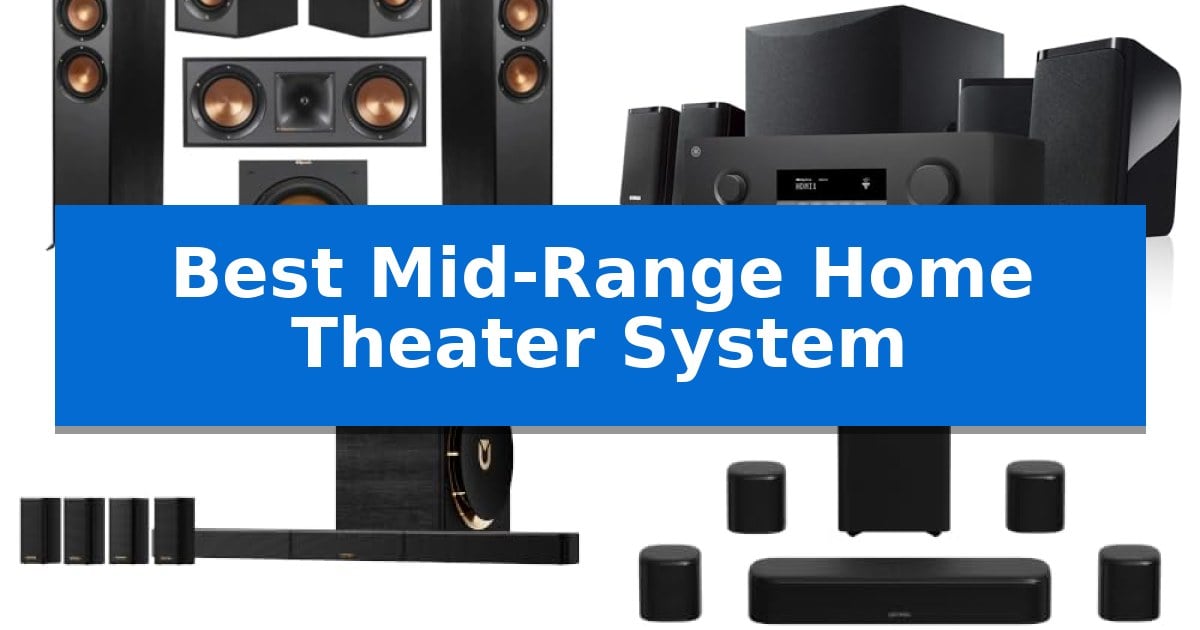
Finding the right audio setup can transform your living room into a private cinema, but navigating the technical specifications of modern audio gear is often overwhelming. Whether you are looking for a traditional receiver-based setup or a streamlined soundbar solution, selecting the Best Mid-Range Home Theater System requires balancing room size, connectivity needs, and your preferred level of immersion.
This guide breaks down five distinct home theater options, focusing on how their specific configurations—from discrete 9.1.6 channels to optimized 5.1 soundbar bundles—impact your daily viewing experience. We examine the practical trade-offs of each system to help you determine which setup best aligns with your space and existing entertainment hardware.
You may also want to compare Best Mid-Range Home Theater Subwoofers, Best Mid-Range Home Theater Receivers, and Best Mid-Range Home Theater Projectors.
Best Mid-Range Home Theater System
Quick Comparison
| Product | Best For | Key Strength | Score |
|---|---|---|---|
| Klipsch Reference Dolby Atmos Home Theater | Best Overall | Integrated Dolby Atmos elevation in floorstanding speakers for immersive height audio. | 4.9 |
| Yamaha YHT-4970U Home Theater System | All-in-One 5.1 Channel Package | All-in-one package includes receiver, 5.1 speakers, subwoofer, and all required cabling. | 4.5 |
| Ultimea Skywave X100 Home Theater System | Wireless 9.1.6 Spatial Audio | Wireless 9.1.6 architecture eliminates speaker-to-speaker cabling. | 4.6 |
| Ultimea Aura Series 7.1 Soundbar | Expanded Surround Sound Coverage | Hybrid wireless-wired rear speaker setup simplifies room installation. | 4.7 |
| Sony BRAVIA Theater System 6 | Optimized for Bravia TV Users | Dedicated center channel for improved dialogue clarity. | 4.6 |
How We Chose
- Audio Architecture: Assessing the channel count and speaker configuration to determine the depth of the soundstage.
- Connectivity Standards: Evaluating support for modern video pass-through, such as 8K/4K, and wireless streaming protocols.
- Ease of Integration: Checking for room calibration tools and compatibility with existing TV ecosystems.
- Dialogue Clarity: Analyzing the presence of dedicated center channels or proprietary vocal processing algorithms.
- Installation Complexity: Distinguishing between comprehensive wired bundles and simplified wireless or hybrid setups.
1 Klipsch Reference Dolby Atmos Home Theater — Complete Cinematic Speaker Bundle
Achieving a cinematic audio environment requires a cohesive integration of processing power and speaker output. The Klipsch Reference Dolby Atmos Home Theater bundle addresses this by pairing a high-performance 9.2-channel receiver with a multi-component speaker system designed to deliver both horizontal and vertical sound fields.
At the heart of the system is the Onkyo TX-NR7100 9.2-Channel A/V Receiver, which provides 220W per channel and supports 8K/4K video pass-through. This receiver acts as the central hub, utilizing automatic room calibration to optimize the output of the included Klipsch Reference speakers for your specific listening space.
The speaker configuration features R-625FA floorstanding speakers equipped with integrated up-firing Dolby Atmos elevation channels. These drivers bounce sound off the ceiling to create realistic overhead effects, while the R-52C center channel ensures dialogue remains clear and focused. Low-frequency impact is handled by the R-12SW 12-inch powered subwoofer, which utilizes a spun copper IMG driver and a high-efficiency digital amplifier.
Designed for modern connectivity, the system includes built-in HEOS streaming and voice control support. The components are housed in scratch-resistant black wood-grain cabinets, providing a refined aesthetic that integrates into most home entertainment setups while maintaining the durability required for long-term use.
Best for: Home theater enthusiasts seeking a pre-matched, comprehensive 9.2-channel system that combines powerful amplification with integrated Dolby Atmos height effects.
Skip if: Those with limited floor space or smaller rooms, as the full-sized floorstanding speakers and 12-inch subwoofer require significant physical footprint.
PROS
- Integrated Dolby Atmos elevation in floorstanding speakers for immersive height audio.
- 9.2-channel receiver provides extensive power and 8K video compatibility.
- Automatic room calibration simplifies the setup process for optimal sound.
- Dedicated center channel ensures crisp dialogue clarity.
CONS
- Large physical footprint requires substantial dedicated space for the floorstanding speakers and subwoofer.
- Complex installation due to the number of components and wiring requirements.
2 Yamaha YHT-4970U Home Theater System — All-in-One 5.1 Channel Package
The Yamaha YHT-4970U Home Theater System simplifies the transition to immersive audio by bundling a high-performance Dolby Atmos AV Receiver with a complete 5.1 speaker array and a dedicated powered subwoofer. By including all necessary cabling and a setup microphone for automatic room acoustic optimization, this system removes the guesswork often associated with building a multi-channel setup from individual components.
Designed for modern media demands, the receiver supports 4K/120 and 8K/60 video pass-through, ensuring compatibility with high-end gaming consoles and the latest display standards. It incorporates advanced dynamic range technologies like Dolby Vision and HDR10+, while gaming-specific features such as ALLM and VRR provide a responsive experience for connected hardware.
Usability is a core focus of the system, featuring Bluetooth Multipoint for seamless switching between two audio source devices. Users can further tailor their listening experience through a variety of sound modes or by utilizing the Scene buttons to recall up to four custom presets, allowing for quick adjustments based on the content being viewed.
The included Quick Guide and intuitive on-screen menu system facilitate a straightforward installation process. Whether configuring the speakers or adjusting input settings, the system is engineered to get users up and running with minimal technical friction, making it a practical choice for those seeking a cohesive, all-in-one home theater solution.
Best for: Users seeking a comprehensive, all-in-one 5.1 surround sound solution that integrates current 4K/8K video standards and automated room calibration.
Skip if: Audiophiles looking for modular components to build a custom high-end sound system or those requiring a wireless speaker configuration.
PROS
- All-in-one package includes receiver, 5.1 speakers, subwoofer, and all required cabling.
- Automated room correction via included setup microphone ensures optimized audio performance.
- Supports next-gen gaming features including 4K/120, 8K/60, VRR, and ALLM.
- Bluetooth Multipoint allows for easy switching between two wireless source devices.
CONS
- Wired speaker configuration requires cable management across the room.
- Fixed component selection limits the ability to upgrade individual speakers or the receiver independently.
3 Ultimea Skywave X100 Home Theater System — Wireless 9.1.6 Spatial Audio
Achieving a cinematic soundscape often requires complex wiring and bulky receivers, but the Ultimea Skywave X100 Home Theater System simplifies this by utilizing CineMesh Dual 5GHz wireless technology. This system eliminates the need for physical cables between the soundbar, subwoofers, and surround speakers, maintaining a connection latency of less than 20ms for synchronized audio playback.
The Ultimea Skywave X100 Home Theater System features a 9.1.6-channel architecture that incorporates 6 dedicated height channels to reproduce spatial audio from Dolby Atmos and DTS:X content. Powered by a 2,000 MIPS DSP and a 24-bit/192kHz signal path, the system performs object-based audio rendering and channel steering to place sounds accurately within your room.
Designed for high-output performance, the system utilizes GaN amplification to deliver up to 1,500W of peak power. This architecture is engineered to reduce switching losses and thermal dissipation, supporting fast transient response during demanding scenes. The included subwoofers leverage Gravus Ultra-Linear Bass Technology to extend low-frequency response down to 20Hz, ensuring deep bass dynamics.
Usability is enhanced through independent surround level control, which allows you to adjust each wireless speaker based on your specific room layout and seating position. This flexibility helps compensate for asymmetric room shapes, ensuring consistent surround balance. The system is also THX-tuned, focusing on tonal balance, dialogue reproduction, and imaging to meet specific performance criteria.
Best for: Users seeking a high-channel-count spatial audio experience without the complexity of running physical cables to rear speakers or subwoofers.
Skip if: Users who prefer a traditional wired setup or those with very small rooms where a 9.1.6-channel system may be physically overwhelming.
PROS
- Wireless 9.1.6 architecture eliminates speaker-to-speaker cabling.
- CineMesh Dual 5GHz technology ensures low-latency synchronization under 20ms.
- GaN amplification provides efficient 1,500W peak power output.
- Independent surround level control allows for precise room-specific calibration.
CONS
- Requires significant physical space to accommodate the 9.1.6-channel speaker configuration.
4 Ultimea Aura Series 7.1 Soundbar — Expanded Surround Sound Coverage
Achieving a balanced soundstage in a living room environment often requires balancing discrete channel separation with manageable hardware footprints. The Ultimea Aura Series 7.1 Soundbar addresses this by utilizing a 7.1-channel surround sound architecture, which employs three front channels and four dedicated surround speakers to expand spatial coverage beyond standard configurations.
At the core of its audio performance is the proprietary VocalMatrix processing, an algorithm designed to isolate and distribute vocal elements across the discrete channels. This is complemented by VoiceMX dialogue optimization, which targets the 120Hz to 6kHz frequency range to maintain clarity during complex soundtracks. For low-end impact, the system features BassMX low-frequency acoustic engineering, utilizing an 18mm high-excursion driver housed in a 6.1L enclosure to extend bass response down to 45Hz.
The system simplifies installation through a hybrid connectivity architecture. While the front surround speakers connect directly to the main soundbar, the rear right speaker establishes a wireless link to the unit, with the left rear speaker connecting via cable to that point. This design reduces the need for extensive cable runs across the room. Additionally, the inclusion of Bluetooth 6.0 provides a modern standard for wireless audio transmission and device pairing.
Users can further refine the output via the Ultimea app, which offers a 10-band graphic equalizer and 121 preset sound profiles. The system also supports over-the-air (OTA) firmware updates, ensuring that performance refinements remain accessible over time. With its compact profile measuring approximately 15.7 inches in length, it provides a functional solution for those seeking multi-channel immersion without the bulk of traditional receiver-based setups.
Best for: Home theater enthusiasts seeking a discrete 7.1 surround experience with reduced cable management requirements.
Skip if: Users who prefer a traditional receiver-based system with extensive physical input/output options for multiple legacy components.
PROS
- Hybrid wireless-wired rear speaker setup simplifies room installation.
- Dedicated VocalMatrix and VoiceMX processing enhances dialogue intelligibility.
- 10-band graphic equalizer allows for granular frequency-response tuning.
- Bluetooth 6.0 provides efficient and stable wireless connectivity.
CONS
- Limited physical connectivity compared to full-sized AV receivers.
- Rear speakers require a wired connection between each other despite the wireless link to the soundbar.
5 Sony BRAVIA Theater System 6 — Optimized for Bravia TV Users
Achieving a balanced audio setup for your living room requires hardware that integrates seamlessly with your existing display. The Sony BRAVIA Theater System 6 provides a dedicated 5.1-channel configuration, utilizing three front-firing speakers and two rear speakers to create a focused soundstage. By including a wired subwoofer, the system ensures that low-frequency effects are handled separately from the main audio channels, which is essential for maintaining clarity during cinematic playback.
The system is engineered for modern media consumption, featuring support for Dolby Atmos and DTS:X to deliver immersive audio formats. A standout design choice is the inclusion of a dedicated center channel speaker, which prioritizes dialogue reproduction. When paired with a compatible BRAVIA TV, users gain access to Voice Zoom 3, a feature that specifically enhances speech intelligibility, ensuring that dialogue remains crisp even during complex action sequences.
Usability is centered around the BRAVIA Connect app, which allows for smartphone-based control over volume, sound profiles, and advanced settings. For those who enjoy music, the system includes wireless Bluetooth streaming and an up-mixing function that restores acoustic details to standard audio tracks. The Multi Stereo mode further expands the listening experience by outputting audio from all speakers simultaneously, effectively filling the room with sound.
Integration is a primary focus for this setup, particularly for users already invested in the Sony ecosystem. The system is designed to be controlled directly through the TV menu, simplifying the user experience by reducing the need for multiple remotes. With its 5.1-channel architecture and focus on dialogue clarity, this system serves as a functional upgrade for those looking to move beyond standard television speakers without the complexity of a full component-based home theater.
Best for: Users who own a compatible BRAVIA TV and want a streamlined, integrated 5.1-channel surround sound experience.
Skip if: Those who require a fully wireless speaker setup, as this system utilizes a wired subwoofer and rear speaker configuration.
PROS
- Dedicated center channel for improved dialogue clarity.
- Integrated control via BRAVIA TV menus and the BRAVIA Connect app.
- Immersive audio support including Dolby Atmos and DTS:X.
- Multi Stereo mode for room-filling sound performance.
CONS
- Wired subwoofer and rear speakers require cable management.
- Ecosystem-dependent features like Voice Zoom 3 require a compatible BRAVIA TV.
Best Mid-Range Home Theater System Buying Guide
Understanding Channel Configurations
The number of channels in a home theater system, such as 5.1 or 9.1.6, indicates the number of speakers and subwoofers included. A 5.1 system is the standard for most living rooms, providing a balanced surround experience. Higher channel counts, like 9.1.6, incorporate overhead height channels to create a more three-dimensional sound field, which is essential for fully utilizing Dolby Atmos content.
When choosing your configuration, consider your room layout. More speakers require more physical space and cable management. If you prefer a cleaner aesthetic, look for systems that utilize wireless surround speakers or high-performance soundbars that simulate spatial audio through advanced processing.
Video Pass-Through and Compatibility
Modern home theater systems often act as a hub for your media devices. Ensure your receiver or soundbar supports the video standards of your TV, such as 4K/120Hz or 8K pass-through, especially if you are a gamer using next-generation consoles. Features like HDMI eARC are critical for sending high-quality audio back from your TV to your sound system with a single cable.
Compatibility with your specific TV brand can also simplify your experience. Some systems offer proprietary integration, such as enhanced dialogue control or unified menu navigation, which can significantly reduce the complexity of managing multiple remotes.
The Role of Room Calibration
Every room has unique acoustic properties that can affect how sound reaches your ears. Systems that include automatic room calibration use a setup microphone to measure your space and adjust the output of each speaker accordingly. This process helps correct for uneven speaker placement or furniture that might absorb or reflect sound.
If you are setting up a system in a non-traditional space, such as an open-concept living room, room correction is a valuable feature. It ensures that the audio remains balanced and that the surround effects are properly localized to your seating position.
Dialogue Enhancement Technologies
One of the most common complaints in home audio is muffled or unclear dialogue during action-heavy scenes. Many modern systems address this by including a dedicated center channel speaker or using digital signal processing (DSP) to isolate vocal frequencies. These technologies dynamically adjust the volume of voices to ensure they remain intelligible against background music and sound effects.
When evaluating a system, look for features like voice-specific equalization or adjustable center-channel levels. These tools allow you to fine-tune the audio profile to your personal preference, ensuring that dialogue is always crisp and clear, regardless of the content you are watching.
Wireless vs. Wired Connectivity
Wired systems generally offer the most reliable connection and are often preferred for high-fidelity setups. However, they require running cables across your room, which can be a significant installation challenge. Wireless systems, particularly those using 5GHz bands, provide a more flexible installation process by reducing the need for long cable runs to rear speakers or subwoofers.
If you choose a wireless system, verify the latency specifications. High-quality wireless setups are designed to keep latency below 20ms, ensuring that the audio remains perfectly synchronized with the video on your screen. This is particularly important for gaming and fast-paced action movies.
Frequently Asked Questions
What is the difference between 5.1 and 9.1.6 channel systems?
A 5.1 system uses five speakers and one subwoofer for standard surround sound. A 9.1.6 system adds more surround and height channels, creating a more immersive, three-dimensional audio environment that better supports complex object-based formats like Dolby Atmos.
Do I need an AV receiver for a home theater system?
Traditional speaker bundles usually require an AV receiver to power the speakers and process audio signals. However, many modern soundbar-based home theater systems include all necessary amplification within the soundbar itself, eliminating the need for a separate receiver.
How does HDMI eARC benefit my home theater setup?
HDMI eARC (Enhanced Audio Return Channel) allows your TV to send high-quality, uncompressed audio signals back to your home theater system through a single HDMI cable. This simplifies your setup and ensures you get the best possible sound quality from your streaming apps and connected devices.
Can I use a home theater system in a small room?
Yes, but you should choose a system that fits your space. Compact soundbar bundles or 5.1 systems are often better suited for smaller rooms, as they provide surround sound without the clutter of excessive wiring or oversized floorstanding speakers.
Why is room calibration important?
Room calibration uses a microphone to analyze your room's acoustics and adjust the sound output of each speaker. This helps compensate for room shape, furniture placement, and other factors that can negatively impact audio quality, ensuring a balanced soundstage at your seating position.
Conclusion: Our Top Pick
Selecting the right system depends on your specific room layout and your desire for either a traditional, modular setup or a modern, simplified solution. For those seeking a comprehensive, high-performance experience, the Klipsch Reference Dolby Atmos Home Theater stands out as a robust choice. It combines the power of dedicated floorstanding speakers with a 9.2-channel receiver, offering a level of cinematic immersion that is difficult to replicate with smaller, integrated units.
While the Klipsch bundle requires more space and setup time, its ability to deliver authentic overhead effects and powerful low-frequency impact makes it an excellent investment for dedicated movie enthusiasts. If your priority is a balance of performance and ease of installation, consider how your room constraints might favor a more compact or wireless-focused alternative.