
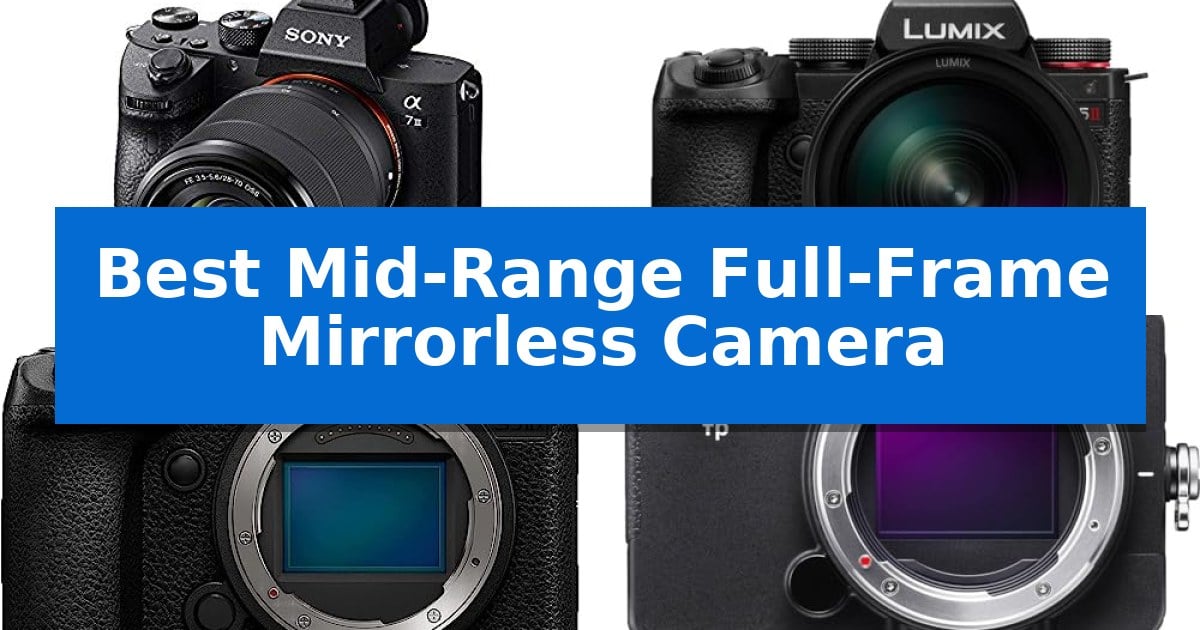
Finding the right balance between image quality and portability is the primary challenge when selecting a new imaging system. Whether you are upgrading from a crop-sensor body or seeking a more capable tool for professional work, the Best Mid-Range Full-Frame Mirrorless Camera market offers diverse options that prioritize different workflows, from high-speed action to cinematic video production.
Our analysis focuses on the technical specifications that define these systems, such as sensor architecture, autofocus reliability, and stabilization technologies. By examining these core components, we aim to clarify which model aligns with your specific shooting requirements, ensuring you invest in a platform that supports your creative goals without unnecessary complexity.
You may also want to compare Best Mid-Range FPV Drone, Best Mid-Range Floor Stereo Speakers, and Best Mid-Range Floor Standing Speakers.
Best Mid-Range Full-Frame Mirrorless Camera
Quick Comparison
| Product | Best For | Key Strength | Score |
|---|---|---|---|
| Sony Alpha a7 III Mirrorless Camera | Best Overall | 24.2MP BSI full-frame sensor for high-quality imaging. | 4.9 |
| Panasonic Lumix S5II Mirrorless Camera | Advanced Video and Autofocus | Phase Hybrid AF provides reliable focus tracking for dynamic subjects. | 4.3 |
| Panasonic Lumix S5IIX Mirrorless Camera | Professional Streaming Capabilities | Unlimited video recording via integrated active cooling. | 4.4 |
| Sigma fp Mirrorless Camera | Ultra-Compact Full-Frame Design | World's smallest and lightest full-frame mirrorless camera | 4.3 |
| Sony a7R II Mirrorless Camera | High-Resolution Sensor Detail | 42.4MP full-frame sensor for high-resolution detail. | 4.3 |
How We Chose
- Sensor Architecture: Assessing the resolution and low-light capabilities provided by the full-frame CMOS sensors.
- Autofocus Performance: Evaluating the speed and accuracy of phase-detection and subject-tracking systems.
- Video Capabilities: Comparing internal recording formats, stabilization technology, and thermal management.
- Design and Ergonomics: Considering the physical build, weight, and layout for various shooting environments.
- System Compatibility: Analyzing the utility of lens mounts and essential connectivity options.
1 Sony Alpha a7 III Mirrorless Camera — Reliable Hybrid Performance
The Sony Alpha a7 III Mirrorless Camera provides a versatile foundation for photographers by pairing a high-resolution 24.2MP BSI full-frame image sensor with an advanced readout speed. This combination allows for a 15-stop dynamic range and a broad ISO 50 to 204,800 range, ensuring flexibility across diverse lighting environments.
Performance is driven by a sophisticated autofocus system featuring 693 phase-detection and 425 contrast AF points, which cover approximately 93% of the image area. This density of focus points supports reliable tracking for both still subjects and action, complemented by the ability to shoot at up to 10fps using either the mechanical or silent shutter.
Designed for hybrid workflows, the camera includes the SEL2870 lens in the box, making it a ready-to-use kit for various focal lengths. The body is built around the Exmor R CMOS sensor, which balances detail with high-speed data processing. It also utilizes the NP-FZ100 rechargeable battery to support extended operation during long sessions.
While the camera offers professional-grade imaging capabilities, users should note that the system relies on a Micro USB interface for connectivity. The inclusion of the 28-70mm lens provides a convenient starting point, though those requiring specialized optics for specific professional applications may eventually look to expand their lens collection.
Best for: Photographers seeking a versatile, high-resolution full-frame system capable of fast tracking and wide dynamic range.
Skip if: Users who require the latest USB-C connectivity standards or those who prefer a more compact, fixed-lens system.
PROS
- 24.2MP BSI full-frame sensor for high-quality imaging.
- 693 phase-detection AF points covering 93% of the frame.
- 10fps continuous shooting with AE/AF tracking.
- 15-stop dynamic range for improved detail in highlights and shadows.
CONS
- Micro USB connectivity instead of modern USB-C.
- Kit lens limitations for specialized professional photography.
2 Panasonic Lumix S5II Mirrorless Camera — Advanced Video and Autofocus
The Panasonic Lumix S5II Mirrorless Camera leverages Phase Hybrid AF technology to maintain focus precision, a critical advantage for photographers capturing dynamic subjects in street or portrait settings. This 24.2MP full-frame system balances high-resolution still photography with the capability for 6K video recording, providing a robust foundation for diverse creative workflows.
Stability is a core design focus, evidenced by the inclusion of Active I.S. technology. This feature is specifically engineered to counteract camera shake during handheld movement, offering a practical solution for vloggers who need smooth footage without relying on external gimbals or stabilization rigs. The camera's internal stabilization helps maintain professional production standards in mobile shooting environments.
Included in this kit is a 24-60mm f/2.8 lens, which offers a versatile focal range suitable for everything from wide-angle landscapes to tighter portrait compositions. The constant f/2.8 aperture ensures consistent light intake across the entire zoom range, allowing users to maintain exposure settings and depth-of-field control even when adjusting focal length.
Designed for professional and enthusiast use, the body is built to withstand varied shooting conditions. With a 2-year warranty included, the system provides long-term support for users seeking a reliable, high-performance platform for both photography and videography.
Best for: Content creators and photographers who require a versatile, stabilized full-frame system for both high-resolution stills and 6K video production.
Skip if: Users who prioritize an ultra-compact or lightweight camera body may find the dimensions and weight of this full-frame system less suitable for minimalist travel.
PROS
- Phase Hybrid AF provides reliable focus tracking for dynamic subjects.
- 6K video capability supports high-resolution professional production.
- Active I.S. stabilization reduces shake for handheld vlogging.
- 24-60mm f/2.8 lens offers a versatile focal range with a constant aperture.
CONS
- Physical footprint is larger and heavier than entry-level mirrorless options.
- Full-frame sensor requires specific lens compatibility for optimal performance.
3 Panasonic Lumix S5IIX Mirrorless Camera — Professional Streaming Capabilities
Achieving professional-grade video production requires a reliable foundation, and the Panasonic Lumix S5IIX Mirrorless Camera provides this through its integrated heat dispersion mechanism. By combining a small fan with a high-efficiency heat sink, this camera enables unlimited video recording and livestreaming without the size constraints typically associated with heavy-duty cooling systems.
At the heart of the system lies a 24.2-MP 35mm full-frame CMOS sensor paired with advanced signal processing. This hardware supports high-resolution capture and 14+ stop V-Log/V-Gamut dynamic range, ensuring broad color depth for professional grading. For those requiring high-end production formats, the device supports 5.8K Pro-Res and RAW output over HDMI.
The camera introduces Phase Hybrid Autofocus, utilizing advanced subject detection to maintain focus on moving targets even in challenging lighting. This is complemented by Active I.S. technology, which is specifically engineered to stabilize footage during walking shots, providing a smoother result for handheld video work.
Connectivity and versatility remain central to the design. The unit supports both wireless and wired IP streaming, making it a flexible tool for creators who need to broadcast directly from the field or studio. With its compact form factor and robust feature set, it serves as a capable hybrid tool for those balancing photography and high-bitrate video production.
Best for: Content creators and videographers who require unlimited recording times and professional-grade streaming capabilities in a compact full-frame body.
Skip if: Photographers who prioritize extreme resolution for large-format printing or those who do not require advanced video-centric features like Pro-Res and IP streaming.
PROS
- Unlimited video recording via integrated active cooling.
- Phase Hybrid Autofocus for reliable subject tracking.
- Active I.S. technology optimized for handheld walking shots.
- Professional video support including 5.8K Pro-Res and RAW over HDMI.
CONS
- Advanced video features may be excessive for users focused strictly on still photography.
4 Sigma fp Mirrorless Camera — Ultra-Compact Full-Frame Design
Achieving a balance between portability and high-end imaging capability is often a challenge for photographers, but the Sigma fp Mirrorless Full-Frame Digital Camera addresses this by offering a full-frame sensor in an exceptionally small footprint. Weighing only 422 grams, it stands as the world's smallest and lightest full-frame mirrorless camera, making it an ideal candidate for those who prioritize mobility without sacrificing the shallow depth of field and detail provided by a 35mm sensor.
At the heart of this device is a 24.6MP BSI CMOS sensor, which provides the foundation for high-resolution stills. For video creators, the camera supports UHD 4K video recording at 24, 25, and 30 fps, ensuring high-quality output for professional or personal projects. To assist with handheld shooting, the camera includes Electronic Image Stabilization (EIS), which helps maintain sharpness and stability during movement.
The build quality is designed for versatility in various environments, featuring a dust and splash-proof structure encased in a robust, lightweight aluminum body. This sealed design provides confidence when shooting in unpredictable weather conditions. With a 4-year warranty included, the camera is positioned as a reliable tool for long-term use in travel and everyday photography scenarios.
While the compact form factor is a significant advantage, users should note that the design focuses on minimalism to maintain its small size. It is a specialized tool that excels in scenarios where weight and space are at a premium, offering a distinct alternative to bulkier camera systems.
Best for: Travel photographers and creators who require a full-frame sensor in the smallest possible form factor.
Skip if: Users who prioritize a deep grip, extensive physical buttons, or a built-in viewfinder may find the minimalist, compact design less intuitive for traditional ergonomics.
PROS
- World's smallest and lightest full-frame mirrorless camera
- High-resolution 24.6MP BSI CMOS sensor
- Durable dust and splash-proof aluminum body
- Integrated UHD 4K video recording capabilities
CONS
- Minimalist design lacks the deep grip and physical controls found on larger bodies
5 Sony a7R II Mirrorless Camera — High-Resolution Sensor Detail
The Sony a7R II Mirrorless Camera distinguishes itself through the integration of the world’s first full-frame 5-axis in-body image stabilization, specifically optimized for its high-resolution 42.4MP Exmor R CMOS sensor. This design choice provides a robust foundation for both still photography and 4K movie recording, ensuring that fine detail is captured with precision across a wide ISO range up to 102,400.
Engineered for professional workflows, the camera features a 2.4-million dot XGA OLED Tru-Finder equipped with ZEISS T- coating for clear monitoring. The inclusion of a Fast Hybrid AF system, utilizing 399 focal plane phase-detection points, enhances focus accuracy, while shutter vibration suppression and a silent shutter mode allow for discreet operation in sensitive environments.
Connectivity and ergonomics are central to its utility, offering Wi-Fi and NFC capabilities for smartphone integration via camera apps. The body is built to be durable and reliable, featuring an enhanced grip and layout that supports professional use. The system also supports full pixel readout during 4K recording to maintain image integrity without pixel binning.
The Sony a7R II Mirrorless Camera provides a comprehensive set of tools for those prioritizing resolution and stabilization in a compact form factor. While it offers advanced autofocus and high-end video features, users should note that it relies on the NP-FW50 battery system, which is a consideration for extended shooting sessions.
Best for: Professional photographers and videographers who require high-resolution imagery and effective in-body stabilization in a compact mirrorless body.
Skip if: Users who require the latest dual-card slot redundancy or those who prefer a larger battery capacity for extremely long-duration field work.
PROS
- 42.4MP full-frame sensor for high-resolution detail.
- 5-axis in-body image stabilization for steady handheld shots.
- Fast Hybrid AF with 399 phase-detection points.
- 4K movie recording with full pixel readout.
CONS
- NP-FW50 battery may require spares for long shoots.
- Single card slot configuration.
Best Mid-Range Full-Frame Mirrorless Camera Buying Guide
Understanding Sensor Technology
The full-frame sensor is the heart of these cameras, providing a larger surface area that captures more light and offers superior depth-of-field control compared to smaller formats. A back-illuminated (BSI) sensor design often improves light-gathering efficiency, which is particularly beneficial for low-light photography and maintaining high dynamic range in challenging lighting conditions.
When choosing a camera, consider the balance between resolution and readout speed. Higher megapixel counts provide more detail for cropping or large prints, but faster readout speeds are essential for reducing rolling shutter during video capture and improving the performance of electronic shutters during high-speed burst shooting.
Autofocus and Subject Tracking
Modern phase-detection autofocus (PDAF) systems have transformed how cameras track moving subjects. By utilizing a high number of focus points across the frame, these systems can maintain sharp focus on eyes, faces, and specific objects even when they move rapidly or erratically across the scene.
Reliability in adverse lighting is a key differentiator. Cameras that combine phase-detection with advanced contrast-detection algorithms often perform more consistently, reducing focus hunting and ensuring that the camera locks onto the intended subject immediately, which is crucial for street photography and event coverage.
Video Stabilization and Thermal Management
For handheld video, in-body image stabilization (IBIS) is a vital feature. Advanced stabilization technologies, such as active modes that compensate for walking, allow for smoother footage without the need for external gimbals. This is particularly important for vloggers and run-and-gun filmmakers who need to maintain a compact setup.
Thermal management is equally important for long-form recording. Cameras equipped with active cooling systems, such as internal fans and high-efficiency heat sinks, can record for extended periods without overheating. This capability is essential for professional streaming or long-duration interviews where reliability is non-negotiable.
Form Factor and Portability
The physical dimensions and weight of a camera body dictate how it fits into your workflow. A compact, lightweight design is ideal for travel and everyday carry, allowing for extended shooting sessions without fatigue. However, smaller bodies may have fewer physical controls or smaller grips, which can affect handling with larger lenses.
Consider the balance between the camera's footprint and its build quality. A dust and splash-proof structure provides peace of mind when shooting in unpredictable weather, ensuring the internal electronics remain protected. Always weigh the benefit of a smaller body against the need for a robust, weather-sealed chassis.
Connectivity and Workflow Integration
Modern cameras serve as hubs for content creation, requiring versatile connectivity options. Features like RAW over HDMI and professional-grade IP streaming capabilities allow for seamless integration into studio environments or live production workflows. These interfaces ensure that the camera can output high-quality data to external recorders or broadcast software.
Wireless connectivity is also essential for modern creators. Whether transferring files to a mobile device or controlling the camera remotely, robust wireless protocols streamline the post-production process. Evaluate the available ports and wireless options to ensure they meet the demands of your specific editing and distribution pipeline.
Frequently Asked Questions
What is the primary advantage of a full-frame sensor?
A full-frame sensor offers a larger surface area, which typically results in better low-light performance, improved dynamic range, and shallower depth-of-field control compared to smaller sensors.
Does a higher megapixel count always mean better image quality?
Not necessarily. While higher resolution allows for more detail and larger prints, it can also lead to larger file sizes and may require more powerful computing hardware for editing.
Why is in-body image stabilization important for video?
In-body image stabilization helps compensate for camera shake during handheld shooting, resulting in smoother, more professional-looking video without requiring external stabilization gear like gimbals.
How does weather sealing affect camera usage?
Weather sealing, such as a dust and splash-proof structure, protects the internal components from moisture and debris, allowing you to shoot in more challenging outdoor environments with greater confidence.
What should I look for in a camera for long-form video recording?
For long-form recording, prioritize cameras with active cooling systems, such as internal fans, which prevent overheating and allow for unlimited recording times.
Conclusion: Our Top Pick
Selecting the right camera depends on your specific balance of photography and video needs. For those seeking a versatile system that excels in both domains, the Sony Alpha a7 III Mirrorless Camera stands out as a highly capable choice. Its combination of a 24.2MP BSI full-frame sensor, advanced phase-detection autofocus with 693 points, and a 15-stop dynamic range provides a solid foundation for a wide variety of shooting scenarios.
While other models offer specialized features like active cooling or ultra-compact designs, the Sony Alpha a7 III Mirrorless Camera remains a reliable hybrid performer. Its ability to handle both high-speed tracking and high-quality image capture makes it a practical investment for users looking to upgrade their imaging capabilities without moving into more complex or expensive professional systems.