
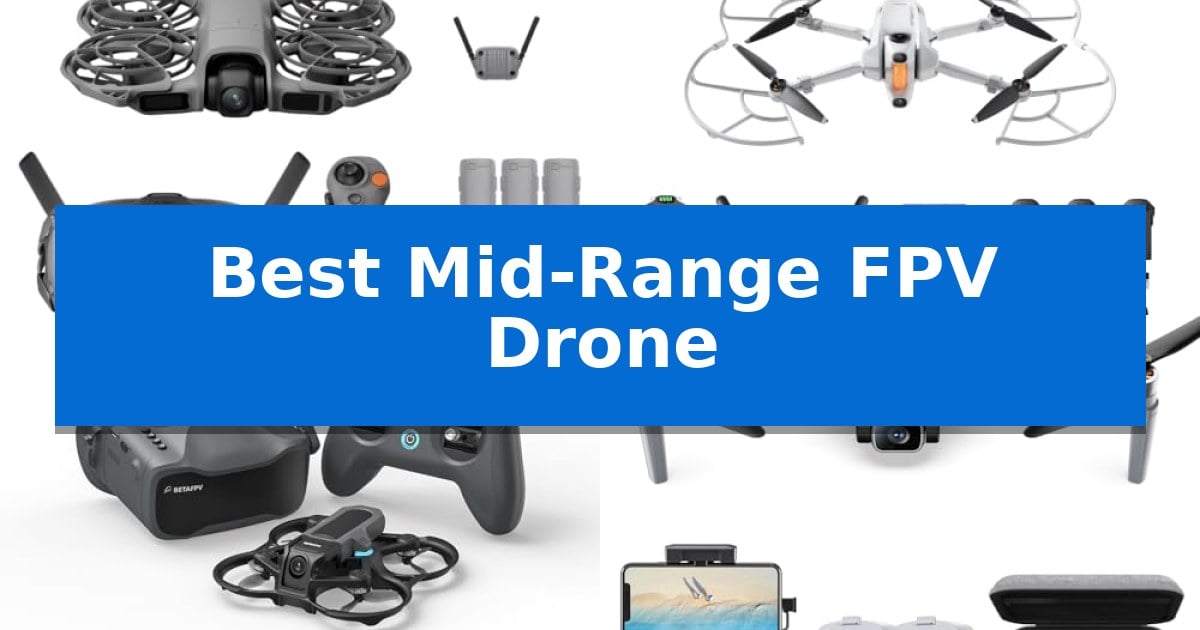
Finding the right aerial platform can be a daunting task, especially when balancing flight performance with ease of use. Whether you are a beginner looking to transition from basic camera drones or an enthusiast seeking more immersive flight, selecting the Best Mid-Range FPV Drone requires careful consideration of transmission stability, flight modes, and overall durability.
Our guide focuses on models that bridge the gap between entry-level stability and professional-grade agility. By examining key specifications such as transmission range, battery life, and integrated safety features, we provide a clear overview of the current market to help you make an informed decision for your next flight.
You may also want to compare Best Mid-Range Floor Stereo Speakers, Best Mid-Range Floor Standing Speakers, and Best Mid-Range Flat Screen TV.
Best Mid-Range FPV Drone
Quick Comparison
| Product | Best For | Key Strength | Score |
|---|---|---|---|
| DJI Neo 2 Motion Fly More | Best Overall | Ultra-lightweight 151g design with full-coverage propeller guards. | 4.9 |
| Antigravity A1 Pro 8K 360 Drone | Immersive 360-Degree Flight | 8K 360-degree video capture allows for flexible reframing after the flight. | 4.9 |
| BETAFPV Aquila16 FPV Kit | Ready-to-Fly Indoor Performance | Three flight modes with adjustable speed settings for skill progression. | 4.5 |
| Holy Stone HS360D GPS Drone | Extended Range FPV Transmission | 80-minute total flight time via included dual-battery system | 4.6 |
| Nexaero F3 GPS Drone | Controller with Built-in Screen | Built-in 7.22-inch screen on the controller for direct FPV monitoring. | 4.9 |
How We Chose
- Transmission Stability: Assessing the reliability and latency of the video link between the drone and the pilot.
- Flight Modes and Controls: Evaluating the versatility of flight modes for both beginners and experienced pilots.
- Imaging Capabilities: Reviewing the resolution and stabilization features of the onboard camera systems.
- Portability and Build: Considering the weight, size, and inclusion of protective features like propeller guards.
- Battery Efficiency: Analyzing total flight time per charge and the value of included power systems.
1 DJI Neo 2 Motion Fly More — Seamless FPV for Beginners
The DJI Neo 2 Motion Fly More distinguishes itself with a highly portable 151g frame, making it a practical entry point for those looking to experience FPV flight without the bulk of traditional setups. This compact drone is C0 certified and includes full-coverage propeller guards, prioritizing safety and ease of transport for beginners.
Equipped with a digital transceiver and the RC Motion 3 controller, the system provides a stable transmission link for immersive flight. Users can capture high-quality 4K footage, while features like ActiveTrack and SelfieShot simplify the process of recording dynamic aerial content. The inclusion of three batteries and a charging hub in the combo ensures extended flight sessions.
Operation is designed for accessibility, featuring palm takeoff and landing capabilities alongside intuitive gesture controls. For those who prefer alternative monitoring, the system integrates with an Apple Watch to view live feeds, check flight status, or adjust tracking via voice commands.
While the drone offers a versatile flight experience with omnidirectional obstacle sensing, users should note that the DJI Fly app is not available on Google Play. It must be downloaded directly from the official DJI website to ensure full functionality and access to the latest user manuals.
Best for: Beginners seeking a compact, all-in-one FPV drone kit with intuitive motion-based controls and integrated safety features.
Skip if: Experienced pilots requiring high-speed racing performance, manual FPV acro-mode customization, or professional-grade camera sensors.
PROS
- Ultra-lightweight 151g design with full-coverage propeller guards.
- Intuitive motion control via the included RC Motion 3 and Goggles N3.
- Comprehensive bundle including three batteries and a dedicated charging hub.
- Advanced flight features like ActiveTrack and omnidirectional obstacle sensing.
CONS
- App accessibility requires manual download from the official website due to Google Play restrictions.
- Fixed-focus camera limitations compared to professional cinematography drones.
2 Antigravity A1 Pro 8K 360 Drone — Immersive 360-Degree Flight
Capturing immersive aerial footage requires more than just a camera; it demands a system that handles complex perspectives with ease. The Antigravity A1 Pro 8K 360 Drone distinguishes itself by utilizing dual 1-inch Micro-OLEDs and pancake optics within its Vision Goggles, providing a 90-degree field of view that significantly enhances the pilot's immersion during flight.
This drone simplifies the creative process through its 8K 360-degree capture capability. By recording everything in the environment simultaneously, pilots can focus on flying while reframing cinematic angles during post-production. The system includes Auto Editing 2.0 within the companion app, which automatically applies professional pacing and maneuvers to raw footage, streamlining the workflow for creators.
Versatility is built into the power management and control systems. Users can choose between a standard battery to maintain a 249g weight for regulation-friendly flights or swap to the high-capacity batteries for up to 39 minutes of flight time per charge. Navigation is equally flexible, offering FreeMotion Mode for intuitive point-to-fly control or traditional FPV mode for manual wrist-based steering.
Safety and advanced flight features are integrated via an omnidirectional obstacle avoidance system that combines 360-degree sensing with binocular vision. For complex shots, the Sky Genie feature enables automated maneuvers like arc shots and spiral ascents with a single tap, while Deep Track technology keeps subjects centered, ensuring professional-looking results even for solo operators.
Best for: Creators and pilots seeking a comprehensive, all-in-one 360-degree FPV system that prioritizes ease of use and immersive visual quality.
Skip if: Pilots who require a traditional, non-360 camera setup for specific cinematic color grading or those who prefer a lightweight, minimalist drone without goggles.
PROS
- 8K 360-degree video capture allows for flexible reframing after the flight.
- Micro-OLED Vision Goggles provide a wide 90-degree field of view for high-quality immersion.
- Omnidirectional obstacle avoidance enhances flight safety during complex maneuvers.
- Comprehensive kit includes three high-capacity batteries, a 256GB memory card, and a charging hub.
CONS
- 340g weight with high-capacity batteries exceeds the 249g threshold for specific registration-free regulations.
- Complex 360-degree workflow may require a learning curve for those accustomed to traditional single-lens drone cinematography.
3 BETAFPV Aquila16 FPV Kit — Ready-to-Fly Indoor Performance
The BETAFPV Aquila16 FPV Kit provides a comprehensive entry point for new pilots by bundling a brushless quadcopter with a LiteRadio 2 SE Transmitter and VR03 FPV Goggles. This kit is designed to handle both indoor and outdoor flight, featuring a 350mW video transmission system that maintains a stable signal up to 200 meters, ensuring consistent visual feedback through the 4.3-inch 800*480px HD LCD display.
Performance is managed through three distinct flight modes—N, S, and M—which allow beginners to scale their skills from basic stability to more advanced maneuvers. The included transmitter comes pre-loaded with ELRS V3 firmware and supports joystick calibration and firmware updates directly through the BETAFPV system. For added convenience, the drone includes Turtle Mode, which allows the pilot to flip the quadcopter over if it lands upside down without needing to manually retrieve it.
Power management is tailored to the flight mode, with a default 1100mAh battery providing up to 8 minutes of flight time in N/S modes. For those transitioning to M mode, a separate 650mAh battery is available. The VR03 FPV Goggles include a built-in video recording function and are compatible with most analog VTX systems, offering a practical way to capture and review flight footage.
The system is built for accessibility, though it requires basic maintenance; the camera cable may loosen during impacts, requiring the user to occasionally reseat the connection to restore signal. By supporting FPV simulator practice via the transmitter, the kit allows users to build muscle memory before their first real-world flight, making it a functional choice for those learning the basics of FPV piloting.
Best for: Beginners seeking an all-in-one FPV package that includes a simulator-compatible transmitter and integrated video recording goggles.
Skip if: Experienced pilots requiring high-speed racing performance or long-range capabilities beyond the 200-meter signal limit.
PROS
- Three flight modes with adjustable speed settings for skill progression.
- Built-in DVR function in the goggles for recording and replaying flights.
- Turtle Mode functionality to recover from crashes without manual intervention.
- ELRS V3 firmware compatibility for improved operating range.
CONS
- Camera cable sensitivity may require manual reseating after frequent impacts.
- Limited 200-meter range restricts long-distance outdoor flying.
4 Holy Stone HS360D GPS Drone — Extended Range FPV Transmission
The Holy Stone HS360D GPS Drone prioritizes extended operational endurance by utilizing a dual-battery system that provides up to 80 minutes of total flight time. This capacity allows for prolonged aerial sessions, reducing the frequency of landings required for battery swaps during photography or exploration tasks.
A primary technical advantage of this quadcopter is the wired connection between the remote controller and your mobile device. By bypassing standard wireless-only transmission for the control link, this design choice works to minimize video latency, providing a more responsive FPV experience for the pilot while maintaining a transmission range of up to 20,000 feet.
The imaging system features a 1/3'' CMOS sensor paired with a 4K wide-angle lens, capable of capturing 3840×2160 resolution imagery. While the 85-degree field of view is optimized for specific framing, the unit remains highly portable due to its foldable frame and a total weight of under 249g, which removes the need for FAA registration.
Navigation is supported by integrated GPS modes, including Follow Me, Waypoint Flight, and Circle Fly. These automated features, alongside one-tap QuickShots, assist in executing complex flight paths, while the HS Fly App serves as a platform for ongoing software enhancements to maintain system performance.
Best for: Travelers and beginners who require a lightweight, FAA-compliant drone with extended flight endurance and low-latency wired FPV transmission.
Skip if: Pilots who require advanced mechanical gimbal stabilization or sophisticated obstacle avoidance sensors for high-speed cinematic tracking.
PROS
- 80-minute total flight time via included dual-battery system
- Wired controller connection significantly reduces FPV latency
- Under 249g design bypasses FAA registration requirements
- 4K UHD camera with 1/3'' CMOS sensor
CONS
- 85-degree field of view may limit wide-angle landscape capture
5 Nexaero F3 GPS Drone — Controller with Built-in Screen
The Nexaero F3 GPS Drone simplifies the piloting experience by integrating a 7.22-inch display directly into the remote controller, eliminating the need for a separate smartphone or app for real-time FPV transmission. This design choice ensures zero-latency monitoring and provides immediate access to photo and video previews, making it a practical choice for users who prefer a dedicated, all-in-one flight interface.
Engineered for versatility, the drone features a 2K camera capable of recording at 60fps with HDR, supported by EIS image stabilization to maintain steady footage during flight. The inclusion of an AI-powered object tracking system allows the drone to automatically follow subjects, while specialized night-shot technology assists in capturing clearer imagery in low-light environments.
Portability and regulatory convenience are central to its design, as the Nexaero F3 GPS Drone weighs under 249g, which removes the requirement for FAA and Remote ID registration. It arrives with a revamped shoulder bag for transport and includes two 7.6V 2700mAh batteries, providing a combined 64 minutes of total flight time to extend sessions without frequent recharging.
Safety is managed through a Smart Safety Ecosystem that utilizes GPS positioning to trigger an auto-return function in the event of low battery, signal loss, or manual command. While the system is designed for ease of use, the manufacturer recommends that beginners practice in windless, indoor environments initially to master pre-flight calibration and flight controls before attempting outdoor operation.
Best for: Beginners and hobbyists who want an all-in-one FPV system with a built-in screen and extended flight time without the need for FAA registration.
Skip if: Professional videographers requiring higher than 2K resolution or those who prefer using their own mobile device and dedicated flight apps for advanced mapping and mission planning.
PROS
- Built-in 7.22-inch screen on the controller for direct FPV monitoring.
- Under 249g weight avoids the need for FAA and Remote ID registration.
- 64 minutes of total flight time with the included dual modular batteries.
- EIS image stabilization for smoother video capture.
CONS
- Limited to 2K resolution, which may not satisfy users seeking 4K or higher clarity.
- Requires manual pre-flight calibration and specific practice for beginners to ensure safe operation.
Best Mid-Range FPV Drone Buying Guide
Understanding Flight Modes
Most mid-range drones offer multiple flight modes, such as Normal, Sport, and Manual. Normal mode typically provides GPS-assisted hovering, which is essential for beginners learning to maintain position. Sport mode increases speed and responsiveness, while Manual mode allows for full acrobatic control.
Choosing a drone that supports a gradual learning curve is vital. Look for models that offer position hold and auto-return features to prevent crashes while you are still mastering the controls.
Transmission and Latency
The connection between your controller and the drone is the lifeline of your flight experience. Low-latency FPV transmission is critical for real-time navigation, especially when flying through tight spaces or at higher speeds.
Some systems utilize wired connections between the controller and mobile device to minimize lag, while others rely on dedicated digital transceivers. Prioritize systems that offer consistent, high-definition feeds to avoid disorientation during flight.
Weight and Regulations
Many modern drones are designed to weigh under 249g, which often simplifies registration requirements in many jurisdictions. This lightweight build is ideal for travel and casual flying but may be more susceptible to wind interference.
Always check your local aviation regulations before your first flight. A drone that is FAA-friendly or registration-free can save you significant administrative effort while still providing high-quality aerial photography.
Camera Quality and Stabilization
For those interested in capturing footage, the sensor size and stabilization method are key. EIS (Electronic Image Stabilization) is common in this category and helps smooth out shaky footage caused by drone movement or wind.
Consider whether you need 4K resolution for high-detail captures or if a 2K sensor with advanced tracking features better suits your needs. Features like ActiveTrack can also simplify filming by keeping a subject centered automatically.
Safety and Durability
FPV flying inherently involves a higher risk of impact. Features like omnidirectional obstacle sensing and full-coverage propeller guards are invaluable for protecting your investment, especially when practicing indoors or near obstacles.
Look for drones that include modular batteries and easy-to-replace parts. A robust safety ecosystem, including Smart Return-to-Home, ensures that your drone can navigate back to the takeoff point if it loses signal or runs low on power.
Frequently Asked Questions
Do I need to register a drone under 249g?
Regulations vary by country. In many regions, drones weighing under 249g are exempt from certain registration requirements, but you should always verify with your local aviation authority.
What is the benefit of a built-in screen on the controller?
A built-in screen eliminates the need to mount a smartphone to your controller. This often results in lower latency, better visibility in bright sunlight, and a more streamlined setup process.
Can I fly an FPV drone indoors?
Yes, provided the drone is compact and equipped with propeller guards. Models designed for indoor performance often feature specific flight modes that prioritize stability and safety in confined spaces.
What is the difference between GPS and non-GPS drones?
GPS drones use satellite positioning to maintain a stable hover and provide features like auto-return. Non-GPS drones, often used for pure FPV racing, require manual pilot input to maintain position.
How do I improve my flight time?
Flight time is primarily determined by battery capacity and flight style. Carrying extra batteries and avoiding aggressive maneuvers in high-speed modes can help extend your time in the air.
Conclusion: Our Top Pick
Choosing the right drone depends on your specific goals, whether you are prioritizing cinematic capture or the thrill of immersive flight. After evaluating the available options, the DJI Neo 2 Motion Fly More stands out as the most versatile choice for those seeking a balance of portability, safety, and ease of use.
With its lightweight design, integrated propeller guards, and intuitive gesture controls, the DJI Neo 2 Motion Fly More provides a reliable entry point into FPV flight. Its combination of 4K imaging and stable transmission makes it a well-rounded option for beginners and enthusiasts alike.