
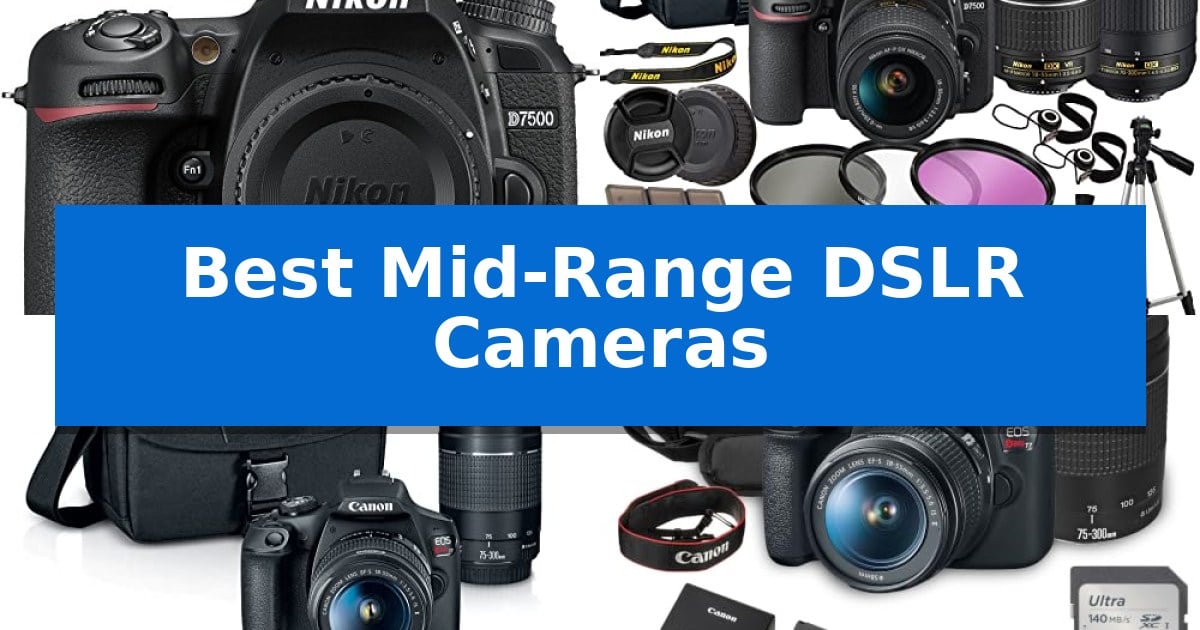
Finding the right camera often feels like balancing technical specifications against practical usability. Whether you are upgrading from a basic kit or looking for a more robust tool for creative projects, the Best Mid-Range DSLR Cameras offer a blend of advanced sensor technology and manual control that bridges the gap between entry-level simplicity and professional-grade complexity.
This guide examines five distinct camera options, focusing on their sensor capabilities, autofocus systems, and overall versatility. By understanding how these features translate into real-world photography, you can make an informed decision that aligns with your specific shooting style and long-term goals.
You may also want to compare Best Mid-Range DSLR Camera for Beginners, Best Mid-Range DSLR Camera, and Best Mid-Range Drones.
Best Mid-Range DSLR Cameras
Quick Comparison
| Product | Best For | Key Strength | Score |
|---|---|---|---|
| Nikon D7500 DSLR Camera | Best Overall | Professional-grade image processing and metering technology. | 4.9 |
| Nikon D7500 DSLR Lens Kit | Complete Versatile Shooting Bundle | Comprehensive bundle including two NIKKOR lenses, tripod, and 64GB memory card. | 4.5 |
| Canon EOS Rebel T7 DSLR Camera | Reliable Entry-Level Standard | Double zoom lens kit included for immediate versatility. | 4.6 |
| Canon EOS Rebel T7 Double Lens Kit | Extended Reach for Beginners | Comprehensive bundle including two versatile lenses, a memory card, and a bag. | 4.3 |
| Nikon D3200 DSLR Camera | Intuitive Controls for Learning | Guide Mode provides built-in, step-by-step assistance for learning camera settings. | 4.3 |
How We Chose
- Sensor resolution and image processing capabilities for detail and color accuracy.
- Autofocus system performance, including point count and tracking reliability.
- Video recording versatility, focusing on resolution and frame rate options.
- Ergonomics and interface design, specifically regarding screen functionality and manual controls.
- Bundle value and accessory inclusion for immediate shooting readiness.
1 Nikon D7500 DSLR Camera — Advanced Performance for Enthusiasts
The Nikon D7500 DSLR Camera distinguishes itself through its high-performance imaging pipeline, utilizing the same processing and metering technology found in the professional-grade D500. This integration ensures that photographers have access to advanced image quality and a versatile ISO range within a more compact, enthusiast-focused body.
Designed for versatility, the camera features a 3.2-inch tilting LCD screen with full touch functionality, allowing for intuitive navigation and flexible shooting angles. The build is rated for operation in temperatures ranging from 0°C to 40°C, providing reliability across diverse environments. For those focused on action, the 51-point AF system includes 15 cross-type sensors and group area AF, supporting continuous shooting speeds of up to 8 fps.
Beyond still photography, the device is equipped for modern production needs, offering 4K Ultra HD video recording alongside 1080p full HD options. It includes advanced features like power aperture control, auto ISO, and 4K UHD time-lapse capabilities. Connectivity is streamlined via built-in Wi-Fi and Bluetooth, which integrate directly with the Nikon SnapBridge app for efficient image transfer.
The Nikon D7500 DSLR Camera serves as a robust tool for those transitioning into more demanding photographic work. While it offers a comprehensive suite of features, users should note that its performance is optimized for the DX-format ecosystem, making it a specialized choice for those already invested in or building toward that specific lens mount and sensor size.
Best for: Enthusiasts seeking professional-grade image processing and high-speed autofocus in a versatile, mid-range DSLR body.
Skip if: Photographers who require full-frame sensor performance or those who prefer a mirrorless system for a lighter, more compact form factor.
PROS
- Professional-grade image processing and metering technology.
- High-speed 8 fps continuous shooting with a 51-point AF system.
- 4K Ultra HD video recording with advanced aperture control.
- Tilting 3.2-inch touch LCD screen for flexible composition.
CONS
- DX-format sensor may not meet the needs of full-frame photography requirements.
- Weight of 1.66 pounds is heavier than mirrorless alternatives.
2 Nikon D7500 DSLR Lens Kit — Complete Versatile Shooting Bundle
The Nikon D7500 DSLR Lens Kit serves as a comprehensive entry point for photographers requiring a versatile system, centered around a 20.9MP DX-format CMOS sensor and the EXPEED 5 image processor. This combination enables an 8 fps continuous shooting rate for up to 100 consecutive JPEGs, providing a reliable foundation for capturing fast-moving subjects or time-lapse sequences.
Designed for multimedia flexibility, the camera supports 4K UHD video recording at 30 fps. The inclusion of a 3.2-inch 922k-dot tilting touchscreen LCD allows for intuitive menu navigation and precise focus adjustments during live-view shooting. Connectivity is managed through SnapBridge Bluetooth and Wi-Fi, facilitating wireless image transfer and remote control capabilities.
The bundle includes two versatile lenses: the AF-P DX NIKKOR 18-55mm f/3.5-5.6G VR and the AF-P DX NIKKOR 70-300mm f/4.5-6.3G. These lenses cover a broad focal range, making the kit suitable for various photographic scenarios. The system utilizes a Multi-CAM 3500FX II 51-point AF system, which works in conjunction with a 180k-pixel RGB sensor to maintain focus accuracy.
Beyond the core camera and optics, the kit provides essential accessories such as a 64GB Class 10 SD memory card, a 50-inch tripod, a slave flash, and a 3-piece filter kit. This collection of tools is intended to support immediate use, offering a complete setup for those looking to expand their photographic capabilities without sourcing individual components separately.
Best for: Photographers seeking a complete, all-in-one bundle that includes a versatile dual-lens system and essential accessories for immediate use.
Skip if: Users who require a more compact, mirrorless form factor or those who do not need the included tripod, flash, and filter accessories.
PROS
- Comprehensive bundle including two NIKKOR lenses, tripod, and 64GB memory card.
- High-speed performance with 8 fps continuous shooting for up to 100 frames.
- Advanced autofocus system using a 51-point array and 180k-pixel RGB sensor.
- Integrated connectivity via SnapBridge Bluetooth and Wi-Fi for remote control.
CONS
- Large physical footprint compared to modern mirrorless camera systems.
- Import model status which may influence specific regional support or warranty considerations.
3 Canon EOS Rebel T7 DSLR Camera — Reliable Entry-Level Standard
The Canon EOS Rebel T7 DSLR Camera provides a versatile entry point into photography by bundling a 24.1 Megapixel CMOS (APS-C) sensor with a double zoom lens kit, including both EF-S 18-55mm and EF 75-300mm lenses. This combination allows users to transition between wide-angle shots and telephoto zoom without needing immediate additional investments.
Designed for those learning the craft, the camera features a 9-Point AF system with AI Servo AF to assist in tracking subjects. The inclusion of an optical viewfinder with approximately 95% coverage offers a traditional shooting experience, while the built-in Wi-Fi and NFC technology facilitates easier image transfer to compatible devices.
Beyond still photography, the device supports FHD 1080p video capture. For users looking to repurpose their equipment, the EOS Utility Webcam Beta Software enables the camera to function as a high-quality webcam on both Mac and Windows systems, adding utility beyond standard field use.
The camera operates within a temperature range of 32-104°F, making it suitable for a variety of environments. With its 24.1 Megapixel resolution and comprehensive lens kit, it serves as a foundational tool for beginners who require a balance of manual control and accessible features.
Best for: Beginner photographers seeking a comprehensive, all-in-one kit that covers both wide-angle and telephoto focal lengths.
Skip if: Users who require advanced 4K video recording or a more compact mirrorless form factor for travel.
PROS
- Double zoom lens kit included for immediate versatility.
- 24.1 Megapixel CMOS sensor for high-resolution imagery.
- Built-in Wi-Fi and NFC for convenient connectivity.
- Webcam compatibility via EOS Utility software.
CONS
- Optical viewfinder limited to 95% coverage.
- FHD 1080p video resolution may not meet higher-end production needs.
4 Canon EOS Rebel T7 Double Lens Kit — Extended Reach for Beginners
Stepping into photography with a dedicated system requires versatile tools that can adapt to various subjects, from wide-angle landscapes to distant wildlife. The Canon EOS Rebel T7 Double Lens Kit provides this flexibility by including both an EF-S 18-55mm IS II lens for general use and an EF 75-300mm f/4-5.6 III lens for extended telephoto reach, ensuring beginners have the necessary glass to cover most scenarios right out of the box.
At the heart of the system is a 24.1MP APS-C CMOS sensor, which delivers high-resolution images with accurate color reproduction. This sensor is paired with a 9-point autofocus system designed to maintain sharpness across a variety of subjects. For those interested in digital storytelling, the camera supports Full HD 1080p video recording at 30p, offering a straightforward path for capturing social content or family events.
Usability is a core focus, as the camera includes a wide selection of automatic scene modes that help new photographers achieve properly exposed shots without needing deep manual expertise. The compact, beginner-friendly design is complemented by a bundle that includes a 64GB memory card and a shoulder bag, providing a complete starting package for those looking to move beyond smartphone photography.
While the system is highly capable for learning, it is important to note that this is a dedicated DSLR platform. Users should be prepared for the physical size of an interchangeable lens camera compared to mobile devices, though the trade-off is the significant increase in optical versatility and control over depth of field provided by the included lenses.
Best for: Beginners seeking a complete, versatile photography kit that includes both standard and telephoto lenses for learning various shooting styles.
Skip if: Users who require a pocketable, ultra-compact device or those who prioritize advanced 4K video features over traditional DSLR ergonomics.
PROS
- Comprehensive bundle including two versatile lenses, a memory card, and a bag.
- 24.1MP APS-C sensor provides high-quality, detailed images.
- User-friendly interface with automatic scene modes for quick setup.
- Reliable 9-point autofocus system for consistent subject tracking.
CONS
- Larger physical footprint compared to modern mirrorless or mobile alternatives.
- 1080p video limitation may not meet the needs of creators looking for 4K resolution.
5 Nikon D3200 DSLR Camera — Intuitive Controls for Learning
The Nikon D3200 DSLR Camera simplifies the transition to interchangeable lens photography through its integrated Guide Mode, which offers step-by-step shooting assistance and sample images to help users master camera settings. This entry-level system is built around a 24.2MP DX-format CMOS sensor and the EXPEED 3 image processor, providing a foundation for capturing high-resolution JPEG or RAW files.
Versatility is provided by the included AF-S DX 18-55mm f/3.5-5.6G VR lens. This optic covers a range from wide-angle to portrait focal lengths, while the built-in Vibration Reduction (VR) stabilization helps mitigate blur caused by handheld camera shake. The camera body is designed to be lightweight and compact, prioritizing portability for travel and daily use.
For those interested in videography, the device supports Full HD 1080p recording at 24, 25, and 30 fps, alongside 720p at 60 fps. It features full-time autofocus during video capture and manual exposure control, allowing for creative adjustments in varied lighting conditions. The bundle includes essential accessories such as a 64GB memory card, a replacement battery, and a 3PC MC PRO filter kit to support immediate use.
This bundle provides a comprehensive starting point for new photographers by including a USB card reader, a memory card wallet, and a cleaning kit. The combination of the high-resolution sensor and the guided learning interface makes this kit a practical choice for those seeking a dedicated camera system for photography and video projects.
Best for: Beginners seeking an all-in-one bundle that includes educational guidance and essential accessories for learning photography and video.
Skip if: Users requiring advanced features like 4K video recording, weather-sealing, or high-speed burst rates for professional sports photography.
PROS
- Guide Mode provides built-in, step-by-step assistance for learning camera settings.
- 24.2MP DX-format sensor delivers high-resolution images with detailed tonal gradation.
- Vibration Reduction (VR) lens technology helps maintain sharpness during handheld shooting.
- Comprehensive bundle includes a 64GB memory card, extra battery, and filter kit.
CONS
- Entry-level feature set lacks the advanced controls and high-speed performance found in professional-grade models.
Best Mid-Range DSLR Cameras Buying Guide
Sensor and Image Quality
The heart of any DSLR is its image sensor. Mid-range models typically utilize APS-C sensors, which provide a significant upgrade in light sensitivity and dynamic range compared to smaller sensors found in compact cameras or smartphones.
When evaluating these cameras, consider the megapixels and the image processor. A higher megapixel count allows for more detailed prints and cropping flexibility, while a robust processor ensures that your camera can handle high-speed shooting and complex lighting conditions without sacrificing image quality.
Autofocus Systems
A reliable autofocus (AF) system is essential for capturing sharp images, especially when dealing with moving subjects. Look for cameras that offer a high number of cross-type sensors, which are more sensitive and accurate than standard AF points.
The ability to track subjects across the frame is a key differentiator. Advanced systems often include group area AF or dedicated tracking modes, which help maintain focus on your subject even when they move unpredictably through the scene.
Video Capabilities
Many modern photographers require a camera that excels in both stills and video. Mid-range DSLRs often support Full HD 1080p or 4K UHD recording, providing the resolution needed for high-quality social content or creative filmmaking.
Pay attention to features like stereo sound support, auto ISO in video mode, and the availability of time-lapse recording. These tools allow for greater creative control and can simplify the post-production process significantly.
Ergonomics and Controls
The physical design of a camera dictates how quickly you can adjust settings while shooting. A tilting touchscreen LCD is a valuable asset, allowing for easier composition from low or high angles and providing intuitive menu navigation.
Consider the weight and grip of the camera body. A well-balanced body ensures comfort during long shooting sessions, while clearly labeled buttons and dials allow you to change exposure settings, such as aperture and shutter speed, without taking your eye off the viewfinder.
Connectivity and Bundles
Modern workflows often require quick image transfers. Features like built-in Wi-Fi and Bluetooth enable seamless connectivity to mobile devices, making it easier to share your work or control the camera remotely.
If you are just starting out, consider the value of a lens kit. Bundles that include multiple lenses, memory cards, and tripods offer a comprehensive starting point, ensuring you have the necessary reach and support for various shooting scenarios right out of the box.
Frequently Asked Questions
What is the main advantage of an APS-C sensor?
An APS-C sensor is larger than those found in many compact cameras, allowing for better low-light performance, improved dynamic range, and more control over depth of field.
Are these cameras suitable for beginners?
Yes, many of these models include features like 'Guide Mode' or intuitive automatic scene settings, which help beginners learn manual controls while still capturing high-quality images.
Do I need a double lens kit?
A double lens kit is beneficial if you want to cover a wide range of focal lengths, from wide-angle shots for landscapes to telephoto reach for distant subjects, without purchasing additional lenses separately.
How does Wi-Fi connectivity help?
Built-in Wi-Fi allows you to transfer photos wirelessly to your smartphone or tablet for quick editing and sharing, and often enables remote camera control via a mobile app.
What is the benefit of a tilting touchscreen?
A tilting screen allows you to compose shots from difficult angles, such as ground level or overhead, and the touch functionality makes navigating menus and reviewing images much faster.
Conclusion: Our Top Pick
When selecting the right camera, the Nikon D7500 DSLR Camera stands out as a versatile choice for those who want a balance of high-end performance and intuitive handling. With its advanced 51-point AF system, 4K UHD video capabilities, and robust sensor, it provides the tools necessary to grow your photography skills while maintaining excellent image quality in a variety of lighting conditions.
While other options in this list offer excellent value for beginners, the D7500's combination of speed and processing power makes it a reliable long-term investment for enthusiasts. Its ability to handle fast-paced action and provide detailed, high-resolution results ensures it remains a capable companion for diverse creative projects.