
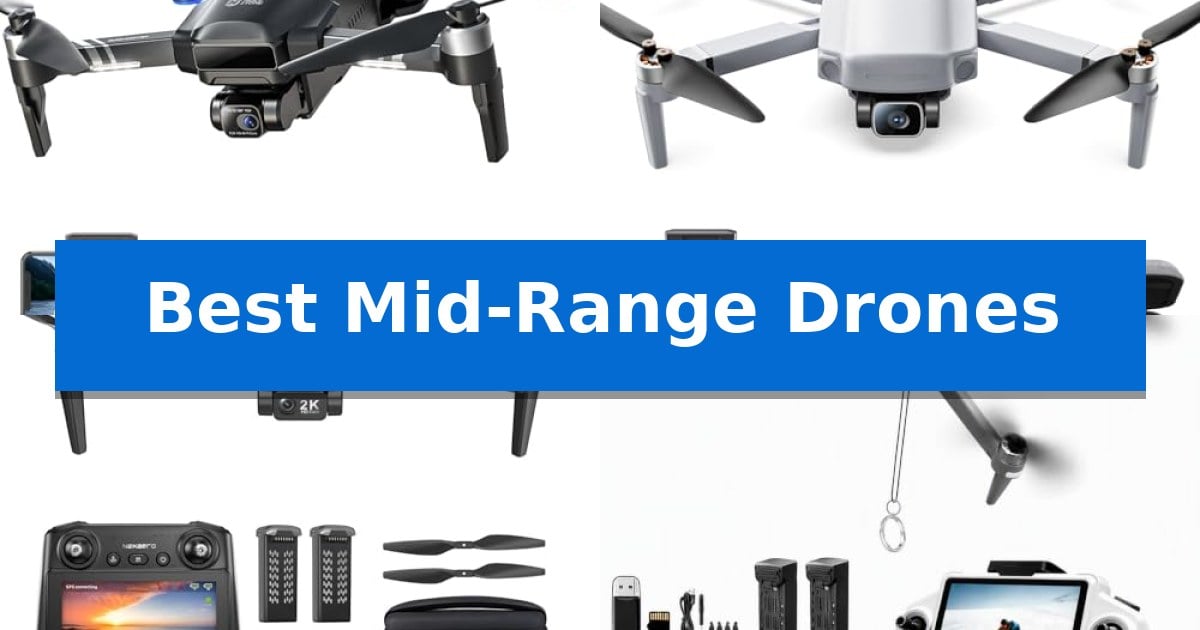
Finding the right aerial platform often feels like navigating a complex landscape of technical specifications and varying flight regulations. Whether you are capturing cinematic landscapes or inspecting property, the Best Mid-Range Drones offer a sophisticated middle ground between entry-level toys and professional-grade equipment, providing enough stability and image quality for serious hobbyists without the prohibitive cost of flagship models.
Our analysis focuses on the essential trade-offs that define this category, including battery efficiency, transmission reliability, and ease of operation. By prioritizing features that genuinely impact your flight experience, we have identified the models that provide the most consistent results for your specific needs.
You may also want to compare Best Mid-Range Drone with Camera, Best Mid-Range Drone, and Best Mid-Range Dolby Atmos Soundbars.
Best Mid-Range Drones
Quick Comparison
| Product | Best For | Key Strength | Score |
|---|---|---|---|
| Holy Stone HS600 GPS Drone | Best Overall | 2-axis gimbal with EIS for stable 4K video capture. | 4.9 |
| Holy Stone HS360D GPS Drone | Longest Range FPV Transmission | Wired remote connection significantly reduces video latency for smoother FPV. | 4.6 |
| Dingdongwu F3 GPS Drone | Integrated Screen for Easy Control | Integrated 7.22-inch display eliminates the need for smartphone app connectivity. | 4.3 |
| Giffke YL059 GPS Drone | Includes Obstacle Avoidance Sensors | Under 249g weight eliminates the need for FAA or Remote ID registration. | 4.9 |
| LYHFPV GPS Drone | Reliable GPS Return-to-Home | Under 249g design eliminates the need for FAA or Remote ID registration. | 4.6 |
How We Chose
- Image Stabilization: We prioritized models featuring gimbal systems and electronic image stabilization (EIS) to ensure smooth, professional-looking footage.
- Transmission Range: We assessed the reliability of video feeds and control signals over distance to ensure uninterrupted flight control.
- Flight Duration: We analyzed the total airtime provided by battery systems to minimize downtime during field use.
- Regulatory Compliance: We identified models that simplify the user experience by adhering to weight and Remote ID standards.
- Operational Ease: We looked for intelligent flight modes and GPS-assisted features that assist beginners in achieving stable, controlled maneuvers.
1 Holy Stone HS600 GPS Drone — Best for Stable 4K Aerial Video
Capturing professional-grade aerial footage requires a balance of stability and portability, and the Holy Stone HS600 GPS Drone addresses this with its integrated 2-axis gimbal and EIS stabilization. By combining these mechanical and electronic systems with brushless motors, this drone is engineered to maintain steady flight even in challenging conditions, supporting Level 6 wind resistance.
For those looking to explore further, the Holy Stone HS600 GPS Drone features a WiFi repeater integrated directly into the remote controller, extending the transmission range up to 10,000 feet. This setup allows for long-range FPV flight, while the Sony sensor-enhanced camera captures 4K/30FPS video to ensure high-clarity results for your creative projects.
Usability is a core focus, as the drone includes GPS intelligent functions such as one-key return, lost signal return, and low battery return to provide security during operation. The system is also FAA-compliant with integrated Remote ID, removing the need for additional modules and simplifying the setup process for pilots.
The Holy Stone HS600 GPS Drone offers a streamlined experience through its enhanced remote controller, which supports a direct data cable connection to your smartphone for real-time streaming. With a weight of 541g and an included portable carrying case, this drone is built for enthusiasts who need a reliable, stable, and transportable solution for aerial photography.
Best for: Enthusiasts and adults seeking a stable, long-range 4K camera drone with integrated GPS safety features.
Skip if: Users requiring a sub-250g drone for specific regulatory exemptions or those needing a 3-axis gimbal for more advanced cinematic stabilization.
PROS
- 2-axis gimbal with EIS for stable 4K video capture.
- 10,000-foot transmission range via integrated WiFi repeater.
- Integrated Remote ID for FAA compliance.
- GPS-based return-to-home safety features.
CONS
- 541g weight exceeds the sub-250g threshold for certain drone regulations.
- 2-axis gimbal provides less stabilization than 3-axis alternatives.
2 Holy Stone HS360D GPS Drone — Longest Range FPV Transmission
The Holy Stone HS360D GPS Drone prioritizes long-range connectivity by utilizing a wired connection between the remote controller and your mobile device, which helps minimize video latency compared to standard Wi-Fi-only systems. This design choice supports a stable 6KM HD image transmission range, providing a more consistent FPV experience for pilots operating at distance.
Equipped with a 1/3'' CMOS sensor and a 4K wide-angle lens, this quadcopter captures 3840×2160 resolution photos across an 85° field of view. The inclusion of two batteries provides a total flight time of up to 80 minutes, allowing for extended sessions without frequent landing for power swaps.
Weighing under 249g, the Holy Stone HS360D GPS Drone falls into a weight class that does not require FAA registration for recreational use. Its foldable architecture and included carrying case are intended to simplify transport for outdoor enthusiasts who need a compact, portable aerial imaging solution.
The drone integrates several automated flight modes, including Follow Me, Waypoint Flight, and Circle Fly, alongside an Auto Return to Home function for added security. Users can manage updates and performance enhancements through the dedicated HS Fly App, which is designed to support ongoing feature improvements.
Best for: Travelers and hobbyists who require a lightweight, FAA-compliant drone with long-range FPV transmission and extended flight time.
Skip if: Professional cinematographers who require advanced obstacle avoidance sensors or a larger sensor size for low-light performance.
PROS
- Wired remote connection significantly reduces video latency for smoother FPV.
- Under 249g weight eliminates the need for FAA registration.
- 80-minute total flight time provided by the included dual-battery setup.
- 6KM transmission range offers extensive reach for aerial photography.
CONS
- 85° field of view may be narrower than some specialized wide-angle action cameras.
- 1/3'' CMOS sensor is optimized for standard daylight conditions rather than professional-grade low-light environments.
3 Dingdongwu F3 GPS Drone — Integrated Screen for Easy Control
The Dingdongwu F3 GPS Drone simplifies the flight experience by integrating a large 7.22-inch display directly into the remote control, removing the requirement for a smartphone app or complex wireless pairing. This design choice enables immediate, plug-and-play operation for pilots who prefer a dedicated, distraction-free interface for real-time FPV monitoring.
Engineered for versatility and endurance, the drone features a dual-battery system that provides a combined 64 minutes of flight time, allowing for extended sessions without frequent landing. Its 1503 brushless motors provide Level 5 wind resistance, ensuring stability during outdoor use, while the integrated GPS and anti-lost program facilitate features like one-key return and precise hovering.
The camera system captures footage in 2K HD resolution with a 90-degree adjustable lens, supported by 5GHz transmission for stable image delivery. Advanced AI functionality includes object locking and tracking, alongside specialized modes for capturing clear imagery in low-light conditions, making it a capable tool for varied environments.
Designed with portability in mind, the Dingdongwu F3 GPS Drone weighs less than 249g and features a foldable frame, which simplifies transport and exempts the user from FAA Remote ID registration requirements. The package includes a comprehensive set of accessories, including spare propellers and a carrying case, providing a complete solution for beginners and travelers alike.
Best for: Beginners and travelers who prioritize a simplified, all-in-one flight experience without the need for smartphone integration.
Skip if: Professional cinematographers or users requiring 4K resolution and advanced obstacle avoidance sensors may find the 2K camera and feature set insufficient for their needs.
PROS
- Integrated 7.22-inch display eliminates the need for smartphone app connectivity.
- 64-minute total flight time via dual intelligent batteries.
- Under 249g weight ensures portability and avoids FAA Remote ID registration.
- Brushless motors provide stable Level 5 wind resistance.
CONS
- 2K resolution may not meet the requirements of users seeking higher-fidelity 4K aerial footage.
4 Giffke YL059 GPS Drone — Includes Obstacle Avoidance Sensors
Navigating the skies with a device that weighs under 249g is a significant advantage for travel, as the Giffke YL059 GPS Drone avoids the need for FAA or Remote ID registration in the United States. This foldable unit is designed for portability, making it a practical choice for those who want to capture aerial footage during outdoor adventures without managing complex regulatory requirements.
The drone features 4-way obstacle avoidance to assist in reducing collision risks, which is particularly beneficial for new pilots. It is powered by brushless motors that provide stability in 4-level wind conditions, while the included dual 7.4V 1300mAh batteries offer a total flight time of up to 60 minutes. Pilots can monitor essential flight data, such as battery levels and GPS status, directly on the controller's integrated 4.3" HD screen.
Equipped with a 4K HD camera featuring a 120° wide-angle lens and a 90° adjustable pitch, the system is capable of capturing varied perspectives, including overhead shots for property inspections. The 5GHz FPV transmission technology supports real-time video viewing at distances up to 6561ft, allowing for reliable visual feedback during operation.
To ensure safety, the drone utilizes intelligent GPS flight functions, including an automatic return-to-home feature that triggers if the signal is lost or the battery runs low. The inclusion of smart flight modes like follow-me and orbit flight allows users to automate camera movement, helping them focus on framing their shots while the drone handles the navigation.
Best for: Beginners and travelers seeking a lightweight, FAA-compliant drone with integrated obstacle avoidance and a dedicated controller screen.
Skip if: Professional videographers requiring higher-end sensor sizes or advanced raw image processing capabilities beyond standard 4K consumer output.
PROS
- Under 249g weight eliminates the need for FAA or Remote ID registration.
- 4-way obstacle avoidance sensors help reduce the risk of flight collisions.
- 60 minutes of total flight time provided by two included batteries.
- Integrated 4.3" HD screen on the controller allows for real-time FPV viewing without needing a separate smartphone.
CONS
- Requires manual pre-flight calibration and lens protector removal for optimal performance.
- Limited to 4-level wind resistance, which may impact stability in stronger gusts.
5 LYHFPV GPS Drone — Reliable GPS Return-to-Home
Capturing aerial footage requires a balance of portability and flight stability, and the LYHFPV GPS Drone addresses this by integrating a 4K HD camera with a 90° adjustable lens. This setup allows users to frame shots precisely while the 5G Wi-Fi connection maintains a real-time feed for monitoring content as it is captured.
For extended flight sessions, the system includes two 7.4V/2200mAh intelligent batteries, providing a combined 60 minutes of flight time. The drone is powered by brushless motors and features an altitude hold system designed to maintain stability during hover, even when encountering windy conditions.
Safety and ease of use are central to the design, particularly for those new to piloting. The GPS Auto Return function serves as a critical safety mechanism, automatically triggering a return to the home point if the battery runs low or if the signal is lost. This is complemented by Fly-Away Protection and a detailed flight log to help track the device.
Weighing under 249g, this unit falls below the threshold that requires FAA or Remote ID registration, making it a convenient option for travel and casual use. The included remote features an LCD screen that provides real-time telemetry data, and the drone supports a maximum transmission range of 1,968 feet for broader exploration.
To ensure consistent performance, the manufacturer specifies that compass calibration must be performed before each takeoff. Additionally, the GPS system requires a connection to at least eight satellites to initiate flight, ensuring that the automated safety features are fully operational before the drone leaves the ground.
Best for: Beginners and travelers seeking a lightweight, FAA-compliant drone with automated safety features and extended flight time.
Skip if: Professional cinematographers requiring advanced obstacle avoidance sensors or higher-bitrate video recording capabilities.
PROS
- Under 249g design eliminates the need for FAA or Remote ID registration.
- 60 minutes total flight time provided by two included high-capacity batteries.
- GPS-enabled auto-return functionality for enhanced flight safety and loss prevention.
- Brushless motors and altitude hold system support stable flight performance.
CONS
- Requires compass calibration before every flight to maintain GPS accuracy.
- Minimum of 8 GPS satellites needed to initiate flight operations.
Best Mid-Range Drones Buying Guide
Understanding Flight Stability
Flight stability is primarily governed by the drone's motor quality and onboard stabilization technology. Models equipped with brushless motors generally offer superior durability and wind resistance compared to brushed alternatives, allowing for more precise hovering and smoother movement in breezy conditions.
The inclusion of a 2-axis or 3-axis gimbal is a critical differentiator for video quality. While electronic stabilization (EIS) can correct some shakiness, a physical gimbal physically compensates for the drone's tilting, resulting in significantly more fluid, cinematic footage.
Transmission and Connectivity
The range and clarity of your video feed depend on the transmission technology. Many modern drones utilize 5GHz FPV transmission or wired controller-to-phone connections to reduce latency and interference, which is essential for maintaining control during long-range flights.
Consider how the drone connects to your mobile device. Some systems require a Wi-Fi connection, while others use a dedicated data cable to the remote, which often provides a more stable, lag-free viewing experience for the pilot.
Battery Life and Efficiency
Total flight time is a major factor in how much you can accomplish in a single session. Most mid-range drones provide between 25 and 35 minutes of flight per battery, but many kits now include dual batteries to effectively double your time in the air.
Look for intelligent battery management systems that provide low-battery alerts. These systems are often integrated with GPS auto-return functions, ensuring the drone safely navigates back to the takeoff point before power is completely exhausted.
Regulatory Considerations
Weight is a significant factor for drone pilots in the United States. Drones weighing under 249g are often exempt from certain FAA registration requirements, making them highly attractive for travelers and casual users who want to avoid extra administrative steps.
Integrated Remote ID is becoming a standard requirement for newer drones. Choosing a model that is already compliant ensures you can fly in a wider variety of locations without needing to purchase and attach additional hardware modules.
Intelligent Flight Modes
Modern GPS drones offer automated features like Follow Me, Waypoint Flight, and Circle Fly. These modes allow the drone to handle navigation while you focus on framing the perfect shot, which is particularly useful for solo content creators.
Obstacle avoidance sensors provide an extra layer of security for newer pilots. While these systems do not make a drone invincible, they significantly reduce the risk of collisions in complex environments, allowing for more confident flight maneuvers.
Frequently Asked Questions
Do I need an FAA license to fly these drones?
Drones weighing under 249g are generally exempt from FAA registration for recreational use, but you should always check local regulations and the latest FAA guidelines before your flight.
What is the benefit of a brushless motor?
Brushless motors are more efficient, quieter, and offer better durability and wind resistance than brushed motors, which is essential for maintaining stable flight in outdoor environments.
How does GPS help with drone safety?
GPS allows the drone to maintain a precise hover position and enables critical safety features like one-key return-to-home, which automatically brings the drone back if the signal is lost or the battery gets low.
Is a gimbal necessary for 4K video?
While 4K resolution provides detail, a gimbal is necessary to eliminate the micro-jitters and vibrations caused by wind and movement, ensuring your footage looks smooth and professional.
Can I fly these drones in windy conditions?
Many mid-range drones are rated for specific wind resistance levels (e.g., Level 5 or 6). Always check the manufacturer's wind resistance rating and avoid flying in conditions that exceed these limits to prevent loss of control.
Conclusion: Our Top Pick
When selecting from the Best Mid-Range Drones, the Holy Stone HS600 GPS Drone stands out as the most balanced choice for those prioritizing video stability and reliable flight performance. Its combination of a 2-axis gimbal, EIS, and brushless motors ensures that your 4K footage remains smooth even when conditions are less than ideal.
While other models offer unique advantages like integrated screens or specific weight profiles, the HS600's robust feature set and FAA-compliant design make it a versatile tool for both beginners and experienced pilots. If you require a stable, long-range platform that simplifies the creative process, this model provides the most consistent and reliable experience.