
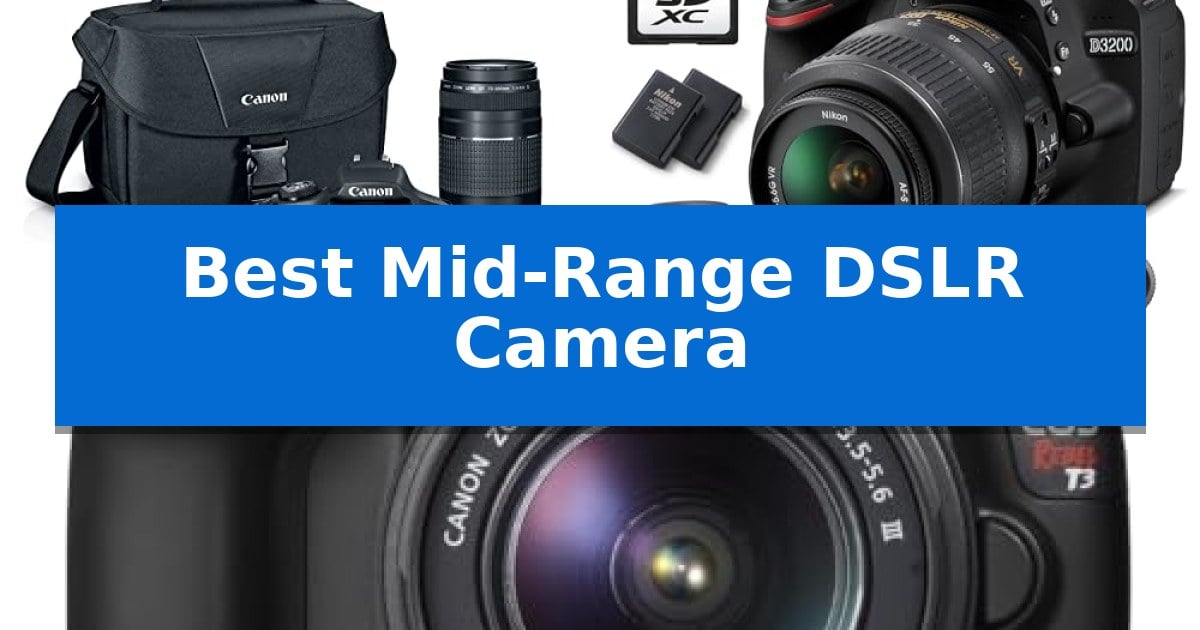
Finding the right photographic tool requires balancing image quality with ease of use. Whether you are capturing landscapes or family portraits, the Best Mid-Range DSLR Camera provides the manual control necessary to grow your skills while maintaining a portable form factor.
Our selection focuses on models that offer a blend of sensor performance, lens versatility, and intuitive interfaces. By examining the core technical specifications and included accessories, we help you identify which camera aligns with your specific creative goals and current photography experience.
You may also want to compare Best Mid-Range Drones, Best Mid-Range Drone with Camera, and Best Mid-Range Drone.
Best Mid-Range DSLR Camera
Quick Comparison
| Product | Best For | Key Strength | Score |
|---|---|---|---|
| Canon EOS Rebel T7 DSLR Camera | Best Overall | Double zoom lens kit included for immediate versatility. | 4.9 |
| Nikon D3200 DSLR Camera | Beginner Friendly Guide Mode | 24.2MP DX-format sensor for high-resolution images. | 4.7 |
| Canon EOS Rebel T3 DSLR Camera | Compact Entry Level Choice | Basic+ control menu simplifies the learning curve for new photographers. | 4.3 |
How We Chose
- Sensor capabilities and image resolution for print-ready detail.
- Lens kit versatility to ensure coverage for various shooting scenarios.
- Ease of use through built-in guidance modes and intuitive menu systems.
- Connectivity options for seamless file transfer and remote operation.
- Physical design and ergonomics for comfortable handheld shooting.
1 Canon EOS Rebel T7 DSLR Camera — Versatile Dual Lens Starter Kit
The Canon EOS Rebel T7 DSLR Camera distinguishes itself as a versatile entry point for photography through its inclusion of a double zoom lens kit, featuring both an EF-S 18-55mm and an EF 75-300mm lens. This combination provides users with immediate flexibility, covering wide-angle perspectives for landscapes and telephoto reach for distant subjects right out of the box.
At the heart of the system is a 24.1 Megapixel CMOS (APS-C) sensor, which works in tandem with a 9-Point AF system and AI Servo AF to maintain focus on moving subjects. The camera supports an ISO range of 100–6400, expandable to 12800, allowing for adjustments in varying lighting conditions. For those interested in videography, it offers Full HD 1080p video capture.
Usability is enhanced by integrated built-in Wi-Fi and NFC technology, enabling streamlined image transfer. The camera also features an optical viewfinder with approximately 95% coverage, providing a traditional shooting experience. Beyond still photography, the unit can function as a high-quality webcam when paired with the EOS Utility Webcam Beta Software on Mac or Windows systems.
Designed for portability, the device measures 5.1 inches in width and 4 inches in height, weighing approximately 3 pounds. It is built to operate within a temperature range of 32-104°F, ensuring reliability across various environments. The kit serves as a comprehensive solution for those looking to explore manual controls and interchangeable lens photography.
Best for: Beginner photographers seeking a complete, versatile kit that includes both standard and telephoto lenses for diverse shooting scenarios.
Skip if: Users who require advanced 4K video recording capabilities or a more compact mirrorless form factor will find this traditional DSLR design less suitable.
PROS
- Double zoom lens kit included for immediate versatility.
- High-resolution 24.1 Megapixel CMOS sensor.
- Integrated Wi-Fi and NFC for easy connectivity.
- Compatible with EOS Utility Webcam software.
CONS
- Optical viewfinder limited to approximately 95% coverage.
- Video resolution capped at Full HD 1080p.
2 Nikon D3200 DSLR Camera — Beginner Friendly Guide Mode
Stepping into the world of interchangeable lenses requires a camera that balances technical capability with an approachable interface. The Nikon D3200 DSLR Camera centers its design around a Beginner-friendly Guide Mode, which provides step-by-step shooting assistance and sample images to help new photographers learn manual settings without the typical steep learning curve.
At the heart of the system is a 24.2MP DX-format CMOS sensor paired with the EXPEED 3 image processor. This combination ensures high-resolution output with smooth tonal gradation and accurate color reproduction. Whether shooting in JPEG or RAW, the camera provides the necessary detail for creative photography, while the included AF-S DX 18-55mm f/3.5-5.6G VR lens offers versatile coverage for everything from landscapes to portraiture.
For those interested in videography, the device supports Full HD 1080p recording at 30, 25, and 24 fps, alongside 720p at 60 fps. The inclusion of full-time autofocus during video capture helps maintain sharpness, while manual exposure controls allow for creative lighting adjustments. The lens also features Vibration Reduction (VR) stabilization, which is essential for minimizing blur during handheld shooting.
This bundle is designed for immediate utility, arriving with a 64GB memory card, a replacement battery, and a comprehensive cleaning kit. The lightweight, compact body is built for portability, making it a practical choice for travel and daily use. By combining a high-resolution sensor with an intuitive educational interface, this camera serves as a robust entry point for those looking to move beyond smartphone photography.
Best for: Entry-level photographers and travelers who want a high-resolution DSLR with built-in educational tools to learn manual shooting.
Skip if: Users who require advanced features like 4K video recording, a weather-sealed body, or a more extensive selection of physical buttons for rapid professional adjustments.
PROS
- 24.2MP DX-format sensor for high-resolution images.
- Beginner-friendly Guide Mode for educational support.
- Vibration Reduction (VR) lens included to reduce handheld blur.
- Comprehensive bundle including a 64GB memory card and cleaning kit.
CONS
- Limited video resolution capped at 1080p.
- Compact body may feel less ergonomic for users with larger hands.
3 Canon EOS Rebel T3 DSLR Camera — Compact Entry Level Choice
The Canon EOS Rebel T3 DSLR Camera offers a practical entry point into interchangeable lens photography, centered around a 12MP APS-C CMOS sensor. This model provides the foundational controls necessary for those moving beyond fixed-lens cameras, featuring a 9-point AF system that assists in subject acquisition across various compositions.
Designed for straightforward operation, the camera includes a Basic+ control menu that simplifies adjustments for users who prefer guided settings. It supports continuous shooting at up to 3 frames per second, allowing for basic action capture, while the ISO 100-6400 range provides flexibility for varying lighting conditions.
The rear of the body houses a 2.7-inch LCD with 230,000 dots, serving as the primary interface for menu navigation and image review. For those interested in multimedia, the device is capable of 720p HD video recording. The system also integrates with Eye-fi wireless SD card options, enabling streamlined image transfer workflows.
This kit includes the EF-S 18-55mm f 3.5-5.6 III lens, providing a versatile focal range suitable for everyday subjects. The camera's design prioritizes a balance between physical controls and accessibility, making it a functional tool for learning manual exposure and composition techniques.
Best for: Beginners seeking an affordable, dedicated camera body and lens kit to learn manual photography controls.
Skip if: Users requiring high-resolution video, high-speed burst rates, or advanced autofocus tracking for professional sports and wildlife photography.
PROS
- Basic+ control menu simplifies the learning curve for new photographers.
- Includes a versatile EF-S 18-55mm lens for immediate use.
- Eye-fi wireless SD card compatibility for convenient image management.
- Reliable 12MP APS-C CMOS sensor for standard print and digital output.
CONS
- 720p HD video resolution is limited compared to modern standards.
- 2.7-inch LCD screen resolution is basic for detailed focus checking.
Best Mid-Range DSLR Camera Buying Guide
Sensor Size and Image Quality
The APS-C CMOS sensor is the standard for this category, offering a balance between physical size and image detail. A higher megapixel count allows for more flexibility when cropping images during post-processing without significant loss of quality.
Consider how the sensor works with the camera's processor to handle different lighting conditions. Look for models that provide a wide ISO range, which enables clearer photos in low-light environments where flash may not be appropriate.
Lens Versatility and Mounts
The lens mount is the most critical factor for long-term investment. Choosing a system with a wide selection of compatible optics ensures you can expand your kit from standard zooms to specialized portrait or telephoto lenses as your needs evolve.
Many mid-range kits include dual-lens options, such as an 18-55mm for general use and a 75-300mm for distant subjects. This combination provides immediate flexibility, allowing you to experiment with different focal lengths right out of the box.
Autofocus and Performance
A reliable autofocus system is essential for capturing sharp images of moving subjects. Look for cameras that feature multiple focus points and tracking capabilities, which help maintain focus on your subject even when they are not centered in the frame.
Advanced features like eye detection AF can significantly improve portrait photography by ensuring the subject's eyes remain in sharp focus. This technology reduces the time spent adjusting settings, allowing you to focus on composition.
Video Capabilities
Modern DSLRs are often used for more than just still photography. Ensure the camera supports Full HD 1080p video recording at frame rates that suit your needs, such as 24 or 30 fps for a cinematic look or higher rates for smoother motion.
Check for manual exposure controls during video mode. Having the ability to adjust aperture, shutter speed, and ISO while recording provides greater creative control over the final look of your footage.
Connectivity and Workflow
Built-in Wi-Fi and NFC technology simplifies the process of transferring images to mobile devices for quick sharing. This feature is particularly useful for photographers who want to post updates on the go without needing a computer.
Some models also support software that allows the camera to function as a high-quality webcam. This dual-purpose functionality adds value, especially for those who participate in frequent video calls or live streaming.
Frequently Asked Questions
What is the main advantage of a DSLR over a smartphone?
A DSLR offers a larger sensor and interchangeable lenses, which provide significantly better depth-of-field control, superior low-light performance, and the ability to capture high-resolution RAW files for professional-grade editing.
Are these cameras suitable for beginners?
Yes, many models include features like a 'Guide Mode' or simplified menu systems that provide step-by-step assistance, helping new users learn the impact of different settings on their photos.
Do I need a dual-lens kit?
A dual-lens kit is highly recommended if you want to cover a wide range of subjects, from wide-angle landscapes to zoomed-in portraits, without needing to purchase additional lenses immediately.
Can I use these cameras for professional work?
While these are categorized as mid-range or entry-level, they are capable of producing high-quality images suitable for professional use, provided the photographer understands lighting, composition, and post-processing.
How do I clean my camera sensor?
It is best to use a dedicated sensor cleaning kit or have it professionally serviced. Avoid touching the sensor directly, as it is extremely delicate and prone to damage from oils or dust.
Conclusion: Our Top Pick
For those seeking the most versatile and well-rounded option, the Canon EOS Rebel T7 DSLR Camera stands out as the top choice. Its combination of a high-resolution 24.1 Megapixel sensor, dual-lens kit, and integrated Wi-Fi makes it an excellent foundation for any photographer looking to advance their craft.
While other models offer unique features like specific guide modes, the overall balance of performance and lens compatibility provided by this kit ensures it remains a reliable tool for years to come. It effectively bridges the gap between simple point-and-shoot cameras and more complex professional systems.