
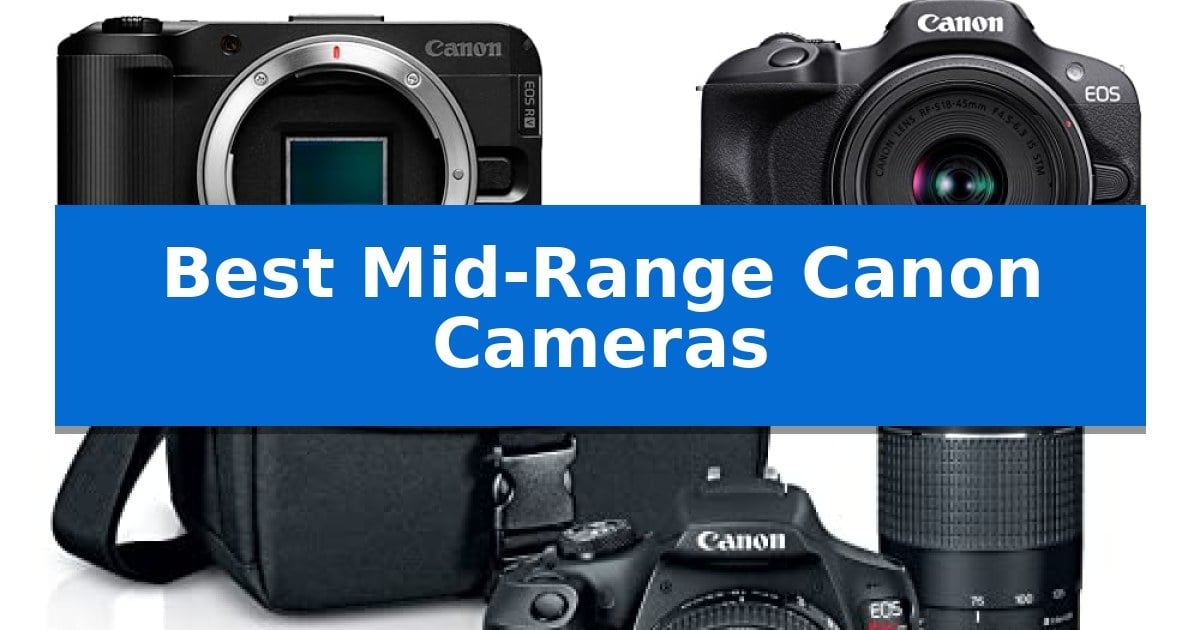
Finding the right camera involves balancing sensor performance with your specific shooting style. Whether you are upgrading from a smartphone or transitioning between systems, the Best Mid-Range Canon Cameras offer a variety of features tailored to different creative needs.
Selecting the correct model requires looking beyond megapixel counts to understand how autofocus systems, lens compatibility, and body design impact your daily workflow. This guide examines three distinct options to help you determine which camera aligns with your technical requirements and long-term goals.
You may also want to compare Best Mid-Range Cameras for the Price, Best Mid-Range Cameras for Photography, and Best Mid-Range Cameras.
Best Mid-Range Canon Cameras
Quick Comparison
| Product | Best For | Key Strength | Score |
|---|---|---|---|
| Canon EOS R50 Mirrorless Camera | Best Overall | Dedicated vertical video features including a specific tripod mount and front-facing record button. | 4.9 |
| Canon EOS R100 Mirrorless Camera | Lightweight Mirrorless Entry Point | Extremely compact and lightweight body for superior portability. | 4.8 |
| Canon EOS Rebel T7 DSLR Camera | Reliable DSLR for Beginners | Comprehensive double zoom lens kit covering a wide focal range. | 4.6 |
How We Chose
- Sensor type and resolution capabilities
- Autofocus tracking technology and subject detection
- Lens mount system and native lens compatibility
- Video recording resolution and frame rate options
- Physical dimensions and ergonomic design for portability
1 Canon EOS R50 Mirrorless Camera — Advanced Autofocus for Creators
The Canon EOS R50 Mirrorless Camera introduces a specialized design for content creators, featuring the first dedicated EOS V series body that prioritizes vertical video workflows. By integrating a Vertical Video tripod mount and a dedicated Front Record button, this camera streamlines the physical process of capturing social-media-ready content without requiring complex menu navigation.
At its core, the system utilizes a 24.2 MP APS-C CMOS Image Sensor paired with the DIGIC X Image Processor. This combination supports high-resolution recording, including 4K 59.94p (cropped) and 4K 29.97p (full-width), alongside Full-HD 119.8p for high-frame-rate creative work. The inclusion of a Slow and Fast mode provides direct control over frame rates, allowing users to adjust playback speed for cinematic effects directly in-camera.
Focus performance is driven by Dual Pixel CMOS AF II, which provides advanced subject tracking capabilities. This system is engineered to recognize and maintain focus on People, Animals, and Vehicles, with a specific Register People Priority function that helps ensure consistent tracking of specific subjects during dynamic shooting scenarios.
Designed for versatility, the camera functions as a compact tool for both vlogging and live streaming. Its physical design is optimized for handheld use, weighing approximately 2.12 pounds, which balances portability with the requirements of an interchangeable lens system. This model serves as a dedicated solution for those transitioning from mobile devices to a more robust, sensor-driven imaging platform.
Best for: Content creators and vloggers who require a compact, dedicated system for vertical video production and advanced subject tracking.
Skip if: Photographers needing full-frame sensor performance or those who require uncropped 4K recording at higher frame rates.
PROS
- Dedicated vertical video features including a specific tripod mount and front-facing record button.
- Dual Pixel CMOS AF II with intelligent subject detection for people, animals, and vehicles.
- High-frame-rate recording options including Full-HD 119.8p for smooth slow-motion playback.
- Compact APS-C form factor suitable for handheld vlogging and mobile content creation.
CONS
- 4K 59.94p recording is cropped, which may limit field-of-view options compared to full-width modes.
- Body-only configuration requires separate investment in compatible RF-S or RF lenses.
2 Canon EOS R100 Mirrorless Camera — Lightweight Mirrorless Entry Point
The Canon EOS R100 Mirrorless Camera distinguishes itself as the smallest and lightest body within the EOS R series, offering a highly portable solution for those transitioning to an interchangeable lens system. Its compact footprint is designed for mobility without sacrificing the core functionality required for high-quality stills and video capture.
At the heart of the system lies a 24.1 megapixel CMOS (APS-C) sensor paired with the DIGIC 8 image processor. This combination supports detailed image rendering and enables 4K video recording at up to 24 frames per second. For those prioritizing fluid motion, the camera also supports Full HD video at 60 fps and HD recording at up to 120 fps.
Usability is enhanced by the Dual Pixel CMOS AF system, which utilizes 143 zones to track subjects. It features dedicated human face and eye detection, alongside animal and vehicle detection capabilities, ensuring consistent focus for both photography and videography. The camera supports continuous shooting at up to 6.5 shots per second in One-Shot AF mode.
Connectivity is integrated through built-in Wi-Fi and Bluetooth, facilitating easier file management. As an entry-level mirrorless option, it provides a straightforward interface for beginners looking to experiment with natural bokeh and manual lens control while maintaining a lightweight kit for everyday use.
Best for: Beginner photographers and creators seeking a lightweight, portable mirrorless camera with interchangeable lens capabilities.
Skip if: Users requiring advanced professional features like high-frame-rate 4K video or extensive physical control dials may find this entry-level model limiting.
PROS
- Extremely compact and lightweight body for superior portability.
- Dual Pixel CMOS AF with reliable face, eye, animal, and vehicle detection.
- 24.1 megapixel APS-C sensor provides high image clarity and natural bokeh.
- Built-in Wi-Fi and Bluetooth for convenient connectivity.
CONS
- 4K video limited to 24 fps, which may not suit all creative needs.
- Entry-level feature set lacks some advanced manual controls found in higher-tier models.
3 Canon EOS Rebel T7 DSLR Camera — Reliable DSLR for Beginners
Capturing high-resolution imagery and versatile video content is the primary focus of the Canon EOS Rebel T7 DSLR Camera, which arrives as a comprehensive double zoom lens kit. By pairing a 24.1 Megapixel CMOS (APS-C) sensor with both an EF-S 18-55mm and an EF 75-300mm lens, this system provides the necessary reach for both wide-angle landscapes and distant subjects, making it a practical starting point for those building a photography kit.
The camera integrates a 9-Point AF system with AI Servo AF to assist in maintaining focus, while the optical viewfinder offers approximately 95% coverage for traditional framing. For those looking to expand their utility beyond still photography, the device supports FHD 1080p video capture and can function as a high-quality webcam when paired with the EOS Utility Webcam Beta Software on Mac or Windows systems.
Connectivity is streamlined through built-in Wi-Fi and NFC technology, allowing for efficient image transfer. The camera is designed to operate within a temperature range of 32–104°F, ensuring reliability across various environments. With a native ISO range of 100–6400, expandable to 12800, it provides the flexibility needed to adjust to different lighting conditions.
This DSLR balances manual control with accessible features, such as improved Dual Pixel CMOS AF and eye detection AF, which help simplify the process of capturing sharp portraits. While it offers a robust feature set for beginners, users should note that the optical viewfinder coverage is 95%, meaning the final image may capture slightly more area than what is seen during composition.
Best for: Beginner photographers who require a versatile, all-in-one lens kit for both close-range and telephoto shooting.
Skip if: Professional photographers or videographers who require 4K resolution or 100% viewfinder coverage for precise framing.
PROS
- Comprehensive double zoom lens kit covering a wide focal range.
- Built-in Wi-Fi and NFC for convenient file sharing.
- Versatile webcam functionality via EOS Utility software.
- High-resolution 24.1 MP sensor for detailed images.
CONS
- 95% viewfinder coverage may result in slight framing differences.
- 1080p video limit lacks 4K recording capabilities.
Best Mid-Range Canon Cameras Buying Guide
Understanding Sensor Types
The APS-C CMOS sensor is a hallmark of these mid-range models, providing a balance between image quality and body size. This sensor size offers a crop factor that can be advantageous for telephoto work, effectively extending the reach of your lenses.
Choosing between a mirrorless and DSLR system often comes down to the viewing experience. Mirrorless cameras utilize electronic viewfinders, while DSLRs rely on optical viewfinders, which provide a direct, lag-free view through the lens.
Autofocus and Subject Tracking
Modern autofocus systems, such as Dual Pixel CMOS AF, significantly improve the hit rate for moving subjects. These systems use dedicated pixels on the sensor to calculate focus, providing fast and accurate tracking for both stills and video.
Advanced features like human face and eye detection or animal and vehicle subject detection allow the camera to lock onto specific targets automatically. This reduces the need for manual focus adjustments in fast-paced shooting environments.
Lens Mount Compatibility
The RF-S lens mount is central to Canon's current mirrorless lineup, offering a wide aperture and short back-focus distance. This design allows for more compact lens constructions without sacrificing optical performance.
For those invested in legacy glass, DSLR mounts like the EF-S system provide access to a vast ecosystem of existing lenses. Compatibility should be a primary consideration if you already own a collection of glass from previous systems.
Video Capabilities
Many mid-range cameras now include 4K video recording, which provides higher detail for post-production cropping. It is important to check the frame rate options, as higher frame rates like 60 fps or 120 fps are essential for smooth slow-motion playback.
Features such as Slow and Fast mode and dedicated vertical video tripod mounts cater specifically to content creators. These tools streamline the workflow for social media platforms where vertical orientation is standard.
Portability and Ergonomics
The physical size and weight of a camera body determine how often you will carry it. A lightweight mirrorless body is often preferred for travel and street photography, while a more substantial DSLR grip may offer better stability for long-lens work.
Consider the placement of controls, such as a Front Record button, which can make a significant difference in usability during live streaming or self-recording sessions.
Frequently Asked Questions
What is the main difference between the R-series and the Rebel series?
The R-series cameras are mirrorless, featuring the RF-S mount and electronic viewfinders, while the Rebel series are DSLRs that use the EF-S mount and optical viewfinders.
Can I use my old lenses on a new mirrorless camera?
Yes, but you will likely need a mount adapter to maintain electronic communication between the lens and the camera body.
Does the sensor size affect image quality?
The APS-C sensor provides high image clarity and detail, making it a capable choice for both beginners and enthusiasts compared to smaller sensor formats.
Are these cameras suitable for professional video work?
These cameras offer features like 4K recording and advanced autofocus, which are suitable for content creation, vlogging, and live streaming.
What does Dual Pixel CMOS AF do?
It is an autofocus technology that uses pixels on the image sensor to provide fast, accurate focus tracking for both still images and video recording.
Conclusion: Our Top Pick
When selecting from the Best Mid-Range Canon Cameras, the Canon EOS R50 Mirrorless Camera stands out for its specialized features designed for modern creators. Its integration of a vertical video tripod mount and a dedicated front record button makes it a highly efficient tool for those focused on vlogging and live streaming.
While the R50 offers advanced autofocus and a compact form factor, ensure your existing lens collection is compatible with the RF-S mount or that you have the necessary adapters. For users prioritizing a lightweight, modern mirrorless experience, this model provides a robust balance of performance and creative control.