
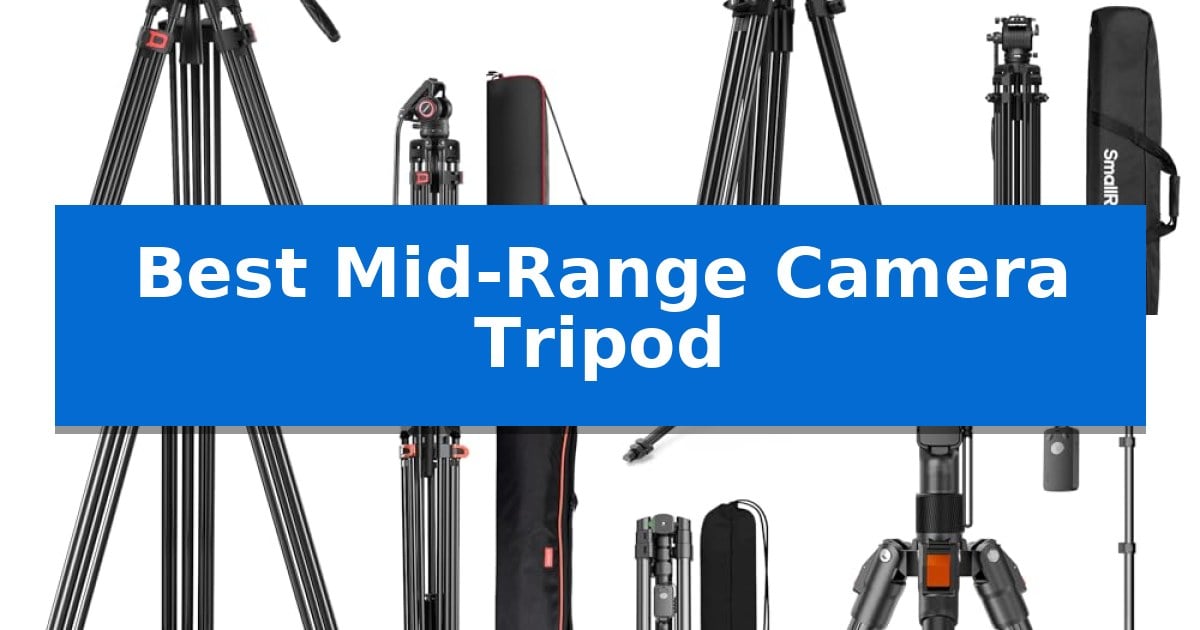
Finding the right support for your camera shouldn't require a professional studio budget. A reliable Best Mid-Range Camera Tripod provides the essential balance of structural integrity and portability, ensuring your shots remain steady whether you are capturing landscapes or filming video content.
Selecting the right model involves weighing your specific needs, such as maximum load capacity and the type of head included. We have evaluated five distinct tripods to help you navigate the options and identify the best tool for your photography or videography workflow.
You may also want to compare Best Mid-Range Camera for Wildlife Photography, Best Mid-Range Camera for Scenery and Wildlife, and Best Mid-Range Business Laptops.
Best Mid-Range Camera Tripod
Quick Comparison
| Product | Best For | Key Strength | Score |
|---|---|---|---|
| NEEWER TP74 Video Tripod | Best Overall | Smooth fluid drag pan head with friction damping for professional video movement. | 4.9 |
| SMALLRIG AD-14 Video Tripod | Compact Build for Travel Shoots | High weight capacity of 8kg (18lbs) in a portable 3.1kg frame. | 4.3 |
| COMAN FF16LS Video Tripod | Heavy Duty Stability for Filmmakers | High load capacity of 22.04 lbs supports professional camera rigs. | 4.3 |
| XXZU VCT-5499 Camera Tripod | Versatile 3-in-1 Monopod Design | Versatile 3-in-1 design functions as a tripod, monopod, or selfie stick. | 4.3 |
| K&F CONCEPT K234A0 Camera Tripod | Lightweight Option for Quick Setups | Lightweight and portable design at only 2.53lbs. | 4.8 |
How We Chose
- Stability and Weight Capacity: Evaluating the maximum load to ensure the tripod can safely support your specific camera and lens combination.
- Head Versatility: Assessing the fluid or ball head mechanisms for smooth panning, tilting, and ease of adjustment during active shooting.
- Portability and Build: Comparing folded dimensions, net weight, and material construction to determine suitability for travel versus studio use.
- Height and Adjustability: Checking the range of extension and leg locking mechanisms for quick setup and diverse shooting angles.
- Compatibility: Verifying mounting standards and quick-release plate systems to ensure seamless integration with your existing camera gear.
1 NEEWER TP74 Video Tripod — Smooth Fluid Head for Video
Achieving smooth, professional-grade camera movements requires a stable foundation, and the NEEWER 74" Video Tripod with Fluid Head provides this through its premium fluid drag pan head. This system incorporates a smooth friction damping and balancing system that supports 360° rotation and -75°/+90° tilt, allowing for precise control during video capture.
Built for demanding environments, the tripod features double tandem aluminum alloy legs that offer a max load capacity of 17.6lb/8kg. Stability is further enhanced by a mid-level spreader and nonslip rubber feet, ensuring the setup remains secure during use. The 3-section telescopic legs allow for height adjustments ranging from 34" to 74", providing versatility for various shooting angles.
The NEEWER 74" Video Tripod with Fluid Head prioritizes efficiency with a quick-release plate system compatible with both DJI RS2/RS3/RS3 PRO gimbals and Manfrotto 501PL/504PL plates. This design enables users to transition between tripod and gimbal shooting in seconds. Additionally, the 1/4" threaded hole on the head allows for the attachment of external accessories like monitors, microphones, or video lights.
For transport, the unit folds down to 36" and includes a carrying bag. While the robust aluminum construction provides durability, it is a substantial piece of equipment, weighing approximately 10.9 lbs. The inclusion of a bubble level and a telescopic handle ensures that operators can maintain straight horizons and smooth panning motions throughout their production.
Best for: Videographers and content creators who need a heavy-duty, stable tripod with a fluid head for smooth panning and tilting movements.
Skip if: Travelers or photographers who require an ultra-lightweight, compact tripod for hiking or long-distance portability.
PROS
- Smooth fluid drag pan head with friction damping for professional video movement.
- High load capacity of 17.6lb/8kg suitable for heavy DSLR cameras and camcorders.
- Versatile quick-release system compatible with popular gimbals and industry-standard plates.
- Adjustable height range from 34" to 74" for diverse shooting scenarios.
CONS
- Substantial weight of 10.9 lbs makes it less ideal for frequent long-distance travel.
2 SMALLRIG AD-14 Video Tripod — Compact Build for Travel Shoots
Achieving consistent camera stability during location shoots requires a balance between structural integrity and portability. The SMALLRIG AD-14 Video Tripod addresses this by utilizing a 2-2-1 aluminum alloy leg layout, which provides a robust foundation capable of supporting a maximum load of 8kg (18lbs) while maintaining a manageable weight of 3.1kg (6.8lbs).
The tripod features a professional fluid head equipped with infinite tilt drag control, allowing for precise adjustments across a +85° to -78° tilt range. This system supports the 501PL quick-release plate standard, facilitating rapid transitions between setups. For uneven terrain, the legs are engineered with a horseshoe-shaped ball head design that includes an integrated anti-drop feature, ensuring stability on gravel or irregular surfaces.
Designed for travel, the unit collapses to a folded height of 88cm (34 inches), allowing it to fit into standard overhead compartments. Users can adjust the working height from 85cm to 186cm (73 inches), utilizing the 65mm bowl mount for quick leveling. The frame also includes two 1/4"-20 mounts for attaching external accessories such as microphones or monitors.
This kit provides a comprehensive solution for videographers needing a reliable, portable platform. By combining a high-capacity fluid head with a durable, adjustable leg system, it offers a versatile tool for various field environments.
Best for: Videographers who require a portable yet heavy-duty support system for location shoots and travel.
Skip if: Users seeking an ultra-lightweight carbon fiber tripod for long-distance hiking or those requiring a smaller footprint than 88cm when folded.
PROS
- High weight capacity of 8kg (18lbs) in a portable 3.1kg frame.
- Infinite tilt drag control for smooth camera movements.
- Horseshoe-shaped leg feet provide stability on uneven terrain.
- Integrated 1/4"-20 accessory mounts for monitors or microphones.
CONS
- Folded length of 88cm may be bulky for smaller travel bags.
- Aluminum alloy construction is heavier than carbon fiber alternatives.
3 COMAN FF16LS Video Tripod — Heavy Duty Stability for Filmmakers
Achieving stable, professional-grade camera support requires a foundation that balances structural integrity with operational precision. The COMAN FF16LS Video Tripod addresses this through a high-strength aluminum alloy dual-tube construction, providing a robust base capable of supporting a maximum load of 22.04 lbs. Designed for filmmakers who require reliable performance, its 60mm bowl-shaped base and mid-level spreaders ensure that heavy camera rigs remain secure during operation.
At the heart of this system is the Q6 fluid head, which facilitates smooth 360° panning and a tilt range of -75° to +90°. The integration of a built-in damping and dynamic balancing system allows for controlled, fluid movements, essential for capturing professional video sequences. The inclusion of a one-touch quick release plate, compatible with both 1/4” and 3/8” screws, ensures rapid transitions between handheld and tripod-mounted shooting.
Usability is enhanced by an innovative flip-lock leg system, which enables quick height adjustments without the need for twisting mechanisms. Despite its heavy-duty classification, the tripod is engineered to maintain a functional profile for vlogging and field production. Safety is prioritized through a dedicated release button that prevents accidental equipment detachment, providing peace of mind when mounting expensive DSLRs or camcorders.
This system serves as a comprehensive solution for creators needing a tall, stable platform that does not sacrifice ease of use. By combining durable materials with precise fluid control, it offers a balanced approach to mid-range production requirements.
Best for: Filmmakers and content creators requiring a stable, heavy-duty tripod with fluid head control for DSLRs and camcorders.
Skip if: Users seeking an ultra-lightweight, compact travel tripod for hiking or minimal gear setups may find the robust, dual-tube design too bulky for their needs.
PROS
- High load capacity of 22.04 lbs supports professional camera rigs.
- Fluid head with dynamic balancing enables smooth panning and tilting.
- Dual-tube aluminum construction provides exceptional structural stability.
- Quick-release plate compatibility with 1/4” and 3/8” screws fits most cameras.
CONS
- Heavy-duty build results in a larger footprint compared to lightweight travel tripods.
4 XXZU VCT-5499 Camera Tripod — Versatile 3-in-1 Monopod Design
Achieving stable, versatile framing for diverse shooting environments requires equipment that adapts to the terrain rather than forcing the photographer to compensate. The XXZU VCT-5499 Camera Tripod distinguishes itself with a 3-in-1 detachable center column that transforms into a monopod or selfie stick, providing a flexible solution for travelers and content creators who need to minimize gear weight while maintaining functionality.
Engineered from aluminum alloy, this tripod features thickened tubes and anti-slip rubber feet to provide a secure base for DSLR cameras, smartphones, and accessories. The structure supports a maximum load of 17.64lb in a vertical orientation, while the 360° ball head allows for rapid switching between landscape and portrait orientations without repositioning the entire stand. Integrated level indicators on both the head and column assist in achieving precise alignment for consistent framing.
For challenging outdoor conditions, the legs offer 3-level angle adjustment, enabling the tripod to spread horizontally for a minimum height of 15.35 inches. This independent leg adjustment ensures stability on uneven surfaces like rocky trails or stairs. When extra security is required, a bottom hook allows for the attachment of counterweights to further reduce vibration.
Portability is a core design focus, as the unit folds down to 14.17 inches and weighs approximately 2.18 lbs. It includes a dedicated phone holder and a built-in remote control with a 10m range, simplifying operation for group shots or vlogging. An additional 1/4-inch screw hole is provided for mounting external accessories such as microphones or LED lights, making it a comprehensive kit for mobile production.
Best for: Travelers and outdoor photographers who require a lightweight, multi-functional support system that converts easily between a tripod and a monopod.
Skip if: Professional photographers requiring heavy-duty support for large telephoto lenses or cinema rigs that exceed the 17.64lb vertical load capacity.
PROS
- Versatile 3-in-1 design functions as a tripod, monopod, or selfie stick.
- Independent 3-level leg adjustment provides stability on uneven terrain.
- Compact and lightweight construction folds to 14.17 inches for easy transport.
- Integrated 360° ball head allows for quick orientation changes.
CONS
- Weight capacity decreases to 6.61lb when the head is tilted at a 45° angle.
5 K&F CONCEPT K234A0 Camera Tripod — Lightweight Option for Quick Setups
Achieving stable camera placement while maintaining portability is a priority for photographers who need to transition quickly between locations. The K&F CONCEPT K234A0 Camera Tripod addresses this by offering a lightweight aluminum construction that weighs just 2.53lbs, making it a practical choice for travel and field work.
This tripod features a 360-degree ball head capable of supporting up to 17.6lbs, which provides the flexibility required for precise landscape panning or adjusting camera angles for vlogging. The inclusion of a 360-degree panning dial allows for controlled movement, while the standard 1/4-inch thread ensures compatibility with most DSLR cameras, projectors, and telescopes.
Efficiency in the field is supported by the quick flip leg lock system, designed to allow for rapid height adjustments with one hand. The tripod can extend from a minimum height of 20.4 inches up to 64.1 inches, and it collapses down to 15.5 inches for storage in the included carrying bag.
For specialized shooting requirements, the center column can be inverted, enabling low-angle photography or unique perspectives that standard setups might not accommodate. The design also supports Arca-Swiss quick-release plates, simplifying the process of mounting and removing equipment during active shooting sessions.
Best for: Travel photographers and vloggers who require a lightweight, versatile tripod that can be set up and adjusted quickly.
Skip if: Users who require a heavy-duty, professional-grade tripod for extremely heavy cinema rigs or those who prioritize maximum stability over portability.
PROS
- Lightweight and portable design at only 2.53lbs.
- 360-degree ball head supports up to 17.6lbs.
- Quick flip leg locks for fast, one-handed height adjustments.
- Versatile center column allows for inverted, low-angle shooting.
CONS
- Lightweight aluminum build may be less stable than heavier, professional-grade alternatives in high-wind conditions.
Best Mid-Range Camera Tripod Buying Guide
Understanding Load Capacity
The maximum load capacity is the most critical specification for any tripod. It dictates the weight of the camera and lens setup the tripod can safely support without compromising stability or risking damage to your equipment.
Always choose a tripod with a load rating that exceeds the total weight of your heaviest camera body and lens combination. This provides a safety margin, ensuring that even in windy conditions, your gear remains secure.
Fluid Head vs. Ball Head
The head type significantly impacts how you operate your camera. A fluid head is designed for videography, offering damped movement for smooth, cinematic pans and tilts.
Conversely, a ball head is generally preferred for still photography. It allows for rapid adjustments and locking, making it ideal for quick framing changes when you need to move between portrait and landscape orientations.
Material and Durability
Most mid-range tripods utilize aluminum alloy construction. This material provides a robust, rigid frame that resists flexing, which is essential for long-exposure photography or steady video footage.
While aluminum is heavier than carbon fiber, it remains the standard for durability at this price point. Look for features like nonslip rubber feet or mid-level spreaders to further enhance stability on uneven surfaces.
Portability for Travel
If you frequently shoot on location, the folded height and net weight are vital. A tripod that collapses to under 16 inches is often easier to pack in a standard backpack or carry-on luggage.
Consider models that offer quick-flip leg locks or telescopic sections, as these allow for rapid deployment. A balance between a lightweight build and a sturdy frame is the hallmark of a great travel tripod.
Compatibility and Mounting
Ensure the tripod features a standard 1/4-inch or 3/8-inch mounting thread. This ensures compatibility with almost all modern DSLR and mirrorless cameras.
Many modern tripods also include Arca-Swiss compatible quick-release plates or specific systems for gimbals. Checking these details beforehand prevents frustration when you need to switch between handheld and tripod shooting.
Frequently Asked Questions
What is the main advantage of a fluid head?
A fluid head provides consistent resistance, which allows for smooth, jerk-free pans and tilts, essential for high-quality video production.
Can I use a video tripod for still photography?
Yes, you can. While video tripods are optimized for motion, they provide excellent stability for still photography, though they may be heavier than dedicated photo tripods.
How do I know if a tripod is stable enough for my camera?
Check the manufacturer's maximum load rating. A good rule of thumb is to ensure the tripod's rating is at least 1.5 to 2 times the weight of your camera and lens.
What does a center column hook do?
A hook on the center column allows you to hang a weight, such as your camera bag, to lower the center of gravity and increase stability in windy conditions.
Are aluminum tripods better than carbon fiber?
Aluminum is generally more affordable and highly durable, though heavier. Carbon fiber is lighter and absorbs vibrations better, but it typically comes at a higher price point.
Conclusion: Our Top Pick
For those seeking the best balance of stability, professional-grade movement, and build quality, the NEEWER TP74 Video Tripod stands out as the top choice. Its robust aluminum construction and fluid drag system provide the reliability needed for both photography and videography.
While other options offer specific benefits like extreme portability or 3-in-1 versatility, the NEEWER TP74 delivers the most consistent performance for a wide variety of shooting scenarios. It is a dependable foundation for any creator looking to upgrade their gear without overspending.