
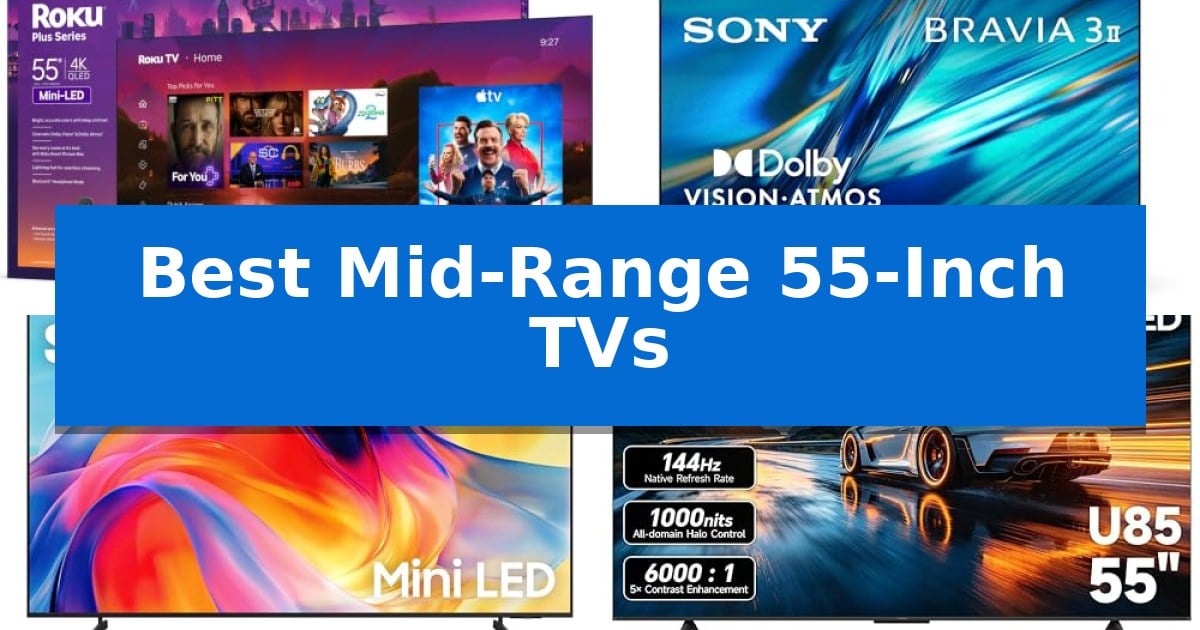
Finding the right screen for your living room requires balancing advanced display technology with practical daily usability. The market for Best Mid-Range 55-Inch TVs has evolved significantly, offering premium features like Mini-LED and high-refresh-rate gaming panels at more accessible price points than ever before.
Whether you are prioritizing a seamless streaming interface, competitive gaming performance, or vibrant color accuracy for cinematic viewing, selecting the right model depends on how you use your display. We have analyzed the latest 2026 releases to help you navigate these options and identify which television best aligns with your specific entertainment needs.
You may also want to compare Best Mid-Range 55-Inch TV, Best Mid-Range 55-Inch 4K TV, and Best Mid-Range 50-Inch TV.
Best Mid-Range 55-Inch TVs
Quick Comparison
| Product | Best For | Key Strength | Score |
|---|---|---|---|
| Roku Plus Series Smart TV | Best Overall | Mini-LED and QLED technology for improved contrast and color | 4.9 |
| Sony BRAVIA 3 II LED Smart TV | Best for PlayStation 5 Gaming | PS5-exclusive features like Auto HDR Tone Mapping and Auto Genre Picture Mode. | 4.8 |
| Samsung M70H Series Mini LED TV | Best for Vibrant Color Accuracy | Mini LED Processor 4K for superior contrast and brightness. | 4.8 |
| iFFALCON U85 MiniLED Smart TV | Best for High-Refresh Gaming | Native 144Hz panel with VRR support up to 240Hz for fluid motion. | 4.7 |
| Amazon Ember 4-Series Smart TV | Best Value for Alexa Users | Omnisense technology for automatic display wake-up. | 4.3 |
How We Chose
- Display technology and panel type, specifically focusing on Mini-LED and QLED implementations for contrast and brightness.
- Gaming-centric specifications, including refresh rates, HDMI 2.1 connectivity, and support for variable refresh rate (VRR) technologies.
- Smart platform usability, assessing the intuitiveness of the interface and the breadth of available streaming applications.
- Audio-visual standards support, such as Dolby Vision and Dolby Atmos, which define the immersive quality of the viewing experience.
- Value-added features, including voice control integration, specialized picture modes, and ease of setup for various home environments.
1 Roku Plus Series Smart TV — Best for Simplified Streaming
The Roku Plus Series Smart TV streamlines home entertainment by integrating a Mini-LED and QLED display system that balances sharp contrast with vibrant color reproduction. Designed for users who prioritize ease of use, this 55-inch model eliminates complex menu navigation in favor of the intuitive Roku interface.
Beyond its display capabilities, the television features Dolby Vision and Dolby Atmos support to enhance cinematic content. The Roku Smart Picture Max technology further simplifies the viewing experience by automatically adjusting settings based on the content being displayed, removing the need for manual calibration.
Practicality is central to the design, evidenced by the enhanced voice remote. This accessory includes personal shortcuts for favorite applications and a built-in remote finder button on the side of the TV chassis to prevent loss. For private listening, the Bluetooth Headphone Mode allows users to stream audio directly to wireless headphones.
The integration of the Sports Zone provides a centralized hub for live scores, highlights, and game start reminders, specifically catering to sports viewers. With its combination of advanced display hardware and a simplified software ecosystem, this model offers a cohesive solution for those seeking a straightforward, high-performance viewing experience.
Best for: Users seeking a high-contrast Mini-LED display paired with a simplified, user-friendly streaming interface.
Skip if: Viewers requiring advanced gaming-specific features like high-refresh-rate VRR or those who prefer a non-Roku smart ecosystem.
PROS
- Mini-LED and QLED technology for improved contrast and color
- Roku Smart Picture Max for automatic image optimization
- Enhanced voice remote with integrated remote finder
- Bluetooth Headphone Mode for private audio listening
CONS
- Roku-exclusive interface may not suit users preferring other smart platforms
2 Sony BRAVIA 3 II LED Smart TV — Best for PlayStation 5 Gaming
Achieving a high-performance home theater experience often hinges on how well your hardware integrates with your existing devices. The Sony 55 Inch BRAVIA 3 II LED Smart TV distinguishes itself through deep integration with the PlayStation 5, offering specialized features like Auto HDR Tone Mapping and Auto Genre Picture Mode that automatically adjust settings for gaming and streaming.
Beyond gaming, the display utilizes the XR Processor with AI scene recognition to manage color, contrast, and clarity. The inclusion of XR Triluminos Pro technology enables the reproduction of over a billion colors, while XR Clear Image works to reduce noise and restore detail in various content types. For audio, the unit features X-Balanced Speakers and supports Dolby Atmos and DTS:X for immersive sound.
The television is built on the Google TV platform, which now incorporates Gemini for natural language interaction, allowing users to search for content or control smart home devices via voice. The physical design features a Flush Surface and a minimal bezel, intended to keep the focus on the screen rather than the hardware.
Connectivity for high-performance setups is provided by 4x HDMI 2.1 ports, supporting 4K/120Hz, VRR, and ALLM for responsive gaming. Additionally, the package includes access to SONY PICTURES CORE with IMAX Enhanced content, providing five movie credits and a 12-month subscription to a library of classic films.
Best for: Gamers who own a PlayStation 5 and want a display that automatically optimizes picture settings for console gaming.
Skip if: Users who prioritize a specific panel technology like OLED for deeper blacks or those who do not require advanced gaming-specific HDMI 2.1 features.
PROS
- PS5-exclusive features like Auto HDR Tone Mapping and Auto Genre Picture Mode.
- Four HDMI 2.1 ports supporting 4K/120Hz, VRR, and ALLM for high-performance gaming.
- AI-driven picture processing via the XR Processor for real-time clarity and color optimization.
- Integrated Google TV with Gemini for advanced voice control and content discovery.
CONS
- Limited to LED display technology, which may not match the contrast ratios found in OLED alternatives.
3 Samsung M70H Series Mini LED TV — Best for Vibrant Color Accuracy
The Samsung M70H Series Mini LED TV distinguishes itself through its advanced Mini LED Processor 4K, which utilizes precise dimming to achieve deep contrast and bright highlights. This 55-inch display is engineered to enhance visual depth, ensuring that details remain sharp whether you are viewing high-definition content or fast-paced action sequences.
Performance is further bolstered by the Motion Xcelerator + DLG 120Hz technology, which optimizes the refresh rate to maintain fluidity during sports and gaming. For those who prioritize color accuracy, the Pure Color Spectrum feature leverages advanced color technology to produce one billion true-to-life colors, while the Color Booster tool allows for manual intensity adjustments to make on-screen imagery more vivid.
Designed for versatility, the television includes a dedicated Gaming Hub that centralizes access to consoles, cloud services, and apps. Sports enthusiasts benefit from the specialized Soccer Mode, which applies specific settings to sharpen motion by 40% and enhance green tones by 30% for a more realistic turf appearance during matches.
The Samsung M70H Series Mini LED TV also provides extensive entertainment options through Endless Free Content, granting access to over 2,700 streaming choices and 750 subscription-free channels via Samsung TV Plus. This integrated ecosystem ensures a wide variety of news, sports, and movies are available immediately upon setup without requiring additional subscriptions.
Best for: Users who prioritize vibrant color accuracy and specialized motion optimization for gaming and sports.
Skip if: Viewers seeking a basic, entry-level television who do not require advanced Mini LED dimming or high-refresh-rate gaming features.
PROS
- Mini LED Processor 4K for superior contrast and brightness.
- Motion Xcelerator + DLG 120Hz for fluid motion in sports and gaming.
- Pure Color Spectrum delivering one billion colors.
- Integrated Gaming Hub for centralized console and cloud access.
CONS
- Premium feature set may exceed the needs of casual viewers.
- Advanced processing requirements necessitate a stable power and signal environment.
4 iFFALCON U85 MiniLED Smart TV — Best for High-Refresh Gaming
Achieving a fluid gaming experience requires more than just a high-resolution display; it demands a panel capable of keeping pace with rapid frame rates. The iFFALCON 55" 4K MiniLED Smart TV addresses this by integrating a native 144Hz panel that supports variable refresh rates up to 240Hz, ensuring motion remains crisp during intense gameplay.
Beyond its gaming credentials, the iFFALCON 55" 4K MiniLED Smart TV utilizes MiniLED technology to deliver up to 1000 nits of peak brightness and a 6,000:1 contrast ratio. The inclusion of Dolby Vision IQ allows the display to automatically calibrate based on ambient room lighting, while IMAX Enhanced certification provides a standardized visual and audio profile for compatible content.
Connectivity is a primary focus, featuring four HDMI 2.1 ports. Two of these ports are dedicated to high-performance gaming, supporting 4K at 144Hz, while the remaining two accommodate streaming devices or Blu-ray players at 4K/60Hz. The unit also includes Auto Low Latency Mode (ALLM) to streamline the transition into game-ready settings.
For audio, the system employs a 2.1-channel configuration with 50W output, featuring Dolby Atmos passthrough and DTS Virtual:X. The integration of Google TV provides access to a wide array of streaming applications, while built-in hotel mode and IP/IR control options offer versatility for commercial or hospitality environments.
Best for: Competitive gamers and users requiring a high-refresh display with versatile commercial control options.
Skip if: Users who prioritize a slim, minimalist aesthetic may find the 10.8-inch depth requirement challenging for specific wall-mount or tight-space configurations.
PROS
- Native 144Hz panel with VRR support up to 240Hz for fluid motion.
- Four HDMI 2.1 ports providing extensive connectivity for multiple consoles and PCs.
- MiniLED local dimming for high-contrast HDR performance.
- Integrated hotel mode and IP/IR control for professional or commercial installations.
CONS
- Substantial depth of 10.8 inches may limit placement options in smaller rooms.
5 Amazon Ember 4-Series Smart TV — Best Value for Alexa Users
Upgrading your home entertainment setup often centers on finding a display that balances visual fidelity with smart integration. The Amazon Ember 4-Series Smart TV addresses this by combining 4K Ultra HD resolution with HDR10+ support, ensuring that content appears with improved contrast and crisp detail. Its design is centered around the latest Fire TV experience, which prioritizes quick navigation through personalized recommendations and pinned applications.
Performance is driven by a new quad-core processor and Wi-Fi 6 support, which work together to ensure that apps load quickly and streaming remains smooth. A standout inclusion is the custom Omnisense technology, which utilizes built-in sensors to wake the display automatically when you enter the room, allowing for immediate access to artwork or your preferred media.
Beyond standard streaming, this model expands its utility through Amazon Luna and Xbox Game Pass integration. By allowing users to stream premium games directly without a console—using phones as controllers—it serves as a versatile hub for both media consumption and casual gaming. Connectivity is further supported by four HDMI inputs and AirPlay compatibility, making it straightforward to integrate soundbars, consoles, and mobile devices into your existing ecosystem.
The Alexa Voice Remote Enhanced provides a direct interface for managing the TV and connected smart home devices. By pressing the voice button, users can search across apps or control home automation naturally, reducing the time spent navigating complex menus. This model is designed for those who want a streamlined, responsive interface that minimizes scrolling and maximizes time spent watching.
Best for: Users deeply integrated into the Amazon ecosystem who want a responsive smart TV with built-in cloud gaming capabilities and voice-controlled automation.
Skip if: Viewers requiring high-end gaming features like 120Hz refresh rates or advanced VRR support, as this model focuses on smart streaming and casual play.
PROS
- Omnisense technology for automatic display wake-up.
- Wi-Fi 6 support for faster app loading and smooth streaming.
- Integrated cloud gaming via Amazon Luna and Xbox Game Pass.
- Four HDMI inputs for flexible device connectivity.
CONS
- Subscription fees may apply for access to certain content libraries.
- Limited to standard 60Hz refresh rate for gaming applications.
Best Mid-Range 55-Inch TVs Buying Guide
Understanding Display Technology
Modern mid-range televisions often utilize Mini-LED and QLED technologies to enhance picture quality. Mini-LED backlighting allows for more precise control over local dimming zones, which results in deeper blacks and brighter highlights compared to traditional LED panels.
QLED technology uses quantum dots to produce a wider color gamut, ensuring that colors remain vibrant even at higher brightness levels. When shopping, consider how these technologies impact your specific viewing environment, particularly in rooms with significant ambient light.
Gaming Performance and Refresh Rates
For gamers, the refresh rate and input latency are critical factors. A 120Hz or 144Hz refresh rate provides smoother motion, which is essential for fast-paced action games and sports. Look for models that support HDMI 2.1, as this standard enables high-bandwidth features like 4K at 120Hz.
Additionally, features such as Variable Refresh Rate (VRR) and Auto Low Latency Mode (ALLM) help synchronize the TV with your console or PC, reducing screen tearing and minimizing input lag for a more responsive experience.
Smart Platform Integration
The smart TV operating system dictates how you interact with your content. Platforms like Roku TV and Google TV offer distinct advantages, such as simplified home screens, personalized recommendations, and extensive app libraries.
Consider how well the TV integrates with your existing smart home ecosystem. Voice control via Alexa or Google Assistant can streamline navigation, allowing you to search for shows or control connected devices without needing to use a physical remote.
Audio and Cinematic Standards
Visual quality is only half of the cinematic experience. Support for Dolby Vision and Dolby Atmos ensures that you are getting the best possible picture and sound from compatible streaming services and media.
While many mid-range TVs have capable built-in speakers, those seeking a true home theater experience should look for models that support eARC (Enhanced Audio Return Channel), which allows for high-quality, uncompressed audio transmission to an external soundbar or receiver.
Connectivity and Versatility
The number and type of ports available on your TV determine how many devices you can connect simultaneously. A robust selection of HDMI 2.1 inputs is vital for users with multiple consoles, a streaming box, and a soundbar.
Beyond physical ports, consider wireless connectivity options like Wi-Fi 6, which provides a more stable connection for high-bitrate 4K streaming. Some models also offer specialized modes for hospitality or office use, providing added versatility for non-traditional setups.
Frequently Asked Questions
What is the main benefit of Mini-LED over standard LED?
Mini-LED technology uses smaller, more numerous light sources behind the screen, allowing for more precise local dimming. This results in better contrast, deeper blacks, and higher peak brightness.
Do I need HDMI 2.1 for casual viewing?
HDMI 2.1 is primarily beneficial for gamers who want to take advantage of 4K at 120Hz or higher refresh rates. For standard movie and TV show streaming, current HDMI standards are sufficient.
How do I know if a TV supports my smart home devices?
Check the specifications for compatibility with platforms like Alexa, Google Home, or Apple HomeKit. Most modern smart TVs clearly list which voice assistants and ecosystems they support.
Can I use my own headphones with these TVs?
Many modern smart TVs include Bluetooth support, allowing you to connect wireless headphones for private listening, which is a great feature for late-night viewing.
Is a 144Hz refresh rate necessary for sports?
While 144Hz is excellent for gaming, a 120Hz panel is generally more than enough to handle fast-moving sports content without noticeable blur, provided the TV has good motion processing.
Conclusion: Our Top Pick
Selecting the right television involves prioritizing the features that matter most to your daily routine, whether that is high-performance gaming or simple, intuitive streaming. After reviewing the current market, the Roku Plus Series Smart TV stands out as our top recommendation for most users due to its combination of Mini-LED picture quality and the exceptionally user-friendly Roku interface.
This model excels by removing the complexity often associated with smart TVs, offering a streamlined experience that lets you get straight to your content. While other models in this list may offer more specialized gaming or color-accuracy features, the Roku Plus Series provides the most balanced and reliable performance for a wide range of home entertainment needs.