
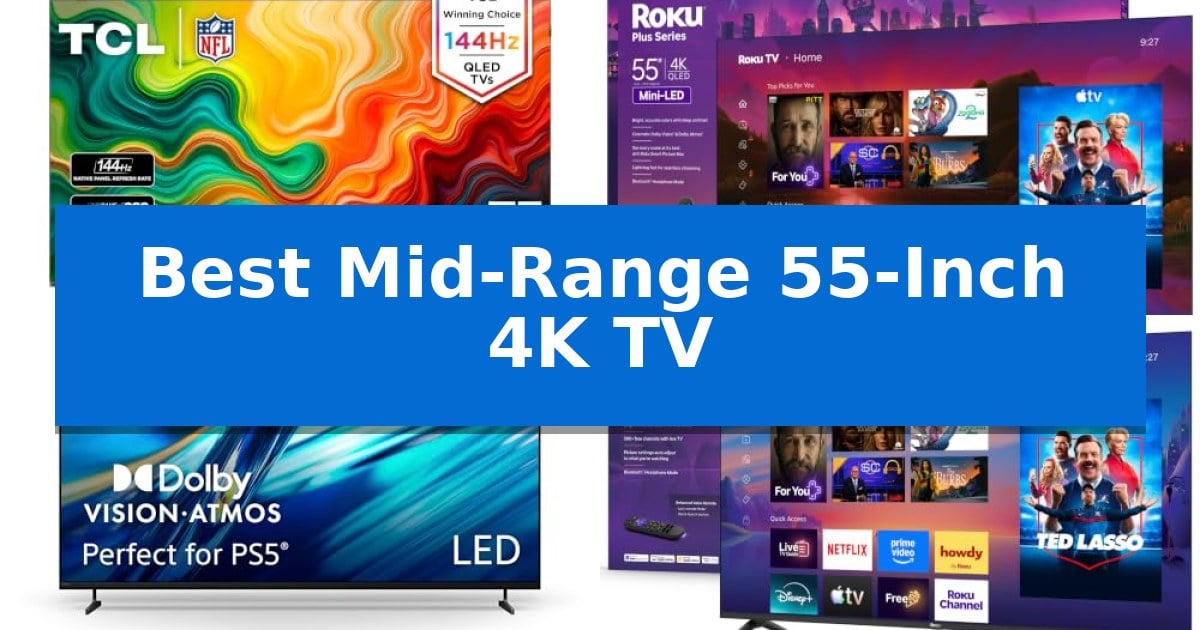
Finding the right balance between advanced features and price is the primary challenge when shopping for a new display. A Best Mid-Range 55-Inch 4K TV should offer enough versatility to handle modern gaming consoles, high-definition streaming, and cinematic content without requiring a premium investment.
Our analysis focuses on identifying which models provide the most significant upgrades in panel technology and processing power. We examine how these televisions integrate into your existing entertainment setup, ensuring you get the best possible visual experience for your specific viewing environment.
You may also want to compare Best Mid-Range 50-Inch TV, Best Mid-Range 50-59 Inch TV, and Best Mid-Range 43-Inch TVs.
Best Mid-Range 55-Inch 4K TV
Quick Comparison
| Product | Best For | Key Strength | Score |
|---|---|---|---|
| TCL T7 Series 4K Smart TV | Best Overall | Native 120Hz refresh rate for smooth motion. | 4.9 |
| Roku Plus Series 4K Smart TV | Simple Interface With Mini-LED | Mini-LED and QLED technology for improved contrast and color. | 4.3 |
| Sony BRAVIA 3 II 4K TV | Optimized For PlayStation 5 | Dedicated PS5 features like Auto HDR Tone Mapping and Auto Genre Picture Mode. | 4.5 |
| Roku Select Series 4K TV | Accessible QLED Picture Quality | QLED screen with HDR10 for vibrant and accurate color performance. | 4.5 |
| Amazon Ember 4-Series Smart TV | Streamlined Alexa Integration | Omnisense technology provides automated wake-up functionality. | 4.9 |
How We Chose
- Panel technology and color accuracy for consistent image quality.
- Refresh rate and motion handling for gaming and sports performance.
- Smart platform responsiveness and ease of content discovery.
- Connectivity options including HDMI 2.1 and eARC support.
- Build quality and design considerations for home integration.
1 TCL T7 Series 4K Smart TV — High Refresh Rate Gaming Value
Achieving a fluid, high-refresh-rate experience for both competitive gaming and fast-paced sports is the primary focus of the TCL T7 Series 4K Smart TV. This 55-inch display distinguishes itself with a native 120Hz refresh rate, ensuring motion remains crisp and fluid without the blur often found on standard 60Hz panels.
Under the hood, the TCL T7 Series 4K Smart TV utilizes the TCL AIPQ Pro Processor to manage color, contrast, and clarity. The integration of QLED Quantum Dot Technology allows the screen to cover nearly the entire DCI-P3 color space, providing vibrant, accurate color reproduction. For high-dynamic-range content, the display supports HDR PRO+, including Dolby Vision, HDR10+, and HLG, which work to enhance fine details in both bright and dark scenes.
Gamers and media enthusiasts benefit from the inclusion of Game Accelerator 240 and VRR (Variable Refresh Rate) support, which help maintain visual stability during intense sequences. The unit is equipped with four HDMI inputs, including one with eARC, facilitating high-speed connections for modern consoles and external audio systems. Spatial audio is handled through Dolby Atmos processing, creating an immersive soundstage for movies and games.
The television operates on the Google TV platform, centralizing streaming apps and live channels. Connectivity is supported by high-speed Wi-Fi 5, while hands-free voice control is available through compatibility with Amazon Alexa, Google Assistant, and Apple HomeKit. Additionally, users can utilize Apple AirPlay 2 for seamless media sharing from Apple devices, rounding out a versatile feature set for a mid-range home entertainment setup.
Best for: Gamers and sports fans who prioritize a native 120Hz refresh rate and wide color gamut for fast-motion content.
Skip if: Users who require advanced local dimming zones for deep blacks or those who prefer a more premium build material than the standard chassis provided.
PROS
- Native 120Hz refresh rate for smooth motion.
- QLED Quantum Dot Technology for vibrant color accuracy.
- Comprehensive HDR support including Dolby Vision and HDR10+.
- Game Accelerator 240 and VRR for optimized gaming performance.
CONS
- Wi-Fi 5 connectivity may be slower than newer Wi-Fi 6 standards.
- Standard motion enhancement relies on MEMC, which may not suit all viewing preferences.
2 Roku Plus Series 4K Smart TV — Simple Interface With Mini-LED
Achieving a balanced home theater experience often hinges on finding a display that integrates smart functionality with high-end panel technology. The Roku 55-Inch Plus Series Smart TV addresses this by combining Mini-LED and QLED backlighting, which works to deliver sharp contrast and vibrant color reproduction for a variety of media.
Beyond its display capabilities, this television is built around the Roku experience, prioritizing a simplified interface that minimizes navigation time. Users can access live TV, news, and streaming services through a centralized home screen, while the Roku Smart Picture Max feature automatically adjusts settings to optimize the image based on the content being viewed.
Practicality is integrated into the hardware design through the enhanced voice remote. This accessory includes personal shortcuts for favorite applications and a remote finder button on the side of the television to help locate it if misplaced. For those who prefer private listening, the Bluetooth Headphone Mode allows for wireless audio output, ensuring that late-night viewing does not disturb others.
The Sports Zone feature provides a dedicated space to track live scores, set game start reminders, and view highlights, catering to viewers who prioritize live sports. With its 4K resolution and support for Dolby Vision and Dolby Atmos, the unit is designed to provide a cohesive cinematic and streaming experience without requiring manual calibration for every source.
Best for: Users who prioritize a straightforward, integrated streaming interface and want the contrast benefits of Mini-LED technology in a mid-range package.
Skip if: Viewers who require advanced professional-grade gaming features like high-refresh-rate VRR or those who prefer a different smart ecosystem platform.
PROS
- Mini-LED and QLED technology for improved contrast and color.
- Roku Smart Picture Max for automatic image optimization.
- Bluetooth Headphone Mode for private listening.
- Enhanced voice remote with integrated remote finder.
CONS
- Limited to the Roku ecosystem for smart features.
- No specific gaming-focused refresh rate or VRR specifications provided.
3 Sony BRAVIA 3 II 4K TV — Optimized For PlayStation 5
Achieving a cinematic experience at home often hinges on the integration between your display and your console. The Sony 55 Inch BRAVIA 3 II LED 4K HDR Smart Google TV is engineered with specific hardware optimizations for the PlayStation 5, including Auto HDR Tone Mapping and Auto Genre Picture Mode, which automatically adjust settings to prioritize visual fidelity during gaming sessions.
Beyond its gaming capabilities, the Sony BRAVIA 3 II 4K TV utilizes an advanced XR Processor that employs AI scene recognition to refine color, contrast, and clarity. The inclusion of XR Triluminos Pro technology allows the panel to reproduce over a billion colors, while XR Clear Image works to restore detail and minimize noise in various types of content.
The display features a 120Hz refresh rate, supported by Motionflow XR to maintain smoothness during fast-paced action or sports. For audio, the television integrates Dolby Vision and Dolby Atmos support, complemented by X-Balanced Speakers designed to reduce distortion and provide clearer sound resolution.
Design and usability are central to this model, which features a minimalist, flush-surface aesthetic with an almost invisible bezel. Users can navigate content via Google TV with Gemini, which provides a centralized hub for streaming services and smart home control, while the included SONY PICTURES CORE access offers a library of IMAX Enhanced content.
Best for: Gamers who own a PlayStation 5 and want a display that automatically optimizes picture settings for high-performance gaming.
Skip if: Users who require a smaller or larger screen size, as this model is specifically a 55-inch unit.
PROS
- Dedicated PS5 features like Auto HDR Tone Mapping and Auto Genre Picture Mode.
- 120Hz refresh rate with Motionflow XR for smooth motion handling.
- AI-powered XR Processor for real-time picture optimization.
- Comprehensive streaming access via Google TV and SONY PICTURES CORE.
CONS
- Fixed 55-inch form factor may not suit all room sizes or viewing distances.
4 Roku Select Series 4K TV — Accessible QLED Picture Quality
The Roku Select Series 4K TV centers its design on a frameless aesthetic that prioritizes the screen, allowing it to integrate into modern living spaces without visual clutter. This 55-inch display utilizes QLED technology paired with HDR10 to deliver accurate color reproduction and brightness, supported by Roku Smart Picture which automatically optimizes incoming signals to match the content being viewed.
Navigation and content discovery are handled through the integrated Roku platform, which features a simplified home screen and fast Wi-Fi connectivity for quick app launches. The system includes personalized picks and a centralized search function, reducing the time spent browsing for shows or movies across various streaming services.
Practical usability is enhanced by the enhanced voice remote, which includes a lost remote finder feature to help locate it when misplaced. For audio, the television is engineered for clear speech and higher volume output, while the inclusion of Bluetooth Headphone Mode allows for private listening without disturbing others in the home.
The device offers broad ecosystem support, including compatibility with Siri, Alexa, and Google Assistant for voice control. Users can also utilize Apple AirPlay to share media directly from their Apple devices to the screen, making it a versatile hub for various media sources.
Best for: Users seeking a straightforward, integrated streaming experience with QLED picture quality and convenient smart home connectivity.
Skip if: Viewers who require advanced gaming-specific features like high-refresh-rate panels or specialized HDMI 2.1 gaming ports.
PROS
- QLED screen with HDR10 for vibrant and accurate color performance.
- Frameless design provides a modern, minimalist look.
- Bluetooth Headphone Mode allows for private audio listening.
- Enhanced voice remote includes a built-in lost remote finder.
CONS
- Limited technical specifications regarding gaming-specific refresh rates or advanced port standards.
5 Amazon Ember 4-Series Smart TV — Streamlined Alexa Integration
The Amazon Ember 55" 4-Series Smart TV utilizes custom Omnisense technology to detect your presence, automatically waking the display to showcase artwork or prepare for immediate viewing. This integration of motion-sensing capabilities creates a seamless transition from a passive home decor piece to an active entertainment hub.
Equipped with a quad-core processor and Wi-Fi 6 support, this model prioritizes rapid navigation and smooth content delivery. The interface, updated for 2026, organizes media into dedicated categories and allows for pinned applications, reducing the time spent searching through menus. For those who prefer hands-free control, the included Alexa Voice Remote Enhanced enables natural language commands to manage smart home devices or locate specific shows across various streaming services.
Visual performance is anchored by 4K Ultra HD resolution paired with HDR10+ support, which works to maintain detail and contrast in both bright and dark environments. The hardware includes four HDMI inputs, providing sufficient connectivity for multiple gaming consoles, soundbars, or other external peripherals. Additionally, users can leverage AirPlay to mirror content directly from compatible mobile devices.
Beyond traditional streaming, the television supports cloud-based gaming through Amazon Luna and Xbox Game Pass. This functionality allows for direct gameplay without the need for a physical console, utilizing connected smartphones as controllers. These features combine to offer a versatile, connected experience for modern living spaces.
Best for: Users seeking a highly integrated smart TV that combines motion-sensing convenience with direct cloud-gaming capabilities.
Skip if: Viewers requiring specialized high-end gaming features like 120Hz refresh rates or advanced local dimming zones for professional-grade picture quality.
PROS
- Omnisense technology provides automated wake-up functionality.
- Wi-Fi 6 support ensures fast app loading and smooth streaming.
- Cloud gaming integration allows for console-free play via Luna and Xbox Game Pass.
- Four HDMI inputs offer flexible connectivity for external devices.
CONS
- Subscription fees may apply for accessing certain content libraries.
- No dedicated console hardware included for high-performance local gaming.
Best Mid-Range 55-Inch 4K TV Buying Guide
Understanding Panel Technology
The display panel is the most critical component of your television. QLED and Mini-LED technologies are common in this segment, offering improved brightness and contrast compared to standard LED screens. These technologies use quantum dots or smaller light sources to create more vibrant colors and deeper blacks.
When choosing a display, consider the DCI-P3 color space coverage. A wider color gamut ensures that movies and games look closer to the creator's intent, providing more natural skin tones and richer landscapes.
Gaming and Motion Performance
For gamers, a 120Hz refresh rate is essential for smooth motion in fast-paced titles. Features like VRR (Variable Refresh Rate) and ALLM (Auto Low Latency Mode) help synchronize the TV with your console, reducing screen tearing and input lag.
Motion handling is equally important for sports enthusiasts. Technologies like MEMC (Motion Estimation, Motion Compensation) help reduce blur during rapid camera movements, ensuring that the action remains clear and easy to follow.
Smart TV Ecosystems
The operating system dictates how you interact with your content. Platforms like Google TV and Roku TV offer different approaches to navigation and app support. Google TV is often praised for its deep integration with personalized recommendations and voice assistants.
Roku TV is known for its simplicity and uncluttered interface. If you prefer a straightforward experience that gets you to your favorite apps quickly, a Roku-based system may be the better choice for your household.
Connectivity and Ports
Ensure your new TV has enough HDMI 2.1 ports to accommodate your devices. This standard is necessary for 4K gaming at high frame rates and supports advanced features like eARC, which allows you to send high-quality audio to a soundbar or receiver using a single cable.
Check for additional wireless capabilities such as Wi-Fi 6 or Bluetooth Headphone Mode. These features provide flexibility in how you connect your audio equipment and ensure a stable connection for high-bandwidth streaming services.
Audio and Immersive Sound
While many users opt for a dedicated soundbar, the internal audio processing of your TV still matters. Support for Dolby Atmos allows for spatial audio, creating a more immersive soundstage that mimics a theater environment.
Look for models with X-Balanced speakers or advanced audio processing that can clarify dialogue and improve bass response. These features ensure that even without external speakers, your audio remains clear and distortion-free.
Frequently Asked Questions
What is the difference between QLED and Mini-LED?
QLED uses a layer of quantum dots to enhance color and brightness, while Mini-LED refers to the backlight system that uses thousands of tiny LEDs for more precise contrast control.
Do I need HDMI 2.1 for streaming?
No, HDMI 2.1 is primarily beneficial for high-end gaming consoles that support 4K at 120Hz. Standard streaming services function perfectly on older HDMI standards.
Can I use my existing soundbar with these TVs?
Yes, all these models include HDMI ports with eARC support, which is the industry standard for connecting external audio systems.
Which smart platform is easier to use?
Roku is generally considered the simplest interface, while Google TV offers more advanced features and deeper integration with smart home devices.
Is a 120Hz refresh rate necessary for movies?
Most movies are filmed at 24 frames per second, so 120Hz is not strictly necessary for cinema, but it does help with motion smoothing and is vital for gaming.
Conclusion: Our Top Pick
After evaluating the current market, the TCL T7 Series 4K Smart TV stands out as the most balanced option for most users. Its combination of a native 120Hz panel, QLED technology, and comprehensive HDR support makes it a highly capable choice for both gaming and cinematic viewing.
While other models offer specific advantages like a simpler interface or deep ecosystem integration, the TCL T7 delivers the most robust set of hardware features for its price point. It provides a reliable, high-performance foundation for any modern home entertainment setup.