
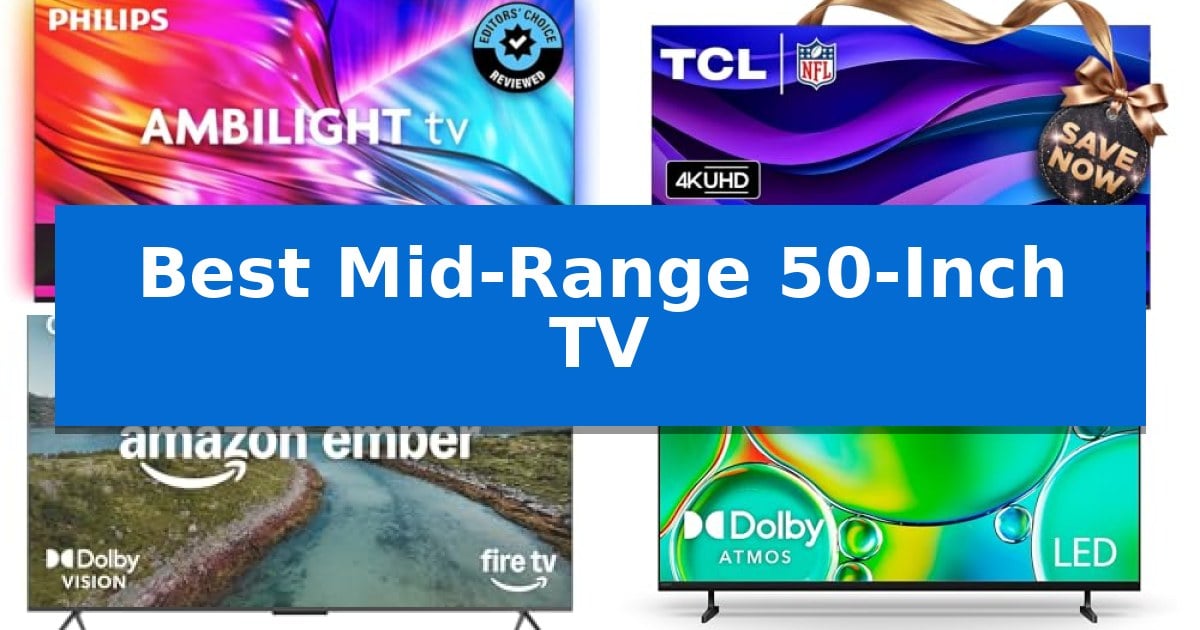
Finding the Best Mid-Range 50-Inch TV requires balancing high-end display technologies with the smart features that define your daily viewing experience. Whether you are upgrading your home theater or looking for a responsive display for gaming, the mid-range market offers significant advancements in color accuracy and motion handling without the premium price tag of flagship models.
Our guide focuses on identifying which models provide the most value based on your specific needs, such as integrated streaming platforms, gaming-specific optimizations, and connectivity standards. By evaluating these displays, we help you navigate the technical specifications to find a screen that fits your space and your entertainment habits perfectly.
You may also want to compare Best Mid-Range 50-59 Inch TV, Best Mid-Range 43-Inch TVs, and Best Mid-Range 40-Inch 4K Smart TV.
Best Mid-Range 50-Inch TV
Quick Comparison
| Product | Best For | Key Strength | Score |
|---|---|---|---|
| Philips 7985 Series 4K QLED TV | Best Overall | Ambilight LED projection creates an immersive viewing experience by matching wall colors to screen con… | 4.9 |
| TCL R7D 4K QLED Roku TV | Smooth Motion for Fast Action | FullView bezel-less design for a modern, minimalist aesthetic. | 4.4 |
| Amazon Ember QLED Fire TV | Hands-Free Alexa Voice Control | Hands-free Alexa voice control for navigation and smart home management. | 4.5 |
| Sony BRAVIA 2 LED Smart TV | Optimized for PlayStation Gaming | Exclusive PS5 features including Auto HDR Tone Mapping and Auto Genre Picture Mode. | 4.9 |
| VIZIO V-Series Quantum QLED TV | Fast Wi-Fi 6 Streaming | Quantum Dot technology for enhanced color volume and brightness. | 4.4 |
How We Chose
- Display technology and HDR support for color accuracy and contrast.
- Smart platform interface speed and app availability.
- Gaming-specific features like refresh rates and input lag reduction.
- Physical port configuration including HDMI standards and eARC support.
- Build quality and physical dimensions for room placement.
1 Philips 7985 Series 4K QLED TV — Immersive Ambilight Wall Projection
The Philips 50-Inch Class 7985 Series 4K UHD QLED Ambilight Smart Roku TV distinguishes itself through integrated rear LED lighting that projects colors onto your wall, synchronizing with on-screen action or pulsing to your music. This immersive feature, known as Ambilight, creates a unique visual environment that extends beyond the physical boundaries of the 50-inch display.
Equipped with a 4K QLED panel, this television utilizes quantum dot technology to enhance color range, brightness, and contrast. It supports Dolby Vision, HDR10, and HLG to optimize high-dynamic-range content, while the 120 PMR processing helps maintain smooth motion during fast-paced sports or action sequences.
Audio performance is handled by built-in Dolby Atmos speakers, designed to provide clear dialogue and spatial effects without requiring external hardware. For those who prefer a dedicated sound system, the HDMI 1 port supports eARC, allowing for a seamless connection to soundbars or AV receivers.
The integrated Roku platform provides a centralized hub for popular streaming services like Netflix, Disney+, and Prime Video, alongside access to over 500 free live channels. The interface also includes a Roku Backdrops feature, which transforms the idle screen into a digital gallery, and the unit supports voice control via Alexa, Siri, and Google Assistant.
Connectivity is robust, featuring four HDMI inputs, USB, Ethernet, and optical audio outputs. The television measures approximately 43.7 x 28.3 x 11.0 inches with the stand and is compatible with 200 x 100 mm VESA mounts for flexible installation options.
Best for: Viewers seeking an immersive home theater experience with built-in ambient lighting and a user-friendly, all-in-one streaming interface.
Skip if: Users requiring high-refresh-rate gaming features or those with limited wall space who cannot utilize the Ambilight projection effectively.
PROS
- Ambilight LED projection creates an immersive viewing experience by matching wall colors to screen content.
- Quantum dot QLED technology provides enhanced color accuracy and brightness for 4K content.
- Integrated Roku platform offers a comprehensive selection of streaming apps and free live channels.
- Flexible connectivity with four HDMI ports and eARC support for external audio systems.
CONS
- Ambilight performance is most effective when the TV is placed against a plain, light-colored wall.
- Standard 50-inch footprint may require specific VESA mounting hardware for wall installation.
2 TCL R7D 4K QLED Roku TV — Smooth Motion for Fast Action
Finding the Best Mid-Range 50-Inch TV requires balancing smart features with display performance. The TCL 50" R7D 4K QLED Roku TV (50R7D) centers its design around a FullView bezel-less metal frame, offering a clean, modern aesthetic that fits into most living spaces without dominating the room.
This model delivers a true 4K UHD (3840×2160) panel that supports Open HDR, HDR10, HDR10+, and HLG. These standards work together to provide sharper detail and enhanced contrast. For those who watch fast-paced content, the Motion Rate 240 with MEMC technology is included to reduce blur and judder, keeping the picture sharp during action sequences or sports.
Integration is a primary focus for this unit. As a Roku TV, it consolidates live local news, sports, and streaming channels onto one home screen. It also supports Google Cast and AirPlay 2, allowing users to mirror media directly from mobile devices or laptops. Smart home compatibility extends to Amazon Alexa, Google Home, and Apple HomeKit.
Gamers benefit from Auto Low Latency Mode (ALLM), which automatically shifts the display to a dedicated game mode when a console is powered on, aiming for a more responsive experience. Connectivity is handled by 3 HDMI inputs (including ARC/eARC), a USB port, and optical digital audio, enabling the simultaneous connection of soundbars, consoles, and streaming hardware.
Best for: Users seeking a versatile, integrated smart TV experience with dedicated gaming features and broad streaming support.
Skip if: Viewers requiring a larger screen size or advanced high-end panel technologies beyond standard 4K HDR capabilities.
PROS
- FullView bezel-less design for a modern, minimalist aesthetic.
- Integrated Roku TV platform for simplified content access.
- Auto Low Latency Mode (ALLM) for responsive gaming.
- Broad HDR format support including HDR10+ and HLG.
CONS
- Limited to 50-inch form factor, which may not suit all room sizes.
3 Amazon Ember QLED Fire TV — Hands-Free Alexa Voice Control
The Amazon Ember 50" QLED Series with Fire TV integrates Omnisense technology, which utilizes built-in sensors to wake the display automatically when you enter the room. This feature allows the screen to transition instantly from displaying artwork to your preferred media, streamlining the start of your viewing experience.
Equipped with a 4K QLED display and support for Dolby Vision and HDR10+ Adaptive, this model is engineered to maintain visual clarity across varying lighting conditions. The inclusion of a quad-core processor and Wi-Fi 6 support ensures that applications load efficiently and streaming remains stable during high-demand tasks.
The 2026 Fire TV experience offers a redesigned interface that prioritizes content discovery through dedicated categories and personalized recommendations via Alexa+. Users can navigate the system using the voice remote or utilize the hands-free voice control to manage playback and smart home devices, even when the television is powered off.
For connectivity and versatility, the unit features four HDMI inputs for external devices like consoles or soundbars, and supports AirPlay for wireless content sharing. Privacy is addressed through a physical switch that electronically disconnects the microphones, providing a tangible control over the device's listening capabilities.
Beyond traditional media, the Amazon Ember QLED Fire TV supports cloud gaming through Amazon Luna and Xbox Game Pass. This functionality allows for console-free gaming, where users can utilize their smartphones as controllers to access a library of titles directly through the television interface.
Best for: Users seeking a smart-integrated television that offers hands-free voice control and built-in support for cloud gaming without the need for a separate console.
Skip if: Viewers who prioritize specific high-end gaming monitor features like variable refresh rates beyond standard streaming capabilities or those who require a different smart ecosystem integration.
PROS
- Hands-free Alexa voice control for navigation and smart home management.
- Omnisense technology for automated wake-up and display features.
- Wi-Fi 6 support for faster and more stable streaming performance.
- Cloud gaming integration with Amazon Luna and Xbox Game Pass.
CONS
- Microphone privacy switch requires physical interaction to ensure total disconnection.
- Limited to Fire TV ecosystem for smart features and app management.
4 Sony BRAVIA 2 LED Smart TV — Optimized for PlayStation Gaming
Integrating a dedicated gaming suite into a living room setup, the Sony 50 Inch BRAVIA 2 II LED 4K HDR Smart GoogleTV (K-50S20M2) leverages exclusive PlayStation 5 optimizations to bridge the gap between console performance and home entertainment. This model is designed to handle high-motion content and complex visual data, ensuring that both cinematic streaming and interactive gaming benefit from specialized processing.
At the core of the display is the 4K Processor X1, which utilizes 4K X-Reality PRO to upscale content to near-4K resolution, restoring texture and detail to lower-resolution sources. The integration of Triluminos Pro technology ensures a wide color gamut, while Motionflow XR provides intelligent motion handling to reduce blur during fast-paced sequences, such as sports or action-heavy film scenes.
Gamers gain a distinct advantage through the Game Menu, a centralized interface for adjusting picture settings and activating assist features. When paired with a PS5, the TV automatically engages Auto HDR Tone Mapping and Auto Genre Picture Mode, which calibrate the display specifically for the console's output. This removes the need for manual adjustment when switching between gaming and streaming media.
The Google TV platform serves as the central hub, consolidating streaming applications into a single, navigable interface. Connectivity is further bolstered by native support for Apple AirPlay 2 and Google Cast, allowing for seamless content sharing from mobile devices. For added utility, the Eco Dashboard provides a unified view for managing energy efficiency settings, ensuring the display operates within your preferred power parameters.
Best for: PlayStation 5 owners seeking a dedicated display that automatically optimizes picture settings for both gaming and streaming.
Skip if: Users requiring advanced high-refresh-rate gaming features beyond standard console optimizations or those needing a screen size larger than 50 inches.
PROS
- Exclusive PS5 features including Auto HDR Tone Mapping and Auto Genre Picture Mode.
- 4K Processor X1 with X-Reality PRO for effective content upscaling.
- Motionflow XR for blur-free motion in fast-paced media.
- Centralized Game Menu for quick access to picture and assist settings.
CONS
- Fixed 50-inch screen size may not suit all room dimensions.
- Limited to standard LED panel technology compared to higher-tier OLED alternatives.
5 VIZIO V-Series Quantum QLED TV — Fast Wi-Fi 6 Streaming
Achieving a balance between high-end visual fidelity and responsive gaming performance often leads to the VIZIO 50" Class V-Series Quantum 4K QLED Smart TV, which utilizes Quantum Dot technology to produce over one billion colors. This display is engineered to deliver significant color volume and brightness, ensuring that HDR content—including support for Dolby Vision, HDR10+, HDR10, and HLG—maintains deep blacks and vibrant highlights.
For users prioritizing connectivity and gaming, the integration of Wi-Fi 6 provides a stable, high-speed foundation for 4K streaming, effectively minimizing buffering. Gamers benefit from a specialized suite of features, including an ultra-low input lag under 10ms at 4K/60Hz, HDMI Variable Refresh Rate (VRR), and Dynamic Motion Rate 120, all of which work to eliminate screen tearing during fast-paced play on modern consoles.
The user experience is centered around the VIZIO OS interface, which offers immediate access to major streaming platforms and the WatchFree+ service, providing over 300 live channels without additional subscription costs. Navigation is managed through the included VIZIO Voice Remote, simplifying the process of switching between apps and live content.
Measuring 43.8 inches in width and 25.5 inches in height, this unit fits standard media consoles while offering a versatile feature set for both home theater enthusiasts and gamers. While it provides a comprehensive suite of smart features, users should note that the device includes a 90-day limited warranty.
Best for: This TV is best for gamers and streaming enthusiasts who require low-latency performance and high color accuracy in a mid-range 50-inch form factor.
Skip if: Skip this model if you require an extended manufacturer warranty beyond 90 days or if your home setup demands a screen size larger than 50 inches.
PROS
- Quantum Dot technology for enhanced color volume and brightness.
- Ultra-low input lag under 10ms for responsive gaming.
- Wi-Fi 6 connectivity for stable 4K streaming.
- Comprehensive HDR support including Dolby Vision and HDR10+.
CONS
- 90-day limited warranty is shorter than many standard retail offerings.
Best Mid-Range 50-Inch TV Buying Guide
Understanding Display Technology
The shift toward QLED and Quantum Dot technology has made high-quality color volume more accessible in the mid-range segment. These displays use a layer of quantum dots to enhance brightness and color saturation, which is particularly beneficial for viewing in rooms with ambient light.
When comparing models, look for support for multiple HDR standards such as Dolby Vision or HDR10+. These formats allow the TV to adjust brightness and contrast on a scene-by-scene basis, ensuring that dark shadows and bright highlights retain detail.
Smart Platform Ecosystems
The operating system is the hub of your viewing experience. Platforms like Roku TV and Google TV offer distinct advantages in terms of interface simplicity and content discovery. A fast processor is essential to ensure that menus load quickly and apps transition smoothly.
Consider how the TV integrates with your existing smart home devices. Features like Alexa or Google Assistant voice control can streamline navigation, while support for AirPlay or Google Cast allows for quick content sharing from mobile devices.
Gaming Performance and Motion
For gamers, the input lag and refresh rate are critical. Features like Auto Low Latency Mode (ALLM) and Variable Refresh Rate (VRR) help synchronize the TV with your console, reducing screen tearing and ensuring a responsive feel during fast-paced gameplay.
Motion handling technologies, such as MEMC or Motion Rate, are designed to reduce blur in sports and action sequences. These features are particularly useful for maintaining clarity during high-speed movement, preventing the judder often seen on lower-end panels.
Connectivity and Sound
The number and type of HDMI ports determine how many devices you can connect simultaneously. Look for at least one port with eARC (Enhanced Audio Return Channel), which allows you to send high-quality audio to a soundbar or receiver using a single cable.
Wireless connectivity, specifically Wi-Fi 6, is becoming a standard for mid-range TVs. This ensures a more stable connection for 4K streaming, reducing the likelihood of buffering when watching high-bitrate content.
Placement and VESA Mounting
Before purchasing, verify the VESA mounting pattern and the physical footprint of the stand. A 50-inch TV requires a stable surface or a wall mount capable of supporting its weight and dimensions.
Consider the bezel design, as a bezel-less or slim-profile build can make the television appear more modern and less intrusive in smaller living spaces. Always check the depth of the unit if you plan to mount it flush against a wall.
Frequently Asked Questions
What is the main benefit of QLED technology?
QLED technology uses quantum dots to produce more vibrant colors and higher peak brightness compared to standard LED panels, resulting in a more vivid picture.
Do I need a separate streaming device?
Most modern mid-range TVs come with built-in smart platforms like Roku or Google TV, which provide access to all major streaming services without needing an external box.
What is eARC and why does it matter?
eARC (Enhanced Audio Return Channel) allows you to transmit high-quality, uncompressed audio from your TV to a soundbar or receiver using a single HDMI cable.
How does Auto Low Latency Mode (ALLM) help?
ALLM automatically detects when a gaming console is connected and switches the TV to a low-latency mode, which minimizes input lag for a more responsive gaming experience.
Can I mount these TVs on the wall?
Yes, all the listed models support standard VESA mounting patterns, allowing you to attach them to compatible wall mounts for a clean, space-saving installation.
Conclusion: Our Top Pick
Choosing the right television depends on how you prioritize gaming performance, smart features, and visual immersion. For those seeking a unique viewing experience, the Philips 7985 Series 4K QLED TV stands out due to its integrated Ambilight technology, which projects ambient light onto the wall to extend the visual experience beyond the screen.
While other models offer specific advantages for console gaming or smart home integration, the Philips 7985 provides a well-rounded package of 4K QLED picture quality and versatile connectivity. It remains a compelling choice for users who want a balance of performance and aesthetic appeal in their living room.