
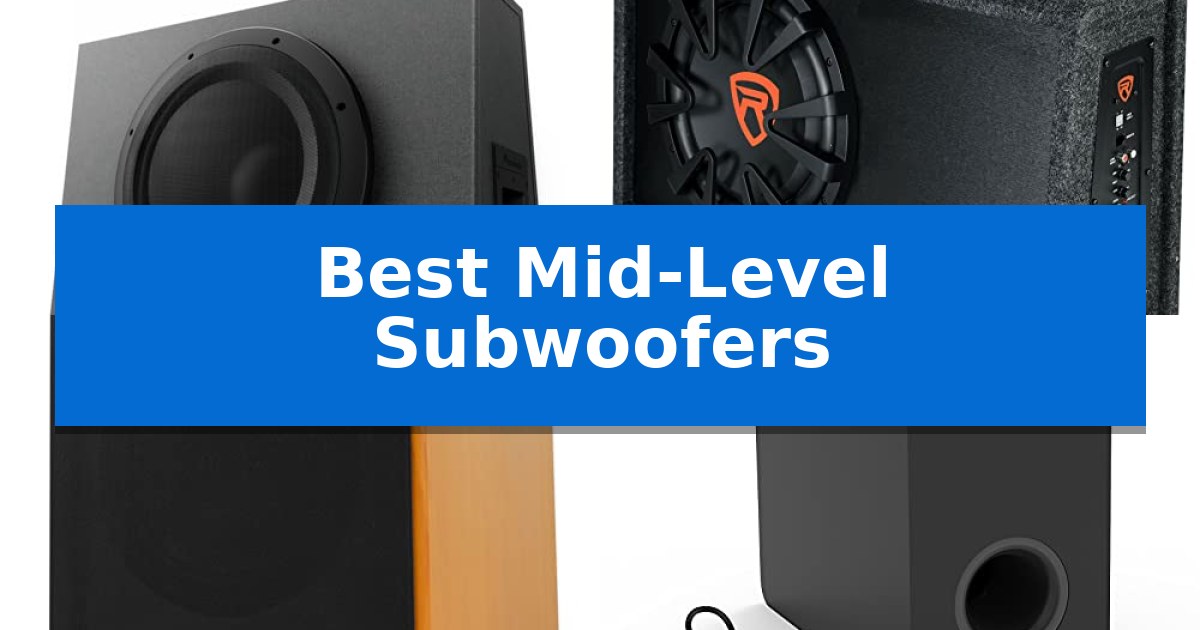
Achieving a deep, resonant soundstage often requires more than just standard speakers. Whether you are upgrading your car audio or enhancing a home theater, finding the Best Mid-Level Subwoofers can significantly improve your listening experience by adding depth to low-frequency sounds.
Selecting the right unit involves balancing power handling, enclosure size, and integration options. We have analyzed several powered models to help you understand which features best suit your specific audio requirements and available installation space.
You may also want to compare Best Mid-Level Studio Headphones, Best Mid-Level Point and Shoot Camera, and Best Mid-Level Nikon Cameras.
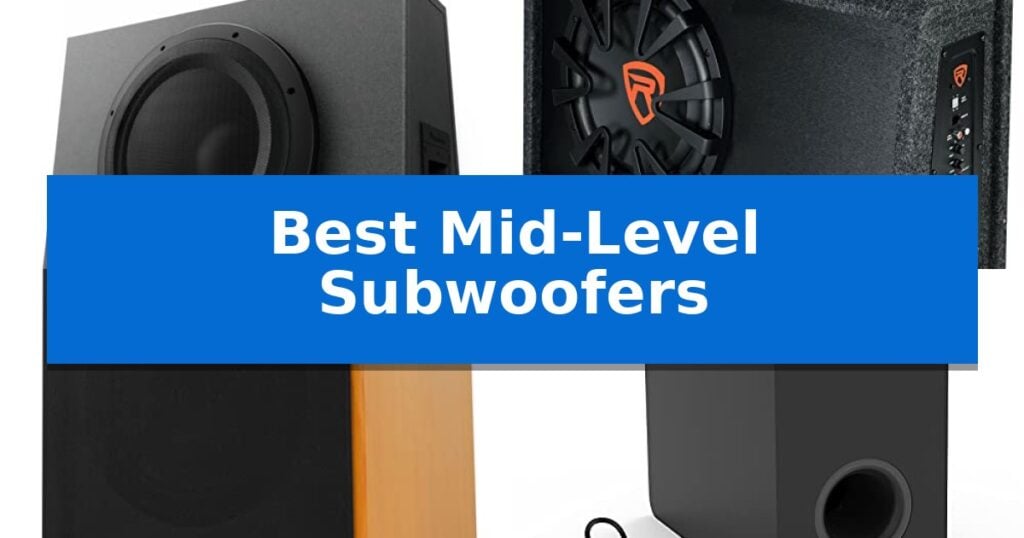
Best Mid-Level Subwoofers
Quick Comparison
| Product | Best For | Key Strength | Score |
|---|---|---|---|
| Pioneer TS-WX1210A Powered Subwoofer | Best Overall | Built-in 300-watt Class D amplifier for efficient power delivery. | 4.9 |
| Rockville RVS12A Powered Subwoofer | Slim Vented Design for Trunk Space | Vented enclosure design for increased bass efficiency and volume. | 4.3 |
| Rockville Rock Shaker Powered Subwoofer | Classic Wood Finish for Home Theater | Adjustable crossover and phase controls for precise room tuning. | 4.7 |
| Bestisan SW65D Powered Subwoofer | Compact Side-Firing Room Filler | Compact 6.3-inch width fits easily into tight shelf spaces or corners. | 4.7 |
| Pyle PLBX8A Powered Subwoofer | Low-Profile Fit for Tight Spaces | Low-profile 3-inch height enables installation in tight vehicle spaces. | 4.9 |
How We Chose
- Power Handling: Assessing the RMS and peak wattage to ensure sufficient bass output for your specific environment.
- Enclosure Design: Evaluating the physical dimensions and shape to determine suitability for tight spaces or specific room layouts.
- Connectivity Options: Checking for high-level and RCA inputs to ensure compatibility with both factory and aftermarket head units or receivers.
- Sound Customization: Reviewing the availability of adjustable crossovers, phase control, and bass boost features for fine-tuning performance.
- Installation Flexibility: Considering the mounting requirements and overall build to ensure a straightforward setup process.
1 Pioneer TS-WX1210A Powered Subwoofer — Dynamic Bass for Immersive Audio
Achieving a deep, resonant soundstage in a vehicle often requires more than just factory speakers, and the Pioneer TS-WX1210A Powered Subwoofer provides a streamlined solution by integrating a high-output amplifier directly into its enclosure. This active design simplifies the installation process for those looking to add low-frequency depth without the complexity of matching separate components.
At the heart of the unit is a 12-inch cone paired with a 300-watt Class D amplifier. This combination is engineered for efficiency, producing minimal heat while maintaining high output levels. With a max power handling of 1200 Watts and a sensitivity rating of 114 dB, the system is capable of delivering clear, loud bass even when paired with lower power inputs, ensuring consistent performance across various volume levels.
The Pioneer TS-WX1210A Powered Subwoofer offers significant control over the audio output, featuring an adjustable low pass filter, phase control, and variable bass boost ranging from 0 to +12 dB. These adjustments allow users to fine-tune the sound reproduction to match specific music genres or personal preferences, ensuring the bass integrates smoothly with the existing audio setup.
Designed with an innovative shape to increase high rigidity and reduce internal standing waves, the enclosure is built for both acoustic performance and practical placement. Its compact footprint allows for flexible installation, including under-seat options, making it a versatile choice for vehicles where space is at a premium but audio quality remains a priority.
Best for: Drivers seeking a space-efficient, all-in-one bass upgrade that integrates easily with both factory and aftermarket radio systems.
Skip if: Audiophiles requiring extreme custom power configurations or those with extremely limited cargo space who need an ultra-slim, low-profile form factor.
PROS
- Built-in 300-watt Class D amplifier for efficient power delivery.
- Flexible sound adjustment controls including variable bass boost and phase control.
- High sensitivity rating of 114 dB for clear output at various volume levels.
- Rigid enclosure design to minimize internal standing waves.
CONS
- Large 12-inch footprint may limit placement options in smaller vehicle interiors.
2 Rockville RVS12A Powered Subwoofer — Slim Vented Design for Trunk Space
Achieving deep, resonant low-frequency output in a vehicle often requires balancing physical footprint with acoustic efficiency. The Rockville RVS12A 12" Slim Vented Powered Car Subwoofer addresses this by utilizing a specialized vented enclosure design, which is engineered to produce tighter and louder bass response compared to traditional sealed alternatives.
At the core of this system is a 300W RMS built-in amplifier paired with a 12-inch driver capable of 1400W peak power. This integration ensures that the subwoofer is optimized for its specific enclosure, providing a cohesive audio solution that simplifies installation by eliminating the need for an external amplifier.
Usability is enhanced through precise sound management tools, including an adjustable low-pass crossover and a 30Hz subsonic filter. These controls allow users to tailor the frequency output to their specific vehicle acoustics. Furthermore, the inclusion of a dash-mounted remote bass knob provides real-time level adjustments directly from the driver's seat.
Constructed with a durable MDF enclosure finished in black carpet, the unit is designed to withstand the rigors of trunk environments. Its compact dimensions—measuring 12.4 inches in height and 29.9 inches in width—are intended to maximize trunk utility while maintaining the necessary internal volume for effective bass reproduction.
Best for: Drivers looking to add impactful low-frequency reinforcement to a car audio system without sacrificing significant trunk space.
Skip if: Users who require an ultra-compact under-seat solution or those seeking extreme competition-level SPL output beyond the capabilities of a single 12-inch integrated system.
PROS
- Vented enclosure design for increased bass efficiency and volume.
- Integrated 300W RMS amplifier simplifies installation and component matching.
- Dash-mounted remote bass knob allows for convenient, on-the-fly volume control.
- Adjustable crossover and subsonic filter provide essential frequency management.
CONS
- Large physical footprint compared to dedicated ultra-slim under-seat models.
3 Rockville Rock Shaker Powered Subwoofer — Classic Wood Finish for Home Theater
Achieving a balanced low-end response in a home theater setup often requires a dedicated unit that handles frequency management without overwhelming the room. The Rockville Rock Shaker 8" Classic Wood Powered Subwoofer addresses this by combining a 200W RMS high-excursion woofer with a rear-ported MDF enclosure designed to enhance sound resonance.
This subwoofer provides essential audio tailoring through adjustable crossover controls ranging from 50Hz to 200Hz, alongside a phase switch for 0 or 180-degree alignment. These features allow for precise integration with existing stereo or home theater receivers, ensuring the bass output complements the rest of your audio system rather than clashing with it.
Connectivity is handled via both RCA line-level and speaker-level inputs, offering flexibility for various gaming and media setups. The unit's physical footprint of 15" x 11.6" x 14.3" is intended to balance performance with space-saving requirements, making it a practical addition to living areas where floor space is at a premium.
Constructed with a classic wood finish, the enclosure prioritizes durability and acoustic stability. By utilizing a Class D amplifier to power the 8-inch driver, the system maintains a focus on delivering distortion-free low-frequency output suitable for movies, music, and gaming environments.
Best for: Small to medium-sized living spaces requiring a compact, versatile subwoofer for home theater and gaming integration.
Skip if: Users seeking massive, room-shaking output for very large dedicated cinema rooms may require a larger driver or higher wattage than this 8-inch model provides.
PROS
- Adjustable crossover and phase controls for precise room tuning.
- Versatile connectivity options including RCA and speaker-level inputs.
- Compact MDF wood enclosure designed for durability and resonance.
- 200W RMS power output suitable for balanced home audio.
CONS
- 8-inch driver size may be limited for extremely large listening environments.
4 Bestisan SW65D Powered Subwoofer — Compact Side-Firing Room Filler
Achieving a balanced sound profile in a compact home theater setup often requires a dedicated low-frequency driver that does not dominate the room. The Bestisan SW65D Powered Subwoofer addresses this by utilizing a unique side-firing speaker design that integrates satellite speakers on its flanks, aiming to distribute audio more evenly across the listening environment.
Measuring just 6.3 inches wide, this unit is engineered for tight spaces where traditional, bulky subwoofers might not fit. Despite its small footprint, it includes a suite of connectivity options, including RCA, LFE, and AUX inputs, alongside high-level speaker inputs and outputs. This versatility allows it to connect directly to receivers, soundbars, or bookshelf speakers, making it a flexible addition to various audio configurations.
Users can manage the output through integrated controls that allow for fine-tuning of both volume and bass levels. This level of manual adjustment is essential for matching the subwoofer's performance to specific room acoustics, ensuring that the low-end response complements rather than overwhelms the primary speakers.
The enclosure features a modern, sleek aesthetic that allows it to blend into most living spaces without drawing unnecessary attention. By prioritizing a compact form factor without sacrificing the necessary input options for standard home audio equipment, it provides a practical solution for those looking to enhance their system's depth.
Best for: Small to medium-sized living spaces where a compact, versatile subwoofer is needed to integrate with existing soundbars or bookshelf speakers.
Skip if: Large home theater environments that require high-output, deep-frequency extension beyond what a 6.5-inch driver can physically produce.
PROS
- Compact 6.3-inch width fits easily into tight shelf spaces or corners.
- Versatile connectivity including LFE, RCA, AUX, and high-level inputs.
- Side-firing design helps optimize sound distribution in smaller rooms.
- Dedicated controls for precise volume and bass adjustments.
CONS
- 6.5-inch driver size limits the absolute depth and power of low-frequency reproduction compared to larger models.
5 Pyle PLBX8A Powered Subwoofer — Low-Profile Fit for Tight Spaces
Integrating a dedicated low-frequency driver into a vehicle cabin often presents a challenge due to limited floor space, yet the Pyle 8-Inch Low-Profile Amplified Subwoofer System addresses this by utilizing a compact 3-inch high enclosure. This design allows for installation under most vehicle seats, providing a space-efficient method to enhance audio output without sacrificing significant cabin utility.
The system features an integrated amplifier capable of a 600-watt maximum power output, designed to deliver low-frequency bass volume. To ensure compatibility with various head units, the device includes both high-level (speaker line) inputs and low-level (RCA) inputs. This flexibility allows for integration into systems that lack dedicated subwoofer pre-outs, as the unit can draw signals directly from existing speaker wiring.
Usability is managed through an onboard control suite, which includes low-pass crossovers and an adjustable input sensitivity control ranging from 0.12V to 3.5V. The inclusion of a variable bass boost and a remote level control module provides the ability to adjust bass output from the driver's position, allowing for real-time tuning of the audio profile.
Measuring 12.8 inches by 9.5 inches by 3 inches, the Pyle PLBX8A is built for tight-clearance environments. The package includes necessary mounting hardware, facilitating a straightforward installation process for users looking to upgrade their car stereo sound system with a self-contained, active subwoofer solution.
Best for: Drivers with limited cabin space who require a compact, all-in-one powered subwoofer solution that fits under a seat.
Skip if: Users seeking high-output competition-grade bass or those with extremely restricted under-seat clearance that falls below the 3-inch height requirement.
PROS
- Low-profile 3-inch height enables installation in tight vehicle spaces.
- Dual input options support both RCA and speaker-level signal sources.
- Integrated 600-watt amplifier eliminates the need for a separate external power unit.
- Remote level control allows for convenient bass adjustments from the driver's seat.
CONS
- Fixed 8-inch driver size limits the absolute depth of low-frequency reproduction compared to larger enclosures.
Best Mid-Level Subwoofers Buying Guide
Understanding Power and Sensitivity
The power rating of a subwoofer, typically measured in RMS (Root Mean Square), indicates the continuous power the unit can handle. A higher RMS value generally allows for cleaner, more consistent bass, while peak power represents the maximum burst the system can manage.
Sensitivity is equally important, as it determines how efficiently the subwoofer converts power into sound. A higher sensitivity rating means the subwoofer can produce louder audio with less power, which is particularly beneficial for systems with limited amplifier output.
Enclosure Types and Space Constraints
Subwoofers come in various enclosure styles, such as vented or sealed designs. Vented enclosures often provide louder, more impactful bass by utilizing airflow, making them popular for trunk installations where space allows.
For more confined areas, such as under a vehicle seat or in a small room, low-profile or compact enclosures are ideal. These units prioritize a slim design without sacrificing the ability to deliver necessary low-frequency response.
Connectivity and Integration
Compatibility is a critical factor when integrating a subwoofer into an existing setup. Models featuring high-level inputs are essential if your receiver or head unit lacks dedicated RCA subwoofer outputs, as they allow you to connect directly to speaker wires.
RCA or LFE inputs offer a cleaner signal path for users with modern home theater receivers or aftermarket car stereos. Ensuring your chosen subwoofer supports the input type available in your system is vital for a seamless installation.
Fine-Tuning Your Audio
Most powered subwoofers include built-in controls to help you blend the bass with your main speakers. An adjustable low-pass crossover allows you to set the frequency at which the subwoofer stops playing, ensuring it only handles the low notes.
Phase control and variable bass boost are additional tools that help align the subwoofer's output with your room's acoustics. These adjustments prevent muddy sound and ensure the bass feels tight and precise rather than overwhelming.
Material and Build Quality
The construction of the enclosure significantly impacts sound quality. MDF (Medium Density Fiberboard) is a common material choice because it is dense and rigid, which helps reduce unwanted vibrations and internal standing waves.
A well-built enclosure ensures that the energy produced by the woofer is directed outward rather than lost to cabinet resonance. Look for durable finishes and reinforced corners if the unit will be placed in a high-traffic or mobile environment.
Frequently Asked Questions
What is the difference between high-level and low-level inputs?
High-level inputs accept signals from standard speaker wires, which is useful if your audio source lacks RCA outputs. Low-level inputs, or RCA inputs, are designed for dedicated subwoofer outputs on receivers or head units.
Can I install a powered subwoofer under a car seat?
Yes, if you choose a low-profile model specifically designed for tight spaces. Always check the height dimensions of the unit against the clearance available under your seat.
Why does my subwoofer have a crossover control?
The crossover control determines the frequency range the subwoofer reproduces. It helps ensure the subwoofer only plays the deep bass notes, preventing it from interfering with the midrange frequencies handled by your main speakers.
Does a larger subwoofer always mean better bass?
Not necessarily. While larger cones can move more air, the enclosure design, amplifier power, and your specific room or vehicle acoustics play a major role in the quality and depth of the bass produced.
What is the purpose of a subsonic filter?
A subsonic filter removes extremely low frequencies that are below the human hearing range. This protects the subwoofer from over-excursion and prevents the amplifier from wasting power on frequencies that do not contribute to audible sound.
Conclusion: Our Top Pick
For those seeking a balance of power and integration, the Pioneer TS-WX1210A Powered Subwoofer stands out as the top choice. Its 1200-watt max power handling and built-in 300-watt Class D amplifier provide a robust foundation for upgrading any audio system, while the flexible installation options allow it to fit into various setups.
While this model offers significant performance, ensure your chosen installation location provides enough clearance for its 12-inch cone and enclosure dimensions. Its combination of high-level inputs and adjustable sound controls makes it a highly adaptable solution for both factory and aftermarket audio environments.