
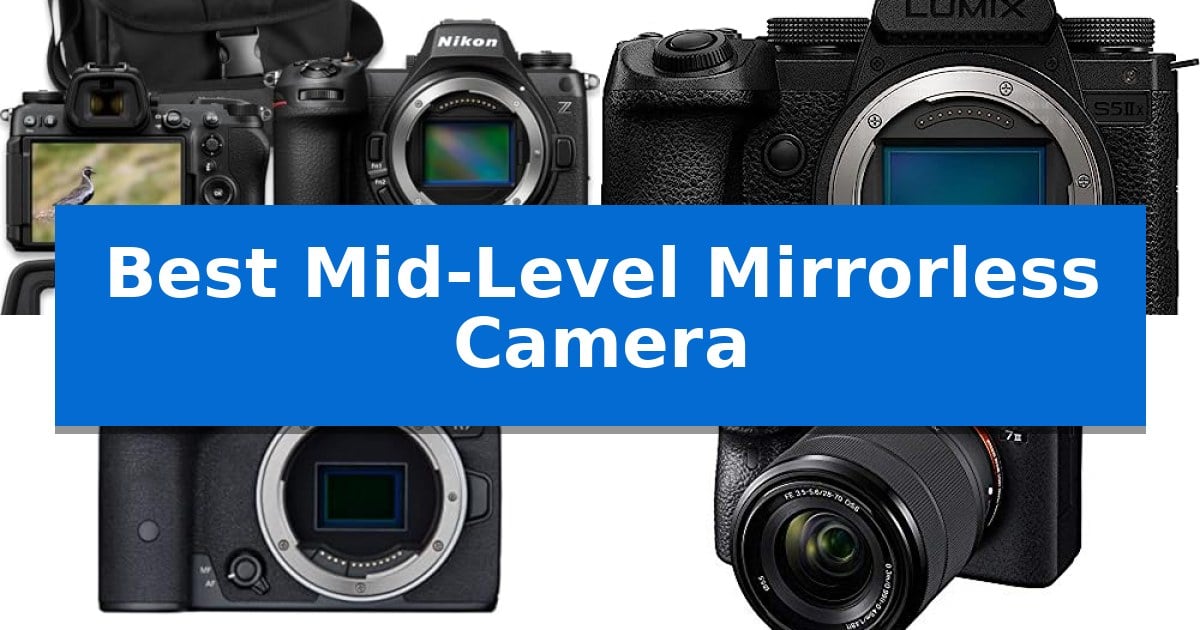
Finding the right balance between professional performance and portability is the primary challenge for photographers moving beyond entry-level gear. The Best Mid-Level Mirrorless Camera must offer enough technical sophistication to handle demanding assignments while remaining intuitive enough for daily creative work.
Whether you are focusing on high-speed action, hybrid video production, or high-resolution stills, the current market provides specialized tools that cater to these specific needs. This guide evaluates four distinct models to help you identify which system aligns with your current lens collection and shooting style.
You may also want to compare Best Mid-Level Microphone, Best Mid-Level Desktop Computers, and Best Mid-Level Color Laser Printer.
Best Mid-Level Mirrorless Camera
Quick Comparison
| Product | Best For | Key Strength | Score |
|---|---|---|---|
| Nikon Z6 III Mirrorless Camera | Best Overall | Partially-stacked sensor for faster readout and reduced rolling shutter. | 4.9 |
| Panasonic LUMIX S5IIX Mirrorless Camera | Unlimited recording for hybrid creators | Unlimited video recording and livestreaming via an integrated cooling system. | 4.4 |
| Canon EOS R7 Mirrorless Camera | High-speed APS-C action specialist | High-speed continuous shooting up to 30 fps with the electronic shutter. | 4.4 |
| Sony Alpha a7 III Mirrorless Camera | Versatile full-frame workhorse | Advanced 24.2MP BSI Full-frame sensor for high image quality. | 4.3 |
How We Chose
- Sensor technology and image processing speed
- Autofocus tracking accuracy and subject detection capability
- Video resolution, frame rate options, and recording limitations
- Ergonomics, build quality, and interface layout
- System compatibility and lens ecosystem availability
1 Nikon Z6 III Mirrorless Camera — Flagship speed in mid-range body
The Nikon Z6 III Mirrorless Camera introduces a significant advancement in mid-range imaging by incorporating a partially-stacked CMOS sensor. This architecture enables faster data readout speeds, which directly contributes to reduced rolling shutter and unlocks high-performance capabilities previously reserved for flagship models.
At the heart of the system is the EXPEED 7 image processor, the same engine found in Nikon's top-tier Z8 and Z9 cameras. This processor provides the necessary computational power to support AI-based subject detection and a highly responsive autofocus system with 493 points. The camera is designed to handle demanding workflows, offering 6K 60p N-RAW and 6K 30p ProRes RAW internal video recording, alongside 4K 120p and Full HD 240p slow-motion options.
Usability is enhanced by a 5760k-dot electronic viewfinder (EVF) that provides a bright and fluid viewing experience, complemented by a 3.2-inch 4-axis tilting touchscreen LCD. For high-speed action, the camera supports up to 20 fps raw shooting and 60 fps JPEG shooting, with a pre-capture function capable of reaching 120 fps. The inclusion of both CFx Type B and SD memory card slots offers flexible storage management for various professional needs.
This 11-piece bundle includes essential accessories such as a 128 GB memory card, an extra battery, and a carrying case, all backed by a 1-Year Manufacturer Warranty. The Nikon Z6 III Mirrorless Camera balances these high-end specifications within a body designed for versatility, making it a capable tool for those requiring speed and precision in a mid-level package.
Best for: Aspiring professionals who require flagship-level speed, high-resolution raw video, and advanced autofocus in a versatile mid-range body.
Skip if: Users who do not require high-speed burst shooting or internal raw video recording may find more cost-effective options with simpler feature sets.
PROS
- Partially-stacked sensor for faster readout and reduced rolling shutter.
- EXPEED 7 processor enables flagship-level AF and high-speed burst rates.
- Professional video capabilities including 6K N-RAW and 4K 120p.
- Dual card slots supporting both CFx Type B and SD media.
CONS
- High-performance features may exceed the requirements of casual photographers.
2 Panasonic LUMIX S5IIX Mirrorless Camera — Unlimited recording for hybrid creators
The Panasonic LUMIX S5IIX Mirrorless Camera distinguishes itself as a robust hybrid tool through its integrated heat dispersion mechanism, which utilizes a small fan and high-efficiency heat sink to enable unlimited video recording and livestreaming. This design choice ensures the camera remains compact while maintaining consistent performance during extended production sessions.
Equipped with a 24.2-MP 35mm full-frame CMOS sensor, the camera provides high resolution and natural image description. The inclusion of Phase Hybrid Autofocus allows for fast and accurate subject tracking, maintaining focus on targets even in adverse lighting or when multiple moving objects are present in the frame.
For video professionals, the system offers 14+ stop V-Log/V-Gamut capture, supporting high dynamic range and broad color reproduction. The camera supports advanced workflows including 5.8K Pro-Res, internal Pro-Res recording, and RAW output over HDMI, alongside wired and wireless IP streaming capabilities.
The Panasonic LUMIX S5IIX Mirrorless Camera also features Active I.S. technology, which is specifically engineered to stabilize video footage during handheld walking shots. This stabilization, combined with in-camera color grading tools, provides a versatile solution for creators who require high-end video functionality in a portable form factor.
Best for: Hybrid creators who require unlimited video recording and professional-grade streaming capabilities in a compact full-frame body.
Skip if: Photographers who prioritize an ultra-lightweight, pocketable camera body over advanced video-centric cooling and streaming features.
PROS
- Unlimited video recording and livestreaming via an integrated cooling system.
- Phase Hybrid Autofocus for reliable subject tracking in challenging light.
- Active I.S. technology for enhanced stabilization during handheld movement.
- Professional video support including 5.8K Pro-Res and RAW over HDMI.
CONS
- Larger physical footprint compared to non-hybrid focused mirrorless models due to the internal cooling fan.
3 Canon EOS R7 Mirrorless Camera — High-speed APS-C action specialist
Capturing fast-moving subjects requires a camera that can keep pace, and the Canon EOS R7 Mirrorless Camera is engineered specifically for this demand. With its 32.5-megapixel APS-C CMOS sensor, it provides the telephoto reach and high-resolution detail necessary for sports, wildlife, and action photography.
The camera features Dual Pixel CMOS AF technology with approximately 100% coverage, utilizing 651 AF zones to track subjects across the entire frame. This system is paired with a 5-Axis In-body Image Stabilization (IBIS), which works with coordinated control to minimize shake during both handheld photography and video recording.
For those focused on speed, the Canon EOS R7 Mirrorless Camera offers a 15 fps mechanical shutter and a 30 fps electronic shutter. It also includes a RAW Burst Mode with a 1/2-second pre-shooting function, ensuring you never miss the critical moment of an action sequence.
Video creators benefit from professional-grade 4K recording capabilities that exceed 30 minutes, supported by Movie Servo AF for reliable subject tracking. The device includes an extra LP-E6NH battery pack, extending your time in the field, while the compact and lightweight chassis ensures portability without sacrificing a firm, ergonomic grip.
Best for: Photographers and content creators who prioritize high-speed burst shooting and advanced subject-tracking autofocus for action and wildlife.
Skip if: Users who require a full-frame sensor for specific low-light requirements or those who prefer a larger, heavier body for balance with massive telephoto lenses.
PROS
- High-speed continuous shooting up to 30 fps with the electronic shutter.
- Advanced Dual Pixel CMOS AF with 100% frame coverage.
- 5-Axis In-body Image Stabilization for steady handheld shots.
- Extended 4K video recording capabilities.
CONS
- APS-C sensor size may not meet the needs of users specifically seeking full-frame performance.
4 Sony Alpha a7 III Mirrorless Camera — Versatile full-frame workhorse
The Sony Alpha a7 III Mirrorless Camera distinguishes itself through a high-performance 24.2MP Back-Illuminated 35mm Full-frame Image Sensor paired with an advanced readout speed that is 1.8 times faster than previous iterations. This architecture provides a robust foundation for photographers requiring both high resolution and rapid data processing in a compact, full-frame body.
Engineered for versatility, the camera features an expansive 15-stop dynamic range and supports 14-bit uncompressed RAW output, ensuring significant detail retention in high-contrast scenes. The integration of 693 phase-detection and 425 contrast AF points covers 93% of the image area, facilitating precise subject tracking during both still photography and video capture.
Performance is further bolstered by a continuous shooting capability of up to 10fps, available in both silent and mechanical shutter modes with full AE/AF tracking. This makes the system suitable for capturing fast-moving subjects while maintaining focus accuracy. The native ISO range extends from 50 to 204,800, providing flexibility across diverse lighting environments.
The included SEL2870 lens offers a practical focal range for general-purpose shooting, making this a comprehensive kit for those transitioning to a full-frame system. The body design incorporates a 3-inch LCD and utilizes the NP-FZ100 rechargeable battery, balancing ergonomic handling with the power demands of a high-resolution sensor.
Best for: Photographers seeking a versatile, high-resolution full-frame system capable of rapid autofocus and wide dynamic range for diverse shooting conditions.
Skip if: Users requiring a lightweight, pocketable camera or those who do not need the specific depth and light-gathering capabilities of a full-frame sensor.
PROS
- Advanced 24.2MP BSI Full-frame sensor for high image quality.
- Extensive 693-point phase-detection AF system covering 93% of the frame.
- 10fps continuous shooting with full AE/AF tracking.
- Wide 15-stop dynamic range for improved highlight and shadow detail.
CONS
- Larger physical footprint compared to APS-C or Micro Four Thirds systems.
- Weight of the full-frame body and lens may be a factor for extended travel.
Best Mid-Level Mirrorless Camera Buying Guide
Sensor Design and Image Quality
The sensor architecture is the foundation of any camera, dictating how light is captured and processed. A partially-stacked sensor or a back-illuminated (BSI) sensor design often provides faster readout speeds, which is essential for reducing rolling shutter during video capture and improving autofocus responsiveness.
When evaluating these cameras, consider the megapixel count in relation to your output needs. While higher resolution is beneficial for large prints or heavy cropping, a lower-resolution sensor often provides superior low-light performance and faster burst shooting speeds, making it a better choice for action and event photography.
Autofocus and Subject Tracking
Modern autofocus systems rely heavily on AI-based subject detection to maintain focus on eyes, faces, animals, or vehicles. A camera with a high number of AF zones covering nearly the entire frame provides significantly more flexibility when composing shots with off-center subjects.
Look for systems that utilize Phase Hybrid AF technology. This combination of phase-detection and contrast-detection points ensures that the camera can lock onto targets quickly even in challenging lighting conditions, which is crucial for sports, wildlife, or fast-paced street photography.
Video Capabilities and Thermal Management
For hybrid creators, the ability to record high-quality video is just as important as still performance. Features like 6K internal raw recording or ProRes support offer professional-grade flexibility in post-production, allowing for extensive color grading and detail recovery.
Thermal management is a critical factor for long-form recording. Cameras equipped with active cooling systems, such as integrated fans and heat sinks, are designed to prevent overheating, enabling unlimited recording times that are necessary for interviews, events, and long-duration vlogging.
Stabilization and Ergonomics
In-body Image Stabilization (IBIS) is a vital feature for handheld shooting, allowing for slower shutter speeds without the need for a tripod. A 5-axis system provides the most comprehensive compensation for pitch, yaw, and roll movements, resulting in smoother video and sharper handheld stills.
Ergonomics determine how comfortable a camera is during extended use. A deep, secure grip and a well-placed tilting or articulating touchscreen LCD allow for better control and composition from awkward angles. Consider the weight and balance of the body, especially if you plan to pair it with larger telephoto lenses.
System Ecosystem and Compatibility
The camera body is only one part of the equation; the lens mount and available glass ecosystem are equally important. Before committing to a system, ensure that the native lens selection covers the focal lengths you require for your specific style of photography.
Check for compatibility with existing accessories, such as external microphones, lighting, and memory card formats like CFexpress Type B or SD cards. A system that supports industry-standard interfaces ensures that you can integrate the camera into your existing workflow without needing to replace all your peripheral gear.
Frequently Asked Questions
What is the benefit of a partially-stacked sensor?
A partially-stacked sensor design allows for faster data readout speeds compared to traditional sensors. This results in reduced rolling shutter distortion during video recording, faster autofocus performance, and higher continuous shooting frame rates.
Do I need a full-frame or APS-C sensor?
Full-frame sensors generally offer better low-light performance and shallower depth-of-field control. APS-C sensors provide a 'crop factor' that effectively increases the reach of your lenses, which is often preferred for sports and wildlife photography where extra telephoto distance is beneficial.
How does active cooling affect video recording?
Active cooling systems, which include internal fans and heat sinks, dissipate heat generated by the processor during high-resolution video recording. This prevents the camera from shutting down due to thermal limits, allowing for unlimited recording times.
What is the advantage of IBIS?
In-body Image Stabilization (IBIS) compensates for camera shake caused by hand movement. This allows photographers to use slower shutter speeds in low light and helps videographers achieve stable, handheld footage without needing a gimbal.
Why is the EXPEED 7 processor significant?
The EXPEED 7 image processor provides significantly faster processing speeds, which enables advanced AI-based subject detection, higher buffer capacities for burst shooting, and fluid video performance, ensuring the camera remains responsive during high-demand tasks.
Conclusion: Our Top Pick
When selecting the Nikon Z6 III Mirrorless Camera, you are investing in a versatile system that bridges the gap between mid-range accessibility and flagship performance. Its partially-stacked sensor and EXPEED 7 processor provide the speed necessary for demanding action, while the 6K internal raw video capabilities make it a powerful tool for hybrid creators.
While other models offer specific advantages like APS-C reach or unlimited recording, the Nikon Z6 III stands out for its balanced feature set. It is an ideal choice for those who require a reliable, high-speed camera that can handle both professional video production and high-resolution still photography without compromise.