
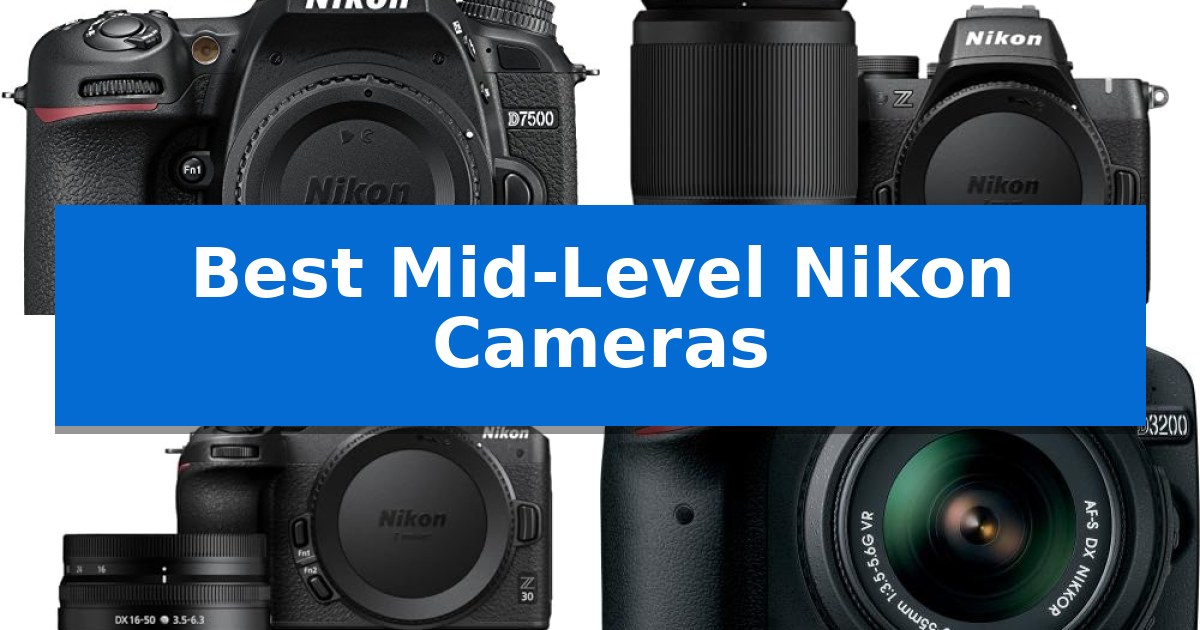
Finding the right camera involves balancing technical capabilities with your specific shooting style. Whether you are transitioning from a smartphone or looking to upgrade your existing gear, the Best Mid-Level Nikon Cameras offer a blend of performance and portability that serves both photography enthusiasts and content creators.
This selection focuses on models that provide meaningful upgrades in sensor technology, autofocus precision, and creative control. By examining the distinct advantages of both DSLR and mirrorless platforms, we aim to clarify which system aligns best with your long-term goals and current equipment.
You may also want to compare Best Mid-Level Mirrorless Camera, Best Mid-Level Microphone, and Best Mid-Level Desktop Computers.
Best Mid-Level Nikon Cameras
Quick Comparison
| Product | Best For | Key Strength | Score |
|---|---|---|---|
| Nikon D7500 DSLR Camera | Best Overall | Advanced 51-point AF system with 15 cross-type sensors for precise tracking. | 4.9 |
| Nikon Z50 II Mirrorless Camera | Modern features for creative control | Advanced subject tracking for nine distinct categories including birds and vehicles. | 4.5 |
| Nikon Z 30 Mirrorless Camera | Compact choice for content creators | Compact and lightweight design optimized for handheld vlogging. | 4.8 |
| Nikon D3200 DSLR Camera | High resolution for entry-level users | High-resolution 24.2 MP sensor for detailed images | 4.8 |
| Nikon D3400 DSLR Camera | Seamless wireless image sharing | 24.2MP DX-Format CMOS Sensor for high-resolution images. | 4.8 |
How We Chose
- Sensor resolution and image quality capabilities
- Autofocus speed and subject tracking accuracy
- Video resolution and frame rate options
- Connectivity features for wireless image transfer
- Physical ergonomics and lens system compatibility
1 Nikon D7500 DSLR Camera — Advanced performance for enthusiasts
The Nikon D7500 DX-Format Digital SLR Body distinguishes itself through a high-performance 51-point AF system that includes 15 cross-type sensors, providing the precision needed for tracking moving subjects. Designed for enthusiasts who demand versatility, this camera integrates advanced imaging technology equivalent to the professional-grade D500, ensuring high-quality results across a wide range of lighting conditions.
Equipped with a large 3.2-inch tilting LCD screen featuring touch functionality, the camera allows for intuitive navigation and flexible shooting angles. This interface simplifies menu adjustments and image review, making it a practical tool for both still photography and videography. The build is rated for operation in temperatures ranging from 0°C to 40°C, supporting reliable use in varied environments.
For those focused on multimedia, the camera supports 4K Ultra HD video recording alongside 1080p full HD capabilities. It includes professional-leaning features such as power aperture control and auto ISO, which assist in maintaining consistent exposure during video capture. The inclusion of built-in Wi-Fi and Bluetooth connectivity, managed via the Nikon SnapBridge app, streamlines the process of transferring images to mobile devices.
The Nikon D7500 DSLR Camera balances speed and image quality with its 8 fps continuous shooting capability, making it well-suited for action and wildlife photography. While it offers a robust feature set, users should note that as a DSLR, it maintains a traditional form factor that is larger than mirrorless alternatives, which may be a consideration for those prioritizing extreme portability.
Best for: Enthusiasts who require a versatile, high-speed DSLR capable of professional-grade autofocus and 4K video recording.
Skip if: Users who prefer a compact, lightweight mirrorless camera system or those who do not require the specific physical footprint of a traditional DSLR.
PROS
- Advanced 51-point AF system with 15 cross-type sensors for precise tracking.
- 4K Ultra HD video recording with professional control options.
- 8 fps continuous shooting for capturing fast-paced action.
- Integrated Wi-Fi and Bluetooth for seamless connectivity.
CONS
- Larger physical footprint compared to modern mirrorless camera bodies.
- Fixed DSLR design may not suit users seeking maximum portability.
2 Nikon Z50 II Mirrorless Camera — Modern features for creative control
Capturing lifelike color and detail is often limited by the hardware in your pocket, but the Nikon Z50 II Mirrorless Camera bridges that gap with a superior 20.9-megapixel DX format (APS-C) sensor. Designed to be lightweight and portable, this camera fits easily into a small bag while providing a significant upgrade in image quality over standard smartphone sensors.
Creativity is at the forefront of this model, featuring a dedicated Picture Control button that provides instant access to 31 built-in presets. For those who want more, the camera supports downloading bespoke Cloud Picture Controls directly via the Nikon Imaging Cloud. These adjustments can be previewed in real-time, allowing for immediate aesthetic refinement before you even press the shutter.
Reliability in focus is handled by an advanced system capable of automatically detecting and tracking nine distinct subjects, including people, animals, and vehicles. Specialized modes for birds and airplanes further enhance autofocus precision for challenging subjects. For videographers, the system offers 4K UHD/60p recording, in-camera 120p slow-motion in Full HD, and a dedicated product review mode to ensure smooth focus transitions.
Practicality is built into the design, which includes a pop-up flash for balanced indoor lighting and a Night Portrait mode for natural results after dark. The included NIKKOR Z DX 16-50mm and 50-250mm VR lenses provide a versatile range for various shooting scenarios. Sharing your work is simplified through the Nikon SnapBridge app, which facilitates quick wireless transfers to your smart devices.
Best for: Photographers and content creators seeking a compact, versatile mirrorless system with advanced subject tracking and creative in-camera color processing.
Skip if: Users who require full-frame sensor performance or professional-grade weather sealing for extreme environmental conditions may find this DX-format model limiting.
PROS
- Advanced subject tracking for nine distinct categories including birds and vehicles.
- Versatile lens kit included with both 16-50mm and 50-250mm VR optics.
- Creative flexibility via 31 built-in Picture Control presets and cloud integration.
- High-quality video capabilities including 4K UHD/60p and slow-motion support.
CONS
- DX-format sensor may not meet the specific low-light or depth-of-field requirements of full-frame enthusiasts.
- Compact form factor might feel less ergonomic for users with larger hands or those using heavy telephoto lenses.
3 Nikon Z 30 Mirrorless Camera — Compact choice for content creators
Capturing high-quality content requires a balance of portability and technical capability, a need addressed by the Nikon Z 30 Mirrorless Camera. Designed specifically for creators, this device features a compact, lightweight body that houses a versatile 16-50mm wide-angle zoom lens, making it a practical choice for those who need to move quickly between locations.
The camera prioritizes video performance with crisp 4K resolution and advanced autofocus with eye tracking for both people and pets. To assist in challenging environments, it offers outstanding low-light performance and rock-steady image stabilization, ensuring footage remains clear even when handheld. The inclusion of a flip-out touchscreen selfie monitor allows for precise framing during self-recording.
Usability is enhanced by vlogger-focused additions such as a built-in stereo microphone with adjustable sensitivity and a red REC light that provides visual confirmation when recording is active. For those who stream, the camera supports plug and play webcam operation and smooth Full HD 60p streaming over USB-C, while also allowing for constant power delivery during extended sessions.
As a system, the Nikon Z 30 Mirrorless Camera is built to evolve. It maintains compatibility with the entire line of NIKKOR Z lenses, ranging from fast primes to macro options, allowing users to expand their creative toolkit as their requirements grow. This modular approach ensures the hardware remains relevant as your production needs become more complex.
Best for: Content creators and vloggers who require a portable, high-quality mirrorless camera with advanced video features and lens expandability.
Skip if: Photographers who prioritize a dedicated electronic viewfinder or those who need a camera body with a built-in flash, as this model lacks both.
PROS
- Compact and lightweight design optimized for handheld vlogging.
- Advanced autofocus with reliable eye tracking for subjects.
- Versatile lens compatibility with the extensive NIKKOR Z system.
- Stream-ready connectivity including plug-and-play USB-C support.
CONS
- Lacks an electronic viewfinder, relying entirely on the rear touchscreen.
- No built-in flash, requiring external lighting solutions for still photography.
4 Nikon D3200 DSLR Camera — High resolution for entry-level users
The Nikon D3200 DSLR Camera centers its performance on a high-resolution 24.2 MP DX-format CMOS sensor, providing significant detail for entry-level photography. This model integrates the EXPEED III Image Processing engine to manage data from the sensor, ensuring efficient handling of high-resolution files during both still capture and video recording.
Designed for versatility, the camera features a 3.0-inch rear LCD screen with 921,000 dots, allowing for clear composition and menu navigation. Users can capture Full HD 1080p movies with one-touch recording, simplifying the transition between photography and videography. The system includes an 18-55mm f/3.5-5.6 AF-S DX NIKKOR zoom lens, offering a standard focal range suitable for various shooting scenarios.
The camera supports a wide ISO sensitivity range, which assists in adapting to different lighting conditions. Its compact form factor, measuring approximately 4.92 inches in length and weighing one pound, balances portability with the ergonomics of a traditional DSLR body. This specific unit is manufacturer refurbished, ensuring it meets factory standards and includes all original accessories.
Practicality is enhanced by the inclusion of a 52 mm filter thread on the provided lens, allowing for the attachment of standard optical filters to modify light or protect the front element. The package is supported by a 90-day limited warranty, providing a defined period of coverage for the refurbished hardware.
Best for: Entry-level photographers seeking high-resolution imaging and a versatile zoom lens in a compact DSLR form factor.
Skip if: Users requiring advanced professional features like weather sealing, high-speed burst rates, or 4K video recording will find this entry-level model limiting.
PROS
- High-resolution 24.2 MP sensor for detailed images
- Includes a versatile 18-55mm zoom lens
- Efficient EXPEED III image processing
- Simple one-touch Full HD 1080p movie recording
CONS
- Limited 90-day warranty period
- Refurbished status may not suit those seeking new-in-box equipment
5 Nikon D3400 DSLR Camera — Seamless wireless image sharing
The Nikon D3400 DSLR Camera simplifies the transition from mobile photography to dedicated camera systems through its integrated SnapBridge Bluetooth Connectivity, which allows for seamless wireless image sharing. This feature enables users to transfer images directly to compatible smart devices, ensuring that high-quality captures are ready for sharing without manual file transfers.
At the core of its imaging capabilities is a 24.2MP DX-Format CMOS Sensor paired with the EXPEED 4 Image Processor. By omitting the Optical Low-Pass Filter, the camera is designed to maximize resolution and detail, providing clarity for a variety of shooting scenarios. The included 18-55mm VR DX AF-P Zoom Lens provides a versatile focal range suitable for everyday photography, while the vibration reduction technology assists in maintaining image stability.
The camera maintains a compact form factor, measuring 4.88 inches in width and 3.86 inches in height, making it a manageable option for travel or daily use. Its design prioritizes accessibility for those looking to explore manual controls while benefiting from the performance of a dedicated sensor.
When considering this model, it is important to note that it is a specialized tool for those seeking the ergonomics and sensor performance of a DSLR. While it offers advanced connectivity, users should ensure their workflow aligns with the specific requirements of a dedicated camera body and lens system.
Best for: Photographers seeking a compact, entry-level DSLR with wireless image transfer capabilities for immediate sharing.
Skip if: Users who require advanced video features, a tilting touchscreen display, or a more robust weather-sealed body for professional field work.
PROS
- 24.2MP DX-Format CMOS Sensor for high-resolution images.
- SnapBridge Bluetooth Connectivity for wireless image sharing.
- No Optical Low-Pass Filter design for increased sharpness.
- Includes 18-55mm VR DX AF-P Zoom Lens for immediate utility.
CONS
- Fixed rear display lacks articulation or touch functionality.
- Limited physical controls compared to higher-tier professional bodies.
Best Mid-Level Nikon Cameras Buying Guide
Sensor Format and Image Quality
The sensor is the heart of your camera, determining how much detail you can capture and how well the device performs in low light. Most mid-level models utilize a DX-format (APS-C) sensor, which provides a balance between high-resolution output and a compact, lightweight body design.
Choosing between a larger sensor or a higher pixel count depends on your subject matter. If you frequently shoot in dim environments, look for a camera with a robust ISO range and advanced image processing to maintain clarity and minimize noise in your final files.
Autofocus Systems and Performance
Reliable autofocus is essential for capturing fleeting moments. Modern mirrorless cameras often feature advanced subject detection, which can automatically track people, animals, and vehicles, significantly reducing the effort required to keep your subject sharp.
DSLR systems typically rely on dedicated phase-detection sensors. While these are highly effective for traditional viewfinder shooting, they differ in operation from the on-sensor tracking found in mirrorless bodies. Consider how you prefer to compose your shots—through an optical viewfinder or a digital screen—when evaluating these systems.
Video Capabilities and Content Creation
If you plan to record video, look for resolutions like 4K UHD and high frame rates for smooth slow-motion playback. Features such as built-in electronic vibration reduction and dedicated product review modes can greatly simplify the production process for vloggers and streamers.
Connectivity is equally important for creators. Built-in Wi-Fi and Bluetooth allow you to transfer files to your mobile device quickly, making it easier to share your work on social media or manage your assets while on the go.
Lens Ecosystem and Compatibility
Your camera is only as good as the glass attached to it. Before purchasing, verify which lens mount the body uses. Nikon's Z-mount system is designed for mirrorless cameras and offers a wide array of modern optics, while the F-mount is the standard for the company's long-standing DSLR lineup.
Investing in a system that allows for future expansion is a smart strategy. Ensure the camera you choose is compatible with a broad range of lenses, from wide-angle zooms for landscapes to fast primes for portraits, so your kit can grow alongside your skills.
Ergonomics and Portability
The physical design of the camera affects how long you can comfortably shoot. A deep grip can provide better stability for heavier lenses, while a compact, lightweight body is often preferred for travel and daily carry.
Consider the interface as well. A tilting touchscreen can be invaluable for shooting from awkward angles or for vloggers who need to monitor their framing while recording. Test the button layout to ensure that your most-used settings are easily accessible during active shooting.
Frequently Asked Questions
What is the main difference between DSLR and mirrorless cameras?
DSLR cameras use a mirror and optical viewfinder to show you exactly what the lens sees, whereas mirrorless cameras use an electronic viewfinder or rear screen to display a digital preview of the image.
Can I use my old lenses on a new mirrorless camera?
Yes, many mirrorless systems allow for the use of older lenses through a dedicated mount adapter, though compatibility can vary by model and lens type.
Which camera is best for a beginner interested in vlogging?
Cameras with flip-out screens, built-in stereo microphones, and reliable autofocus tracking are generally the best choices for vloggers and content creators.
Do I need a 4K camera for photography?
4K resolution is primarily a video specification. For photography, look at the megapixel count and sensor size to determine the level of detail and print quality you can achieve.
How important is wireless connectivity in a camera?
Wireless connectivity is highly beneficial if you want to share images instantly to a smartphone or tablet, or if you need to control your camera remotely during a shoot.
Conclusion: Our Top Pick
For photographers seeking a versatile and reliable tool, the Nikon D7500 DSLR Camera stands out as a top choice. It combines a high-performance sensor with a robust autofocus system, making it well-suited for a wide range of subjects, from action to portraiture.
While mirrorless technology offers modern advantages for video and compact portability, the D7500 remains a powerful option for those who prefer the traditional handling and optical viewfinder experience of a DSLR. Its proven build quality and extensive lens compatibility provide a solid foundation for any enthusiast.