
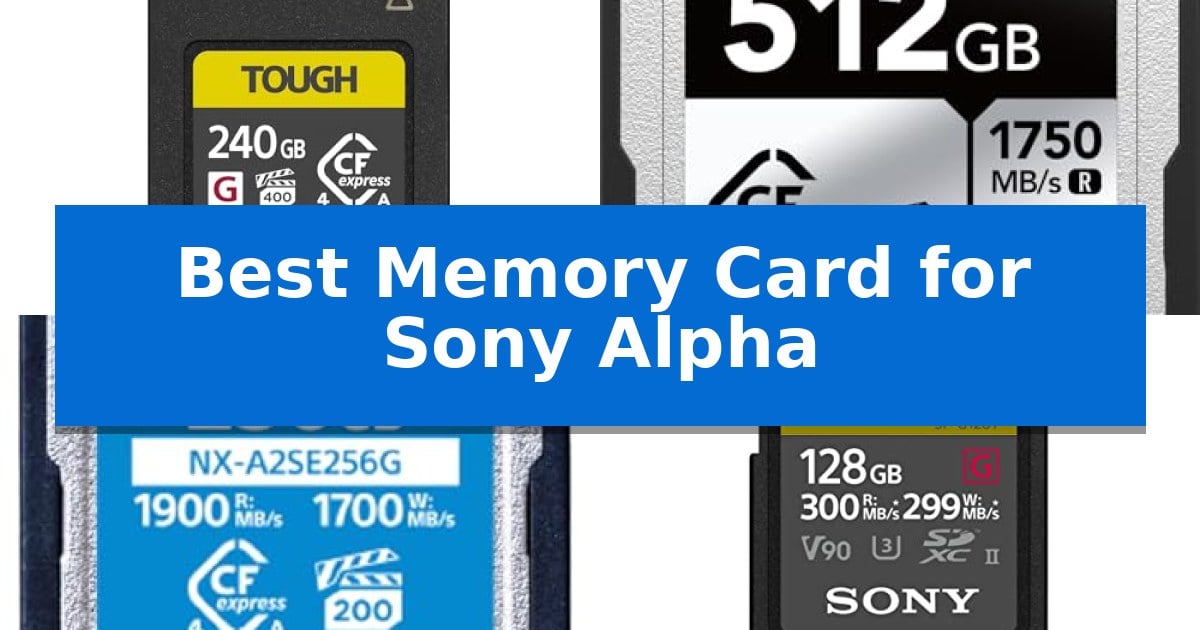
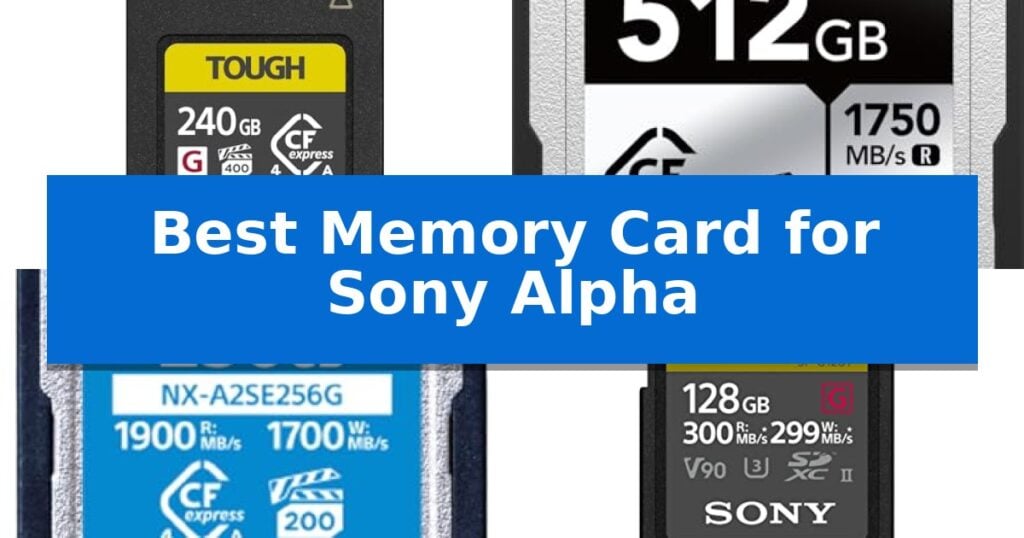
Choosing the right storage media is essential for maintaining the performance of modern high-resolution cameras. Whether you are capturing high-speed burst photography or recording demanding 8K video, the Best Memory Card for Sony Alpha must reliably handle massive data throughput without compromising your workflow.
Selecting the correct card depends on your specific camera model's interface, such as CFexpress Type A for maximum speed or UHS-II SD for versatile, high-capacity storage. We have evaluated the latest options to help you identify which media best aligns with your shooting requirements and technical constraints.
You may also want to compare Best Memory Card for Sony Action Cam 4K, Best Memory Card for Sony a6500, and Best Memory Card for Sony a6400.
Best Memory Card for Sony Alpha
Quick Comparison
| Product | Best For | Key Strength | Score |
|---|---|---|---|
| Sony CEA-G Series CFexpress Type A | Best Overall | Ultra-fast performance with up to 1800MB/s read and 1700MB/s write speeds. | 4.9 |
| Lexar Professional CFexpress Type A | Reliable 8K workflow performance | VPG200 rating ensures reliable sustained write speeds for 8K video. | 4.8 |
| Nextorage Japan CFexpress Type A | Buffer-free continuous shooting | VPG200 certification ensures stable, high-bitrate 4K/8K video recording. | 4.7 |
| Sony TOUGH-G Series SDXC UHS-II | Maximum durability for field work | One-piece molded construction provides superior bend strength. | 4.3 |
| Sony TOUGH-M Series SDXC UHS-II | Rugged reliability for 4K video | 18x stronger than standard UHS-II cards for enhanced physical durability. | 4.4 |
How We Chose
- Interface Compatibility: Verifying support for CFexpress Type A versus UHS-II SDXC standards.
- Sustained Write Speeds: Evaluating VPG (Video Performance Guarantee) ratings for consistent video recording.
- Durability Standards: Assessing physical construction, including water, dust, and shock resistance.
- Capacity Requirements: Considering storage needs for high-bitrate 4K/8K video and RAW image files.
- Transfer Efficiency: Analyzing maximum read speeds to streamline post-production workflows.
1 Sony CEA-G Series CFexpress Type A — Peak speed for high-bitrate recording
Capturing high-bitrate footage and high-resolution burst photography requires a storage medium capable of keeping pace with the advanced processing demands of modern cameras. The Sony CEA-G Series CFexpress Type A Memory Card CEA-G240T addresses this by utilizing next-gen PCIe Gen 4 technology to deliver robust data throughput for demanding professional workflows.
Engineered for reliability during intensive tasks, this card features enhanced heat dissipation to maintain stable performance during prolonged recording sessions. Its VPG400 certification provides a verified standard for high-bitrate video, ensuring consistent write speeds that prevent dropped frames or interruptions when shooting in 4K or 8K resolutions.
The physical design prioritizes resilience, utilizing a reinforced Tough construction to protect against the rigors of field use. This durability ensures that the card remains a dependable component for photographers and videographers who frequently operate in challenging environments where equipment integrity is paramount.
With read speeds reaching up to 1800MB/s and write speeds up to 1700MB/s, this card significantly reduces downtime during file transfers. This performance profile makes it a suitable choice for users who need to move large volumes of data quickly to maintain an efficient post-production pipeline.
Best for: Professional videographers and photographers requiring high-speed, reliable storage for 4K/8K video and continuous burst shooting on Sony Alpha cameras.
Skip if: Users who do not own a camera specifically compatible with the CFexpress Type A format or those who only require standard-speed storage for casual photography.
PROS
- Ultra-fast performance with up to 1800MB/s read and 1700MB/s write speeds.
- VPG400 certification guarantees stable high-bitrate video recording.
- Reinforced Tough construction provides enhanced physical durability.
- Enhanced heat dissipation supports consistent performance during long shoots.
CONS
- Proprietary CFexpress Type A format limits compatibility to specific high-end camera models.
2 Lexar Professional CFexpress Type A — Reliable 8K workflow performance
High-resolution video production and rapid burst photography demand storage media capable of keeping pace with modern camera sensors. The Lexar Professional CFexpress Type A is engineered to support intensive workflows, featuring sustained write speeds of up to 1300MB/s and a VPG200 rating that ensures consistent performance for 8K video recording.
Designed for professional environments, this card offers substantial capacity options up to 2TB, which minimizes the necessity for frequent card swaps during long shoots. When paired with the Lexar Professional CFexpress Type A USB 4.0 Reader, users can achieve maximum read speeds of 1750MB/s, significantly accelerating the offloading process of large data files.
Durability is a core component of its construction, as the card is IP68-rated for dust and water resistance and is drop-proof up to 5 meters. This rugged design provides peace of mind when operating in challenging field conditions, ensuring that captured media remains protected.
To further support long-term reliability, the product includes a limited lifetime warranty and access to the Lexar Recovery Tool, which assists in retrieving lost or deleted files. This combination of high-speed throughput and physical resilience makes it a specialized tool for Sony Alpha and FX camera users.
Best for: Professional filmmakers and photographers using Sony Alpha or FX cameras who require high-speed, reliable storage for 8K video and high-frame-rate burst shooting.
Skip if: Users who do not own a camera compatible with the CFexpress Type A standard or those who do not require the specific high-speed throughput and durability features for their workflow.
PROS
- VPG200 rating ensures reliable sustained write speeds for 8K video.
- IP68-rated for dust and water resistance with drop protection up to 5 meters.
- High-speed offloading capabilities when used with compatible USB 4.0 readers.
- Includes access to the Lexar Recovery Tool for file restoration.
CONS
- Requires a specific USB 4.0 reader to achieve maximum advertised read speeds.
- Higher cost compared to standard SD cards due to the specialized CFexpress Type A interface.
3 Nextorage Japan CFexpress Type A — Buffer-free continuous shooting
Capturing high-speed action and high-resolution video requires a storage medium that keeps pace with the demands of modern professional cameras. The Nextorage Japan CFexpress Type A is engineered to eliminate shutter locks and buffer delays, providing a reliable solution for photographers and videographers using Sony Alpha and FX series cameras.
Built on the advanced CFexpress 4.0 standard, this card delivers maximum read speeds of 1,900 MB/s and maximum write speeds of 1,700 MB/s. These speeds are designed to streamline post-production workflows by drastically reducing transfer times for massive RAW image files and heavy video data when paired with a compatible reader.
For video professionals, the card is VPG200 certified, guaranteeing a minimum sustained write speed of 400 MB/s. This ensures stable, drop-free recording for demanding 4K and 8K formats, such as XAVC S-I 4K. The card is also designed for resilience, having passed five strict durability tests, including shockproof, temperature-resistant (-12°C to 72°C), X-ray proof, anti-magnetic, and electrostatic-resistant standards.
Beyond its performance, the card offers long-term utility through its backward compatibility with CFexpress 2.0 host devices, allowing it to function at peak performance within existing hardware limits. Users also receive access to downloadable Memory Card File Rescue software to assist in recovering accidentally deleted or unreadable files.
Best for: Professional photographers and videographers requiring high-speed, buffer-free continuous shooting and stable 8K video recording on Sony Alpha or FX series cameras.
Skip if: Users who do not require the high-speed performance of CFexpress Type A and are satisfied with the lower cost and speed of standard SD cards.
PROS
- VPG200 certification ensures stable, high-bitrate 4K/8K video recording.
- High-speed performance with 1,900 MB/s read and 1,700 MB/s write speeds.
- Rugged durability tested against extreme temperatures, shock, and magnetic interference.
- Backward compatibility with existing CFexpress 2.0 host devices.
CONS
- Premium cost associated with high-performance CFexpress 4.0 technology.
- Requires a compatible CFexpress 4.0 reader to achieve maximum transfer speeds.
4 Sony TOUGH-G Series SDXC UHS-II — Maximum durability for field work
The Sony TOUGH-G Series SDXC UHS-II is engineered with a unique one-piece molded construction that provides 18 times the bend strength of standard SD cards. This design choice eliminates the traditional rib structure and write-protection switch, creating a sealed, monolithic form factor that prioritizes physical durability for demanding field environments.
This card is built for high-performance workflows, offering transfer speeds up to 300 MB/s and write speeds up to 299 MB/s. It is fully UHS-II, Class 10, and U3 compliant, making it suitable for 4K video recording and high-speed continuous burst photography. The card maintains functionality in extreme conditions with an operating temperature range of -13℉ to +185℉.
Reliability in adverse weather is supported by an IPX8 waterproof and IP6X dustproof rating. The sealed design protects internal components from moisture and debris, which is essential for outdoor photography where environmental exposure is frequent. While optimized for UHS-II cameras, the card remains backward compatible with UHS-I equipment, though performance will be limited to that interface's specifications.
Measuring 1.26 by 0.94 by 0.08 inches, this 128GB card fits standard SD slots while offering a robust physical profile. It is a specialized tool for users who require high-speed data throughput and physical resilience in a single, integrated package.
Best for: Professional photographers and videographers who require extreme physical durability and high-speed write performance for 4K recording and burst shooting.
Skip if: Users who primarily shoot in controlled studio environments or those who do not require the specific structural reinforcement of the TOUGH-G series may find more cost-effective standard SD options.
PROS
- One-piece molded construction provides superior bend strength.
- IPX8 waterproof and IP6X dustproof rating for environmental protection.
- Fast write speeds up to 299 MB/s for 4K video and burst mode.
- Ribless design removes fragile parts for increased longevity.
CONS
- Higher cost compared to standard SD cards due to specialized construction.
- Lack of a physical write-protection switch may be a workflow adjustment for some users.
5 Sony TOUGH-M Series SDXC UHS-II — Rugged reliability for 4K video
Reliability in the field often hinges on the physical resilience of your storage media, and the Sony TOUGH-M series SDXC UHS-II Card 128GB is engineered to withstand demanding environments. Featuring a specialized toughness design, this card is rated as 18x stronger than standard UHS-II cards, providing a robust solution for photographers who frequently operate in challenging outdoor conditions.
Beyond its physical durability, this card offers the technical throughput required for high-resolution workflows. It supports 4K video recording and delivers read speeds up to 277MB/s alongside write speeds up to 150MB/s. These specifications ensure efficient data transfer and stable performance when capturing high-bitrate video or rapid-fire bursts on a Sony Alpha camera.
The card is built to handle exposure to the elements, boasting IPX8 waterproof and IP66 dustproof ratings. This protection is critical for creators who prioritize data integrity while shooting in unpredictable weather or dusty locations. With a 128GB capacity, it provides ample space for extended sessions without the need for frequent card swaps.
Backed by a five-year limited warranty, this storage solution balances high-speed performance with structural integrity. It is a practical choice for those who require a dependable, ruggedized medium that minimizes the risk of mechanical failure during critical shoots.
Best for: Photographers and videographers who require high-speed data transfer and extreme physical durability for outdoor or field-based 4K video production.
Skip if: Users who do not require ruggedized, waterproof storage or those who do not utilize UHS-II compatible hardware may find more cost-effective standard SD options.
PROS
- 18x stronger than standard UHS-II cards for enhanced physical durability.
- IPX8 waterproof and IP66 dustproof ratings for protection in harsh environments.
- Supports 4K video recording with reliable write speeds.
- Includes a five-year limited warranty.
CONS
- Higher cost relative to standard, non-ruggedized SD cards.
Best Memory Card for Sony Alpha Buying Guide
Understanding Memory Card Standards
Sony Alpha cameras utilize two primary types of high-performance memory: CFexpress Type A and SDXC UHS-II. CFexpress Type A cards are designed for the most demanding tasks, offering significantly higher data transfer rates that are necessary for high-bitrate video recording and clearing camera buffers during rapid continuous shooting.
SDXC UHS-II cards remain a versatile choice for many photographers and videographers. While they generally offer lower maximum speeds compared to CFexpress, they are often more affordable and provide sufficient performance for standard 4K video and high-resolution still photography, provided the card meets the required V90 or V60 speed class.
The Importance of VPG Ratings
The Video Performance Guarantee (VPG) is a critical specification for videographers. A VPG rating, such as VPG200 or VPG400, ensures a minimum sustained write speed, which prevents dropped frames during high-bitrate recording. This is particularly important when shooting in formats like XAVC S-I.
Without a certified VPG rating, a card might advertise high peak speeds but fail to maintain the necessary throughput during long recording sessions. Always check your camera's manual to see if a specific VPG level is recommended for the recording modes you intend to use.
Durability and Field Reliability
For photographers working in challenging environments, physical durability is as important as speed. Many professional-grade cards feature monolithic construction or reinforced shells that provide increased resistance to bending, drops, and environmental hazards like dust and moisture.
Cards with IP68 ratings or specific 'Tough' branding are engineered to protect your data against physical mishaps. If you frequently shoot outdoors, in inclement weather, or in remote locations, investing in a card with these rugged specifications is a practical safeguard for your work.
Managing Data Transfer Times
High-resolution images and long video files create massive amounts of data that must eventually be moved to a computer. The maximum read speed of your memory card directly influences how quickly you can offload your footage. Using a compatible, high-speed card reader is just as important as the card itself.
If you are using a CFexpress 4.0 card, ensure your card reader supports the same standard to take full advantage of the potential transfer speeds. This can reduce the time spent waiting for file transfers, allowing you to move from the field to the editing suite more efficiently.
Capacity and Workflow Strategy
Choosing the right capacity involves balancing cost with the need to avoid changing cards mid-shoot. For 8K video or extensive burst photography, larger capacities like 512GB or 1TB are often necessary to prevent interruptions. However, some professionals prefer multiple smaller cards to mitigate the risk of data loss on a single unit.
Consider your typical shooting volume and the file sizes produced by your specific camera settings. If you frequently shoot long-form video, prioritize higher capacity; if you shoot primarily still images, you may find that a smaller, faster card better suits your needs.
Frequently Asked Questions
Can I use a CFexpress Type A card in an SD card slot?
No, CFexpress Type A and SD cards have different physical shapes and electrical interfaces. You must use the card type that matches your camera's specific slot configuration.
What does the V90 rating mean on SD cards?
The V90 rating indicates a minimum sustained write speed of 90MB/s, which is sufficient for most 4K video recording modes found in modern Alpha cameras.
Do I need a special reader for CFexpress Type A cards?
Yes, you need a dedicated CFexpress Type A card reader to achieve the high-speed transfer rates advertised by these cards.
Is it worth paying more for 'Tough' branded cards?
If you frequently work in harsh environments, the added physical protection against water, dust, and bending is a valuable investment for data security.
Will a faster card make my camera shoot faster?
A faster card helps clear the camera's buffer more quickly during continuous shooting, allowing you to maintain a high frame rate for longer, but it does not increase the camera's native burst speed.
Conclusion: Our Top Pick
For those requiring the absolute best in performance and reliability, the Sony CEA-G Series CFexpress Type A stands out as the premier choice. Its VPG400 certification and PCIe Gen 4 technology provide the stable, high-speed throughput necessary for professional 4K and 8K workflows, ensuring you never miss a frame due to buffer limitations.
While other options like the Lexar Professional or Nextorage cards offer excellent alternatives for specific budget or capacity needs, the Sony CEA-G Series remains the benchmark for compatibility and performance within the Sony Alpha ecosystem. It is a robust, high-speed solution for creators who cannot afford to compromise on data integrity during critical shoots.