
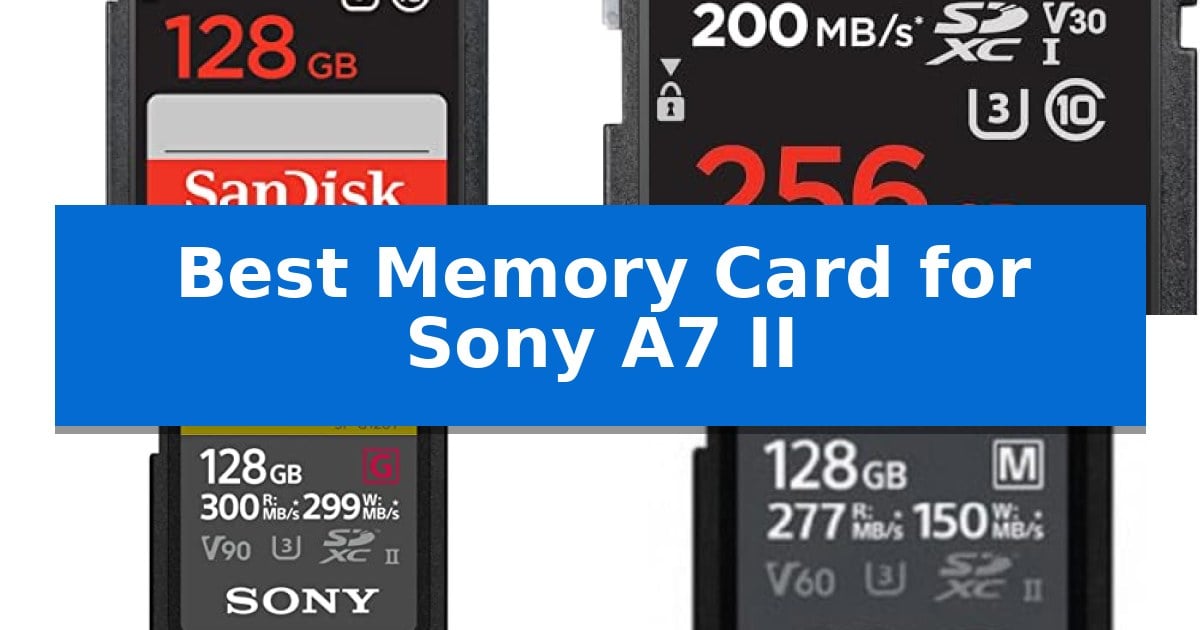
Finding the right storage for your camera is essential to ensuring you never miss a shot during critical moments. When searching for the Best Memory Card for Sony A7 II, you need a balance of speed and reliability that matches the camera's specific requirements for both still photography and video capture.
The Sony A7 II demands a card that can handle its data output without bottlenecking your workflow. Whether you are capturing high-resolution RAW files or recording video, selecting the correct media ensures your camera operates at its peak potential. We have analyzed current market options to help you identify the most suitable storage solution for your specific shooting style.
You may also want to compare Best Memory Card for Security Camera, Best Memory Card for Samsung A50, and Best Memory Card for RAW Photos.
Best Memory Card for Sony A7 II
Quick Comparison
| Product | Best For | Key Strength | Score |
|---|---|---|---|
| SanDisk Extreme Pro SD Card | Best Overall | UHS Speed Class 3 (U3) and V30 ratings for 4K UHD video support | 4.9 |
| SANDISK 256GB Extreme PRO SD Memory Card | Fast Offload for Quick Workflow | Fast offload speeds up to 200MB/s with compatible hardware. | 4.4 |
| Sony TOUGH-G SD Card | Rugged Build for Field Shoots | One-piece molded construction provides 18x greater bend strength than standard cards. | 4.4 |
| Sony TOUGH-M SD Card | Durable Protection for Daily Use | 18x stronger than standard cards for superior physical durability. | 4.8 |
| Lexar Silver SD Card | Smooth 4K Recording Performance | 225MB/s read speed for fast file offloading | 4.6 |
How We Chose
- Compatibility with Sony Alpha series mirrorless camera interfaces.
- Sustained write speeds required for continuous burst mode and video recording.
- Read speeds that facilitate efficient file transfers to your computer.
- Physical durability ratings, including water, dust, and shock resistance.
- Capacity options that align with typical storage needs for high-resolution imagery.
1 SanDisk Extreme Pro SD Card — Reliable Choice for Alpha Series
Reliability during long shooting sessions is essential for any photographer, and the SanDisk 128GB SD Extreme Pro Memory Card is engineered to meet the demands of high-resolution image capture and 4K video recording. Designed specifically for compatibility with the Sony Alpha a7 series, this card ensures that your camera remains ready for the next shot without unnecessary delays.
This memory card features UHS Speed Class 3 (U3) and Video Speed Class 30 (V30) ratings, which are critical specifications for maintaining steady performance when recording 4K UHD video. With read speeds up to 200MB/s and write speeds reaching 90MB/s, it provides the necessary throughput to move large files from the card to your computer efficiently, streamlining your post-production workflow.
The included bundle adds practical value by providing an Everything But Stromboli Multi Slot Card Reader, allowing for immediate file transfers across various devices. This combination is tailored for professionals who require a dependable storage solution that integrates seamlessly with their existing Sony Alpha equipment, ensuring that both the card and the reader are ready for immediate use.
Backed by a Limited Lifetime Warranty, this storage solution offers long-term peace of mind for those who rely on their gear for consistent performance. By balancing high-speed data handling with robust compatibility, it serves as a foundational component for any photographer looking to maximize the capabilities of their Sony camera system.
Best for: Photographers and videographers using Sony Alpha mirrorless cameras who require reliable 4K video recording and efficient file transfer speeds.
Skip if: Users who do not require high-speed 4K video recording or those who already possess a dedicated multi-slot card reader may find the bundled accessories unnecessary.
PROS
- UHS Speed Class 3 (U3) and V30 ratings for 4K UHD video support
- High read speeds up to 200MB/s for faster post-production workflows
- Bundle includes a multi-slot card reader for immediate compatibility
- Limited Lifetime Warranty for long-term reliability
CONS
- Write speeds capped at 90MB/s, which may be a limiting factor for extremely high-bitrate burst photography
2 SANDISK 256GB Extreme PRO SD Memory Card — Fast Offload for Quick Workflow
Reliable storage is essential for capturing high-resolution imagery and 4K video with your camera. The SANDISK 256GB Extreme PRO SD Memory Card is engineered to support demanding workflows, offering UHS Speed Class 3 (U3) and Video Speed Class 30 (V30) ratings to ensure consistent performance during sustained video capture.
Designed for efficiency, this card utilizes SanDisk QuickFlow Technology to achieve read speeds of up to 200MB/s. This feature significantly reduces the time required to transfer large files from the card to your computer, provided you use a compatible reader like the SanDisk Professional PRO-READER. For active shooting, it supports write speeds of up to 140MB/s, which is well-suited for sequential burst mode photography.
With a generous 256GB capacity, this memory card provides ample space for long shooting sessions without the need to swap media frequently. It is built to handle the data-intensive requirements of 4K UHD video recording, making it a practical choice for creators who prioritize both speed and storage reliability in their gear bag.
The card is backed by a lifetime limited manufacturer warranty, offering long-term peace of mind for your professional or hobbyist photography needs. By balancing high-speed offloading capabilities with robust video recording standards, it serves as a dependable foundation for your camera setup.
Best for: Photographers and videographers who need reliable, high-capacity storage for 4K video and burst photography with fast file transfer capabilities.
Skip if: Users who do not have a compatible high-speed card reader will not be able to utilize the maximum 200MB/s offload speeds provided by QuickFlow technology.
PROS
- Fast offload speeds up to 200MB/s with compatible hardware.
- V30 and U3 ratings ensure stable 4K UHD video recording.
- Large 256GB capacity reduces the need for frequent card changes.
- Lifetime limited warranty for long-term reliability.
CONS
- Maximum read speeds require a compatible host device or reader.
- Performance may vary based on specific host device interface limitations.
3 Sony TOUGH-G SD Card — Rugged Build for Field Shoots
Reliability in the field often hinges on the physical integrity of your storage media, and the Sony TOUGH-G series SDXC UHS-II Card 128GB addresses this with a unique one-piece molded construction. By utilizing high-hardness materials, this card achieves a bend strength 18 times greater than the standard SD specification, ensuring it remains functional under demanding environmental conditions.
Beyond its structural resilience, this card is engineered for high-performance workflows. It features a ribless, no-write-protection-switch design, which removes common points of failure found in traditional memory cards. This design choice prioritizes durability, making it a robust companion for photographers who frequently swap cards in challenging locations.
Performance-wise, the card supports transfer speeds up to 300 MB/s and write speeds up to 299 MB/s. These specifications are well-suited for 4K video recording and continuous burst mode shooting, providing the necessary throughput for high-resolution data capture. It is fully UHS-II, Class 10, and U3 compliant, ensuring compatibility with modern camera standards.
The Sony TOUGH-G series SDXC UHS-II Card 128GB is rated IPX8 for waterproofing and IP6X for dustproofing, allowing it to operate in temperatures ranging from -13℉ to +185℉. While it delivers peak performance in UHS-II compatible cameras, it remains backward compatible with UHS-I equipment, offering versatility across different camera bodies.
Best for: Photographers and videographers requiring extreme physical durability and high-speed write performance for 4K recording and burst shooting.
Skip if: Users who require a physical write-protection switch for their specific workflow or those using legacy equipment that does not benefit from UHS-II speed tiers.
PROS
- One-piece molded construction provides 18x greater bend strength than standard cards.
- IPX8 waterproof and IP6X dustproof ratings ensure reliability in harsh environments.
- High-speed performance with up to 299 MB/s write speeds supports 4K video and burst mode.
- Ribless design eliminates fragile parts that are prone to breaking.
CONS
- No physical write-protection switch may be a limitation for specific manual workflows.
- Premium pricing reflects the specialized rugged construction compared to standard SD cards.
4 Sony TOUGH-M SD Card — Durable Protection for Daily Use
Reliability in the field often hinges on the physical integrity of your storage media, and the Sony TOUGH-M series SDXC UHS-II Card 128GB is engineered specifically to withstand demanding environments. Featuring a specialized toughness design, this card is rated to be 18x stronger than standard UHS-II alternatives, providing a robust solution for photographers who frequently swap cards or work in unpredictable conditions.
Beyond its physical resilience, this card is built to handle high-resolution workflows. It supports 4K video recording and offers performance speeds of up to 277MB/s read and 150MB/s write. These specifications ensure that your camera can clear its buffer efficiently, allowing for a smoother shooting experience when capturing high-bitrate video or rapid-fire bursts.
Environmental protection is a core component of its design, with IPX8 waterproof and IP66 dustproof ratings. These features offer peace of mind when shooting outdoors, ensuring that your data remains shielded from moisture and debris. The card is backed by a five-year limited warranty, reflecting the manufacturer's commitment to long-term durability.
Integrating this card into your workflow is straightforward, as it maintains compatibility with standard SDXC slots while providing the advanced performance of the UHS-II interface. Its 128GB capacity provides ample space for extended shooting sessions, reducing the need for frequent card changes during critical moments.
Best for: Photographers and videographers who prioritize physical durability and reliable performance in challenging outdoor environments.
Skip if: Users who only require basic storage for casual photography and do not need the extra physical reinforcement or high-speed UHS-II performance.
PROS
- 18x stronger than standard cards for superior physical durability.
- IPX8 waterproof and IP66 dustproof ratings for environmental protection.
- Supports 4K video recording with fast read and write speeds.
- Includes a five-year limited warranty.
CONS
- Higher cost compared to standard SD cards due to the specialized tough construction.
5 Lexar Silver SD Card — Smooth 4K Recording Performance
The Lexar 128GB Silver SD Memory Card is engineered to support demanding workflows, offering a maximum read speed of 225MB/s to significantly reduce file transfer times. This card is built for reliability in various environments, featuring a design that is wearproof, drop-proof, temperature-proof, x-ray-proof, shockproof, magnetic-proof, and vibration-resistant.
For photographers and videographers using the Sony A7 II, this card provides a 160MB/s maximum write speed, ensuring the camera remains ready for the next shot without unnecessary delays. It carries a V30 speed class rating, which confirms its capability to support 4K 60FPS video recording, providing the consistent data throughput required for high-quality video capture.
Compatibility is a primary focus, with the card designed to integrate seamlessly across a wide range of camera systems, including Sony, Canon, and Nikon. Its 128GB capacity offers ample space for high-resolution images and extended video clips, making it a versatile choice for enthusiasts and professionals alike.
Backed by a Lifetime Limited Warranty, this memory card is constructed to withstand the rigors of field use. Whether you are working in a studio or on location, the combination of high-speed performance and physical durability makes it a dependable component for your camera setup.
Best for: Photographers and videographers who need a reliable, durable, and high-speed storage solution for 4K video recording and high-resolution photography.
Skip if: Users who require specialized UHS-II or V60/V90 speed classes for high-bitrate professional cinema workflows beyond the V30 standard.
PROS
- 225MB/s read speed for fast file offloading
- V30 rating for stable 4K 60FPS video recording
- Comprehensive durability features including shock and temperature resistance
- Lifetime Limited Warranty for long-term peace of mind
CONS
- V30 speed class may limit performance for extremely high-bitrate professional video formats
Best Memory Card for Sony A7 II Buying Guide
Understanding SD Card Speed Classes
Speed classes are critical indicators of how a card handles data. For the Sony A7 II, look for UHS Speed Class 3 (U3), which guarantees a minimum write speed of 30MB/s. This is the baseline requirement for reliable 4K or high-bitrate video recording and prevents the camera from stopping mid-capture.
Additionally, Video Speed Class (V30) ratings provide further assurance for videographers. A V30 card is designed to maintain a consistent write speed of at least 30MB/s, ensuring that your video files are written correctly without dropped frames or corruption during long recording sessions.
The Importance of Read and Write Speeds
While write speed dictates how quickly your camera can save your photos and videos, read speed determines how fast you can offload those files to your editing workstation. Cards with high read speeds, such as those utilizing QuickFlow Technology, can significantly reduce the time spent waiting for large batches of files to transfer.
For photographers shooting in sequential burst mode, a higher write speed is vital. It allows the camera's buffer to clear faster, enabling you to keep shooting without waiting for the camera to finish writing data to the card. This is particularly useful for action, sports, or wildlife photography.
Durability and Environmental Protection
Photography often takes you into challenging environments, from dusty trails to humid coastal areas. Many modern SD cards feature ruggedized designs that are waterproof, dustproof, shockproof, and temperature-proof. These features protect your data from physical damage that could otherwise lead to file loss.
A monolithic, one-piece molded construction is a standout feature for durability. Cards built this way are significantly more resistant to bending and impact compared to standard SD cards, providing a critical layer of security for your professional or personal work in the field.
Capacity Considerations
Choosing the right capacity depends on your file format and shooting frequency. If you primarily shoot in RAW format, your files will be significantly larger than JPEGs, requiring cards with 128GB or 256GB of space to avoid constant card swaps.
For those who frequently record video, higher capacities are almost mandatory. A 256GB card allows for extended recording times, which is essential for events or long-form projects where stopping to change media is not an option.
Compatibility and Future-Proofing
Always ensure your card is compatible with the UHS-I or UHS-II interface supported by your camera. While the Sony A7 II is compatible with various standards, using a card that exceeds the camera's internal bus speed is acceptable, as the card will simply operate at the camera's maximum supported speed.
Investing in a high-quality card today often means it will remain useful if you upgrade your camera body in the future. Opting for reputable brands with lifetime limited warranties provides peace of mind that your investment is protected against manufacturing defects.
Frequently Asked Questions
Does the Sony A7 II support UHS-II cards?
The Sony A7 II is primarily designed for UHS-I cards. While it can physically accept and use UHS-II cards, it will operate them at UHS-I speeds. You will still benefit from the fast read speeds of UHS-II cards when offloading files to a compatible card reader.
What is the minimum speed class I should look for?
For the best experience with the Sony A7 II, you should use at least a UHS Speed Class 3 (U3) card. This ensures the card can handle the camera's data throughput for high-quality video and burst mode photography.
Are rugged SD cards worth the extra cost?
If you shoot outdoors, in unpredictable weather, or travel frequently, the added protection of waterproof, shockproof, and dustproof cards is a valuable insurance policy for your data.
How often should I format my SD card?
It is recommended to format your SD card in-camera after you have successfully backed up your files to a computer. This helps maintain the file system structure and reduces the risk of card errors.
Can I use a 256GB card in my Sony A7 II?
Yes, the Sony A7 II supports high-capacity SDXC cards, including 256GB and larger, provided they are formatted correctly by the camera.
Conclusion: Our Top Pick
Selecting the right storage is a fundamental step in optimizing your camera's performance. Based on our analysis of reliability and compatibility, the SanDisk Extreme Pro SD Card stands out as the most dependable choice for the Sony A7 II. Its consistent performance with UHS-I standards and inclusion of a card reader make it a practical, all-in-one solution for photographers.
While other options offer specialized rugged features or higher theoretical speeds, the SanDisk Extreme Pro provides the necessary stability for daily shooting. It effectively balances the demands of the Sony A7 II with the need for efficient post-production workflows, making it our top recommendation for your kit.