
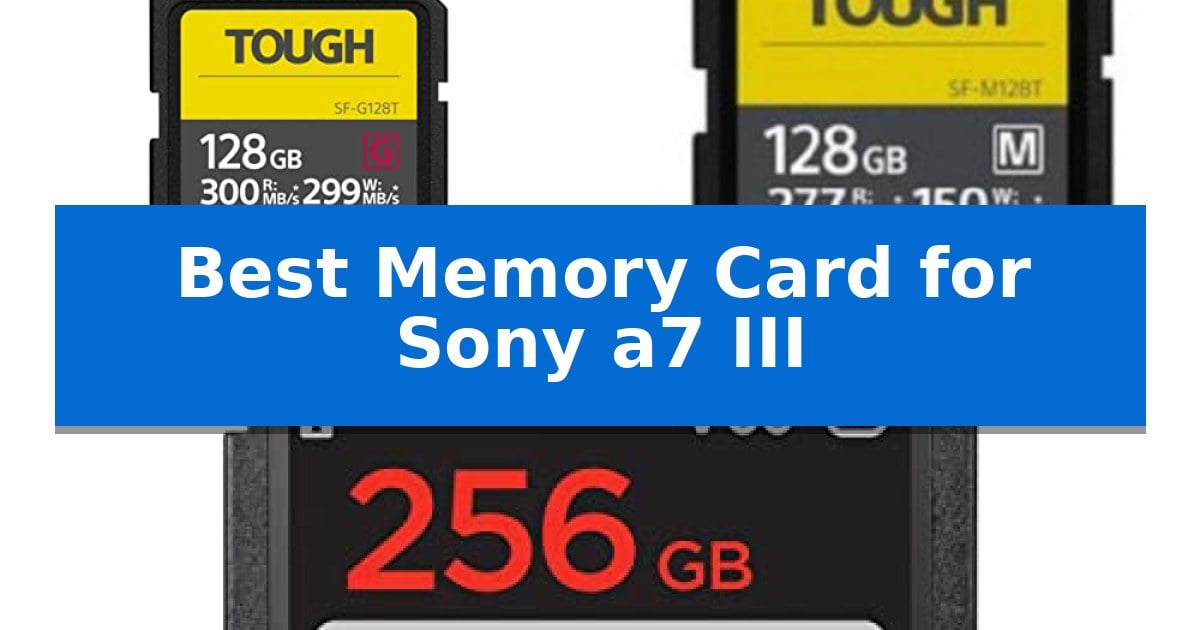
Finding the Best Memory Card for Sony a7 III requires balancing high-speed data throughput with the physical reliability needed for demanding field conditions. Because this camera supports UHS-II standards, choosing the right media directly impacts your ability to clear the buffer during continuous burst shooting and ensures stable write speeds for high-bitrate 4K video recording.
We have evaluated current SDXC options to help you identify which cards provide the necessary performance for your specific workflow. Whether you prioritize extreme environmental protection or high-capacity storage for long-form projects, the following selections focus on the technical specifications that matter most for your camera's performance.
You may also want to compare Best Memory Card for Sony A7 II, Best Memory Card for Security Camera, and Best Memory Card for Samsung A50.
Best Memory Card for Sony a7 III
Quick Comparison
| Product | Best For | Key Strength | Score |
|---|---|---|---|
| Sony TOUGH-G SDXC UHS-II Card | Best Overall | Extreme physical durability with one-piece molded construction. | 4.9 |
| Sony TOUGH-M SDXC UHS-II Card | Reliable speed for 4K video | 18x stronger than standard UHS-II cards for enhanced physical durability. | 4.8 |
| SanDisk Extreme PRO SD UHS-II Card | High-speed transfers for pros | V60 Video Speed Class ensures stable 6K and 4K UHD video recording. | 4.3 |
How We Chose
- Interface Compatibility: Verifying UHS-II support to ensure maximum read and write performance.
- Write Speed Consistency: Assessing sustained write speeds necessary for 4K video and rapid buffer clearing.
- Environmental Durability: Evaluating physical construction, including water and dust resistance ratings.
- Capacity Options: Reviewing available storage tiers to match different project lengths.
- Reliability Features: Identifying design choices like ribless construction that reduce mechanical failure points.
1 Sony TOUGH-G SDXC UHS-II Card — Maximum durability for pro workflows
The Sony TOUGH-G series SDXC UHS-II Card is engineered for demanding environments, featuring the world's first one-piece molded construction that provides 18 times greater bend strength than standard SD cards. This design choice eliminates traditional ribs and the write-protection switch, removing fragile parts that are prone to breakage during intensive field use.
Built for high-performance workflows, this card supports UHS-II, Class 10, and U3 standards, delivering transfer speeds up to 300 MB/s and write speeds up to 299 MB/s. These specifications make it a capable choice for 4K video recording and high-speed continuous burst mode shooting, ensuring data is captured and moved efficiently.
Durability is a core focus, as the card is rated IPX8 waterproof and IP6X dustproof. The monolithic, completely sealed structure allows the card to operate in temperatures ranging from -13°F to +185°F, providing reliability in varied environmental conditions.
While optimized for UHS-II compatible cameras, the card maintains backward compatibility with UHS-I equipment. When used in older devices, it functions at UHS-I speeds, reaching up to 95 MB/s for transfers and 90 MB/s for writing, ensuring versatility across your existing gear.
Best for: Professional photographers and videographers requiring extreme physical durability and high-speed write performance for 4K recording and burst shooting.
Skip if: Users who do not require high-speed UHS-II performance or extreme environmental protection may find more cost-effective standard SD cards sufficient for their needs.
PROS
- Extreme physical durability with one-piece molded construction.
- High-speed performance with up to 299 MB/s write speeds.
- IPX8 waterproof and IP6X dustproof rating for harsh environments.
- Ribless design eliminates common failure points like the write-protection switch.
CONS
- Premium price point compared to standard UHS-I memory cards.
- Lacks a physical write-protection switch, which may be a preference for some users.
2 Sony TOUGH-M SDXC UHS-II Card — Reliable speed for 4K video
Reliability in the field often hinges on the physical resilience of your storage media, and the Sony TOUGH-M series SDXC UHS-II Card 128GB addresses this with a specialized toughness design that is rated 18x stronger than standard UHS-II cards. This construction is intended to survive demanding environments, providing a robust foundation for capturing high-resolution imagery and video.
Beyond its physical durability, this card features an IPX8 waterproof and IPX6 dustproof rating, protecting data against common environmental hazards encountered during outdoor shoots. For videographers, it supports 4K video recording, ensuring the sustained write performance necessary to handle the high data rates required by the Sony a7 III.
The card provides read speeds up to 277MB/s and write speeds up to 150MB/s. These specifications facilitate efficient file transfers to your computer, reducing downtime after a long day of shooting. The 128GB capacity offers a balance between storage space and the need for frequent card swaps during extended sessions.
Backed by a five-year limited warranty, this card is built for professionals who require consistent performance and protection for their work. Its integration with the UHS-II interface ensures it meets the high-speed demands of modern mirrorless camera systems, making it a dependable choice for those who prioritize both speed and hardware longevity.
Best for: Photographers and videographers who need a durable, high-speed storage solution for demanding outdoor environments and 4K recording.
Skip if: Users who do not require extreme physical durability or UHS-II speeds and prefer a more budget-friendly, standard-grade SD card.
PROS
- 18x stronger than standard UHS-II cards for enhanced physical durability.
- IPX8 waterproof and IPX6 dustproof ratings for environmental protection.
- Supports 4K video recording with reliable write speeds.
- Five-year limited warranty provides long-term support.
CONS
- Higher cost compared to standard, non-tough SDXC cards.
- 150MB/s write speed may be a limiting factor for extremely high-bitrate burst shooting compared to higher-tier V90 cards.
3 SanDisk Extreme PRO SD UHS-II Card — High-speed transfers for pros
Efficient workflow for photographers often hinges on the speed of data transfer, and the SanDisk 256GB Extreme PRO SD Memory Card addresses this with read speeds reaching up to 280MB/s. Designed for those who demand reliability during intensive shoots, this card ensures that offloading high-resolution files from your camera to a computer happens with minimal downtime.
Built to support professional workflows, this card carries a Video Speed Class 60 (V60) rating. This specification guarantees a sustained video capture rate of 60MB/s, which is essential for recording 6K and 4K UHD footage without dropped frames. Whether you are capturing time-lapse sequences or continuous burst mode photography, the card supports write speeds up to 150MB/s to keep pace with your camera's buffer.
With a substantial 256GB capacity, you can store a significant volume of high-resolution images and cinema-quality video on a single card. The UHS-II interface provides the necessary bandwidth for modern mirrorless and cinema cameras, making it a robust choice for prosumers who require consistent performance across varied shooting environments.
The SanDisk Extreme PRO SD Memory Card is backed by a lifetime limited manufacturer warranty, emphasizing its role as a long-term tool for your kit. Its design is optimized for real-time recording, ensuring that your data remains secure while you focus on the composition and technical aspects of your shoot.
Best for: Prosumers and professionals requiring reliable, high-speed storage for 6K/4K video recording and continuous burst photography.
Skip if: Users of older cameras that do not support the UHS-II interface or those who do not require the high-speed transfer capabilities of a V60-rated card.
PROS
- V60 Video Speed Class ensures stable 6K and 4K UHD video recording.
- 280MB/s read speeds significantly reduce file offload times.
- 150MB/s write speeds support demanding continuous burst mode shooting.
- 256GB capacity provides ample space for high-resolution media.
CONS
- UHS-II interface may be overkill for cameras lacking compatible hardware slots.
Best Memory Card for Sony a7 III Buying Guide
Understanding UHS-II Standards
The Sony a7 III utilizes the UHS-II interface, which features an extra row of pins to enable significantly faster data transfer rates compared to standard UHS-I cards. To take full advantage of your camera's burst mode and high-resolution video capabilities, you must use a card that supports this protocol.
While UHS-II cards are backward compatible with UHS-I slots, you will only achieve the maximum performance when the card is paired with a compatible device. Always check for the UHS-II logo and the appropriate Video Speed Class (V60 or V90) to ensure your card can handle the sustained data rates required for your specific recording settings.
The Importance of Write Speed
Write speed is the most critical factor for photographers who frequently use continuous burst mode. A card with a high write speed allows the camera's buffer to clear rapidly, meaning you can keep shooting without waiting for the camera to finish writing data to the card.
For videographers, the Video Speed Class rating is the primary indicator of performance. A V60 or V90 rating guarantees a minimum sustained write speed, which is essential for preventing dropped frames or recording errors during high-bitrate 4K video capture.
Durability and Physical Design
Professional photography often takes place in unpredictable environments. Cards with monolithic, one-piece molded construction offer superior bend strength and impact resistance compared to standard plastic-cased SD cards.
Features such as IPX8 waterproof and IP6X dustproof ratings provide an extra layer of security for your data. Additionally, designs that remove fragile components, such as the ribless write protection switch, can significantly reduce the risk of physical damage to the card during frequent handling.
Capacity Considerations
Choosing the right capacity depends on your file format and shooting frequency. High-resolution RAW files and 4K video consume storage space rapidly, making 128GB or 256GB cards common choices for professionals who prefer not to swap media mid-shoot.
It is often safer to use two medium-capacity cards rather than one massive card. This strategy provides a built-in redundancy, ensuring that if one card fails or is lost, you do not lose the entirety of your project's footage.
Reliability and Longevity
Memory cards are subject to wear and tear over time. Look for cards that offer a limited warranty, as this often reflects the manufacturer's confidence in the card's endurance and build quality.
Regularly formatting your cards in-camera—rather than on a computer—helps maintain the file system integrity and can prevent potential corruption issues. Always keep your firmware updated to ensure the best compatibility between your camera and the latest high-performance memory media.
Frequently Asked Questions
Can I use a UHS-I card in my Sony a7 III?
Yes, the Sony a7 III is backward compatible with UHS-I cards. However, you will be limited to UHS-I speeds, which may cause the camera's buffer to fill up faster during burst shooting and may not support the highest bitrate video settings.
What does the V90 rating mean?
The V90 rating indicates a minimum sustained write speed of 90MB/s. This is the gold standard for high-bitrate 4K video recording, ensuring the card can keep up with the data stream without dropping frames.
Why is a ribless design better?
A ribless design removes the thin plastic ribs between the contact pins on the back of the SD card. These ribs are often the first part of a card to break; removing them creates a more durable, solid structure that is less prone to physical damage.
How often should I format my SD card?
It is best practice to format your card in the camera after you have successfully backed up your files to a computer or external drive. This clears the card's file system and prepares it for the specific directory structure of your camera.
Does the Sony a7 III support 256GB cards?
Yes, the Sony a7 III supports high-capacity SDXC cards, including 256GB and larger, provided they are formatted correctly. Always check your camera's manual for the latest firmware compatibility updates.
Conclusion: Our Top Pick
For photographers and videographers who demand the highest level of reliability and speed, the Sony TOUGH-G SDXC UHS-II Card stands out as the premier choice. Its one-piece molded construction provides exceptional bend strength and environmental protection, while its high-speed performance ensures you never miss a shot due to buffer limitations.
While other options offer excellent value, the durability and consistent write speeds of this card make it an essential tool for professional workflows. By investing in this robust media, you gain peace of mind knowing your data is protected against the physical rigors of daily field use.