
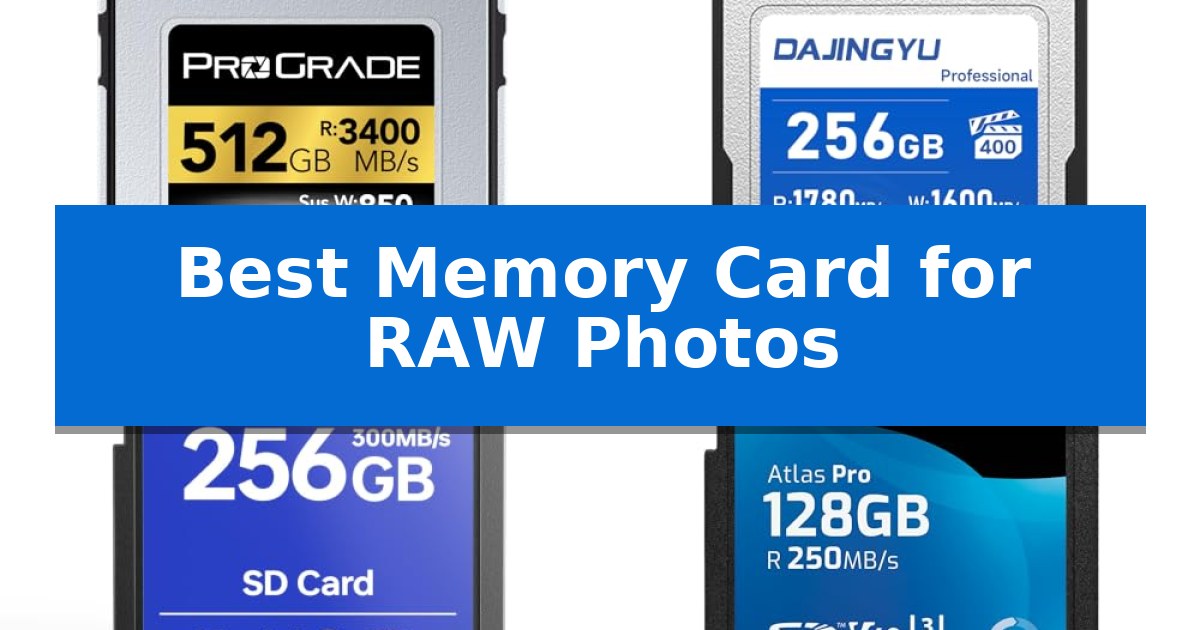
Capturing high-resolution RAW images requires a storage medium that can keep pace with your camera's high-speed buffer. When shooting in continuous burst mode or recording high-bitrate video, a slow card can lead to dropped frames and frustrating delays that interrupt your creative process.
Selecting the Best Memory Card for RAW Photos depends on your camera's specific interface, whether it utilizes CFexpress Type A, Type B, or high-speed SD UHS-II slots. We have analyzed current storage solutions to help you identify the right card for your specific shooting requirements and camera compatibility.
You may also want to compare Best Memory Card for Professional Drone Photography, Best Memory Card for Portrait Photography, and Best Memory Card for Poco F1.
Best Memory Card for RAW Photos
Quick Comparison
| Product | Best For | Key Strength | Score |
|---|---|---|---|
| ProGrade Digital Gold CFexpress Type B | Best Overall | Sustained write speed of 850MB/s for reliable RAW burst shooting. | 4.9 |
| DAJINGYU CFexpress Type A | High-Bitrate RAW Capture | VPG400 certification ensures stable, high-bitrate 4K and 8K video recording. | 4.6 |
| DIGIERA LSU200 SDXC UHS-II | Fast UHS-II for Pro Workflows | UHS-II interface supporting high-speed read and write performance. | 4.6 |
| OWC Atlas Pro SDXC UHS-II | Reliable Sustained Write Performance | Minimum 60MB/s sustained write speed ensures consistent performance. | 4.4 |
| Lexar Silver SD Memory Card | Balanced Speed for Enthusiasts | Fast 225MB/s read speeds for efficient file offloading. | 4.5 |
How We Chose
- Interface Compatibility: Ensuring the card matches the specific slot requirements of your camera, such as CFexpress Type B or SD UHS-II.
- Sustained Write Speed: Prioritizing cards that maintain consistent data transfer rates to prevent buffer bottlenecks during burst shooting.
- Video Performance Standards: Verifying VPG or speed class ratings that guarantee stability for high-bitrate 4K and 8K recording.
- Durability Specifications: Assessing physical resistance to environmental factors like temperature, shock, and X-rays for reliable field use.
- Data Integrity Features: Considering the inclusion of recovery software or specific hardware-level protections for long-term file safety.
1 ProGrade Digital Gold CFexpress Type B — Unmatched Speed for Burst Shooting
Capturing high-resolution RAW images requires a storage medium capable of handling massive data throughput without bottlenecking your workflow. The ProGrade Digital 512GB CFexpress 4.0 Type B Memory Card (Gold) is engineered specifically for this demand, featuring a sustained write speed of 850MB/s to ensure your burst photography remains fluid and free of dropped frames.
Beyond its primary role in burst shooting, this card is optimized for high-bitrate video recording, supporting 4K, 6K, and 8K resolutions. Its architecture leverages PCIe 1.4c and NVMe technology to achieve read speeds up to 3400MB/s, significantly reducing the time required to transfer large files to your workstation. The card is also backward compatible with XQD devices, provided your camera has the latest firmware installed.
Efficiency extends to power management as well. The ProGrade Digital Gold CFexpress Type B is designed to be energy-efficient, helping to preserve your camera's battery life during long sessions. To ensure long-term reliability, the card includes a laser-etched serial number to prevent counterfeiting and is backed by a 3-year warranty. Users can also utilize the separately available Refresh Pro software to maintain performance and recover corrupted files.
This card represents a robust solution for professionals who prioritize consistent performance and data integrity. By combining high-speed data handling with specialized recovery tools and power-saving optimizations, it serves as a reliable foundation for demanding photography and videography projects.
Best for: Professional photographers and videographers who require high-speed, sustained write performance for RAW burst shooting and 8K video recording.
Skip if: Users with older cameras that do not support the CFexpress Type B interface or those who do not require the extreme throughput of the 4.0 standard.
PROS
- Sustained write speed of 850MB/s for reliable RAW burst shooting.
- High-speed data transfer with read speeds up to 3400MB/s.
- Energy-efficient design to help extend camera battery life.
- Backward compatibility with XQD devices via firmware updates.
CONS
- Requires compatible hardware and firmware to utilize full CFexpress 4.0 speeds.
- Maintenance software like Refresh Pro is sold separately.
2 DAJINGYU CFexpress Type A — High-Bitrate RAW Capture
Capturing high-bitrate 8K video and high-resolution RAW stills requires a storage medium that can keep pace with professional camera sensors. The DAJINGYU 256GB CFexpress Type A Memory Card addresses this demand by offering VPG400 certification, which guarantees a minimum sustained write speed of 400 MB/s to prevent dropped frames during intensive recording sessions.
Engineered for high-performance workflows, this card delivers read speeds of up to 1780 MB/s and write speeds of up to 1600 MB/s. These specifications facilitate rapid offloading of large RAW files, significantly reducing downtime between shoots. The card is designed specifically for compatibility with Sony camera systems, including the A7 IV, A1, A7SIII, A7RV, FX3, FX6, and FX30.
Beyond raw speed, the card is built for field reliability. It features a shockproof, temperature-resistant, and X-ray proof construction, ensuring data integrity in challenging environments. The inclusion of a 5-year limited warranty provides long-term support for professional users who rely on consistent hardware performance.
Choosing the right storage involves balancing capacity and throughput requirements. With 256GB of space, this card provides sufficient headroom for extended 8K video capture or high-burst photography, making it a robust choice for creators who prioritize stability and speed in their production chain.
Best for: Professional videographers and photographers using Sony CFexpress Type A-compatible cameras who require sustained high-bitrate recording.
Skip if: Users operating cameras that do not support the CFexpress Type A standard or those with casual storage needs that do not justify the cost of VPG400-certified performance.
PROS
- VPG400 certification ensures stable, high-bitrate 4K and 8K video recording.
- High-speed data transfer with up to 1780 MB/s read and 1600 MB/s write capabilities.
- Durable construction that is shockproof, temperature-resistant, and X-ray proof.
- Includes a 5-year limited warranty for added reliability.
CONS
- Limited compatibility restricted specifically to Sony cameras supporting CFexpress Type A.
3 DIGIERA LSU200 SDXC UHS-II — Fast UHS-II for Pro Workflows
Capturing high-resolution imagery requires a storage medium capable of sustaining rapid data throughput without bottlenecking your camera's buffer. The DIGIERA 256GB LSU200 SDXC UHS-II Memory Card addresses this need by utilizing the UHS-II bus interface, which enables read speeds up to 300MB/s and write speeds up to 250MB/s. These specifications ensure that professional photographers and videographers can offload large RAW files and 8K video footage efficiently.
Beyond raw speed, this card is built for demanding environments. It features a rugged design that is waterproof, shockproof, wear-resistant, and temperature-resistant, providing a layer of physical security for data stored in the field. With a 256GB capacity, it offers sufficient space for approximately 48,000 high-resolution photos, making it a practical choice for long shoots where swapping cards is inconvenient.
The card is rated C10, V90, and U3, indicating it meets the necessary standards for high-speed continuous shooting and professional-grade 8K video recording. Its wide compatibility extends across various devices, including DSLRs, mirrorless cameras, and professional camcorders, ensuring it integrates into diverse professional workflows.
While the card provides high-performance capabilities, users should note that actual usable storage capacity may be slightly lower than the stated 256GB due to system files and formatting requirements. Additionally, peak performance is contingent upon the host device's interface and usage conditions, meaning the card is best utilized in hardware that fully supports the UHS-II standard.
Best for: Professional photographers and 8K videographers who require high-speed write performance for continuous shooting and large file transfers.
Skip if: Casual users or those with older cameras that do not support the UHS-II interface, as they will not be able to leverage the card's maximum speed capabilities.
PROS
- UHS-II interface supporting high-speed read and write performance.
- V90 video speed class ensures reliable 8K recording.
- Rugged, weather-resistant construction for field reliability.
- Large 256GB capacity ideal for high-resolution RAW workflows.
CONS
- Performance dependent on the host device's interface compatibility.
- Usable capacity is reduced by system formatting and firmware.
4 OWC Atlas Pro SDXC UHS-II — Reliable Sustained Write Performance
Capturing high-resolution imagery requires a storage medium that balances speed with reliability, especially when managing large files in the field. The OWC Atlas Pro 128GB SDXC UHS-II is engineered to handle these demands, offering a minimum 60MB/s sustained write speed that ensures consistent performance during extended shooting sessions.
Designed for versatility, this card provides up to 130MB/s write and 250MB/s read speeds, making it suitable for high-resolution RAW photos and moderate burst sequences. Its technical architecture is built to support up to 4K video recording, providing a stable workflow for creators who transition frequently between photography and videography.
Durability is a core component of its design, featuring a tough, bend, shock, and X-ray resistant construction. Furthermore, the card is IP67 dust-proof and waterproof, offering protection against environmental hazards during outdoor shoots. It maintains broad compatibility with a wide variety of DSLR and mirrorless cameras, while remaining backwards compatible with older SD devices and readers.
The OWC Atlas Pro 128GB SDXC UHS-II serves as a dependable tool for photographers who prioritize consistent data throughput. By focusing on sustained performance rather than just peak burst speeds, it provides a stable foundation for professional and enthusiast workflows alike.
Best for: Photographers and videographers who need reliable sustained write speeds for RAW photo bursts and 4K video capture.
Skip if: Users requiring ultra-high-speed V90 performance for 8K video or extremely rapid continuous shooting may find this V60 card limiting.
PROS
- Minimum 60MB/s sustained write speed ensures consistent performance.
- IP67-rated for dust and water resistance.
- Backwards compatible with legacy SD devices and readers.
- Tough construction resistant to shock, bends, and X-rays.
CONS
- V60 rating may not meet the requirements for the highest-bitrate 8K video formats.
5 Lexar Silver SD Memory Card — Balanced Speed for Enthusiasts
Capturing high-resolution images requires a reliable storage medium that can keep pace with rapid shutter releases and large file sizes. The Lexar Silver SD Memory Card is engineered to support professional-grade workflows, offering a 256GB capacity that provides ample space for extensive RAW photo sessions and high-bitrate video projects.
Performance is defined by the card's ability to handle data throughput efficiently. With a max read speed of 225MB/s, this card significantly reduces the time spent transferring large files to a workstation. The 160MB/s max write speed is particularly beneficial for photographers, ensuring the camera buffer clears quickly so you are ready to capture the next shot without unnecessary delay.
Beyond raw speed, the card is rated V30, which guarantees sustained performance for 4K 60FPS video recording. This makes it a versatile tool for hybrid shooters who switch between photography and videography. The card is designed for broad compatibility, functioning seamlessly with major camera systems including Canon, Sony, and Nikon.
Reliability in the field is addressed through a robust construction. The Lexar Silver SD Memory Card is built to be wearproof, drop-proof, temperature-proof, x-ray-proof, shockproof, magnetic-proof, and vibration-resistant. This comprehensive durability profile ensures that your data remains protected even when shooting in challenging or unpredictable environments.
Best for: Professional photographers and videographers who require a balance of high-speed data transfer and reliable storage for 4K video and RAW image workflows.
Skip if: Users who require ultra-high-speed V60 or V90 cards for continuous burst shooting in high-resolution sports or wildlife photography will find this V30 card insufficient.
PROS
- Fast 225MB/s read speeds for efficient file offloading.
- V30 rating ensures stable 4K 60FPS video recording.
- Comprehensive durability including shock, temperature, and magnetic resistance.
- Broad compatibility across major camera brands like Canon, Sony, and Nikon.
CONS
- V30 speed class may limit performance for high-end professional burst photography compared to V60 or V90 alternatives.
Best Memory Card for RAW Photos Buying Guide
Understanding Memory Card Interfaces
The interface of your memory card is the primary factor in determining compatibility and potential speed. CFexpress Type B cards are typically designed for high-end mirrorless and cinema cameras, offering the highest throughput for massive RAW files and 8K video. These cards often utilize PCIe and NVMe protocols to achieve speeds far beyond traditional SD cards.
Conversely, SD UHS-II cards remain the standard for many professional DSLRs and mirrorless systems. While they do not reach the extreme speeds of CFexpress, they provide a balance of performance and wide compatibility. Always check your camera manual to ensure it supports the UHS-II bus, as using a UHS-II card in a UHS-I slot will limit your performance to the slower standard.
The Importance of Sustained Write Speed
For photographers, the sustained write speed is more critical than the advertised maximum burst speed. While a card might claim high peak speeds, the sustained rate determines how long you can hold down the shutter before the camera's buffer fills up and slows down your shooting.
When shooting RAW, file sizes are significantly larger than JPEGs. A card with a high minimum sustained write speed ensures that the data is cleared from the camera's internal memory as quickly as it is recorded, allowing for longer, uninterrupted bursts of action.
Video Performance Guarantees
If your workflow includes video, look for cards with specific Video Performance Guarantee (VPG) ratings. A VPG400 rating, for example, guarantees a minimum sustained write speed of 400MB/s, which is essential for capturing high-bitrate 4K or 8K video without dropped frames.
Without these certifications, a card might perform well for short clips but fail during extended recording sessions. Always match the card's VPG rating to the bitrate requirements of your camera's highest-quality video setting to ensure consistent results.
Durability and Environmental Protection
Professional photography often takes place in unpredictable environments. Many modern memory cards are engineered to be shockproof, temperature-resistant, and X-ray proof, providing a necessary layer of protection for your work.
These physical protections help prevent data corruption caused by environmental stress. While these features do not improve speed, they are vital for photographers who frequently work on location, in extreme weather, or during rigorous travel.
Capacity and Data Management
Choosing the right capacity involves balancing your shooting volume with your backup strategy. While a 512GB card offers massive space for thousands of RAW files, it also represents a single point of failure. Many professionals prefer using two smaller-capacity cards rather than one massive one to mitigate the risk of losing an entire shoot.
Additionally, consider the software tools provided by the manufacturer. Some brands include recovery software that can help restore accidentally deleted or corrupted files, which can be a lifesaver when working on high-stakes projects.
Frequently Asked Questions
Can I use a CFexpress Type B card in a Type A slot?
No, CFexpress Type A and Type B cards have different physical dimensions and pin configurations. You must use the specific card type supported by your camera's card slot.
What does the V90 rating mean on an SD card?
The V90 rating indicates that the card has a minimum sustained write speed of 90MB/s, making it suitable for high-resolution video recording, including 8K.
Do I need the fastest card available for RAW photography?
Not necessarily. The need for speed depends on your camera's burst rate and video bitrate. If you shoot single frames or slow bursts, a mid-range card may be sufficient, but high-speed sports or wildlife photography requires the fastest cards to clear the buffer.
Are all UHS-II cards compatible with UHS-I cameras?
Yes, UHS-II cards are backward compatible with UHS-I devices, but they will operate at the slower UHS-I speed limits.
How often should I format my memory card?
It is recommended to format your memory card in-camera after every shoot once you have successfully backed up your files to a computer or external drive. This helps maintain the file system structure and prevents errors.
Conclusion: Our Top Pick
Choosing the right storage is essential for maintaining the performance of your camera system. For those requiring the highest possible throughput for intensive burst shooting and high-bitrate video, the ProGrade Digital Gold CFexpress Type B stands out as the most capable option due to its sustained write speeds and advanced interface technology.
While this card is optimized for top-tier performance, ensure your camera supports the CFexpress Type B standard before purchasing. If your equipment utilizes SD slots, consider high-speed UHS-II alternatives to ensure your workflow remains efficient and your data stays secure.