
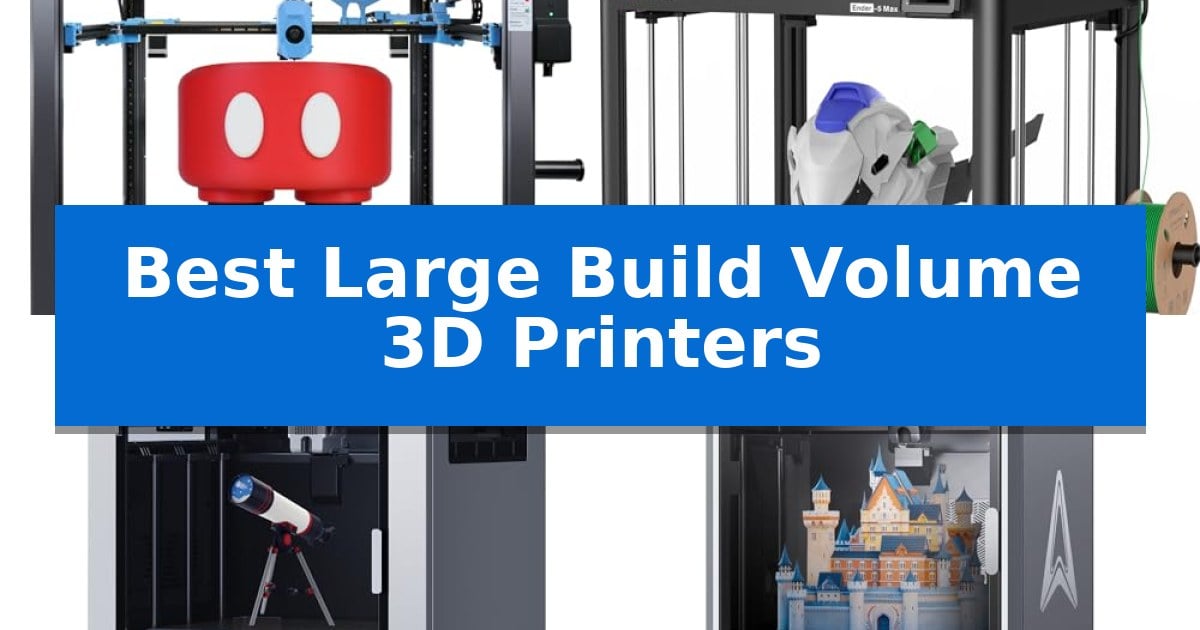
When your creative vision exceeds the constraints of standard desktop machines, you need a system designed for scale. Finding the Best Large Build Volume 3D Printers requires balancing massive print areas with the structural rigidity necessary to maintain precision over long, complex print cycles.
Whether you are producing industrial prototypes, large-scale artistic models, or batch-manufacturing components, the right printer must handle high-temperature materials and high-speed motion without sacrificing surface quality. We have analyzed the leading large-format options to help you identify the machine that aligns with your specific production requirements.
Best Large Build Volume 3D Printers in 2026
Quick Comparison
| Product | Best For | Key Strength | Score |
|---|---|---|---|
| Sovol SV08 Max 3D Printer | Best Overall | Massive 500x500x500mm build volume for large-scale projects. | 4.9 |
| Creality Ender 5 Max 3D Printer | Optimized for Large Print Farms | Expansive 400mm³ build volume for large-scale parts. | 4.7 |
| QIDI Max4 Combo 3D Printer | Industrial-Grade Large Format | Massive 390×390×340mm build volume for large industrial parts. | 4.7 |
| Creality K2 Plus Combo 3D Printer | High-Speed Multi-Color Large Print | Extraordinary 350mm cubic build volume for large models. | 4.5 |
| QIDI Plus5 Combo 3D Printer | Engineering-Grade Large Build | Massive 320×320×300mm build volume for large-scale projects. | 4.9 |
How We Chose
- Total build volume dimensions and the ability to print large parts without partitioning.
- Motion system design, specifically CoreXY kinematics and linear rail integration for high-speed stability.
- Thermal management capabilities, including active chamber heating and high-temperature nozzle compatibility.
- Automation features such as auto-leveling sensors and AI-driven failure detection for reliable long-duration prints.
- Material compatibility and the availability of multi-material or multi-color printing ecosystems.
1 Sovol SV08 Max 3D Printer — Massive 500mm Build Volume
The Sovol SV08 Max 3D Printer provides a massive 500x500x500mm build volume, enabling the production of large-scale industrial parts, prototypes, and oversized props in a single print. By utilizing CoreXY kinematics with a compact design and minimal moving mass, this machine is engineered to maintain high precision even while operating at speeds up to 700mm/s.
Achieving a reliable first layer is simplified through an advanced Eddy Current Sensor system, which performs high-speed, contactless bed leveling to account for surface deviations. The printer features a high-flow 50mm³/s nozzle capable of reaching 300°C, supporting a wide range of materials including PLA, TPU, PETG, ABS, and carbon-fiber-reinforced filaments.
For workflow management, the device includes a built-in 1280×720 HD camera that supports remote monitoring, time-lapse recording, and integration with Obico for cloud-based failure detection. The structural integrity is supported by XYZ full linear rails, which work alongside the CoreXY system to reduce vibration during high-acceleration movements.
The system is designed for future expansion, featuring a reserved interface for an optional heated chamber module to further enhance compatibility with high-temperature materials. With its combination of large-format capacity and high-speed motion architecture, it serves as a robust tool for users requiring significant build space without sacrificing operational efficiency.
Best for: Users requiring a massive 500mm build volume for large-scale industrial prototypes, furniture components, or oversized collectibles.
Skip if: Users with limited workspace or those who primarily print small, intricate items that do not benefit from a large-format 500mm build area.
PROS
- Massive 500x500x500mm build volume for large-scale projects.
- CoreXY kinematics for high-speed, low-vibration printing.
- Eddy Current Sensor for automated, high-accuracy bed leveling.
- 300°C high-temp nozzle compatible with diverse advanced filaments.
CONS
- Large physical footprint requires significant dedicated workspace.
- Heated chamber module is an optional upgrade that must be purchased separately.
2 Creality Ender 5 Max 3D Printer — Optimized for Large Print Farms
Scaling up production requires hardware that balances raw capacity with consistent reliability. The Creality Ender 5 Max 3D Printer is built specifically for this demand, featuring an expansive 400×400×400 mm build volume that allows creators to produce large-scale prototypes or batch-manufacture multiple parts in a single run without the need for splitting models.
Engineered for high-throughput environments, the printer utilizes an ultra-efficient CoreXY system capable of reaching speeds up to 700 mm/s. This performance is supported by a rigid all-metal frame and a precise X-axis linear rail, which work together to minimize vibrations and maintain accuracy during rapid production cycles. The inclusion of a direct-drive dual-gear extruder ensures consistent filament feeding, reducing the risk of clogs during extended 24/7 operation.
Workflow efficiency is further enhanced by integrated WLAN multi-printer control, allowing studios to manage grouped production tasks from a single interface. The system includes a tri-color status indicator for quick visual monitoring of print progress across a farm. Calibration is streamlined through a 64-point auto-leveling system paired with an automatic Z-offset, ensuring reliable first-layer adhesion without manual intervention.
Thermal management is handled by a 1000W rapid-heating bed that reaches operating temperatures in minutes, providing compatibility with a wide range of materials including PLA, PETG, ABS, ASA, and PA. By combining a robust heating system with an epoxy build plate, the machine provides a stable foundation for diverse industrial and creative applications.
Best for: This printer is best for professional studios and print farms requiring high-speed, large-scale production with centralized network management.
Skip if: Skip this model if you have limited workspace, as the large footprint and heavy-duty frame are designed specifically for dedicated production environments rather than compact home setups.
PROS
- Expansive 400mm³ build volume for large-scale parts.
- CoreXY structure enabling high-speed printing up to 700 mm/s.
- WLAN multi-printer control for efficient farm management.
- 64-point auto-leveling for consistent first-layer accuracy.
CONS
- Large physical footprint requires significant dedicated space.
3 QIDI Max4 Combo 3D Printer — Industrial-Grade Large Format
Scaling up production requires hardware that can handle demanding materials and large-scale geometry without compromising structural integrity. The QIDI Max4 Combo 3D Printer addresses this need with a massive 390×390×340mm build volume, providing a significant 55% increase in space over its predecessor to accommodate industrial-grade parts and complex molds in a single print cycle.
Engineered for high-speed output, the machine utilizes closed-loop motors on X/Y axes to achieve a maximum printing speed of 800mm/s and an acceleration of 30,000mm/s². Stability is further reinforced by a 2mm lead screw and anti-backlash nut on the Z-axis, which work to minimize vertical gaps and maintain high surface quality during rapid movements.
The printer is built for versatility in material selection, featuring a 40mm³/s high-flow hotend equipped with a hardened steel nozzle. To ensure consistent results with advanced filaments like ABS-CF, PC, and PPS-CF, it includes a 65℃ active heated chamber. A full-surface silicone heated bed provides uniform thermal distribution, which is essential for preventing warping in large-format prints.
Operational intelligence is integrated through an AI camera that monitors for common failures, such as spaghetti-like errors, and pauses the process automatically to preserve materials. For users requiring multi-color or multi-material capabilities, the system is compatible with the QIDI BOX, which enables intelligent filament management and real-time level monitoring.
Best for: Professionals and enthusiasts requiring a large-format, high-speed machine capable of printing industrial-grade materials like carbon fiber-reinforced nylon.
Skip if: Users who do not require a large-scale build volume or those who prefer a machine that includes the Polar Cooler system pre-installed, as it must be purchased separately.
PROS
- Massive 390×390×340mm build volume for large industrial parts.
- High-speed performance with 800mm/s max speed and closed-loop motors.
- Active 65℃ heated chamber for advanced material compatibility.
- AI-powered failure detection to save time and filament.
CONS
- Polar Cooler system is not included and must be purchased separately.
- Large physical footprint requires significant dedicated workspace.
4 Creality K2 Plus Combo 3D Printer — High-Speed Multi-Color Large Print
The Creality K2 Plus Combo 3D Printer distinguishes itself with an expansive 350x350x350mm build volume, providing the necessary space for large-scale models or high-throughput batch production without the need for partitioning. This machine is engineered for efficiency, utilizing a CFS (Creality Filament System) that enables multi-color printing by supporting up to 16 colors when four units are linked, complete with automatic filament selection and relay capabilities.
Performance is driven by industry-grade FOC step-servo motors on the XYZ axes and extrusion, allowing for print speeds up to 600mm/s and accelerations reaching 30000mm/s². To maintain precision at these speeds, the printer features a Matrix frame structure made from aerospace-grade aluminum alloy, which provides the rigidity required to eliminate resonance and deformation during operation.
Reliability is supported by a suite of 18 smart sensors and dual AI cameras. One camera monitors the chamber for common failures like spaghetti errors, while the toolhead camera optimizes flow rates to prevent underfeeding or overfeeding. The system also includes an active heating chamber that maintains a constant 60°C, facilitating the use of advanced materials like ASA and PPA.
The hardened steel tip nozzle supports temperatures up to 350°C, ensuring compatibility with a wide range of wear-resistant engineering filaments. With a dual Z-axis system and four linear rods, the print bed maintains steady vertical movement, which, combined with automated bed tilt adjustment and leveling, contributes to higher overall print success rates.
Best for: Users requiring a large-format, high-speed 3D printer capable of complex multi-color projects and engineering-grade materials.
Skip if: Users with limited workspace or those who only require small-scale, single-color printing may find the footprint and complexity of this system excessive.
PROS
- Extraordinary 350mm cubic build volume for large models.
- Multi-color printing capability via the intelligent CFS system.
- High-speed operation up to 600mm/s with FOC step-servo motors.
- Active chamber heating up to 60°C for advanced materials like PPA and ASA.
CONS
- Significant physical footprint due to the large build volume and external filament system.
- High complexity requiring management of 18 smart sensors and dual AI systems.
5 QIDI Plus5 Combo 3D Printer — Engineering-Grade Large Build
The QIDI Plus5 Combo 3D Printer provides a substantial 320×320×300mm build volume, offering an 18% increase in space compared to its predecessor. This expanded capacity allows engineers and makers to print full-scale prototypes and batch-produce multiple components in a single session, reducing the need for splitting models or scaling down complex designs.
Engineered for high-performance, this machine features a 370°C maximum extrusion temperature and an actively heated 65°C chamber. These specifications enable the reliable use of advanced materials like PPS-CF, PPA-CF, PC, and nylon, with the heated chamber working to minimize warping and improve layer adhesion for durable, industrial-grade parts.
Stability at high speeds is managed by a rigid CoreXY motion system utilizing X-axis linear guide rails and 9mm timing belts. This architecture supports print speeds up to 600mm/s with 20,000mm/s² acceleration. For extended high-temperature sessions, the system includes a 3-in-1 air filtration system and multiple thermal sensors to maintain a consistent, safe printing environment.
Usability is prioritized through a 10-minute quick setup process and cloud-based slicing, which allows for remote job management. The printer also incorporates an AI-powered camera for monitoring and the ability to skip failed parts during batch production without interrupting the entire print plate, maximizing overall workflow efficiency.
Best for: Engineers and professional makers requiring a large build volume for high-temperature, industrial-grade materials and batch production.
Skip if: Users with limited workspace or those who only print standard PLA models may find the specialized high-temperature features and large footprint unnecessary.
PROS
- Massive 320×320×300mm build volume for large-scale projects.
- Active chamber heating up to 65°C for superior material compatibility.
- High-speed CoreXY motion system capable of 600mm/s printing.
- AI-powered monitoring and smart batch production management.
CONS
- Large physical footprint requires significant dedicated workspace.
- Optional accessories like the Polar Cooler and QIDI BOX are required for full multi-material and advanced cooling functionality.
Best Large Build Volume 3D Printers Buying Guide
Understanding Build Volume Requirements
The primary advantage of these machines is the large build volume, which allows for the creation of full-scale prototypes and oversized collectibles without the need for splitting models into smaller pieces. When selecting a printer, consider not just the maximum dimensions, but how the heated bed maintains consistent temperature across that entire surface to prevent warping.
Larger prints take significantly longer to complete, making high-speed performance and motion stability critical. Systems utilizing CoreXY kinematics and linear rails are generally better equipped to handle the increased mass and inertia of large-format printing while maintaining precise detail.
Thermal Management and Material Versatility
Printing with engineering-grade filaments like ABS, ASA, or carbon-fiber composites requires a controlled environment. An actively heated chamber is a significant benefit, as it minimizes internal stresses that lead to layer separation and warping in large parts.
Check the nozzle temperature capacity of the hotend. A system that supports temperatures up to 350°C provides the flexibility to use advanced, high-melting-point materials, which are often necessary for functional, end-use industrial parts.
Automation and Reliability Features
Large prints represent a significant investment in both time and filament. Automatic bed leveling systems, such as those using Eddy Current sensors, are essential for ensuring a perfect first layer without manual intervention, which is vital when the print surface is large and prone to minor deviations.
AI camera monitoring and spaghetti detection provide peace of mind during long, unattended print sessions. These features can pause the machine if a failure is detected, potentially saving hours of work and significant amounts of material.
Motion Systems and Precision
The rigidity of the frame is the backbone of print quality. Machines constructed with all-metal frames and die-cast aluminum components are far more effective at eliminating resonance and vibration during high-speed movements.
Look for systems that incorporate closed-loop motors or step-servo systems. These technologies allow the printer to maintain high acceleration and speed without losing steps, ensuring that the final output remains accurate even when the print head is moving at 600mm/s or faster.
Multi-Material and Workflow Integration
For users who need to produce complex assemblies or vibrant, multi-colored models, look for printers that support multi-material ecosystems. These systems often use external filament management units to switch colors or materials automatically during the print.
Consider the connectivity options available. Features like WLAN multi-printer control and cloud-based slicing are particularly useful for those managing a small print farm, allowing for centralized management and monitoring of multiple jobs simultaneously.
Frequently Asked Questions
Why is an actively heated chamber important for large prints?
An actively heated chamber maintains a consistent ambient temperature, which is crucial for preventing the rapid cooling of large parts. This significantly reduces the likelihood of warping and layer delamination, especially when using materials like ABS or Nylon.
Do I need a high-flow nozzle for large-format printing?
Yes, a high-flow nozzle allows the printer to extrude more material per second, which is necessary to maintain fast print speeds without under-extrusion. This is essential for reducing the total print time of large, bulky objects.
How does CoreXY kinematics improve print quality?
CoreXY systems use a stationary motor configuration that reduces the moving mass of the print head. This design allows for faster acceleration and higher speeds with significantly less vibration, leading to smoother surfaces and better dimensional accuracy.
What is the benefit of Eddy Current sensor leveling?
Eddy Current sensors provide contactless, high-speed bed leveling. They can detect microscopic surface deviations across the entire build plate, ensuring a consistent first-layer height which is critical for the success of large-format prints.
Can I print with carbon-fiber filaments on these machines?
Most of these large-format printers are equipped with hardened steel nozzles specifically designed to handle the abrasive nature of carbon-fiber-reinforced filaments. Always verify the maximum nozzle temperature and material compatibility in the product specifications.
Conclusion: Our Top Pick
For those prioritizing maximum build space and high-speed industrial performance, the Sovol SV08 Max 3D Printer stands out as the most capable option. Its massive 500mm build volume, combined with a robust CoreXY motion system and advanced Eddy Current leveling, provides the reliability needed for large-scale projects.
While other models offer specialized features like multi-color capabilities or active chamber heating, the SV08 Max delivers an excellent balance of raw capacity and high-speed precision. It is the ideal choice for creators and engineers who need to produce oversized prototypes and industrial components in a single, efficient build cycle.