
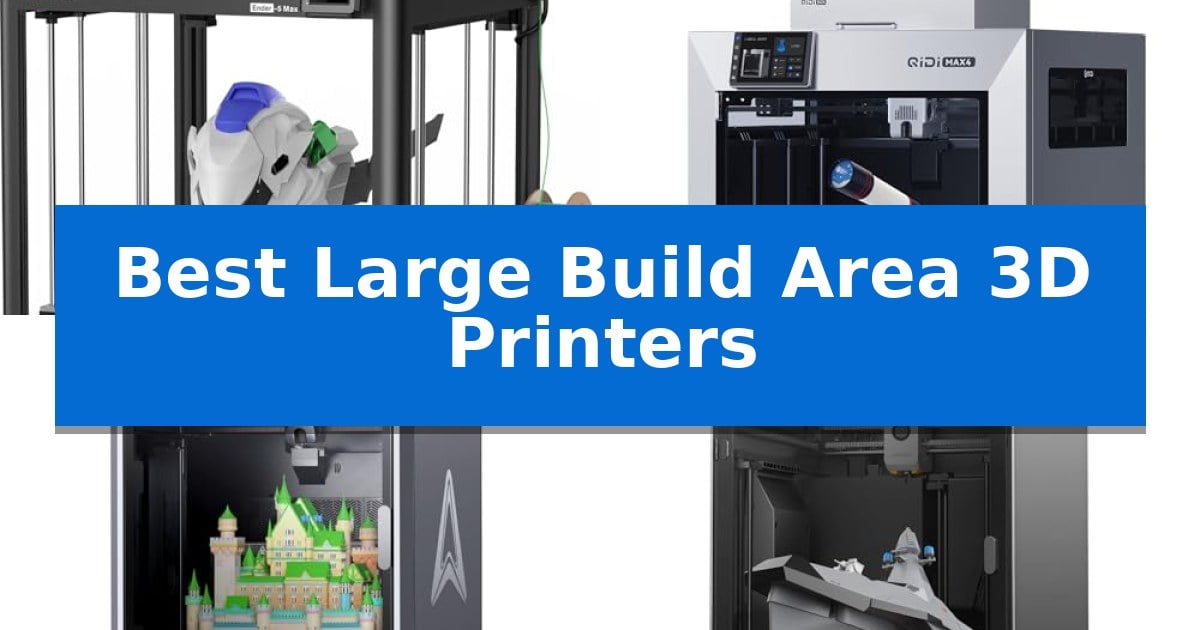
When your creative vision exceeds the constraints of a standard desktop machine, you need a platform that offers more room to maneuver. Scaling up your output requires reliable hardware that maintains structural integrity across larger volumes, ensuring that your oversized prototypes or batch-produced parts are as precise as smaller prints.
Finding the Best Large Build Area 3D Printers involves balancing build volume with the mechanical stability required to prevent layer shifts and warping. Whether you are managing a print farm or developing functional engineering components, the following selections provide the necessary workspace and technical features to handle demanding, large-scale fabrication tasks.
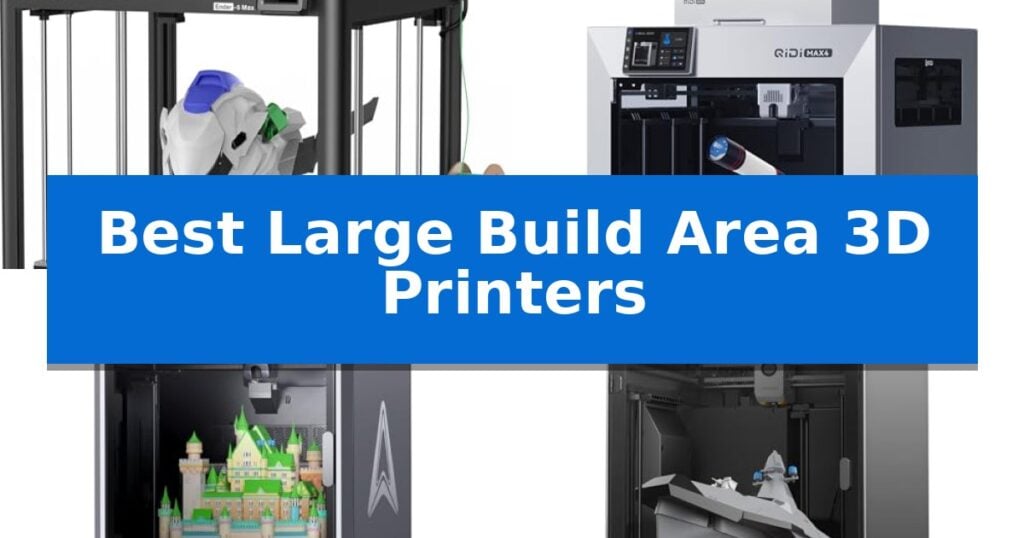
Best Large Build Area 3D Printers in 2026
Quick Comparison
| Product | Best For | Key Strength | Score |
|---|---|---|---|
| Creality Ender 5 Max 3D Printer | Best Overall | Massive 400mm cube build volume for large-scale projects. | 4.9 |
| QIDI Max4 Combo 3D Printer | Industrial Grade Heated Chamber | Expansive 390×390×340mm build volume for large-scale industrial parts. | 4.5 |
| Creality K2 Plus Combo 3D Printer | High Speed Multi-Color Printing | Massive 350350350mm build volume for large-scale projects. | 4.5 |
| Anycubic Kobra S1 Max Combo 3D Printer | Rapid Large Scale Fabrication | Massive 350x350x350mm³ build volume for large-scale, single-piece prints. | 4.6 |
| Longer LK5 Pro 3D Printer | Budget Friendly Large Format | Large 300x300x400mm build volume for oversized projects. | 4.9 |
How We Chose
- Build Volume: Measured the total printable dimensions to ensure true large-scale capability.
- Structural Stability: Assessed frame materials and motion systems like CoreXY for vibration reduction.
- Thermal Management: Evaluated heating systems and chamber enclosures for material compatibility.
- Production Efficiency: Considered features like multi-printer control, auto-leveling, and print speed.
- Reliability Features: Reviewed extrusion systems and sensors designed for long-duration print cycles.
1 Creality Ender 5 Max 3D Printer — Massive 400mm Cube Build Space
For designers and businesses requiring maximum output, the Creality Ender 5 Max 3D Printer provides an expansive 400×400×400 mm build volume. This massive capacity allows for the creation of oversized prototypes or batch production of multiple parts in a single run, significantly streamlining demanding 3D printing workflows.
Efficiency is central to the design, featuring an ultra-efficient CoreXY system capable of reaching speeds up to 700 mm/s. This high-speed performance is supported by a rigid all-metal frame and a precise X-axis linear rail, which work together to minimize vibration and maintain accuracy during rapid production cycles.
The printer is engineered for continuous operation, incorporating a durable dual-gear extruder that ensures stable, consistent filament feeding. To simplify setup and ensure high success rates, the unit includes 64-point auto leveling and an automatic Z-offset, eliminating the need for manual first-layer calibration.
Managing large-scale production is simplified through WLAN multi-printer control and grouped management features. The inclusion of a 1000W rapid-heating bed ensures the platform reaches working temperatures quickly, supporting a wide range of materials including PLA, PETG, ABS, ASA, and PA for versatile manufacturing needs.
Best for: Professional designers and print farms requiring high-speed, large-format production with automated calibration.
Skip if: Users with limited workspace or those who only require small-scale, occasional printing will find the large footprint and industrial feature set unnecessary.
PROS
- Massive 400mm cube build volume for large-scale projects.
- High-speed CoreXY architecture supporting up to 700 mm/s.
- Automated 64-point leveling and Z-offset for consistent first layers.
- WLAN-enabled multi-printer management for print farm scalability.
CONS
- Large physical footprint requires significant dedicated workspace.
- High-power 1000W heating system necessitates stable electrical supply.
2 QIDI Max4 Combo 3D Printer — Industrial Grade Heated Chamber
When large-scale fabrication requires printing industrial parts or complex molds in a single pass, the QIDI Max4 Combo 3D Printer provides a substantial 390×390×340mm build volume. This expansive area is designed to eliminate the need for splitting large projects, while the full-surface silicone heated bed promotes consistent adhesion across the entire print surface.
Engineered for high-speed production, the system utilizes closed-loop motors on the X and Y axes to support printing speeds up to 800mm/s with 30,000mm/s² acceleration. To maintain precision at these velocities, the Z-axis incorporates 2mm lead screws and anti-backlash nuts, which work to minimize vertical gaps and improve surface finish quality.
The printer is built to handle a diverse range of materials, from standard PLA and ABS to high-temperature, abrasive filaments like carbon fiber-reinforced nylon, PC, and PPS-CF. This versatility is supported by a 40mm³/s high-flow hotend featuring a hardened steel nozzle and an active 65℃ heated chamber, which creates the necessary environment for advanced material stability.
Operational intelligence is integrated through a built-in AI camera that monitors for print failures, such as spaghetti-like errors, and pauses the process to preserve materials. For users requiring multi-color or multi-material capabilities, the unit is compatible with the QIDI BOX, which enables 16-color printing and provides automated filament management, including real-time level monitoring.
Best for: Professionals and industrial designers who need to print large-scale, complex prototypes or high-temperature engineering materials in a single go.
Skip if: Users who primarily print small, simple objects or those who lack the physical space for a large-format machine measuring 28x28x30 inches.
PROS
- Expansive 390×390×340mm build volume for large-scale industrial parts.
- Active 65℃ heated chamber for high-temperature material stability.
- High-speed printing up to 800mm/s with closed-loop motor stability.
- AI-powered failure detection to prevent material waste.
CONS
- Polar Cooler system is not included and must be purchased separately.
- Large physical footprint requires significant dedicated workspace.
3 Creality K2 Plus Combo 3D Printer — High Speed Multi-Color Printing
The Creality K2 Plus Combo 3D Printer distinguishes itself with a massive 350350350mm build volume, catering to users who require significant space for large-format projects. This machine integrates a step-servo motor system capable of reaching 600mm/s printing speeds with 30000mm/s² acceleration, ensuring that large prints are completed with efficiency without sacrificing structural integrity.
Engineered for versatility, the system features an actively heated chamber and a high-temp nozzle with a hardened steel tip. This combination enables the use of diverse materials, including PLA, ABS, PETG, and carbon-fiber-reinforced filaments like PA-CF and PPA-CF. The inclusion of the Creality Automatic Material System (CFS) allows for multi-color printing, with the potential to expand to 16 colors by linking four units.
Reliability is supported by a sturdy matrix frame and dual Z-axis assisted by four linear rods, which minimize layer shifting during operation. The printer also utilizes dual AI cameras for real-time monitoring and automated failure detection, such as spaghetti errors or foreign objects, providing an extra layer of oversight for long-duration prints.
Precision is maintained through ingenious anti-tilt auto-leveling, which uses dual independently motorized Z-axes and strain gauge-based compensation. This setup ensures a consistent first layer, reducing the need for manual intervention. The unit also includes an automated run-out sensor and filament cutter to streamline the material management process.
Best for: Users requiring a large-format build area with advanced multi-material and multi-color capabilities.
Skip if: Users who primarily print small, simple objects and do not require a heated chamber or multi-color functionality.
PROS
- Massive 350350350mm build volume for large-scale projects.
- Multi-color printing support via the Creality Automatic Material System.
- High-speed performance with advanced step-servo motor acceleration.
- Wide material compatibility including high-temp and carbon-fiber filaments.
CONS
- Large physical footprint requires significant dedicated workspace.
4 Anycubic Kobra S1 Max Combo 3D Printer — Rapid Large Scale Fabrication
Fabricating large-scale industrial prototypes or expansive enclosures in a single piece requires a machine capable of handling significant volume without the need for splitting or gluing parts. The Anycubic Kobra S1 Max Combo 3D Printer addresses this need with a massive 350x350x350mm³ build volume, providing the necessary workspace for professional-grade engineering projects.
Engineered for speed and precision, this printer utilizes a fully-enclosed CoreXY structure with an all-metal frame to maintain stability during high-speed operations. It supports print speeds up to 600mm/s and 20,000mm/s² acceleration, significantly reducing production time for complex models. The inclusion of a 65°C heated chamber and a 350°C hotend allows users to work with a wide range of materials, including ABS, ASA, PVA, TPU, and PETG, ensuring consistent results without warping.
The system is designed for high-efficiency workflows, featuring the ACE 2 Pro for native 4-color printing, which can be expanded to 16 colors. To ensure accuracy, the printer incorporates Smart LeviQ 3.0 49-point auto-leveling and real-time flow dynamics calibration. These features work together to automate the first-layer process, providing reliable adhesion and reducing the need for manual bed adjustments.
With its combination of large-format capacity and high-speed performance, this unit is well-suited for engineers and designers who require a robust, reliable solution for functional part production. The integrated hardware ecosystem simplifies the transition from digital design to physical prototype.
Best for: Engineers and designers requiring a large-format, high-speed printer for functional prototypes and multi-color industrial parts.
Skip if: Users with limited workspace or those who only require small-scale printing will find the large footprint and specialized industrial features unnecessary.
PROS
- Massive 350x350x350mm³ build volume for large-scale, single-piece prints.
- 600mm/s high-speed printing capability for reduced project turnaround times.
- Native 4-color printing support with expandability up to 16 colors.
- 65°C heated chamber for compatibility with advanced engineering materials.
CONS
- Large physical footprint requires significant dedicated workspace.
5 Longer LK5 Pro 3D Printer — Budget Friendly Large Format
Expanding your creative output often requires moving beyond standard desktop dimensions, and the Longer LK5 Pro 3D Printer provides a substantial 300x300x400mm build volume for larger prototypes and cosplay props. This machine is engineered to handle ambitious projects that exceed the constraints of smaller printers, offering a dedicated space for functional parts and oversized models.
Stability is central to the design, featuring a dual Z-axis configuration and diagonal braces that reinforce the gantry to minimize vibration during operation. The inclusion of a lattice glass bed provides a flat, reliable surface for adhesion, while the TMC2209 silent drivers work to reduce motor noise, making it suitable for home workshop environments where quiet operation is preferred.
Usability is addressed through a 90% pre-assembled design, allowing for a streamlined setup process. Users interact with the printer via a 4.3-inch color touchscreen, which provides an intuitive interface for managing print jobs. The system also incorporates filament runout sensors and a power-loss resume function, which are essential for protecting long-duration prints from unexpected interruptions.
For those who prefer a hands-on approach to their workflow, the printer utilizes open-source firmware that supports editable G-code, allowing for greater customization of print parameters. This combination of a large build area, structural reinforcements, and user-friendly software makes it a practical choice for makers focused on scaling their production capabilities.
Best for: Makers and hobbyists who need a large build volume for cosplay props, functional prototypes, and oversized creative models.
Skip if: Users with limited workspace or those who prioritize a fully assembled, plug-and-play experience without any initial setup requirements.
PROS
- Large 300x300x400mm build volume for oversized projects.
- Dual Z-axis and reinforced frame for improved structural stability.
- Silent TMC2209 drivers to reduce operational noise.
- Power-loss resume and filament sensors to prevent wasted materials.
CONS
- Requires final assembly despite being 90% pre-assembled.
- Large footprint necessitates significant dedicated desk or workshop space.
Best Large Build Area 3D Printers Buying Guide
Evaluating Build Volume and Frame Rigidity
The primary advantage of these printers is their expansive build volume, which allows for the creation of large parts without the need for assembly or gluing. However, as the print area increases, the risk of vibration and mechanical instability also grows. A rigid all-metal frame is essential to minimize wobbling during rapid movements, especially when printing tall models.
Look for systems that utilize linear rails or reinforced gantry designs. These components ensure that the print head moves smoothly and accurately, even at the edges of the build plate. A stable frame is the foundation of repeatable, high-quality results in large-format printing.
Thermal Control and Material Versatility
Printing with advanced materials like ABS, ASA, or carbon-fiber-reinforced filaments requires consistent temperature control. An actively heated chamber is a critical feature for preventing warping and ensuring strong layer adhesion in large parts. By maintaining a stable ambient temperature, the printer reduces the thermal stress that often causes large prints to fail.
Additionally, verify the maximum nozzle temperature and bed heating capabilities. High-flow hotends are often necessary to keep up with the demands of large-scale printing, ensuring that the extruder can maintain a steady flow of material without clogging or under-extrusion.
Motion Systems and Print Speed
Large prints can take days to complete, making print speed a significant factor in your workflow. CoreXY motion systems are highly recommended for large-format printers because they keep the mass of the motors stationary, allowing the print head to move with greater speed and precision. This design significantly reduces the inertia that can lead to artifacts on the surface of your prints.
High-acceleration capabilities, often supported by step-servo motors, allow these machines to finish large projects in a fraction of the time required by standard printers. When evaluating speed, ensure that the machine's structural rigidity can support the increased forces generated by these rapid movements.
Workflow Automation and Management
For users managing a print farm or high-volume production, features like WLAN multi-printer control and AI-based monitoring are invaluable. These tools allow you to manage multiple machines from a single interface, reducing the time spent on manual oversight and configuration.
Automatic features such as 64-point auto-leveling and auto Z-offset are essential for ensuring a perfect first layer across a large surface area. These systems eliminate the need for tedious manual adjustments, significantly improving the success rate of complex, long-duration prints.
Extrusion Reliability
The extruder is the heart of your 3D printer, and for large-scale production, a direct-drive dual-gear system provides the reliability needed for 24/7 operation. This setup offers superior feeding force, which is crucial when using abrasive materials or printing for extended periods where filament consistency is paramount.
Look for printers that include filament run-out sensors and power-loss resume functions. These safety features protect your investment by pausing the print if an issue occurs, allowing you to resume exactly where the machine left off rather than losing hours of work and significant amounts of material.
Frequently Asked Questions
Why is an enclosed chamber important for large 3D prints?
An enclosed chamber maintains a consistent ambient temperature, which is vital for preventing warping and cracking in large parts made from materials like ABS or nylon. It also protects the print from drafts that can disrupt the cooling process.
What is the benefit of a CoreXY motion system?
A CoreXY system uses stationary motors to move the print head, reducing the weight on the moving parts. This allows for higher speeds and accelerations without sacrificing precision, which is essential for large-format printers.
Do I need auto-leveling for a large build plate?
Yes, auto-leveling is highly recommended for large build areas. Achieving a perfectly level first layer across a large surface manually is extremely difficult; automated systems ensure consistent adhesion across the entire print bed.
Can I print multi-color models on these large printers?
Some large-format printers, such as those compatible with material management systems like the CFS or ACE 2 Pro, support multi-color or multi-material printing. Check the specific model's compatibility with these add-ons.
How do I maintain a large-format 3D printer?
Regular maintenance includes cleaning the build plate, checking belt tension, lubricating linear rails or lead screws, and ensuring the hotend is free of debris. For high-volume users, monitoring the extruder gear wear is also important.
Conclusion: Our Top Pick
Selecting the right machine for your large-scale projects depends on your specific material needs and production volume. For those prioritizing a massive, versatile workspace combined with high-speed performance and professional-grade reliability, the Creality Ender 5 Max 3D Printer stands out as a robust solution.
With its 400mm cube build volume, rigid all-metal frame, and advanced auto-leveling, it is designed to handle demanding workflows efficiently. While other models offer specialized features like heated chambers or multi-color capabilities, the Ender 5 Max provides a balanced, high-performance foundation for both businesses and serious makers.