
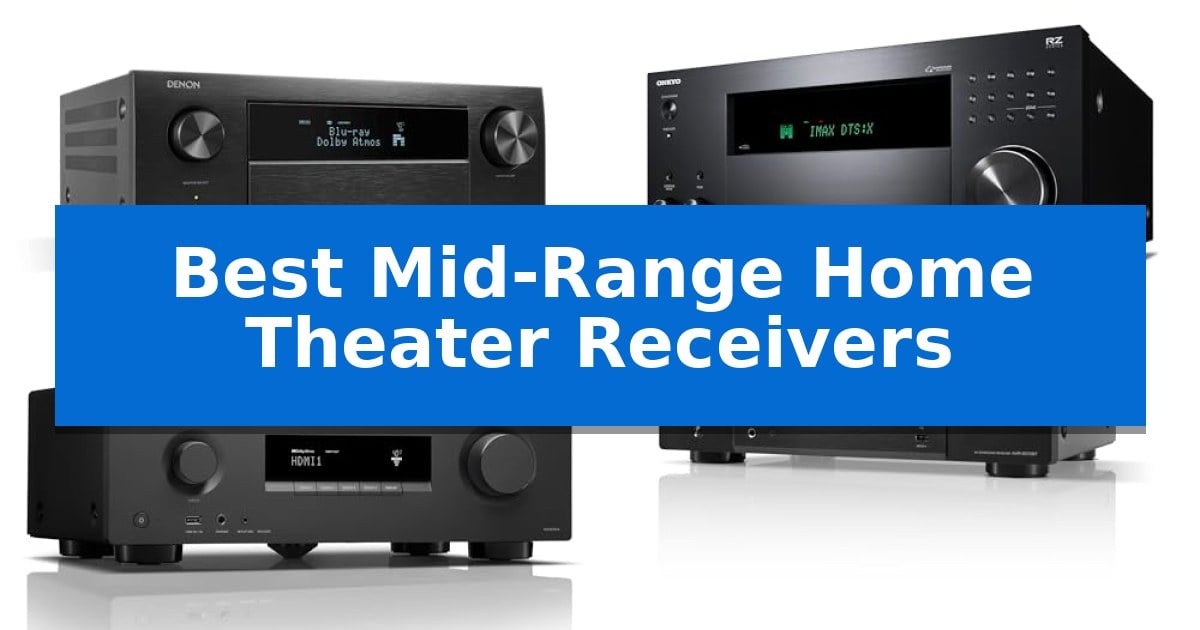
Building a high-quality home cinema requires a central hub that balances power, modern video standards, and acoustic precision. Finding the Best Mid-Range Home Theater Receivers involves navigating a landscape of varying channel counts, HDMI 2.1 capabilities, and proprietary room correction technologies that define how your system interacts with your specific living space.
Whether you are prioritizing immersive 3D audio formats like Dolby Atmos or need seamless 8K video pass-through for next-gen gaming consoles, the right receiver acts as the backbone of your entertainment experience. We have analyzed the latest offerings to help you identify which unit provides the necessary features to anchor your home theater setup effectively.
You may also want to compare Best Mid-Range Home Theater Projectors, Best Mid-Range Home Subwoofers, and Best Mid-Range Home Speakers.
Best Mid-Range Home Theater Receivers
Quick Comparison
| Product | Best For | Key Strength | Score |
|---|---|---|---|
| Denon AVR-X4800H AV Receiver | Best Overall | 9.4-channel amplification with 125W per channel for large-scale soundscapes. | 4.9 |
| Onkyo TX-RZ50 AV Receiver | Precision Room Correction Performance | DIRAC LIVE ROOM CORRECTION for precise acoustic calibration. | 4.7 |
| Yamaha RX300A AV Receiver | Reliable 8K Home Cinema Foundation | Supports 4K/120 and 8K/60 video for high-end gaming and display compatibility. | 4.5 |
| Denon AVR-S570BT AV Receiver | Streamlined Setup for Modern Displays | Four HDMI 2.1 inputs supporting 8K video and gaming features like VRR and QFT. | 4.4 |
| Pyle 5.2 Channel AV Receiver | Budget-Friendly 4K Surround Sound | 4K Ultra HD pass-through for modern display compatibility. | 4.3 |
How We Chose
- Video Signal Integrity: Verification of 8K/60Hz and 4K/120Hz pass-through support for modern display compatibility.
- Acoustic Calibration: Assessment of room correction technologies that measure and optimize speaker output for specific room acoustics.
- Connectivity and Inputs: Evaluation of HDMI 2.1 port counts, eARC support, and multi-room streaming capabilities.
- Amplification and Channel Flexibility: Analysis of power output per channel and the ability to support various surround sound layouts.
- Ease of Setup: Review of on-screen interface design and guided configuration tools for initial system installation.
1 Denon AVR-X4800H AV Receiver — Advanced Processing for Immersive Audio
The Denon AVR-X4800H AV Receiver functions as a robust 9.4-channel command center, delivering 125W per channel to support complex, high-fidelity home theater configurations. This unit is engineered for modern media demands, offering 8K/60Hz pass-through and 4K/120Hz support, which ensures high-resolution video and fluid motion for both cinema and gaming applications.
Immersive audio is a core strength of this receiver, with native support for Dolby Atmos, DTS:X Pro, IMAX Enhanced, and Auro-3D. For environments where installing dedicated height speakers is not feasible, the system utilizes Dolby Height Virtualization and DTS Virtual:X to simulate overhead soundscapes, providing a three-dimensional audio experience from standard speaker layouts.
Connectivity is extensive, featuring 10 HDMI ports (7 in/3 out) with HDCP 2.3 and eARC, facilitating seamless integration with high-end displays and consoles. The inclusion of four dedicated RCA/XLR subwoofer outputs allows for precise low-frequency management, while a dedicated phono input provides direct connectivity for turntable enthusiasts.
Beyond theater performance, the Denon AVR-X4800H AV Receiver integrates HEOS built-in, enabling multi-room wireless audio streaming via Wi-Fi and Bluetooth. This ecosystem allows users to distribute music throughout the home, providing a cohesive audio experience that bridges the gap between dedicated home theater and whole-home music distribution.
Best for: Users requiring a high-channel-count receiver with extensive HDMI 8K connectivity and multi-room wireless audio capabilities for large home theater spaces.
Skip if: Users with limited space or smaller speaker setups who do not require 9.4-channel processing or the advanced multi-room streaming features of the HEOS ecosystem.
PROS
- 9.4-channel amplification with 125W per channel for large-scale soundscapes.
- Comprehensive 8K and 4K/120Hz support for modern video and gaming standards.
- Integrated HEOS wireless multi-room streaming functionality.
- Flexible connectivity with 10 HDMI ports and four dedicated subwoofer outputs.
CONS
- Large physical footprint and weight may require significant shelf space.
- High channel count and processing features represent a premium investment for smaller systems.
2 Onkyo TX-RZ50 AV Receiver — Precision Room Correction Performance
Achieving a balanced home theater setup requires a receiver that can handle modern high-resolution signals while optimizing audio for your specific room acoustics. The Onkyo TX-RZ50 9.2-Channel THX Certified AV Receiver addresses these needs by integrating DIRAC LIVE ROOM CORRECTION, a sophisticated tool designed to calibrate audio output based on the unique physical characteristics of your listening environment.
This 9.2-channel receiver provides the flexibility to power complex speaker configurations, making it suitable for immersive audio setups. With support for 8K HDMI connectivity, the unit is equipped to pass through high-bandwidth video signals from modern gaming consoles and streaming devices, ensuring compatibility with current display standards.
Designed for versatility, the Onkyo TX-RZ50 AV Receiver functions as a central hub for both gaming and cinematic experiences. Its robust construction, weighing 36.05 pounds, reflects its internal amplification capabilities, while the included 3 year parts and labor warranty provides long-term support for the hardware.
While the receiver offers extensive calibration options, users should ensure their existing speaker layout and room dimensions can accommodate a 9.2-channel system to fully utilize its output potential. The unit measures 17.13 inches in width and 7.94 inches in height, requiring adequate shelf space for proper ventilation.
Best for: Home theater enthusiasts who require advanced room calibration and support for high-bandwidth 8K video signals.
Skip if: Users with limited shelf space or those who only require a basic 5.1-channel audio setup may find this 9.2-channel unit exceeds their physical and functional requirements.
PROS
- DIRAC LIVE ROOM CORRECTION for precise acoustic calibration.
- 8K HDMI support for high-resolution video pass-through.
- 9.2-channel configuration for expansive surround sound setups.
- 3 year parts and labor warranty included.
CONS
- Large physical footprint requires significant installation space.
- High channel count may be unnecessary for smaller room configurations.
3 Yamaha RX300A AV Receiver — Reliable 8K Home Cinema Foundation
Building a modern home theater requires a foundation that balances high-resolution video pass-through with immersive audio processing. The Yamaha RX300A AV Receiver addresses this by providing 5.2-channel output capable of driving 70W of power, supporting flexible configurations like 3.1.2-channel setups for those utilizing up-firing or in-ceiling height speakers to achieve Dolby Atmos and DTS Virtual:X soundscapes.
Visual fidelity is prioritized through support for 4K/120 and 8K/60 video signals, ensuring compatibility with next-generation gaming consoles and high-end displays. The receiver integrates HDMI eARC/ARC for simplified audio return and includes advanced gaming-centric features such as ALLM (Auto Low Latency Mode) and VRR (Variable Refresh Rate) to maintain smooth visual performance during fast-paced content.
Usability is streamlined via an included setup microphone that performs automatic room acoustic correction, tailoring the output to your specific environment. Connectivity is further enhanced by Bluetooth Multipoint, which allows users to pair two source devices simultaneously and switch between them without manual re-pairing. The interface is managed through an intuitive on-screen menu and dedicated Scene buttons that store up to four custom presets for instant recall.
Designed for straightforward integration, the unit features high-performance HDMI switching to manage multiple external devices through a single connection to the television. With a 2-year limited warranty, this receiver serves as a reliable hub for users seeking a balance of current video standards and versatile audio control in a compact, 17.125-inch wide chassis.
Best for: Home theater enthusiasts who prioritize 8K/4K120 video passthrough and automated room calibration in a compact 5.2-channel setup.
Skip if: Users requiring more than 5.2 channels or those needing advanced multi-zone audio distribution beyond the standard 5.2 layout.
PROS
- Supports 4K/120 and 8K/60 video for high-end gaming and display compatibility.
- Includes automatic room correction via an included setup microphone.
- Features Bluetooth Multipoint for seamless switching between two audio sources.
- Offers flexible speaker layouts including support for height channels.
CONS
- Limited to a 5.2-channel configuration, which may not suit larger home theater rooms.
- Power output is rated at 70W, which may be insufficient for driving very large or low-sensitivity speakers.
4 Denon AVR-S570BT AV Receiver — Streamlined Setup for Modern Displays
Modernizing a home theater setup often hinges on the ability to handle high-bandwidth video signals and immersive audio formats without requiring a complete overhaul of existing hardware. The Denon AVR-S570BT AV Receiver addresses this by integrating (4) HDMI 2.1 8K inputs, providing a foundation for high-resolution video playback and advanced gaming features like VRR and QFT.
Designed for 5.2 channel configurations, this receiver delivers 70W per channel to drive your surround sound speakers. It supports a wide array of high-fidelity audio formats, including Dolby TrueHD and DTS HD Master, ensuring that soundtracks are processed with clarity. The inclusion of eARC allows for a simplified connection to your television, passing high-quality audio back to the receiver through a single cable.
Usability is a primary focus, evidenced by the inclusion of an on-screen HD Setup Assistant that guides users through the initial configuration process. For daily operation, the unit offers flexible control options, including compatibility with smart TV remotes and a dedicated mobile app for iOS and Android devices, which simplifies source selection and volume adjustments.
Beyond wired connections, the receiver features built-in Bluetooth, enabling wireless streaming from services like Spotify and TIDAL. This functionality allows the device to serve as a central hub for both cinematic experiences and casual music listening, fitting into a variety of home entertainment environments where ease of use is as important as technical capability.
Best for: Users seeking a straightforward, 5.2-channel home theater hub that supports 8K video and modern gaming features.
Skip if: Users who require more than five channels of amplification or advanced multi-room networking features beyond Bluetooth streaming.
PROS
- Four HDMI 2.1 inputs supporting 8K video and gaming features like VRR and QFT.
- Integrated HD Setup Assistant for simplified installation and configuration.
- Versatile control options including mobile app support and smart TV remote integration.
- Wireless streaming capabilities via built-in Bluetooth.
CONS
- Limited to 5.2 channels, which may not suit users looking for Dolby Atmos or multi-room expandability.
5 Pyle 5.2 Channel AV Receiver — Budget-Friendly 4K Surround Sound
The Pyle 5.2 Channel AV Receiver provides a foundational solution for home theater enthusiasts who need to manage multiple audio and video sources. By incorporating 4K Ultra HD pass-through, this unit ensures that high-resolution video signals reach your display without degradation, maintaining visual clarity for modern media setups. It is designed to drive a 5.2 channel surround sound configuration, which creates an immersive audio environment by distributing sound across five speakers and two subwoofers.
Connectivity is a central feature of this receiver, highlighted by a DAC digital interface. This allows for direct integration with computer audio signals, ensuring that digital sources are processed with the clarity required for Hi-Fi audio performance. For those who prefer a cable-free experience, the Bluetooth wireless streaming capability provides the flexibility to play audio directly from mobile devices or computers, making it simple to transition between different media sources.
Reliability is supported through overall system protection circuitry. This integrated safeguard system monitors for overcurrent, short circuits, and overvoltage, which helps protect the amplifier components during extended operation. These safety measures are intended to maintain the longevity of the receiver, providing a stable platform for your home entertainment system.
With a standard form factor and a weight of approximately 11.08 pounds, the receiver is built to fit into existing equipment racks or cabinets. It supports WAV audio formats and includes a 1-year warranty, establishing a reliable framework for users who want to centralize their audio and video routing without unnecessary complexity.
Best for: Users seeking a budget-friendly, entry-level receiver to manage 5.2 surround sound and 4K video pass-through in a home theater.
Skip if: Users requiring advanced features like Dolby Atmos, multi-room audio zones, or high-end room calibration software will find this model too basic.
PROS
- 4K Ultra HD pass-through for modern display compatibility.
- Integrated Bluetooth for wireless audio streaming.
- Built-in protection against overcurrent and short circuits.
- DAC interface for digital audio signal connectivity.
CONS
- Limited format support compared to higher-end receivers.
- Basic feature set lacks advanced surround sound processing.
Best Mid-Range Home Theater Receivers Buying Guide
Understanding Channel Configurations
The channel count of a receiver determines how many speakers you can power directly. A 5.2-channel system is often sufficient for smaller rooms, providing a standard surround sound experience. However, if you intend to use height speakers for Dolby Atmos or DTS:X, you should look for 7.2 or 9.4-channel receivers to accommodate overhead audio.
Always verify the number of dedicated subwoofer outputs. Many modern receivers include multiple independent subwoofer channels, which allow for better bass distribution across your room, preventing dead spots and creating a more uniform low-frequency response.
The Importance of HDMI 2.1 and Gaming Features
For gamers, HDMI 2.1 is a mandatory specification. It enables support for 4K/120Hz video, which is essential for high-frame-rate gaming on modern consoles. Features like VRR (Variable Refresh Rate) and ALLM (Auto Low Latency Mode) further ensure that your receiver does not introduce lag or visual tearing during intense gameplay.
Ensure your receiver supports eARC (Enhanced Audio Return Channel). This allows high-bitrate audio formats to be sent from your TV back to the receiver over a single HDMI cable, simplifying your cable management and ensuring compatibility with high-end streaming services.
Room Correction Technologies
Every room has unique acoustic properties that can color the sound of your speakers. Advanced room correction systems, such as Dirac Live or proprietary manufacturer solutions, use an included microphone to measure your room's response and apply EQ adjustments to compensate for reflections and standing waves.
Investing in a receiver with robust room correction can often yield a greater improvement in sound quality than upgrading your speakers alone. It ensures that your audio system sounds balanced and clear, regardless of your room's shape or furniture placement.
Wireless Streaming and Multi-Room Audio
Modern receivers are more than just amplifiers; they are network-connected devices. Look for built-in platforms like HEOS or Bluetooth Multipoint, which allow you to stream music directly from your phone or integrate the receiver into a wider home audio ecosystem.
Wireless connectivity also simplifies firmware updates, ensuring your receiver remains compatible with the latest audio codecs and video standards as they evolve over time.
Power Requirements and Speaker Matching
While wattage is a common metric, it is important to consider the sensitivity of your speakers. Most home theater setups in standard-sized rooms perform well with receivers offering between 70W and 125W per channel. Ensure the receiver's impedance rating matches your speakers to avoid overheating.
If you are using large, power-hungry floor-standing speakers, prioritize a receiver with a higher power-per-channel rating and a robust power supply to maintain dynamic range during loud action sequences.
Frequently Asked Questions
What is the main advantage of an 8K-ready receiver?
An 8K-ready receiver ensures that your video signal is not bottlenecked when connecting high-resolution sources to an 8K display, supporting future-proof video standards and high-bandwidth gaming.
Do I need a 9.4-channel receiver for a small room?
Not necessarily. A 5.2 or 7.2-channel receiver is often more than adequate for small to medium rooms. 9.4-channel units are primarily intended for larger spaces requiring more complex speaker layouts.
Can I use my existing TV remote to control the receiver?
Yes, most modern receivers support HDMI-CEC, which allows your TV remote to control basic functions like volume and power, provided your TV also supports this standard.
How does room correction improve sound?
Room correction software measures the acoustic anomalies of your specific room and adjusts the frequency response of your speakers to minimize echoes and bass buildup, resulting in a more accurate soundstage.
Why is eARC important for my setup?
eARC allows for the transmission of high-quality, uncompressed audio from your smart TV apps directly to your receiver, ensuring you get the best possible sound from streaming services.
Conclusion: Our Top Pick
After evaluating the current market, the Denon AVR-X4800H AV Receiver stands out as the most versatile option for those seeking a balance of power and advanced processing. Its ability to handle complex 9.4-channel setups, combined with comprehensive 8K video support and HEOS multi-room integration, makes it a robust foundation for any serious home cinema.
While other models offer specific strengths like Dirac Live or budget-friendly entry points, the Denon provides the most consistent performance across both audio and video domains. It is an ideal choice for users who want to ensure their system is ready for current high-end content while maintaining the flexibility to expand their speaker configuration in the future.