
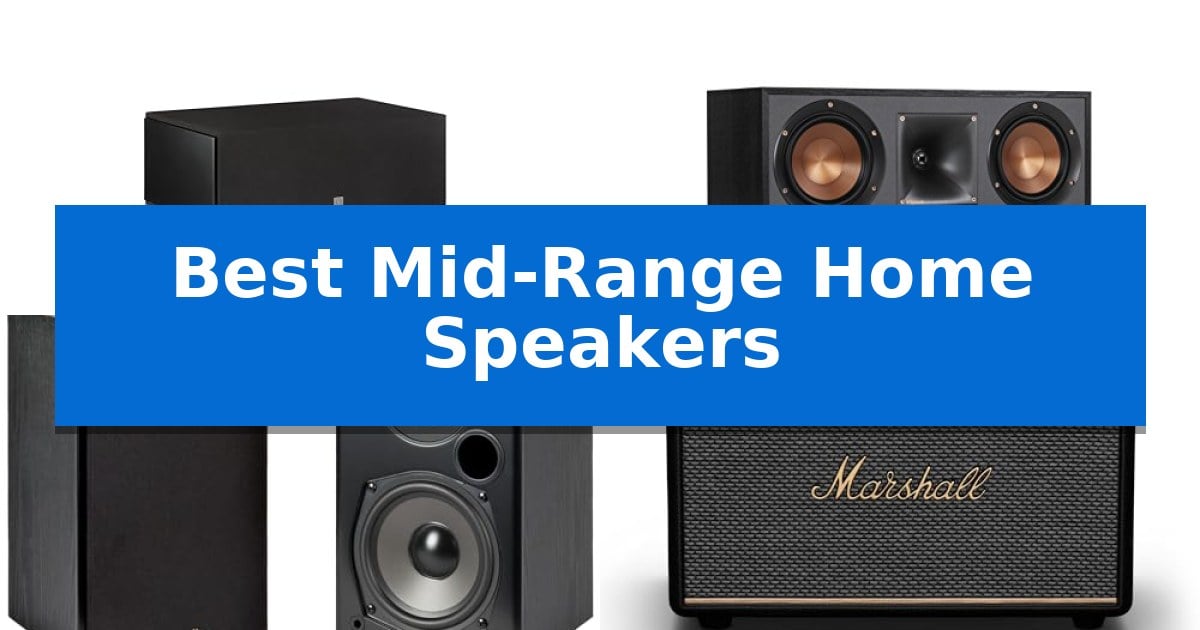
Upgrading your audio setup often feels like a balancing act between budget constraints and the desire for high-fidelity performance. Finding the Best Mid-Range Home Speakers requires identifying equipment that provides clear, detailed sound without the premium price tag of audiophile-grade gear.
Whether you are building a dedicated home theater or simply looking to improve your music listening experience, the right speaker can transform your space. We have analyzed various configurations, from passive bookshelf units to center channel speakers, to help you navigate the options available for your home audio system.
You may also want to compare Best Mid-Range Home Printer, Best Mid-Range Home Computers, and Best Mid-Range Headphones for Music.
Best Mid-Range Home Speakers
Quick Comparison
| Product | Best For | Key Strength | Score |
|---|---|---|---|
| Definitive Technology Dymension DM10 Center Speaker | Best Overall | Timbre-matched to the Dymension series for consistent surround sound. | 4.9 |
| Klipsch R-52C Center Channel Speaker | Powerful Detailed Soundstage | 90×90 Tractrix Horn technology for precise high-frequency dispersion. | 4.7 |
| Polk Audio T15 Bookshelf Speakers | Versatile Surround Sound Starter | Wall-mountable design saves valuable shelf or floor space. | 4.6 |
| Marshall Acton III Bluetooth Speaker | Iconic Design With Wide Sound | Tactile bass and treble controls for manual sound adjustment | 4.7 |
| Edifier P12 Passive Bookshelf Speakers | Wall Mountable Audio Solution | Built-in wall-mount brackets for flexible placement options. | 4.9 |
How We Chose
- Acoustic performance, focusing on driver configuration and frequency response.
- System compatibility, specifically identifying whether a model requires an external amplifier or receiver.
- Installation flexibility, including wall-mounting capabilities and physical dimensions.
- Build quality and design, assessing materials and aesthetic integration into home environments.
- Intended use case, distinguishing between dedicated home theater center channels and versatile bookshelf or wireless units.
1 Definitive Technology Dymension DM10 Center Speaker — Cinematic Dialogue Clarity
Achieving clear, immersive dialogue in a home theater setup requires a center channel that can handle the nuances of both vocal frequencies and cinematic effects. The Definitive Technology Dymension DM10 Center Speaker is engineered to anchor your soundstage, utilizing a dynamic 3-array configuration that features two 5.25" long-throw midrange woofers and a 1" tweeter for high-fidelity audio reproduction.
Beyond its primary drivers, this speaker incorporates a 9" integrated bass-enhancing passive radiator. This design choice allows the unit to produce significant low-end impact from a relatively compact footprint, ensuring that voices remain grounded and effects carry the necessary weight without requiring a separate subwoofer for the center channel alone.
The Definitive Technology Dymension DM10 Center Speaker is designed for seamless integration within the broader Dymension series. It is timbre-matched to other models like the DM40 towers and DM95 wall speakers, allowing users to construct a cohesive 5-channel surround sound system that maintains consistent sonic characteristics across all positions.
Aesthetically, the unit prioritizes a discrete, minimalist design. It is wrapped in an acoustically transparent black cloth grille, allowing it to blend into darkened home theater environments. This focus on form ensures that the listener's attention remains on the media rather than the hardware, while the robust build quality is backed by a 5-year warranty on cabinets and drivers.
Best for: Home theater enthusiasts looking for a timbre-matched, compact center channel that provides clear dialogue and integrated bass support.
Skip if: Users with extremely limited shelf space or those who prefer an exposed-driver aesthetic rather than a full-cloth grille design.
PROS
- Timbre-matched to the Dymension series for consistent surround sound.
- Integrated 9" passive radiator provides enhanced bass impact.
- Acoustically transparent grille creates a minimalist, unobtrusive look.
- Long-throw midrange woofers deliver clear, realistic vocal reproduction.
CONS
- Fixed cloth grille design prevents customization of the speaker's appearance.
- Substantial weight of over 34 pounds requires a sturdy shelf or stand.
2 Klipsch R-52C Center Channel Speaker — Powerful Detailed Soundstage
Achieving a balanced soundstage in a home theater setup often hinges on the performance of the center channel, where the majority of dialogue and critical audio details reside. The Klipsch R-52C Center Channel Speaker is engineered to anchor this position with its signature 90×90 square Tractrix Horn, which is designed to focus high-frequency energy directly toward the listener while minimizing artificial reverb caused by indirect sound bouncing off walls.
This speaker utilizes dual 5.25-inch spun-copper Injection Molded Graphite (IMG) woofers, which provide a rigid yet lightweight foundation for mid-range and low-frequency reproduction. With a frequency response ranging from 89Hz to 21kHz and a sensitivity rating of 95dB, the unit is built to maintain clarity even at higher volumes. It supports up to 400 watts of power handling, allowing it to integrate seamlessly into a variety of home audio configurations.
Measuring 18.75 inches in width and 7.3 inches in height, the Klipsch R-52C Center Channel Speaker features a compact profile that fits easily on most media consoles or shelves. The build quality is supported by a 6-year warranty on parts and labor, reflecting the manufacturer's commitment to long-term durability in a home environment.
While this center channel excels at vocal clarity and high-output performance, it is important to note that its frequency floor is 89Hz. Users should pair this speaker with a dedicated subwoofer to handle the lower-end frequencies that fall outside its range, ensuring a full-spectrum audio experience.
Best for: Home theater enthusiasts seeking clear, focused dialogue and high-sensitivity performance in a compact center channel form factor.
Skip if: Users who require a full-range solution without a separate subwoofer will find the 89Hz lower frequency limit insufficient for deep bass reproduction.
PROS
- 90×90 Tractrix Horn technology for precise high-frequency dispersion.
- High 95dB sensitivity allows for efficient performance with various amplifiers.
- Dual 5.25-inch IMG woofers provide rigid, low-distortion mid-range sound.
- 6-year warranty on parts and labor.
CONS
- 89Hz frequency floor requires a dedicated subwoofer for complete bass coverage.
3 Polk Audio T15 Bookshelf Speakers — Versatile Surround Sound Starter
The Polk Audio T15 Bookshelf Speakers provide a foundational audio solution for home theater enthusiasts, utilizing a 0.75-inch tweeter and a 5.25-inch Dynamic Balance driver to maintain clear, balanced sound even at lower volume levels. These passive speakers are engineered to function as front, left, or rear channels, allowing users to integrate them into a broader surround sound environment.
Designed for versatility, these speakers feature a wall-mountable cabinet, making them suitable for rooms where floor space is limited. The setup process is straightforward, requiring only standard speaker wire to connect to an AV receiver. This simplicity supports a modular approach to home audio, where users can start with a basic pair and expand to a full 5.1 configuration by incorporating additional components like T50 towers or a dedicated subwoofer.
As a passive system, the Polk Audio T15 relies on external amplification, which provides flexibility for users to tailor their audio setup to their specific receiver capabilities. The compact dimensions, measuring approximately 10.7 inches in height and 6.5 inches in width, ensure they fit easily onto shelves or stands. With a 5-year warranty on parts and labor, the design prioritizes long-term utility for those building a home theater system from the ground up.
Best for: Users looking to build a modular home theater system who need compact, wall-mountable speakers to serve as front or rear channels.
Skip if: Users who require active, self-powered speakers with built-in Bluetooth or wireless connectivity will need to look for a different type of system.
PROS
- Wall-mountable design saves valuable shelf or floor space.
- Modular compatibility allows for easy expansion into a 5.1 surround sound setup.
- Dynamic Balance driver technology aims to deliver clear audio at various volume levels.
- Includes a 5-year warranty on parts and labor.
CONS
- Passive design requires an external AV receiver for operation.
- No integrated wireless or Bluetooth connectivity options.
4 Marshall Acton III Bluetooth Speaker — Iconic Design With Wide Sound
The Marshall Acton III Bluetooth Speaker is engineered for those who prioritize a straightforward, plug-in audio experience over the complexities of modern smart-home integration. By focusing on a direct pair-and-play workflow, this speaker eliminates the need for intricate setups, allowing it to function as a reliable, always-ready audio source in any room.
The unit leans heavily into the brand's heritage aesthetic, featuring a stripped-back design that balances a classic rock 'n' roll look with modern environmental considerations. Its construction is notably PVC-free, utilizing 70% recycled plastic and vegan materials, ensuring that the physical build reflects contemporary standards for material sourcing.
Audio performance is defined by an expanded soundstage, which the manufacturer notes provides an immersive, room-filling signature sound. Users retain manual control over their listening environment through dedicated, tactile bass and treble knobs located on the top panel. This physical adjustment allows for immediate fine-tuning of the audio profile without relying on software-based equalizers.
Connectivity is handled by next-generation Bluetooth technology, which is designed to maintain compatibility as future standards evolve. For those who prefer a physical connection, the speaker includes a 3.5mm Aux input, providing a versatile interface for various source devices that do not rely on wireless streaming.
Best for: Users seeking a compact, plug-in home speaker with tactile audio controls and a distinct, heritage-inspired aesthetic.
Skip if: Those requiring a portable, battery-powered speaker or an integrated smart assistant for voice-controlled home automation.
PROS
- Tactile bass and treble controls for manual sound adjustment
- Wide soundstage designed for immersive room-filling audio
- Sustainable construction using 70% recycled plastic and vegan materials
- Simple plug-in operation with both Bluetooth and 3.5mm Aux input
CONS
- Lacks internal battery for portable use
- No built-in smart assistant or voice control capabilities
5 Edifier P12 Passive Bookshelf Speakers — Wall Mountable Audio Solution
Integrating high-fidelity audio into a home theater or listening space often requires balancing performance with physical footprint. The Edifier P12 Passive Bookshelf Speakers address this by offering a compact, two-way design that utilizes 19mm silk dome tweeters to capture fine treble details alongside 4-inch bass drivers for a balanced sound profile.
These speakers are designed for versatility in placement, featuring a built-in wall-mount bracket that allows them to function effectively as rear surround speakers. Their wood-finish aesthetic provides a classic look that integrates easily into various room decors while maintaining a durable build.
As passive units, the Edifier P12 Passive Bookshelf Speakers require an external amplifier or receiver to operate, which provides the user with the flexibility to select amplification hardware that matches their specific power preferences and existing audio setup. The package includes the necessary speaker wires to facilitate a straightforward connection to your chosen receiver.
By incorporating a bass reflex port, these speakers enhance low-frequency response, ensuring that the audio output remains immersive for both music and cinematic applications. This design choice helps the 6-ohm speakers deliver a consistent, natural soundstage within smaller to mid-sized rooms.
Best for: Users seeking a compact, wall-mountable passive speaker solution for home theater surround sound or dedicated stereo listening.
Skip if: Users who prefer an all-in-one active speaker system with built-in amplification and wireless connectivity.
PROS
- Built-in wall-mount brackets for flexible placement options.
- Silk dome tweeters provide detailed high-frequency reproduction.
- Passive design allows for custom amplifier or receiver pairing.
CONS
- Requires external amplifier or receiver to function.
- No wireless or Bluetooth connectivity options.
Best Mid-Range Home Speakers Buying Guide
Understanding Speaker Types
The first step in selecting the right speaker is understanding the difference between passive and active models. Passive speakers, such as the Edifier P12 or Polk Audio T15, require an external amplifier or receiver to function. This gives you more control over your audio chain but necessitates additional equipment.
Conversely, active or powered speakers like the Marshall Acton III include built-in amplification. These are generally easier to set up for casual listening or Bluetooth streaming, as they do not require a separate receiver to operate.
The Role of Center Channel Speakers
In a home theater system, the center channel is responsible for the majority of dialogue and critical sound effects. Models like the Definitive Technology Dymension DM10 and the Klipsch R-52C are engineered specifically to anchor these sounds, ensuring clarity that keeps voices distinct from background music and action sequences.
When choosing a center channel, consider the timbre-matching of your existing speakers. Using speakers from the same series often results in a more cohesive soundstage, as the drivers are designed to work together seamlessly.
Placement and Mounting Options
Where you place your speakers significantly impacts the final sound quality. Bookshelf speakers like the Polk Audio T15 or Edifier P12 are often designed to be placed on stands, shelves, or mounted directly to the wall.
Check for built-in wall-mount brackets if you have limited floor or shelf space. Proper placement at ear level is generally recommended to ensure the high frequencies from the tweeters reach the listener directly.
Frequency Response and Bass Impact
The frequency range of a speaker tells you how much of the audio spectrum it can cover. While bookshelf speakers are compact, many utilize bass reflex ports or passive radiators to enhance low-end performance.
If you desire deep, cinematic bass, look for models that integrate larger woofers or dedicated bass radiators. However, for smaller rooms, a compact speaker with a balanced mid-range is often more effective than an oversized unit that may overwhelm the space.
Connectivity and Future Expansion
Consider how your speakers will connect to your source. Bluetooth-enabled speakers offer convenience for mobile devices, while wired speakers provide a more stable, high-resolution connection for home theater systems.
If you are starting a home theater journey, prioritize speakers that allow for easy expansion. Many entry-level bookshelf pairs can eventually be moved to the rear as surround speakers once you upgrade your front stage with larger tower units or a dedicated center channel.
Frequently Asked Questions
Do I need an amplifier for all home speakers?
No. Passive speakers require an external amplifier or receiver, while active or Bluetooth speakers have built-in amplification and can be powered directly from a wall outlet.
What is the benefit of a center channel speaker?
A center channel speaker is designed to handle dialogue and central audio in a home theater setup, ensuring that voices remain clear and centered even during complex sound scenes.
Can I mount bookshelf speakers on the wall?
Many bookshelf speakers, such as the Edifier P12 and Polk Audio T15, are designed with wall-mounting capabilities or brackets, making them suitable for surround sound or space-saving installations.
What does timbre-matching mean?
Timbre-matching refers to using speakers that share similar sonic characteristics, usually from the same product series, to ensure a consistent sound as audio moves across different channels.
How do I choose between a Bluetooth speaker and a passive system?
Choose a Bluetooth speaker for convenience and portability. Choose a passive system if you are building a dedicated home theater or hi-fi setup that requires high-quality, wired connections.
Conclusion: Our Top Pick
Selecting the right audio equipment depends heavily on your specific room configuration and listening goals. For those building a high-performance home theater, the Definitive Technology Dymension DM10 Center Speaker stands out for its ability to deliver clear dialogue and integrated bass, making it a strong anchor for a multi-channel system.
While this center channel excels in cinematic applications, ensure your existing receiver and speaker setup are compatible to achieve the best results. If you prefer a simpler, standalone solution for music, consider the other bookshelf or Bluetooth options mentioned, which offer different trade-offs in terms of connectivity and installation requirements.