
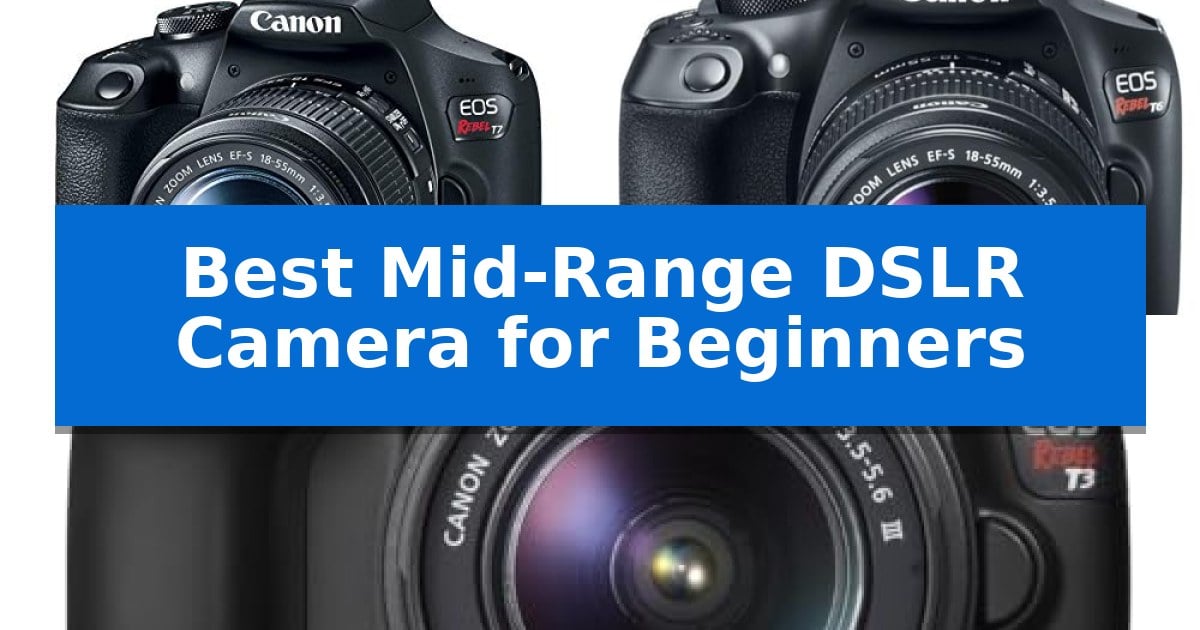
Entering the world of photography can feel overwhelming with so many technical specifications to consider. Finding the Best Mid-Range DSLR Camera for Beginners is about balancing ease of use with the creative control needed to grow your skills.
A reliable camera should bridge the gap between simple point-and-shoot devices and professional equipment. By focusing on intuitive interfaces and essential imaging capabilities, you can capture high-quality photos while learning the fundamentals of light, focus, and composition.
You may also want to compare Best Mid-Range DSLR Camera, Best Mid-Range Drones, and Best Mid-Range Drone with Camera.
Best Mid-Range DSLR Camera for Beginners
Quick Comparison
| Product | Best For | Key Strength | Score |
|---|---|---|---|
| Canon EOS Rebel T7 DSLR Camera | Best Overall | 24.1 Megapixel CMOS sensor for high-resolution images. | 4.9 |
| Canon EOS Rebel T6 DSLR Camera | Budget-Friendly Learning Tool | Optical viewfinder for direct subject framing | 4.3 |
| Canon EOS Rebel T3 DSLR Camera | Simple Controls for Novices | Basic+ control menu simplifies complex settings for new photographers. | 4.4 |
How We Chose
- Sensor resolution and image detail capabilities
- Autofocus speed and reliability for moving subjects
- Ease of use through intuitive menu systems and physical controls
- Connectivity options for transferring and sharing images
- Overall build and ergonomic design for handheld shooting
1 Canon EOS Rebel T7 DSLR Camera — Reliable Entry-Level Standard
Capturing detailed imagery in varied lighting conditions is simplified by the Canon EOS Rebel T7 DSLR Camera, which centers its performance around a 24.1 Megapixel CMOS sensor. This model provides a reliable foundation for those transitioning from mobile photography to dedicated camera systems, balancing high-resolution output with accessible controls.
The camera features a 9-point AF system paired with AI Servo AF, designed to maintain focus on subjects during active shooting. For users navigating different environments, the ISO range of 100 to 6400—expandable to 12800—offers the flexibility needed to adjust for changing light levels without excessive complexity.
Usability is a primary focus of the design, highlighted by a 3.0-inch LCD display and a Scene Intelligent Auto mode that automates settings for beginners. The inclusion of built-in Wi-Fi and NFC technology streamlines the workflow, allowing for direct photo sharing and uploading to social media platforms without requiring external card readers or cables.
Measuring approximately 5.1 by 4 inches, this compact DSLR is built for portability while maintaining the ergonomic grip expected of the system. While it provides a robust entry point into photography, users should note that it relies on a specific lens mount system and standard DSLR physical dimensions, which may influence bag space and accessory compatibility.
Best for: Beginners seeking a dedicated, user-friendly DSLR with built-in wireless sharing capabilities for social media.
Skip if: Users requiring advanced video-centric features, high-speed continuous burst rates, or a mirrorless form factor for reduced weight.
PROS
- 24.1 Megapixel CMOS sensor for high-resolution images.
- Built-in Wi-Fi and NFC for convenient wireless file transfers.
- Scene Intelligent Auto mode simplifies settings for new photographers.
- 9-point AF system provides reliable focus tracking.
CONS
- Fixed LCD screen lacks articulation for complex shooting angles.
- ISO range is functional but limited compared to professional-grade sensors.
2 Canon EOS Rebel T6 DSLR Camera — Budget-Friendly Learning Tool
The Canon EOS Rebel T6 Digital SLR Camera serves as a foundational tool for those transitioning into manual photography, centered around its 18.0 MP APS-C CMOS sensor and DIGIC 4+ image processor. This combination provides the necessary resolution and processing speed to capture detailed images while learning the fundamentals of exposure and composition.
Designed with a high-performance optical viewfinder, the camera allows users to frame subjects directly through the lens, a critical feature for developing an intuitive understanding of focus and depth of field. The 9-point autofocus system, featuring a center cross-type point, assists in achieving sharp focus on subjects, while the ISO 100-6400 range—expandable to 12800—offers flexibility for varying light conditions.
For those interested in multimedia, the device supports Full HD 1080p video recording at 30 fps. The integration of built-in Wi-Fi with NFC simplifies the process of transferring images to compatible mobile devices, streamlining the workflow from capture to sharing without requiring external card readers.
The camera includes a 3.0-inch 920k-dot LCD monitor for menu navigation and image review, alongside a Scene Intelligent Auto mode that helps beginners balance settings automatically. Weighing approximately 2.04 pounds, it provides a substantial feel that helps maintain stability during handheld shooting, making it a practical choice for those building their first photography kit.
Best for: Beginners seeking a dedicated, entry-level DSLR with an optical viewfinder and manual control options to learn photography fundamentals.
Skip if: Users prioritizing a compact, pocketable form factor or advanced 4K video capabilities will find this older DSLR design too bulky and limited for their needs.
PROS
- Optical viewfinder for direct subject framing
- Built-in Wi-Fi and NFC for easy image transfer
- Center cross-type autofocus point for reliable focusing
- Scene Intelligent Auto mode for guided operation
CONS
- Limited 1080p video resolution compared to modern standards
- 3 fps continuous shooting speed is restrictive for fast-moving subjects
3 Canon EOS Rebel T3 DSLR Camera — Simple Controls for Novices
Stepping into the world of photography requires a balance between intuitive operation and the ability to capture high-quality images, which is exactly where the Canon EOS Rebel T3 DSLR Camera finds its footing. Designed for those moving beyond smartphone photography, this camera features a 12MP APS-C CMOS sensor that provides a solid foundation for learning the fundamentals of exposure and composition.
The camera is built around a 9-point AF system, which helps maintain focus on subjects, while the Basic+ control menu simplifies the process of adjusting image settings for novices. Whether you are shooting still images or utilizing the 720p HD video recording capability, the system is designed to keep the learning curve manageable without sacrificing the core functionality of a DSLR.
For those who appreciate convenience, the Canon EOS Rebel T3 DSLR Camera includes Eye-fi wireless SD card compatible menu options, allowing for streamlined image management. The 2.7-inch LCD screen provides a clear view for framing shots and navigating the interface, while the ISO 100-6400 range offers flexibility for varying lighting conditions.
This kit comes paired with the EF-S 18-55mm f/3.5-5.6 III lens, providing a versatile focal range suitable for everyday photography. With a continuous shooting speed of up to 3 frames per second, it is well-equipped to handle candid moments and general subjects, making it a reliable entry point for those looking to develop their skills.
Best for: This camera is best for beginners who want a dedicated, intuitive DSLR system to learn manual photography controls and composition.
Skip if: Skip this model if you require high-speed burst shooting, 4K video resolution, or a modern touchscreen interface.
PROS
- Basic+ control menu simplifies complex settings for new photographers.
- 9-point AF system provides reliable focus tracking for general subjects.
- Eye-fi wireless compatibility allows for easier image transfer options.
- Includes a versatile EF-S 18-55mm lens to get started immediately.
CONS
- 720p video resolution is limited compared to modern full HD or 4K standards.
- 3 frames per second burst rate is restrictive for fast-moving action photography.
Best Mid-Range DSLR Camera for Beginners Buying Guide
Understanding Sensor Size and Resolution
The APS-C CMOS sensor is the heart of a mid-range DSLR. It determines how much light your camera can capture and how much detail will be present in your final images. Higher megapixel counts allow for more cropping flexibility, which is helpful when you are still learning how to frame your shots correctly.
For most beginners, a sensor in the 12 to 24-megapixel range is more than sufficient. It provides a balance between high-quality output and manageable file sizes, ensuring you can store and edit your photos without needing an incredibly powerful computer.
The Importance of Autofocus Systems
A robust autofocus system is critical for ensuring your subjects are sharp. Many entry-level and mid-range DSLRs use a multi-point AF system that allows the camera to track subjects across the frame. Look for models that include a center cross-type point, as this is often more sensitive and accurate in varying light conditions.
Understanding how your camera locks focus—whether through the viewfinder or the LCD screen—will change how you approach different subjects. Practice using different focus points to move away from the default center-weighted mode and gain more creative control over your compositions.
ISO Range and Low-Light Performance
The ISO range dictates how your camera handles dark environments. A wider range allows you to shoot in dimmer conditions without needing a flash, though higher settings can introduce digital noise. A camera that offers a clean base ISO of 100 is ideal for bright daylight photography.
When shooting in low light, you will often need to increase your ISO. Being able to expand this range gives you the flexibility to experiment with night photography or indoor events, provided you understand the trade-off between sensitivity and image grain.
Connectivity and Sharing Features
Modern photography is rarely confined to the camera itself. Features like built-in Wi-Fi and NFC allow you to transfer images directly to a smartphone or tablet. This is a significant advantage for beginners who want to share their work quickly or use a mobile device as a remote shutter.
Check if the camera supports dedicated mobile apps, which often streamline the transfer process. Seamless connectivity ensures that your creative output is accessible whenever you need it, bridging the gap between traditional photography and digital sharing habits.
Ergonomics and User Interface
The physical design of the camera, including the LCD display and button layout, directly impacts your shooting experience. A clear, high-resolution screen makes it easier to review photos and navigate settings, while a well-balanced body helps reduce fatigue during long sessions.
Many mid-range models include Scene Intelligent Auto modes that handle the technical settings for you. This allows you to focus on the subject while the camera manages the exposure, making the learning curve much more manageable for those new to manual controls.
Frequently Asked Questions
What is the main advantage of a DSLR over a smartphone?
A DSLR offers a larger sensor and interchangeable lenses, which provide better depth of field, superior low-light performance, and significantly more control over manual settings like aperture and shutter speed.
Do I need to buy extra lenses immediately?
Most cameras come with an 18-55mm kit lens, which is a versatile starting point. It covers a wide range of common subjects, allowing you to learn the basics before deciding which focal lengths suit your specific interests.
How do I transfer photos to my computer?
You can transfer photos using an SD card reader, a USB cable connected to the camera, or via built-in wireless features if your model supports Wi-Fi or NFC connectivity.
What does the ISO setting do?
ISO measures the sensor's sensitivity to light. Lower numbers are best for bright conditions, while higher numbers help in low light but may introduce more noise or grain into your images.
Is a renewed camera a good choice for beginners?
Renewed cameras can be a cost-effective way to get high-quality gear. Ensure the unit comes with a warranty and has been inspected to meet performance standards before purchasing.
Conclusion: Our Top Pick
Choosing the right camera is the first step toward mastering your craft. The Canon EOS Rebel T7 DSLR Camera stands out as the most balanced option for those starting out, offering a high-resolution 24.1 Megapixel sensor and intuitive features that simplify the learning process.
With its versatile ISO range and reliable autofocus system, this model provides the necessary tools to capture sharp, detailed images in various environments. Its built-in sharing capabilities make it easy to transition from taking photos to showcasing your work, making it an excellent foundation for any aspiring photographer.