
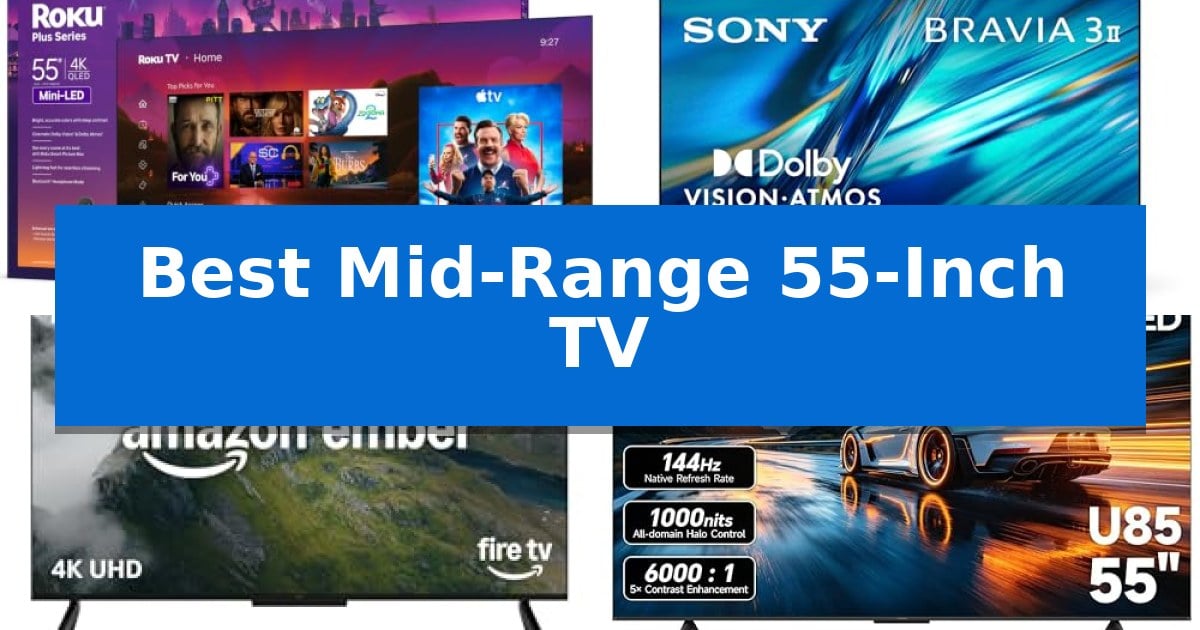
Finding the Best Mid-Range 55-Inch TV involves navigating a crowded market where display quality, smart platform integration, and gaming performance often collide. Whether you are upgrading your living room setup or looking for a dedicated display for console gaming, the right balance of contrast, motion handling, and ease of use is essential for a satisfying viewing experience.
We have analyzed the latest 55-inch models to help you identify which features truly impact your daily entertainment. From advanced Mini-LED panels to intuitive streaming interfaces, our guide focuses on the technical specifications and practical benefits that differentiate these displays, ensuring you make an informed decision for your specific home environment.
You may also want to compare Best Mid-Range 55-Inch 4K TV, Best Mid-Range 50-Inch TV, and Best Mid-Range 50-59 Inch TV.
Best Mid-Range 55-Inch TV
Quick Comparison
| Product | Best For | Key Strength | Score |
|---|---|---|---|
| Roku Plus Series Smart TV | Best Overall | Mini-LED and QLED technology for sharp contrast and color. | 4.9 |
| Sony BRAVIA 3 II Smart TV | Top Choice for Gaming | Four HDMI 2.1 ports for 4K/120Hz gaming | 4.8 |
| Amazon Ember 4-Series Smart TV | Best Value for Alexa Users | Omnisense technology enables automatic display wake-up upon room entry. | 4.6 |
| iFFALCON U85 MiniLED Smart TV | High Refresh Rate Performance | Native 144Hz panel with VRR support up to 288Hz for fluid motion. | 4.4 |
| Roku Select Series Smart TV | Budget-Friendly Everyday Viewing | Frameless design for a modern, unobtrusive aesthetic. | 4.8 |
How We Chose
- Display Panel Technology: Assessing the use of Mini-LED, QLED, or standard LED backlighting for contrast and color accuracy.
- Gaming Performance: Evaluating refresh rates, VRR support, and HDMI 2.1 connectivity for console compatibility.
- Smart Platform Integration: Comparing the ease of navigation, voice control capabilities, and app ecosystem availability.
- Audio and Visual Standards: Checking for support of formats like Dolby Vision, Dolby Atmos, and HDR10+.
- Design and Practicality: Considering physical dimensions, bezel design, and remote control functionality.
1 Roku Plus Series Smart TV — Best for Simple Streaming
The Roku Plus Series Smart TV streamlines the home entertainment experience by integrating a Mini-LED and QLED display panel with the intuitive Roku operating system. This 55-inch model is designed to minimize setup time and simplify navigation, ensuring that access to live TV, news, and sports is immediate upon installation.
Visual performance is managed by Roku Smart Picture Max, which automatically adjusts display settings to match the content being viewed, removing the need for manual calibration. The inclusion of Dolby Vision and Dolby Atmos support provides a foundation for high-contrast imagery and immersive audio, while the Enhanced Voice Remote allows for hands-free searching across thousands of applications.
Practical design elements include an integrated remote finder button on the side of the television, which helps locate the controller if it is misplaced. For private viewing, the Bluetooth Headphone Mode allows users to connect wireless headphones directly to the TV, ensuring audio can be enjoyed without disturbing others in the household.
The Sports Zone feature serves as a centralized hub for game-day viewing, providing live scores, highlights, and start-time reminders. This model balances advanced display technology with user-centric software, making it a functional choice for those who prioritize ease of use alongside modern picture quality.
Best for: Users who want a straightforward, easy-to-navigate smart TV interface combined with high-contrast Mini-LED and QLED picture quality.
Skip if: Viewers who require advanced gaming-specific ports or high-end professional calibration tools, as this model focuses primarily on simplified streaming and automated picture settings.
PROS
- Mini-LED and QLED technology for sharp contrast and color.
- Roku Smart Picture Max for automatic, hassle-free display tuning.
- Enhanced Voice Remote with a built-in remote finder feature.
- Bluetooth Headphone Mode for private, wireless listening.
CONS
- Simplified interface may lack the granular manual control preferred by advanced users.
2 Sony BRAVIA 3 II Smart TV — Top Choice for Gaming
Achieving a high-performance home theater experience often hinges on the display's ability to handle both cinematic content and modern gaming demands. The Sony 55 Inch BRAVIA 3 II LED 4K HDR Smart Google TV distinguishes itself through its integration of the XR Processor, which utilizes AI scene recognition to dynamically optimize color, contrast, and clarity. This model is engineered to bridge the gap between casual viewing and enthusiast-level gaming.
For gamers, the inclusion of four HDMI 2.1 ports supporting 4K/120Hz, VRR, and ALLM provides the necessary bandwidth for responsive gameplay. The TV features specialized PS5 enhancements, such as Auto HDR Tone Mapping and an dedicated Game Menu, allowing users to adjust picture settings and assist features without exiting their session. These tools ensure that the display adapts to the specific output requirements of high-performance consoles.
Beyond gaming, the Sony 55 Inch BRAVIA 3 II LED 4K HDR Smart Google TV prioritizes visual fidelity through XR Triluminos Pro, which reproduces over a billion colors. The Flush Surface design and minimal bezel focus attention on the screen, while Dolby Vision and Dolby Atmos support work to create an immersive environment. The integration of Google TV with Gemini allows for natural language interaction to manage content discovery and smart home control.
The audio experience is supported by X-Balanced Speakers, designed to reduce distortion and improve bass resolution. While the display offers a robust suite of features, users should note that its performance is optimized for those who intend to leverage its specific gaming and AI-driven processing capabilities. The package also includes 4K movie credits for use with SONY PICTURES CORE, adding immediate value for film enthusiasts.
Best for: Gamers and movie enthusiasts who want a high-performance display with dedicated PS5 features and AI-driven picture optimization.
Skip if: Users who do not require high-refresh-rate gaming features or advanced AI processing may find a more cost-effective solution in a standard 4K LED model.
PROS
- Four HDMI 2.1 ports for 4K/120Hz gaming
- AI-driven XR Processor for real-time picture optimization
- Dedicated PS5 features including Auto HDR Tone Mapping
- Immersive audio support with Dolby Atmos and DTS:X
CONS
- Premium feature set may exceed the needs of casual viewers
- Specific gaming optimizations are best utilized with compatible hardware
3 Amazon Ember 4-Series Smart TV — Best Value for Alexa Users
The Amazon Ember 4-Series Smart TV integrates custom Omnisense technology, which utilizes built-in sensors to wake the display automatically when you enter a room. This feature allows the screen to transition instantly into displaying artwork or providing quick access to your favorite streaming content, streamlining the transition from idle to active use.
Designed for modern connectivity, this 55-inch display features Wi-Fi 6 support paired with a new quad-core processor to ensure smooth navigation and fast application loading. The unit includes four HDMI inputs, providing sufficient capacity to connect multiple gaming consoles, soundbars, and other media devices simultaneously.
The visual experience is supported by 4K Ultra HD resolution and HDR10+ compatibility, which work to enhance contrast and brightness for clearer detail in both bright and dark scenes. For those who enjoy gaming, the TV supports streaming via Amazon Luna and Xbox Game Pass, allowing users to play premium titles directly on the screen without the need for a dedicated console.
Navigation is managed through the updated Fire TV interface, which offers personalized recommendations and dedicated content categories. The included Alexa Voice Remote Enhanced allows for natural language voice commands, enabling users to search across apps, control smart home devices, or manage playback with simple verbal prompts.
Best for: Users deeply integrated into the Amazon ecosystem who prioritize voice-controlled smart home management and instant access to streaming services.
Skip if: Viewers seeking high-end gaming features like 120Hz refresh rates or advanced local dimming zones for professional-grade contrast.
PROS
- Omnisense technology enables automatic display wake-up upon room entry.
- Wi-Fi 6 support ensures faster, more stable connectivity for high-bandwidth streaming.
- Integrated cloud gaming support for Amazon Luna and Xbox Game Pass eliminates the need for a console.
- Four HDMI inputs provide flexible connectivity for multiple external devices.
CONS
- Subscription fees may apply for full access to certain content libraries and services.
- Performance relies on internet speed for cloud-based gaming and high-resolution streaming.
4 iFFALCON U85 MiniLED Smart TV — High Refresh Rate Performance
Achieving a fluid gaming experience on a 55-inch display requires more than just high resolution; it demands the high-speed panel responsiveness found in the iFFALCON U85 MiniLED Smart TV. This model distinguishes itself with a native 144Hz panel that supports Variable Refresh Rate (VRR) up to 288Hz, ensuring that fast-paced action remains smooth and free of screen tearing.
The integration of MiniLED technology provides a 6,000:1 contrast ratio and up to 1000 nits of peak brightness, allowing for deep blacks and vibrant highlights that enhance HDR content. With support for Dolby Vision IQ, the display dynamically adjusts to ambient room lighting, while IMAX Enhanced certification ensures that cinematic content is presented with director-approved color and clarity.
Connectivity is a primary strength, featuring four HDMI 2.1 ports. Two of these ports are dedicated to 4K@144Hz gaming, making it a suitable hub for next-generation consoles and high-end PCs. The inclusion of Auto Low Latency Mode (ALLM) and FreeSync Premium Pro further minimizes input lag, keeping the display synchronized with the source device without manual intervention.
Beyond gaming, the iFFALCON U85 MiniLED Smart TV functions as a versatile home theater and commercial display. It features a 50W 2.1-channel audio system with Dolby Atmos and DTS Virtual:X support. For professional or hospitality environments, the inclusion of Google TV hotel mode, IP control, and an IR blaster allows for centralized management and customized input locking, providing utility beyond standard consumer television sets.
Best for: Gamers and home theater enthusiasts who require high-refresh-rate performance and robust connectivity for multiple consoles or PCs.
Skip if: Users who prioritize a smaller form factor or those who do not require advanced gaming-specific features like 144Hz VRR and multiple HDMI 2.1 ports.
PROS
- Native 144Hz panel with VRR support up to 288Hz for fluid motion.
- Four HDMI 2.1 ports providing extensive connectivity for consoles and PCs.
- MiniLED local dimming with 1000 nits brightness for high-contrast HDR.
- Commercial-ready features including hotel mode and IP/IR control.
CONS
- Large 55-inch footprint may be restrictive for smaller living or office spaces.
5 Roku Select Series Smart TV — Budget-Friendly Everyday Viewing
The Roku Select Series Smart TV offers a streamlined entertainment experience by combining a 55-inch 4K HDR10 display with a user-friendly, customizable interface. Its frameless design minimizes distractions, allowing the screen to serve as a clean, modern focal point in any living space.
Performance is enhanced by Roku Smart Picture technology, which automatically optimizes incoming signals to ensure appropriate picture modes for various content. For audio, the television is engineered for clear speech and increased volume, while the included Bluetooth Headphone Mode provides a convenient way to enjoy media privately without disturbing others.
Connectivity and control are central to the user experience, featuring fast Wi-Fi for quick app launching and broad compatibility with Siri, Alexa, and Google Assistant. Users can also utilize Apple AirPlay to share media directly from Apple devices, or navigate the system using the Enhanced Voice Remote, which includes a built-in lost remote finder.
This model balances smart functionality with practical design, offering automatic software updates to keep the system current. While it provides a robust suite of streaming options, including access to 500 plus free live TV channels, its primary value lies in its simplicity and integration within a connected home environment.
Best for: Users seeking a straightforward, smart-integrated 4K television that prioritizes ease of use and quick access to streaming services.
Skip if: Viewers requiring advanced gaming-specific features like high-refresh-rate panels or specialized VRR support for competitive console play.
PROS
- Frameless design for a modern, unobtrusive aesthetic.
- Roku Smart Picture automatically optimizes signal quality.
- Enhanced voice remote includes a convenient lost remote finder.
- Bluetooth Headphone Mode allows for private listening.
CONS
- Limited to standard 60Hz refresh rate for display output.
- Lacks advanced gaming-specific ports or high-end VRR support.
Best Mid-Range 55-Inch TV Buying Guide
Understanding Display Technologies
The display panel is the most significant factor in your viewing experience. Mini-LED and QLED technologies are increasingly common in the mid-range segment, offering superior brightness and deeper contrast compared to traditional LED panels. These technologies help prevent light bleed in dark scenes, which is crucial for cinematic content.
When choosing between these, consider your room's lighting. Mini-LED typically provides better local dimming, making it ideal for bright rooms where glare might be an issue, while QLED excels at maintaining color volume across a wide range of brightness levels.
Gaming Connectivity and Motion
For gamers, the presence of HDMI 2.1 ports is non-negotiable for high-performance consoles. These ports enable 4K at 120Hz or higher, ensuring smooth motion and reduced input lag. Look for models that explicitly support Variable Refresh Rate (VRR) and Auto Low Latency Mode (ALLM) to keep your gameplay responsive.
Motion handling is equally important for sports and action movies. A native high refresh rate panel prevents the blur often seen in fast-moving sequences, providing a clearer image without the need for aggressive software-based motion smoothing.
Smart Platform Ecosystems
Your TV's operating system dictates how you interact with your content. Platforms like Roku TV and Google TV offer distinct advantages, such as simplified home screens, extensive app libraries, and integrated voice search. A responsive interface ensures that launching apps and switching inputs happens without frustrating delays.
Consider how the TV integrates with your existing smart home devices. Many modern mid-range TVs now include Alexa or Google Assistant support, allowing you to control your display, adjust volume, or search for shows using simple voice commands.
Audio Standards and Enhancement
While built-in speakers have improved, support for Dolby Atmos allows the TV to process advanced audio formats, creating a more immersive soundstage. Even if you plan to use a soundbar, ensuring the TV has an eARC port is vital for passing high-quality, lossless audio signals to your external sound system.
Some models also feature specific audio processing modes that prioritize dialogue clarity, which can be a major benefit if you frequently watch news or unscripted content where speech needs to be distinct from background noise.
Physical Design and Placement
A 55-inch screen is a versatile size, but you should always measure your entertainment console to ensure the stand width or wall mount compatibility fits your space. Many newer models feature a frameless design, which minimizes the bezel and keeps the focus entirely on the picture.
Think about cable management and port accessibility. TVs with side-facing ports are generally easier to install on a wall mount, as they prevent cables from being pinched against the back of the panel.
Frequently Asked Questions
What is the main advantage of Mini-LED over standard LED?
Mini-LED uses much smaller light sources, allowing for more precise local dimming zones. This results in deeper blacks and higher peak brightness, significantly improving contrast.
Do I need HDMI 2.1 for streaming movies?
No, HDMI 2.1 is primarily beneficial for high-end gaming consoles and PCs. For streaming services, standard HDMI 2.0 or 2.1 ports will both handle 4K HDR content effectively.
Can I use my existing wireless headphones with these TVs?
Many modern smart TVs, including the Roku and Sony models listed, feature Bluetooth headphone modes that allow for private listening without waking others.
What does VRR do for my gaming experience?
Variable Refresh Rate (VRR) synchronizes the TV's refresh rate with your console's frame rate, eliminating screen tearing and stuttering during intense gameplay.
Is a 55-inch TV too big for a small bedroom?
A 55-inch TV is often considered a great mid-range size. As long as you have a viewing distance of at least 4 to 6 feet, it should provide an immersive experience without overwhelming the room.
Conclusion: Our Top Pick
For those seeking the best balance of performance, ease of use, and visual quality, the Roku Plus Series Smart TV stands out as the top choice. Its combination of Mini-LED and QLED technology provides a high-contrast, vibrant picture that is rare at this price point, while the Roku interface keeps navigation simple and fast.
While other models offer specific advantages for hardcore gamers or those deep in the Google ecosystem, the Roku Plus Series provides the most consistent and user-friendly experience for everyday streaming. It removes the guesswork from picture settings and offers a reliable, high-quality display that fits perfectly into most modern living rooms.