
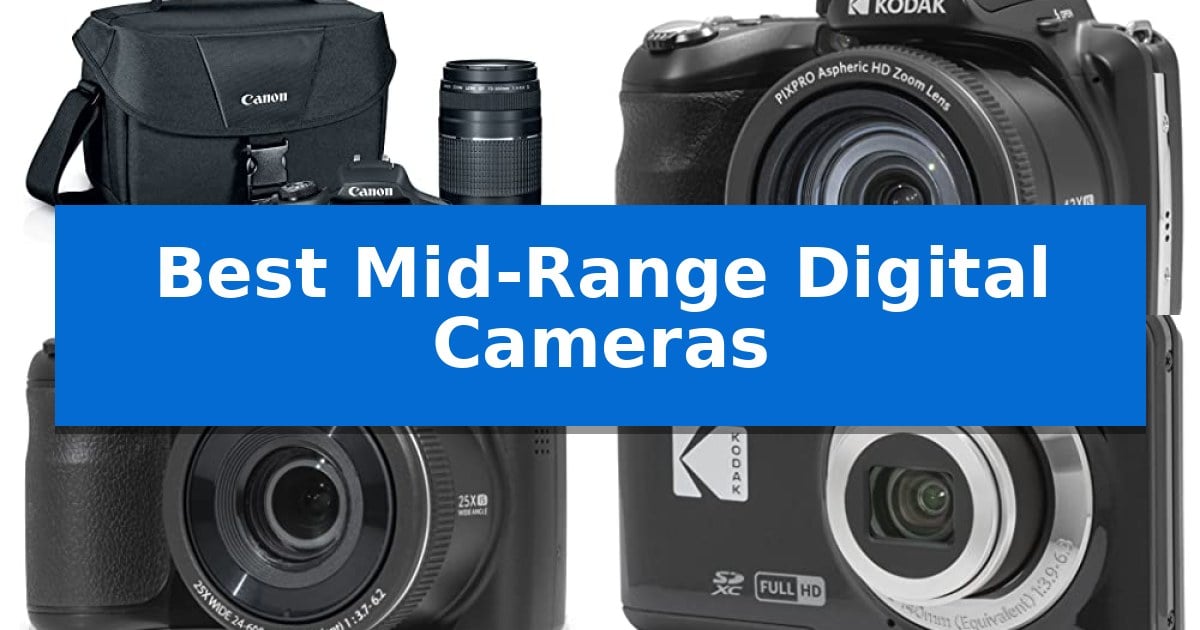
Choosing the right equipment can significantly impact your creative process, whether you are capturing family milestones or exploring wildlife photography. The market offers a variety of options that bridge the gap between basic point-and-shoot devices and professional-grade gear, providing a versatile middle ground for enthusiasts.
In this guide, we examine the Best Mid-Range Digital Cameras to help you identify which features—such as optical zoom range, sensor resolution, and battery type—align with your specific shooting needs. By focusing on practical specifications, we aim to simplify your decision-making process.
You may also want to compare Best Mid-Range Desktop PCs, Best Mid-Range Desktop PC Processors, and Best Mid-Range Desktop Computer.
Best Mid-Range Digital Cameras
Quick Comparison
| Product | Best For | Key Strength | Score |
|---|---|---|---|
| Canon EOS Rebel T7 DSLR Camera | Best Overall | Double Zoom Lens Kit included for immediate versatility. | 4.9 |
| KODAK PIXPRO AZ425 Bridge Camera | High-Reach Optical Zoom Power | 42x optical zoom provides exceptional reach for distant subjects. | 4.7 |
| KODAK PIXPRO AZ255 Bridge Camera | Reliable AA Battery Convenience | 25x optical zoom provides significant reach for distant subjects. | 4.7 |
| KODAK PIXPRO FZ55 Digital Camera | Compact Everyday Point and Shoot | 16MP CMOS sensor for detailed everyday photography | 4.7 |
How We Chose
- Sensor resolution and image quality for print and digital sharing.
- Optical zoom range and lens versatility for different shooting environments.
- Image stabilization effectiveness for handheld photography.
- Battery type and power convenience for various travel scenarios.
- Overall size and weight for portability and daily carry.
1 Canon EOS Rebel T7 DSLR Camera — Versatile Interchangeable Lens System
Capturing high-quality imagery often requires a balance between manual control and accessible automation, which is where the Canon EOS Rebel T7 DSLR Camera enters the frame. This system provides a 24.1 Megapixel CMOS (APS-C) sensor paired with a versatile Double Zoom Lens Kit, including both an EF-S 18-55mm and an EF 75-300mm lens, allowing users to transition from wide-angle landscapes to distant subjects without changing camera bodies.
The camera integrates a 9-Point AF system with AI Servo AF to assist in tracking moving subjects, while the Optical Viewfinder offers approximately 95% viewing coverage for traditional composition. For those looking to expand their utility beyond still photography, the device supports FHD 1080p video capture and can function as a high-quality webcam when paired with the EOS Utility Webcam Beta Software on Mac or Windows systems.
Connectivity is streamlined through built-in Wi-Fi and NFC technology, enabling efficient transfer of files to compatible devices. The inclusion of Improved Dual Pixel CMOS AF and eye detection AF helps maintain focus accuracy, while the ISO range of 100–6400 (expandable to 12800) provides flexibility across varying lighting conditions. The unit is built to operate within a temperature range of 32-104°F.
Designed for those entering the world of interchangeable lens photography, this kit prioritizes a balance of manual depth and ease of use. While the optical viewfinder provides a classic shooting experience, the reliance on specific lens mounts and the physical dimensions of the DSLR body represent a trade-off in portability compared to mirrorless alternatives.
Best for: Beginner photographers seeking a comprehensive, interchangeable lens system for both still photography and high-definition video recording.
Skip if: Users prioritizing an ultra-compact, pocketable form factor or those who require advanced 4K video recording capabilities.
PROS
- Double Zoom Lens Kit included for immediate versatility.
- 24.1 Megapixel CMOS sensor for high-resolution images.
- Built-in Wi-Fi and NFC for convenient file sharing.
- Webcam functionality via dedicated software support.
CONS
- Optical viewfinder limited to 95% coverage.
- 1080p video resolution may not meet high-end 4K requirements.
2 KODAK PIXPRO AZ425 Bridge Camera — High-Reach Optical Zoom Power
Capturing distant subjects is the primary strength of the KODAK PIXPRO AZ425 Bridge Camera, which features a powerful 42x optical zoom lens. This bridge camera is designed to bridge the gap between simple point-and-shoots and complex interchangeable lens systems, offering a versatile 24mm wide-angle lens that handles everything from expansive group photos to detailed wildlife shots.
The camera utilizes a 20MP BSI CMOS sensor, which uses a backside-illuminated design to improve light gathering efficiency in challenging lighting conditions. To ensure clarity when shooting at high zoom levels, the device includes Optical Image Stabilization (OIS), which helps compensate for hand movement and minimizes blur during handheld photography.
For those interested in video, the unit records 1080p Full HD video, providing a straightforward way to document events. The interface is built for accessibility, featuring simple controls and dedicated scene modes that assist beginners, while offering custom modes for those looking to refine their settings.
Power is supplied by a rechargeable Li-Ion battery, rated for approximately 240 shots per charge. The camera supports Class 10 SD, SDHC, or SDXC cards up to 512GB, ensuring ample storage for high-resolution images and video, with data transfer handled via a standard USB connection.
Best for: Photographers who need significant zoom range for wildlife, sports, or travel without the complexity of changing lenses.
Skip if: Users who require professional-grade low-light performance or the ability to swap lenses for specialized optical needs.
PROS
- 42x optical zoom provides exceptional reach for distant subjects.
- Optical Image Stabilization reduces blur during handheld shooting.
- BSI CMOS sensor improves light sensitivity for better image quality.
- Wide-angle 24mm lens offers versatility for group and landscape shots.
CONS
- Battery life is limited to approximately 240 shots per charge.
- Fixed lens design prevents the use of specialized optics.
3 KODAK PIXPRO AZ255 Bridge Camera — Reliable AA Battery Convenience
The KODAK PIXPRO AZ255 Bridge Camera simplifies long-distance photography with its 25x optical zoom lens, allowing users to capture distant subjects without the quality loss associated with digital cropping. This bridge-style camera is built for versatility, utilizing a 24mm wide-angle lens that transitions easily from expansive landscapes to tight, detailed shots of wildlife or stage performers.
Equipped with a 16MP CMOS sensor, this model delivers high-resolution images with accurate color reproduction. To ensure shots remain clear during handheld use, the camera features Optical Image Stabilization (OIS), which compensates for hand shake at higher zoom levels. This is particularly useful when shooting at the full extent of the 25x zoom range.
A standout design choice is the use of standard AA batteries, providing a practical power solution for travelers who may not have access to proprietary charging cradles. This design eliminates concerns about battery compatibility or finding specific power outlets while on the road, making it a reliable companion for camping or international trips.
For video needs, the device records in 1080p Full HD, offering a straightforward way to document events. Files are stored on standard SD, SDHC, or SDXC cards up to 512GB, and the camera includes a 3-inch LCD screen for framing and reviewing content. Connectivity is managed via a standard USB interface for simple file transfers to a computer.
Best for: Travelers and hobbyists who prioritize the convenience of standard AA battery power and long-range optical zoom in a compact bridge camera format.
Skip if: Users seeking professional-grade manual controls, high-speed burst performance, or advanced low-light sensor capabilities will find this entry-level bridge camera limiting.
PROS
- 25x optical zoom provides significant reach for distant subjects.
- AA battery compatibility ensures power availability anywhere.
- Optical Image Stabilization reduces blur during handheld shooting.
- 24mm wide-angle lens offers flexibility for varied shooting environments.
CONS
- Fixed lens system lacks the flexibility of interchangeable lens cameras.
- AA battery reliance may lead to higher recurring costs compared to rechargeable lithium-ion packs.
4 KODAK PIXPRO FZ55 Digital Camera — Compact Everyday Point and Shoot
The KODAK PIXPRO FZ55 Digital Camera provides a straightforward approach to photography with its 16MP CMOS sensor, designed to capture detailed images for everyday use. Its compact form factor, measuring just 3.6 inches in length, makes it a portable option for those who prefer a dedicated device over a smartphone for travel or casual documentation.
Equipped with a 5x optical zoom and a 28mm wide-angle lens, this camera offers flexibility for framing subjects both indoors and outdoors. Users can record 1080p Full HD video, which is suitable for creating simple vlogging content or capturing family moments. The 2.7-inch LCD screen serves as the primary interface for framing shots and navigating the camera's settings.
Practicality is central to the design, as the camera includes a rechargeable LB-012 lithium-ion battery. This battery charges directly inside the camera via a USB connection, with a full charge cycle taking approximately 2 hours. To ensure optimal performance, the manufacturer recommends an initial charge of at least 4 hours before the first use.
Storage is handled via a memory card slot that supports Class 10 SD, SDHC, or SDXC cards with capacities up to 512GB. This wide compatibility allows for extensive photo and video storage without frequent card swaps. The camera's simple point-and-shoot interface is intended to minimize setup time, allowing users to focus on capturing images immediately.
Best for: This camera is best for users seeking a compact, dedicated point-and-shoot device for everyday photography and simple 1080p video recording.
Skip if: Skip this model if you require advanced manual controls, interchangeable lenses, or 4K video recording capabilities.
PROS
- 16MP CMOS sensor for detailed everyday photography
- 5x optical zoom with a versatile 28mm wide-angle lens
- In-camera USB charging for the included lithium-ion battery
- Supports high-capacity SDXC cards up to 512GB
CONS
- Limited to 1080p video resolution, which may not meet the needs of professional creators
- Fixed lens design prevents the use of specialized optics
Best Mid-Range Digital Cameras Buying Guide
Understanding Sensor Resolution
The megapixels of a camera sensor determine the level of detail in your images. Higher resolution allows for larger prints and more flexibility when cropping your photos during post-processing.
For most mid-range users, a sensor between 16MP and 24MP provides a balance between high detail and manageable file sizes, making it ideal for social media sharing and standard photo albums.
The Role of Optical Zoom
Optical zoom is fundamentally different from digital zoom because it uses the physical lens to magnify the subject without losing image quality. A longer zoom range is essential for wildlife or sports photography where you cannot physically get closer to the action.
Consider a wide-angle lens if you frequently shoot landscapes or group photos, as this allows you to capture more of the scene within a single frame.
Image Stabilization Importance
Optical Image Stabilization (OIS) is a critical feature for handheld shooting, especially when using high zoom levels. It compensates for minor hand movements that would otherwise result in blurry or soft images.
If you plan to shoot in lower light or at long distances, prioritize models that include built-in stabilization to ensure your keepers remain sharp and clear.
Power and Battery Considerations
Cameras typically use either rechargeable Li-Ion batteries or standard AA batteries. Rechargeable packs are often lighter and more efficient, while AA compatibility offers unmatched convenience for international travel or remote locations where charging outlets are scarce.
Always check the estimated shot count per charge to ensure the camera can keep up with your typical shooting duration during events or day trips.
Portability and Form Factor
The physical size and weight of a camera dictate how often you will actually carry it. Compact point-and-shoot models are easy to slip into a pocket, while bridge cameras offer more ergonomic grips and controls at the cost of a larger footprint.
Evaluate your storage space and whether you prefer a lightweight device for everyday carry or a more substantial camera that provides better handling for extended sessions.
Frequently Asked Questions
What is the main difference between a bridge camera and a DSLR?
A DSLR typically features an interchangeable lens system, allowing you to swap lenses for specific tasks, whereas a bridge camera features a fixed, high-zoom lens that covers a wide range of focal lengths without needing extra equipment.
Does higher megapixel count always mean better photos?
Not necessarily. While higher megapixels provide more detail, the quality of the sensor and the lens optics play a larger role in color accuracy, low-light performance, and overall image sharpness.
Is optical zoom better than digital zoom?
Yes. Optical zoom uses the physical lens to magnify the image, maintaining full resolution. Digital zoom simply crops and enlarges the existing image, which often results in a loss of clarity and detail.
Can I use these cameras for vlogging?
Many modern digital cameras include 1080p video recording and features suitable for vlogging. Look for models with a flip-out screen or compact designs if you plan to record yourself frequently.
How do I choose between AA batteries and rechargeable packs?
Choose AA batteries if you prioritize the ability to buy power anywhere in the world. Choose rechargeable Li-Ion packs if you prefer a lighter, more sustainable power source that is optimized for your specific camera model.
Conclusion: Our Top Pick
Selecting the right camera depends on your specific goals, whether you need the flexibility of interchangeable lenses or the convenience of an all-in-one zoom system. For those seeking a balance of professional-grade sensor performance and lens versatility, the Canon EOS Rebel T7 DSLR Camera stands out as a highly capable choice for beginners and enthusiasts alike.
With its 24.1 Megapixel sensor and the included double zoom lens kit, this camera provides the tools necessary to grow your photography skills. While it requires carrying extra lenses, the image quality and control it offers make it our top pick for those ready to move beyond basic point-and-shoot photography.