
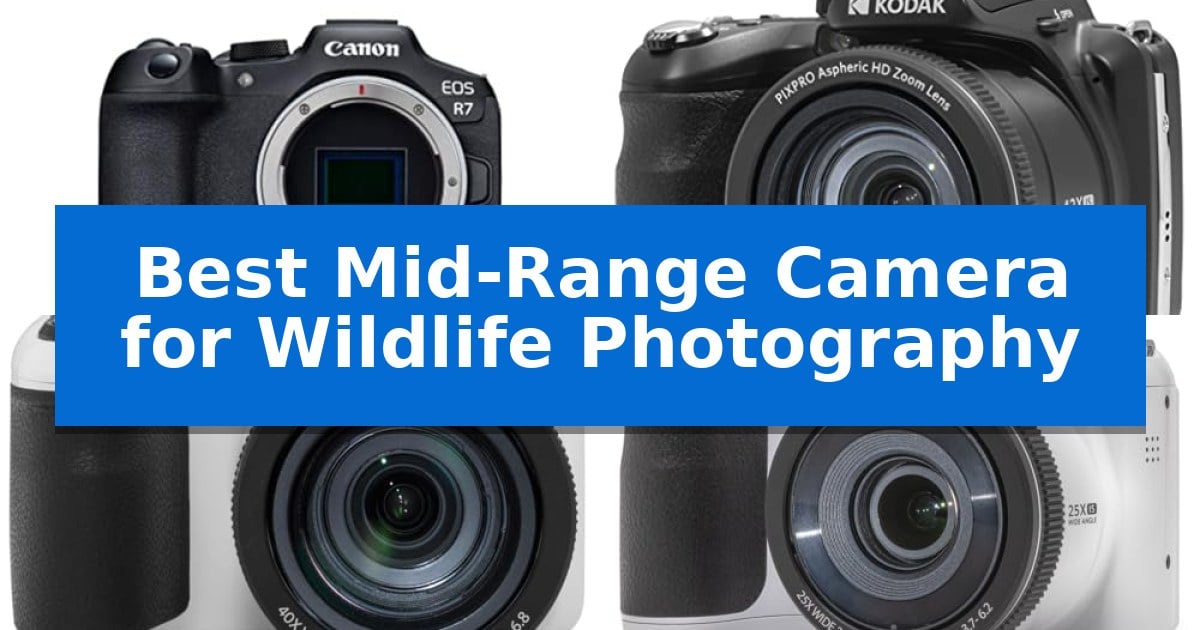
Capturing elusive wildlife requires a unique blend of speed, reach, and image precision. When you are out in the field, the difference between a blurry snapshot and a sharp, professional-grade image often comes down to the responsiveness of your autofocus and the stability of your lens.
Finding the Best Mid-Range Camera for Wildlife Photography means balancing these high-performance needs with a portable form factor that does not weigh you down during long treks. Whether you prioritize high-speed burst shooting or extreme optical zoom, selecting the right tool is essential for documenting nature effectively.
You may also want to compare Best Mid-Range Camera for Scenery and Wildlife, Best Mid-Range Business Laptops, and Best Mid-Range Budget Gaming Laptops.
Best Mid-Range Camera for Wildlife Photography
Quick Comparison
| Product | Best For | Key Strength | Score |
|---|---|---|---|
| Canon EOS R7 Mirrorless Camera | Best Overall | High-speed continuous shooting up to 30 fps with the electronic shutter. | 4.9 |
| KODAK PIXPRO AZ425 Digital Camera | Extreme Zoom for Distant Subjects | 42x optical zoom provides extensive reach for distant subjects. | 4.5 |
| KODAK PIXPRO AZ405 Digital Camera | Versatile Reach for Field Use | 40x optical zoom provides significant reach for distant subjects. | 4.9 |
| KODAK PIXPRO AZ255 Digital Camera | Compact Travel Wildlife Option | 25x optical zoom provides significant reach for wildlife without digital quality loss. | 4.4 |
How We Chose
- Autofocus speed and subject tracking capabilities for erratic movement.
- Optical zoom reach or lens compatibility for distant wildlife subjects.
- Image stabilization performance to minimize blur during handheld shooting.
- Sensor resolution and low-light sensitivity for varied lighting environments.
- Portability and battery endurance for extended field sessions.
1 Canon EOS R7 Mirrorless Camera — Fast Autofocus for Wildlife
Capturing elusive wildlife requires a system that balances reach with responsiveness, and the Canon EOS R7 Mirrorless Camera is engineered specifically to bridge that gap. Built around a 32.5-megapixel APS-C CMOS sensor, this camera provides the telephoto magnification advantage essential for birding and animal photography without the bulk of full-frame alternatives.
At the heart of its performance is the Dual Pixel CMOS AF system, which utilizes 651 autofocus zones covering virtually the entire sensor area. This technology allows for precise subject detection and tracking, ensuring that fast-moving subjects remain in sharp focus. For photographers needing to freeze action, the camera offers a 15 fps mechanical shutter and a 30 fps electronic shutter, complemented by a RAW Burst Mode that includes a 1/2-second pre-shooting buffer to help capture the exact moment an animal enters the frame.
Stability is critical when shooting at long focal lengths, and the Canon EOS R7 Mirrorless Camera addresses this with a 5-Axis In-body Image Stabilization (IBIS) system. This feature works to minimize shake, which is particularly beneficial when shooting handheld in challenging lighting conditions. The inclusion of auto-level technology further assists in maintaining horizon alignment during active shooting sessions.
Designed for versatility, the camera features a comfortable, firm grip that aids in handling during extended field use. Its compact and lightweight construction ensures it remains portable for long treks, while the inclusion of an extra LP-E6NH battery pack provides the endurance needed for extended sessions. Beyond stills, the unit is optimized for 4K video recording with continuous Movie Servo AF, making it a capable tool for those who also document their wildlife encounters through high-quality motion.
Best for: Wildlife and sports photographers who require high-speed continuous shooting and the telephoto reach advantage of an APS-C sensor in a compact body.
Skip if: Photographers who prioritize the shallower depth-of-field and superior low-light performance inherent to full-frame sensor systems.
PROS
- High-speed continuous shooting up to 30 fps with the electronic shutter.
- Advanced Dual Pixel CMOS AF with 100% frame coverage for reliable subject tracking.
- 5-Axis In-body Image Stabilization to counteract camera shake at long focal lengths.
- Compact and lightweight design for improved portability in the field.
CONS
- APS-C sensor size may be a limitation for those requiring maximum low-light sensitivity compared to full-frame sensors.
2 KODAK PIXPRO AZ425 Digital Camera — Extreme Zoom for Distant Subjects
Capturing distant subjects like birds in flight or athletes across a stadium requires significant reach, which is exactly what the KODAK PIXPRO AZ425 Digital Camera provides through its 42x optical zoom lens. This bridge camera is designed to bridge the gap between fixed-lens convenience and the specialized focal lengths needed for wildlife photography, all while maintaining a manageable form factor.
The camera utilizes a 20MP BSI CMOS sensor, which features a backside-illuminated design intended to improve light gathering in challenging conditions, such as overcast days or during the golden hour. To ensure those long-range shots remain clear, the integrated Optical Image Stabilization (OIS) system compensates for hand movement, a critical requirement when shooting at the maximum 42x zoom range where even minor vibrations can impact image sharpness.
For those looking to document their outdoor excursions, the device supports 1080p Full HD video recording. It offers a variety of scene modes to assist beginners, while providing manual control options for more experienced photographers. The camera is powered by a rechargeable Li-Ion battery, rated for approximately 240 shots per charge, and utilizes standard SD, SDHC, or SDXC cards up to 512GB for storage.
With a 24mm wide-angle lens, the camera is versatile enough to handle wide group shots in addition to its primary telephoto capabilities. Its compact design, weighing just under one pound, makes it a practical choice for photographers who need a portable, all-in-one solution for wildlife and sports without the burden of carrying multiple interchangeable lenses.
Best for: Wildlife and sports enthusiasts who require a long-range zoom lens in a single, portable bridge camera body.
Skip if: Users who require professional-grade interchangeable lenses, high-speed burst shooting for rapid wildlife action, or extended battery life beyond 240 shots per charge.
PROS
- 42x optical zoom provides extensive reach for distant subjects.
- Optical Image Stabilization reduces blur during handheld telephoto shooting.
- BSI CMOS sensor improves light sensitivity for better detail in varied lighting.
- Compact, all-in-one design eliminates the need for multiple lenses.
CONS
- Limited battery capacity of approximately 240 shots per charge.
- Fixed-lens system lacks the versatility of interchangeable lens cameras.
3 KODAK PIXPRO AZ405 Digital Camera — Versatile Reach for Field Use
Capturing distant wildlife requires a balance of reach and portability, and the KODAK PIXPRO AZ405 Digital Camera addresses this with a powerful 40x optical zoom lens. This bridge camera allows photographers to frame birds or animals from a distance without needing to physically approach, utilizing a 24mm wide-angle lens that provides the versatility to switch between expansive landscapes and tight close-ups.
The camera integrates a 20MP CMOS sensor designed to produce detailed images suitable for large prints or enlargements. To maintain clarity at the long end of the zoom range, the device includes Optical Image Stabilization (OIS), which helps mitigate the effects of hand shake when shooting handheld. This feature is particularly useful for field work where carrying a tripod may be impractical.
Usability is enhanced by Automatic Scene Detection, which simplifies the technical process by adjusting settings based on the environment. For those interested in capturing movement, the camera supports 1080p Full HD video recording. The interface is centered around a 3-inch LCD screen, providing a clear view for framing shots and navigating the various scene modes.
Designed for travel and remote field use, the KODAK PIXPRO AZ405 Digital Camera operates on standard AA batteries. This choice eliminates the need for proprietary chargers, allowing users to source power globally. The camera is compatible with SD, SDHC, or SDXC cards up to 512GB, ensuring ample storage for high-resolution wildlife sessions.
Best for: Wildlife photographers who prioritize long-range zoom capabilities and the convenience of using standard AA batteries for remote travel.
Skip if: Users who require advanced manual controls, high-speed burst shooting for fast-moving subjects, or the superior low-light performance found in interchangeable lens systems.
PROS
- 40x optical zoom provides significant reach for distant subjects.
- Optical Image Stabilization assists in maintaining sharp frames at high zoom levels.
- AA battery compatibility removes the need for specialized charging equipment in the field.
- 20MP sensor delivers high-resolution images suitable for large prints.
CONS
- AA battery power may result in higher recurring costs compared to rechargeable lithium-ion packs.
- Bridge camera form factor lacks the sensor size and lens flexibility of professional DSLR or mirrorless systems.
4 KODAK PIXPRO AZ255 Digital Camera — Compact Travel Wildlife Option
Capturing distant subjects requires gear that balances reach with portability, and the KODAK PIXPRO AZ255 Digital Camera addresses this with a 25x optical zoom lens. Unlike digital cropping that degrades image quality, this bridge camera provides genuine optical magnification, allowing photographers to pull wildlife, birds, or distant action into sharp focus from a distance.
The camera is built around a 16MP CMOS sensor, which works to maintain color accuracy and detail across varying lighting conditions. To ensure handheld shots remain clear when fully zoomed in, the device features Optical Image Stabilization (OIS). This system is designed to counteract the natural hand shake that often ruins long-range telephoto shots, helping to distinguish between a crisp image and a blurred frame.
Designed for field use and travel, the KODAK PIXPRO AZ255 Digital Camera operates on standard AA batteries. This choice eliminates the need for proprietary charging cables or specific power adapters, as users can source replacements at most retail locations. The unit also supports 1080p Full HD video recording, providing a straightforward way to document wildlife encounters or travel experiences.
The camera includes a 24mm wide-angle lens, offering versatility for capturing expansive landscapes before switching to its telephoto capabilities. Files are stored on standard SD, SDHC, or SDXC cards up to 512GB, and the integrated 3-inch LCD screen allows for immediate framing and review of captured content.
Best for: Travelers and outdoor enthusiasts who need a versatile, battery-flexible zoom camera for capturing wildlife and landscapes without carrying proprietary charging gear.
Skip if: Professional photographers requiring interchangeable lenses, high-speed burst modes for rapid action, or advanced manual controls for low-light environments.
PROS
- 25x optical zoom provides significant reach for wildlife without digital quality loss.
- Optical Image Stabilization minimizes blur during handheld telephoto shooting.
- AA battery compatibility ensures power availability in remote locations.
- 24mm wide-angle lens offers flexibility for both landscapes and close-ups.
CONS
- Fixed lens design limits the ability to upgrade or swap optics for specialized photography.
- Reliance on AA batteries may lead to higher long-term costs compared to rechargeable lithium-ion packs.
Best Mid-Range Camera for Wildlife Photography Buying Guide
Understanding Sensor Size and Resolution
The sensor size is a critical factor in wildlife photography, as it directly impacts your ability to capture detail and perform well in low-light conditions. Many mid-range cameras utilize APS-C sensors, which provide a beneficial crop factor that effectively extends the reach of your lenses, making them ideal for distant subjects.
While higher megapixel counts allow for more aggressive cropping in post-production, it is important to balance this with the sensor's light-gathering capability. A larger sensor typically offers better dynamic range, which is vital when shooting animals in high-contrast environments like shaded forests or bright, open fields.
The Importance of Autofocus Systems
Wildlife rarely stays still, making a sophisticated autofocus system the most important feature for any nature photographer. Look for cameras that offer subject detection and tracking, which can lock onto an animal's eye or body and maintain focus even as it moves across the frame.
Modern mirrorless autofocus systems often cover nearly 100% of the sensor, providing greater flexibility in composition. This allows you to place your subject anywhere in the frame without worrying about focus point limitations, ensuring you never miss a split-second action shot.
Optical Reach and Stabilization
Getting close to wildlife without disturbing them is often impossible, which is why optical zoom or telephoto lens support is non-negotiable. Bridge cameras offer incredible built-in reach, while mirrorless systems allow you to swap lenses to suit the specific distance of your subject.
Because long focal lengths amplify even the slightest hand movement, Optical Image Stabilization (OIS) or In-body Image Stabilization (IBIS) is essential. These technologies compensate for vibrations, allowing you to capture sharp images at high zoom levels without needing a tripod in every situation.
Battery Life and Power Options
Wildlife photography often involves spending hours in remote locations away from power outlets. Cameras that offer extended battery life or support for common battery types, such as AA batteries, provide a significant advantage for long-distance travel and field use.
If your camera uses proprietary battery packs, consider carrying spares and ensuring the device supports USB charging. This allows you to top off your power levels using a portable power bank, keeping your gear ready for action throughout the day.
Durability and Handling
A camera for wildlife needs to be comfortable to hold for long periods. A firm, ergonomic grip helps you maintain a steady hold, especially when using heavy telephoto lenses. Look for a design that balances weight distribution to reduce fatigue during extended shooting sessions.
While not all mid-range cameras are fully weather-sealed, choosing a model with a robust build quality ensures it can withstand the rigors of outdoor use. Always consider the portability of the system, as a camera that is too heavy or bulky may discourage you from taking it on your next adventure.
Frequently Asked Questions
Is a bridge camera better than a mirrorless camera for wildlife?
Bridge cameras offer extreme built-in zoom and convenience, making them excellent for beginners who want reach without changing lenses. Mirrorless cameras offer superior autofocus, image quality, and the flexibility to use specialized telephoto lenses, making them better for serious enthusiasts.
Why does autofocus matter so much for wildlife?
Wildlife moves quickly and unpredictably. A fast, reliable autofocus system with subject tracking ensures your camera can lock onto the animal and keep it sharp, which is essential for capturing action shots like birds in flight or running animals.
Do I need a tripod for wildlife photography?
While a tripod is helpful for maximum stability, many modern cameras feature advanced image stabilization that allows for sharp handheld shooting. However, when using very long focal lengths, a tripod or monopod is still recommended to eliminate shake.
What is the benefit of an APS-C sensor for wildlife?
An APS-C sensor provides a crop factor that effectively increases the focal length of your lenses. This gives you more 'reach' without needing to buy larger, heavier, or more expensive telephoto glass, which is a major advantage when photographing distant wildlife.
Can I use these cameras for video?
Yes, most modern mid-range cameras are capable of recording high-quality video, often in 4K. Features like movie servo autofocus and subject tracking make them effective tools for capturing wildlife behavior in motion.
Conclusion: Our Top Pick
For photographers seeking the best balance of speed, autofocus precision, and image quality, the Canon EOS R7 Mirrorless Camera stands out as the premier choice. Its high-speed mechanical shutter and advanced Dual Pixel CMOS AF system allow you to track erratic animal movements with ease, while the 32.5-megapixel sensor provides the detail needed for professional-grade results.
While bridge cameras offer impressive zoom ranges, the Canon EOS R7 provides a level of performance and versatility that is difficult to match in the mid-range category. Its compact design and robust stabilization make it a reliable companion for any wildlife enthusiast looking to elevate their photography.