
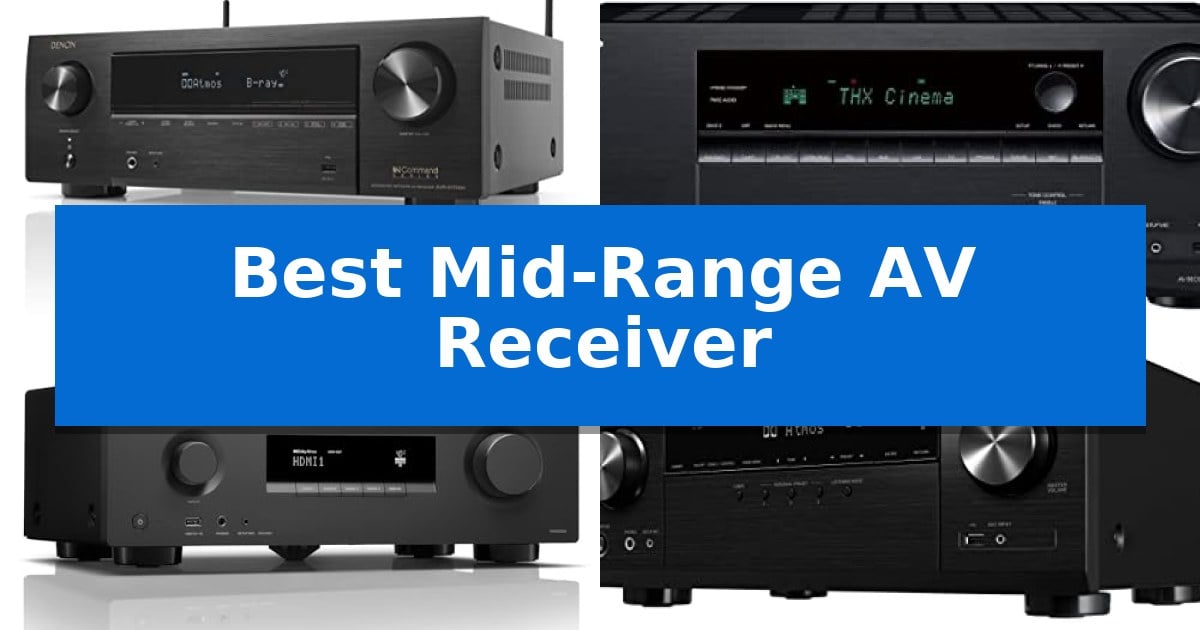
Building a high-quality home theater requires a central hub that can manage your audio and video sources with precision. Finding the Best Mid-Range AV Receiver involves balancing channel count, power output, and support for modern standards like 8K video and immersive audio formats.
Whether you are upgrading your current setup for better sound or integrating new gaming consoles that demand high-bandwidth HDMI, the right receiver acts as the foundation of your entertainment system. We have analyzed current models to help you identify which features and connectivity options best suit your home cinema layout.
You may also want to compare Best Mid-Range Audiophile Speakers, Best Mid-Range Audiophile Headphones, and Best Mid-Range Audio Interface.
Best Mid-Range AV Receiver
Quick Comparison
| Product | Best For | Key Strength | Score |
|---|---|---|---|
| Denon AVR-X1700H AV Receiver | Best Overall | Advanced 8K/60Hz and 4K/120Hz video pass-through for high-end gaming and media. | 4.9 |
| Onkyo TX-NR6100 AV Receiver | THX Certified Cinematic Sound | THX Certified Select for cinema-grade audio performance. | 4.5 |
| Yamaha RX500A AV Receiver | Versatile Streaming and Connectivity | Supports 4K/120 and 8K/60 video for next-gen gaming. | 4.3 |
| Pioneer VSX-935 AV Receiver | Immersive Height Virtualization | Dolby Atmos Height Virtualizer for simulated overhead sound | 4.4 |
| Yamaha RX300A AV Receiver | Essential Features for Home Cinema | Supports 4K/120 and 8K/60 video for high-performance gaming and media. | 4.6 |
How We Chose
- Channel configuration and power output per channel.
- Support for high-resolution video standards including 8K and 4K120Hz.
- Compatibility with immersive audio formats like Dolby Atmos and DTS:X.
- Connectivity options, including HDMI inputs, eARC, and wireless streaming protocols.
- Ease of setup and room calibration capabilities.
1 Denon AVR-X1700H AV Receiver — Balanced Performance for Modern Setups
Modern home theater setups require a hub that balances legacy audio support with the latest high-resolution video standards. The Denon AVR-X1700H AV Receiver addresses this by integrating a high-performance 7-channel amplifier capable of driving immersive 3D audio formats like Dolby Atmos and DTS:X, ensuring your living room is ready for next-generation content.
Beyond its audio capabilities, this receiver features an advanced 8K HDMI video section. With three dedicated 8K inputs and support for 4K/120Hz pass-through, it provides the necessary bandwidth for high-frame-rate gaming and high-resolution media. The inclusion of HDR10+, Dolby Vision, and HLG support ensures that color, contrast, and clarity are preserved across your display devices.
Usability is a core focus, highlighted by an award-winning on-screen quick setup guide. This interface simplifies the process of connecting components and optimizing surround sound through clear, color-coded back-panel layouts. For those managing complex home environments, the unit offers multi-room, multi-source streaming via HEOS, allowing independent audio control in different zones.
Connectivity remains versatile, featuring six HDMI inputs and a dedicated phono input for turntable integration. The system also supports voice control via Alexa and Siri, facilitating hands-free adjustments. While it offers robust features, users should ensure their space accommodates the 17.1-inch width to maintain proper ventilation for the internal components.
Best for: Home theater enthusiasts looking for a future-ready 7.2 channel hub that supports 8K video and multi-room audio streaming.
Skip if: Users requiring more than seven channels of amplification or those with limited shelf space who cannot accommodate the 17.1-inch wide chassis.
PROS
- Advanced 8K/60Hz and 4K/120Hz video pass-through for high-end gaming and media.
- Comprehensive 3D audio support including Dolby Atmos and DTS:X.
- Multi-room streaming capabilities via built-in HEOS technology.
- Simplified setup with an intuitive on-screen guide and color-coded terminals.
CONS
- Physical footprint may be too large for compact media consoles.
- Limited to 7.2 channels, which may not satisfy users seeking more expansive surround configurations.
2 Onkyo TX-NR6100 AV Receiver — THX Certified Cinematic Sound
The Onkyo TX-NR6100 AV Receiver serves as a robust foundation for home theater systems by utilizing a THX Certified Select amplification system. This certification ensures the unit meets rigorous cinema-reference standards for high-output sound, providing the necessary power to drive demanding speaker configurations in medium-to-large rooms. With 210 W/Ch of dynamic audio amplification, the receiver is engineered to maintain clarity and impact during complex sound sequences.
For users prioritizing modern visual fidelity, the receiver integrates 8K resolution support and includes HDMI 2.1 connectivity across three dedicated inputs. This configuration enables a 40Gbps data throughput, a critical specification for maintaining high-bandwidth signal integrity when connecting next-generation gaming consoles or high-resolution media players. This ensures that the visual signal remains uncompressed and responsive for high-frame-rate gaming.
The device manages sophisticated audio environments through 5.2.2-channel Dolby Atmos and DTS:X playback, which delivers object-based surround sound for an immersive listening experience. Beyond the primary theater, the Discrete Zone 2 feature allows for independent audio and video distribution to a secondary room. This capability enables users to enjoy different media in separate areas of the home simultaneously without interrupting the primary playback.
Measuring 18.64 inches in width and weighing approximately 23 pounds, the Onkyo TX-NR6100 AV Receiver is designed for stable placement in standard equipment racks or cabinets. The unit is backed by a 2-year warranty covering parts and labor, providing a structured support framework for this component-based system.
Best for: Home theater enthusiasts requiring THX-certified audio performance and HDMI 2.1 support for 8K gaming and high-resolution media.
Skip if: Users who require more than 7.2 channels for larger speaker arrays or those with limited shelf space who need a compact, low-profile receiver.
PROS
- THX Certified Select for cinema-grade audio performance.
- HDMI 2.1 40Gbps support for high-bandwidth 8K video.
- Discrete Zone 2 audio and video for multi-room distribution.
- 5.2.2-channel configuration for immersive object-based audio.
CONS
- Large physical footprint requires significant shelf space.
- Limited to 7.2 channels, which may not accommodate larger surround sound layouts.
3 Yamaha RX500A AV Receiver — Versatile Streaming and Connectivity
Achieving a balanced home theater setup requires a central hub that handles modern high-bandwidth signals without compromise. The Yamaha RX500A AV Receiver addresses this by offering 4K/120 and 8K/60 video support, ensuring that high-performance gaming consoles and ultra-high-definition displays operate at their full potential through advanced HDMI switching.
Beyond its visual capabilities, this 7.2-channel receiver delivers 70W of power and supports immersive audio formats including Dolby Atmos and DTS:X. The inclusion of an included setup microphone allows for automated room acoustic optimization, helping to tailor the sound profile to your specific listening environment.
Connectivity is a primary focus, featuring integrated Wi-Fi and Bluetooth Multipoint, which allows users to pair two source devices simultaneously. The unit also supports a wide range of streaming platforms such as Spotify Connect, AirPlay 2, and Google Cast, making it a versatile choice for both movie enthusiasts and music listeners.
Practical design elements like the four custom Scene buttons provide quick access to preferred settings, while the on-screen Settings menu simplifies the initial configuration process. With its HDMI eARC support, the receiver streamlines cable management by allowing high-quality audio transmission from your television over a single connection.
Best for: Users seeking a versatile 7.2-channel hub for high-bandwidth gaming and multi-source streaming in a home theater environment.
Skip if: Those requiring more than 70W of power per channel or a configuration exceeding 7.2 channels for larger or more complex speaker arrays.
PROS
- Supports 4K/120 and 8K/60 video for next-gen gaming.
- Includes automated room correction via setup microphone.
- Offers Bluetooth Multipoint for dual-device pairing.
- Features flexible speaker layouts including 5.2.2-channel configurations.
CONS
- Limited to 70W of power output per channel.
4 Pioneer VSX-935 AV Receiver — Immersive Height Virtualization
The Pioneer VSX-935 7.2 Channel Network AV Receiver centers its performance on versatile audio processing, featuring Dolby Atmos and DTS:X support to create an immersive soundstage. This unit provides 170 W/ch (6 ohms, 1 kHz, 10 percent THD, 1ch Driven) or 80 W/ch (8 ohms, 20 Hz-20 kHz, 0.08 percent THD, 2ch Driven, FTC), offering sufficient power for a standard multi-speaker home theater configuration.
Designed for modern media setups, the receiver includes the Dolby Atmos Height Virtualizer, which simulates overhead sound effects even when dedicated ceiling speakers are not installed. This feature is particularly useful for users looking to achieve a sense of vertical audio depth without the complexity of additional hardware installation.
With its 7-channel architecture, the device supports flexible speaker layouts, allowing for both traditional surround sound and object-based audio formats. The inclusion of Dolby Surround and DTS Neural:X Upmixers ensures that legacy stereo or multichannel content can be expanded to utilize all available speakers in your setup.
Measuring approximately 17.13 inches in width and 6.81 inches in height, the Pioneer VSX-935 fits into most standard media consoles. It is a practical choice for those who prioritize high-definition audio decoding and need a reliable hub for a 7.2 channel system, though users should ensure their space accommodates its 20.7-pound weight.
Best for: Home theater enthusiasts seeking a 7.2 channel receiver with advanced height virtualization for immersive audio.
Skip if: Users who require more than 7 channels of amplification or those with limited shelf space for a 20.7-pound unit.
PROS
- Dolby Atmos Height Virtualizer for simulated overhead sound
- Supports Dolby Atmos and DTS:X object-based audio
- 7.2 channel configuration for versatile speaker layouts
- 80 W/ch power output for clear two-channel performance
CONS
- Substantial weight of 20.7 pounds may require sturdy shelving
- Limited to 7 channels, which may not suit larger multi-zone or high-end theater setups
5 Yamaha RX300A AV Receiver — Essential Features for Home Cinema
The Yamaha RX300A AV Receiver simplifies home theater integration by offering a robust 5.2-channel foundation that supports modern high-resolution standards, including 4K/120 and 8K/60 video passthrough. Designed for both cinematic immersion and gaming, this unit provides 70W of power per channel and includes an included setup microphone to automatically calibrate acoustics for your specific room environment.
Beyond its core amplification, the receiver excels in connectivity and ease of use. It features Bluetooth Multipoint technology, allowing users to pair two devices simultaneously for seamless audio switching. The inclusion of Dolby Atmos and DTS Virtual:X enables a dimensional soundstage, even with flexible speaker configurations like 3.1.2-channel setups using up-firing or in-ceiling speakers.
Visual fidelity is prioritized through support for Dolby Vision and HDR10+, ensuring dynamic range compatibility with high-end displays. Gamers benefit from advanced HDMI features such as ALLM (Auto Low Latency Mode) and VRR (Variable Refresh Rate), which help maintain visual synchronization during fast-paced content. The device also utilizes HDMI eARC to streamline audio return from your television via a single cable.
Setup is managed through an intuitive on-screen interface and a comprehensive Quick Guide, reducing the complexity often associated with multi-channel audio systems. Users can further customize their experience by saving specific input and sound settings into four dedicated Scene buttons, allowing for one-touch access to preferred configurations for movies, music, or gaming.
Best for: Home theater enthusiasts seeking a compact, feature-rich 5.2-channel receiver that balances high-resolution video support with flexible speaker layout options.
Skip if: Users requiring more than five amplified channels or those with complex multi-room audio zones will find this 5.2-channel model insufficient for their needs.
PROS
- Supports 4K/120 and 8K/60 video for high-performance gaming and media.
- Includes Bluetooth Multipoint for convenient dual-device audio streaming.
- Features automatic room calibration via an included setup microphone.
- Provides four custom Scene presets for quick access to preferred settings.
CONS
- Limited to a 5.2-channel configuration, which may not suit larger home theater setups.
- Fixed 70W per channel power output may be restrictive for high-impedance or large-room speakers.
Best Mid-Range AV Receiver Buying Guide
Understanding Channel Configurations
The channel count determines how many speakers you can power directly from the receiver. A 7.2 channel system allows for a more expansive surround sound experience, often supporting a 5.2.2 layout with height channels for Dolby Atmos. This is ideal for dedicated home theater rooms where you want to maximize immersion.
A 5.2 channel receiver is often sufficient for smaller living spaces or simpler setups. These models still provide the essential Dolby Atmos and DTS Virtual:X support, ensuring you get a dimensional soundstage without the need for additional speakers that might clutter a smaller room.
HDMI and Video Standards
Modern receivers must handle high-bandwidth video signals to support current gaming consoles and high-definition displays. Look for models that offer 8K/60Hz and 4K/120Hz pass-through to ensure your receiver does not become a bottleneck for your console's performance.
Features like Dynamic HDR, HDR10+, and Dolby Vision are critical for maintaining color accuracy and contrast. An eARC (enhanced Audio Return Channel) port is also essential, as it allows you to send high-quality audio from your TV back to the receiver using a single HDMI cable.
Room Calibration and Setup
Every room has unique acoustic properties that can negatively impact sound quality. Receivers that include a setup microphone and automated room correction software can measure your room's acoustics and adjust speaker characteristics to optimize performance automatically.
Look for receivers that offer an on-screen quick setup guide. These tools simplify the process of connecting speakers and external devices, ensuring that your system is configured correctly even if you are not an audio professional.
Wireless Streaming and Multi-Room Audio
Connectivity goes beyond physical cables. Many mid-range receivers now include built-in Wi-Fi, Bluetooth, and support for streaming services like Spotify Connect or AirPlay 2. This allows you to use your receiver as a high-quality music player when you aren't watching movies.
Bluetooth Multipoint is a particularly useful feature that allows you to pair two source devices simultaneously, making it easy to switch between your phone and tablet without needing to re-pair the receiver each time.
Voice Control and Smart Integration
If you have a smart home, look for receivers that support voice control via Amazon Alexa or Siri. This allows you to adjust the volume, switch inputs, or change tracks hands-free, which is a significant convenience during movie nights.
Advanced models also feature IP control and remote monitoring capabilities. These features allow the receiver to integrate seamlessly with home automation systems, providing a more cohesive and responsive control experience across your entire smart home ecosystem.
Frequently Asked Questions
What is the difference between 5.2 and 7.2 channel receivers?
A 5.2 channel receiver supports five surround speakers and two subwoofers, while a 7.2 channel receiver adds two additional surround channels, allowing for more precise sound placement and support for height channels.
Do I need an 8K receiver if I only have a 4K TV?
While not strictly necessary, an 8K-capable receiver often includes the latest HDMI 2.1 features, such as 4K/120Hz support, which is beneficial for high-end gaming consoles even if your display is limited to 4K.
What is eARC and why does it matter?
eARC (enhanced Audio Return Channel) allows your TV to send high-bitrate audio formats, like uncompressed Dolby Atmos, back to your receiver through a single HDMI cable, simplifying your cable management.
Can I use my receiver for music streaming?
Yes, most modern mid-range receivers feature built-in Wi-Fi and Bluetooth, supporting services like Spotify, AirPlay 2, and TIDAL, allowing them to function as a central hub for your home audio.
How does room calibration work?
Room calibration uses an included microphone to measure how sound reflects off your walls and furniture. The receiver then adjusts the output of each speaker to compensate for these acoustic issues, resulting in more balanced sound.
Conclusion: Our Top Pick
Selecting the right receiver depends on your specific speaker layout and the video sources you intend to use. For most users, the Denon AVR-X1700H AV Receiver stands out as the most balanced option. It provides a robust 7-channel amplifier, comprehensive 8K video support, and an intuitive setup process that makes it accessible for both beginners and enthusiasts.
If your needs are more specialized, such as requiring THX certification or a more compact 5.2 channel footprint, other models in this list offer specific advantages. However, the Denon remains our top recommendation due to its versatile feature set and reliable performance in modern home theater environments.