
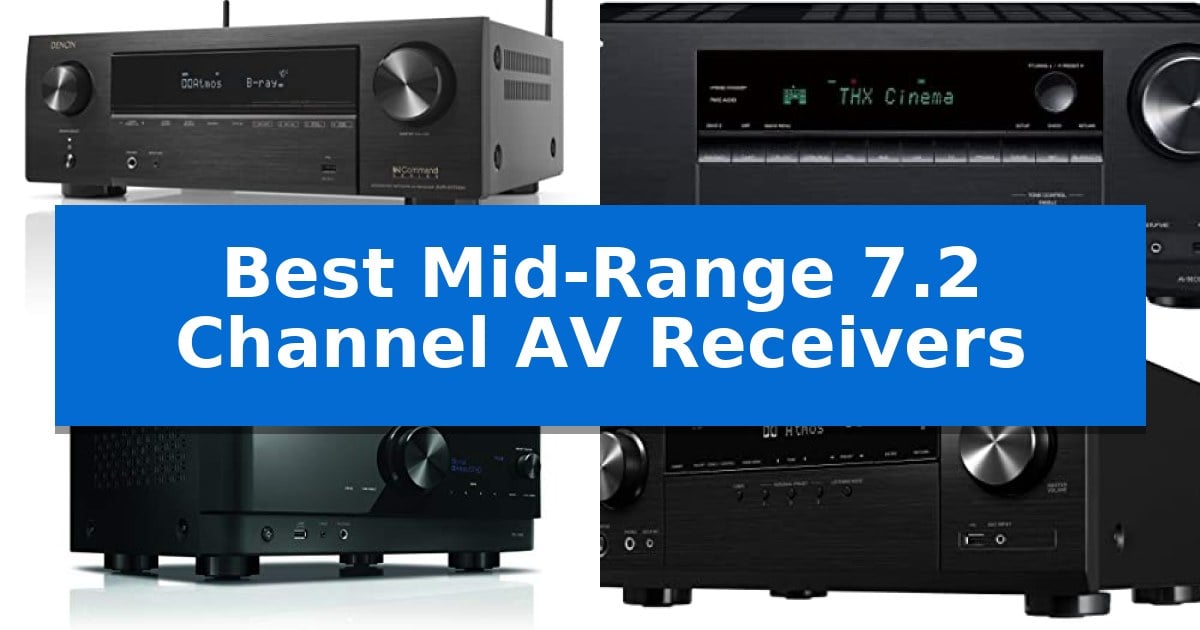
Building a high-quality home theater requires a central hub that can balance complex audio processing with modern video standards. Finding the Best Mid-Range 7.2 Channel AV Receivers means identifying a unit that provides enough power for immersive surround sound without unnecessary complexity or excessive cost.
Whether you are upgrading your current setup for 8K gaming or simply want a more robust foundation for your speaker system, these receivers offer the essential connectivity and processing power needed for a modern living room. We have analyzed the latest offerings to help you navigate the technical specifications and find the right fit for your specific entertainment needs.
You may also want to compare Best Mid-Range 5.1 AV Receiver, Best Mid-Range 4K Projectors, and Best Mid-Range 4K Monitors.
Best Mid-Range 7.2 Channel AV Receivers
Quick Comparison
| Product | Best For | Key Strength | Score |
|---|---|---|---|
| Denon AVR-X1700H AV Receiver | Best Overall | Advanced 8K HDMI video support with 4K/120Hz pass-through for high-end gaming. | 4.9 |
| Onkyo TX-NR6100 AV Receiver | Top THX Certified Pick | THX Select Certification for high-fidelity sound. | 4.7 |
| Yamaha RX-V6A AV Receiver | Best for Music Integration | HDMI 2.1 support for 4K120 and 8K60 video. | 4.6 |
| Pioneer VSX-935 AV Receiver | Reliable Immersive Audio | Supports advanced immersive audio formats including Dolby Atmos and DTS:X. | 4.6 |
| Denon AVR-S960H AV Receiver | Great for Gaming Setups | Advanced gaming features including VRR, QFT, and ALLM for reduced lag. | 4.5 |
How We Chose
- Amplification power and channel configuration stability.
- Support for modern video standards including 8K pass-through and HDR formats.
- Audio processing capabilities for Dolby Atmos and DTS:X immersive sound.
- Versatility of input options for legacy and modern devices.
- Integration features like multi-room streaming and voice control compatibility.
1 Denon AVR-X1700H AV Receiver — Best All-Around Value
The Denon AVR-X1700H AV Receiver simplifies home theater integration through its award-winning on-screen quick setup guide, which provides clear, color-coded instructions for connecting components and optimizing surround sound. This 7.2 channel receiver is designed to handle modern media demands, supporting 8K/60Hz and 4K/120Hz pass-through across its advanced HDMI section to ensure high-fidelity video performance for both gaming and cinema.
Equipped with a high-performance 7-channel amplifier, the unit delivers immersive 3D audio via Dolby Atmos, DTS:X, and DTS Virtual:X. For spaces where height channels are not feasible, the Dolby Atmos Height Virtualization Technology creates a sense of overhead sound, expanding the audio stage without requiring additional speakers.
Connectivity is a primary focus, featuring 6 HDMI inputs and 1 eARC output, alongside a dedicated phono input for vinyl enthusiasts. The receiver integrates into broader home ecosystems through HEOS built-in for multi-room streaming and offers full voice control compatibility with Amazon Alexa and Siri, allowing for hands-free adjustment of volume and source switching.
The Denon AVR-X1700H AV Receiver balances technical capability with practical installation features, such as remote monitoring and IP control for smart home systems. With its 3-year limited warranty, it provides a robust foundation for users looking to centralize their audio and video sources into a single, manageable interface.
Best for: Home theater enthusiasts seeking a versatile, 8K-ready receiver that supports multi-room streaming and comprehensive voice control integration.
Skip if: Users requiring more than two subwoofer outputs or those needing a higher channel count for complex multi-zone audio setups beyond the 7.2 configuration.
PROS
- Advanced 8K HDMI video support with 4K/120Hz pass-through for high-end gaming.
- Intuitive on-screen setup guide with color-coded back-panel connections.
- Multi-source streaming capabilities via HEOS, AirPlay 2, and Bluetooth.
- Dolby Atmos Height Virtualization for immersive audio without extra speakers.
CONS
- Limited to 7.2 channels, which may not satisfy users looking for larger surround sound configurations.
- Only two pre-outs for subwoofers, restricting bass expansion options.
2 Onkyo TX-NR6100 AV Receiver — Top THX Certified Pick
The Onkyo TX-NR6100 7.2 Channel THX Certified Network AV Receiver serves as a central hub for home theater systems, utilizing a 210 W/Ch THX Certified Select Dynamic Audio Amplification system to provide high-output sound. This certification ensures the receiver meets rigorous performance standards for volume and fidelity in medium-sized rooms, making it suitable for users who prioritize cinematic audio quality.
For modern media and gaming setups, the unit incorporates HDMI 2.1 across three inputs. This interface supports 40Gbps data transfer, enabling 8K resolution pass-through and high-refresh-rate gaming, which maintains signal integrity for high-definition sources. These features are essential for enthusiasts connecting current-generation consoles or high-end media players.
The receiver supports 5.2.2-channel Dolby Atmos and DTS:X playback, allowing for multi-dimensional audio configurations. Additionally, the Discrete Zone 2 Audio and Video capability provides flexibility by allowing users to route independent content to a secondary room, effectively expanding the system's utility without requiring additional receivers.
Designed for long-term reliability, the unit includes a 2-year warranty on parts and labor. Its physical dimensions of approximately 21 by 18.64 by 10.64 inches and weight of 22.9 pounds reflect its robust build, providing a stable foundation for a home entertainment installation.
Best for: Home theater enthusiasts who require THX-certified audio performance and HDMI 2.1 support for high-resolution gaming and media.
Skip if: Users who require more than 7.2 channels for complex surround sound configurations or those who need more than three HDMI 2.1-compliant inputs.
PROS
- THX Select Certification for high-fidelity sound.
- HDMI 2.1 (40Gbps) support for 8K and high-bandwidth gaming.
- Discrete Zone 2 functionality for multi-room distribution.
- Powerful 210 W/Ch amplification.
CONS
- Limited to three HDMI 2.1 inputs.
- 7.2 channel limit restricts larger surround sound layouts.
3 Yamaha RX-V6A AV Receiver — Best for Music Integration
Integrating high-resolution audio and modern video standards into a home theater setup requires a receiver that balances processing power with connectivity. The Yamaha RX-V6A AV Receiver addresses this by offering advanced HDMI 2.1 support, including 4K120AB and 8K60B pass-through, which provides the necessary bandwidth for high-frame-rate gaming and ultra-high-definition video sources.
Beyond its video capabilities, this 7.2-channel unit serves as a comprehensive hub for multi-room audio through the MusicCast ecosystem. Users can stream content via Wi-Fi, Bluetooth, or AirPlay 2, and access a wide array of services including Spotify Connect, TIDAL, and Amazon Music HD. The inclusion of Dolby Atmos with Height Virtualization and DTS:X ensures that immersive audio formats are supported for a surround sound experience.
Calibration is managed through the YPAO – R.S.C. and multipoint system, which analyzes room acoustics to adjust audio output for improved clarity. The receiver also features seven HDMI inputs with HDCP 2.3 and eARC support, allowing for simplified integration with modern televisions and peripheral devices. Voice control compatibility with Alexa, Google Assistant, and Siri adds a layer of hands-free convenience for daily operation.
With a focus on versatility, the Yamaha RX-V6A AV Receiver fits into setups that prioritize both legacy device connectivity and future-ready video standards. Its design incorporates Dolby Vision, Hybrid-Log Gamma, and BT.2020 support, ensuring compatibility with current HDR formats. This combination of features makes it a functional choice for those looking to centralize their media control.
Best for: Users who prioritize multi-room audio integration and advanced HDMI 2.1 connectivity for gaming and high-resolution video.
Skip if: Users who require more than 7.2 channels of amplification or those who do not utilize network-based music streaming services.
PROS
- HDMI 2.1 support for 4K120 and 8K60 video.
- Comprehensive MusicCast multi-room audio integration.
- Advanced YPAO multipoint room calibration.
- Wide range of streaming service compatibility.
CONS
- Limited to 7.2-channel output configurations.
4 Pioneer VSX-935 AV Receiver — Reliable Immersive Audio
The Pioneer VSX-935 7.2 Channel Network AV Receiver provides a robust foundation for home theater setups by delivering 170 W/ch (6 ohms, 1 kHz, 10 percent THD, 1ch Driven) or 80 W/ch (8 ohms, 20 Hz-20 kHz, 0.08 percent THD, 2ch Driven, FTC). This power output ensures consistent audio delivery for demanding multi-speaker configurations.
Designed for modern immersive audio, the unit supports Dolby Atmos and DTS:X formats. It includes advanced processing features such as the Dolby Surround Upmixer and DTS Neural:X Upmixer, which help expand standard audio content into a more enveloping soundstage. For users without dedicated ceiling speakers, the Dolby Atmos Height Virtualizer provides a way to simulate overhead sound effects using a traditional speaker layout.
The receiver features a functional, standard chassis design measuring approximately 17.13 inches in width and 6.81 inches in height, weighing 20.7 pounds. Its connectivity and processing capabilities are tailored for those seeking a balance between channel count and audio format support, making it a versatile choice for standard 7.2 channel home entertainment environments.
With a focus on core audio performance, the Pioneer VSX-935 serves as a reliable hub for managing complex audio signals. It is backed by a 1-year warranty, ensuring technical support for the hardware components during the initial period of use.
Best for: Users looking for a dedicated 7.2 channel receiver that supports modern immersive audio formats like Dolby Atmos and DTS:X in a standard home theater setup.
Skip if: Users who require more than 7 channels of amplification or those with space constraints who need a significantly smaller or lower-profile audio component.
PROS
- Supports advanced immersive audio formats including Dolby Atmos and DTS:X.
- Includes Dolby Atmos Height Virtualizer for simulated overhead sound.
- Features individual channel power amplification suitable for 7.2 setups.
CONS
- Requires significant shelf space due to its 20.7-pound weight and full-size chassis dimensions.
- Power output specs are dependent on specific impedance and channel configurations.
5 Denon AVR-S960H AV Receiver — Great for Gaming Setups
The Denon AVR-S960H AV Receiver offers a specialized focus on modern display and gaming standards, featuring 8K/60Hz and 4K/120Hz pass-through capabilities. This 7.2 channel unit is designed to integrate seamlessly into high-performance home theater environments where advanced video processing and low-latency gaming are primary requirements.
Equipped with Dolby Atmos Height Virtualization and DTS Virtual:X, the receiver provides immersive audio experiences without requiring a full overhead speaker array. The inclusion of Variable Refresh Rate (VRR), Quick Frame Transport (QFT), and Auto Low Latency Mode (ALLM) specifically targets gamers looking to minimize lag and frame tearing during high-intensity sessions.
Usability is centered around the award-winning on-screen setup assistant, which guides users through the initial configuration. The system utilizes Audyssey MultEQ XT for precise speaker calibration, ensuring the audio output is tuned to the specific acoustics of the listening environment. Connectivity is extensive, featuring 8 HDMI ports and support for HEOS multi-room wireless audio streaming.
While the receiver provides robust feature sets for modern media, users should be aware that it does not support pass-through from all 4K/120Hz media sources. This trade-off is important for those with complex, multi-device gaming setups that rely on specific high-bandwidth signal paths.
Best for: Gamers and home theater enthusiasts who require 4K/120Hz pass-through and advanced 3D audio virtualization.
Skip if: Users who require universal 4K/120Hz compatibility across all media sources or those with very simple audio-only setups.
PROS
- Advanced gaming features including VRR, QFT, and ALLM for reduced lag.
- 8K and 4K/120Hz pass-through support for high-resolution displays.
- Audyssey MultEQ XT calibration for optimized room acoustics.
- HEOS multi-room integration for wireless audio streaming.
CONS
- Limited 4K/120Hz pass-through compatibility with certain media sources.
Best Mid-Range 7.2 Channel AV Receivers Buying Guide
Understanding Channel Configuration
A 7.2 channel receiver provides seven discrete channels of amplification, allowing for a standard 5.1 surround sound setup plus two additional height or surround back speakers. The ".2" indicates the ability to connect two separate subwoofers, which is essential for balancing low-frequency output in larger rooms.
When selecting your receiver, ensure your room layout can accommodate the extra speakers. While 7.2 systems offer a significant upgrade over 5.1, the physical placement of height channels for Dolby Atmos is critical for achieving the intended spatial audio effect.
Video Connectivity and 8K Standards
Modern receivers must act as a bridge between your source devices and your display. Look for HDMI 2.1 support if you intend to use high-refresh-rate gaming consoles, as this standard enables 4K/120Hz pass-through and variable refresh rates.
Ensure the receiver supports the latest HDR formats like Dolby Vision and HDR10+. These technologies ensure that the video signal remains uncompromised as it travels from your Blu-ray player or console through the receiver to your television.
Room Calibration Technology
Every room has unique acoustic properties that can negatively affect sound quality. Most mid-range receivers include proprietary room calibration software, such as Audyssey or YPAO, which uses a provided microphone to measure speaker distance and frequency response.
This automated process is vital for beginners and enthusiasts alike. It balances the output levels of each speaker, ensuring that the soundstage is cohesive and that the bass response is optimized for your specific seating position.
Multi-Room and Streaming Features
Many contemporary receivers now include built-in network streaming platforms like HEOS or MusicCast. These features allow you to play music throughout your home using compatible wireless speakers without needing additional hardware.
Check for support of your preferred streaming services, such as Spotify or Amazon Music HD. Having these services integrated directly into the receiver simplifies your workflow and often results in higher audio quality compared to Bluetooth streaming.
Power Requirements and Impedance
While wattage ratings are often highlighted, it is important to look at the conditions under which that power is measured. A receiver rated at 80W per channel with two channels driven is usually sufficient for most bookshelf or floor-standing speakers in a medium-sized room.
Always check the impedance compatibility of your speakers. Most mid-range receivers are designed to handle 6-ohm or 8-ohm loads, but if you are using specialized high-end speakers with low impedance, ensure the receiver is rated to handle the power demand to avoid overheating.
Frequently Asked Questions
Can I use a 7.2 receiver with a 5.1 speaker setup?
Yes, you can easily use a 7.2 receiver with a 5.1 system. The receiver will simply not utilize the extra two amplifier channels, and you can configure the settings to reflect your specific speaker layout.
What is the benefit of having two subwoofer outputs?
Two subwoofer outputs allow for better bass distribution throughout a room. This helps eliminate 'dead zones' where bass might be weak and helps smooth out the overall low-frequency response.
Do I need 8K support if I only have a 4K TV?
Not necessarily, but choosing a receiver with 8K support ensures your system is compatible with future display upgrades and often includes the latest HDMI 2.1 features beneficial for gaming.
How do I know if my speakers are compatible?
Check the impedance rating (measured in ohms) on the back of your speakers. Most modern receivers are compatible with standard 6-ohm and 8-ohm speakers.
Is voice control necessary for an AV receiver?
Voice control is a convenience feature that allows you to adjust volume or switch inputs hands-free. It is not required for audio performance but can be a helpful addition if you use smart home ecosystems.
Conclusion: Our Top Pick
Selecting the right receiver depends on your specific balance of gaming needs, music streaming habits, and home theater configuration. For most users, the Denon AVR-X1700H AV Receiver stands out as the most versatile option due to its comprehensive support for 8K video, robust 3D audio processing, and user-friendly setup guide.
While other models offer specific advantages like THX certification or unique multi-room ecosystems, the Denon provides the most reliable foundation for a wide range of home theater setups. Ensure your chosen model matches the impedance of your speakers and the physical space requirements of your room for the best results.