
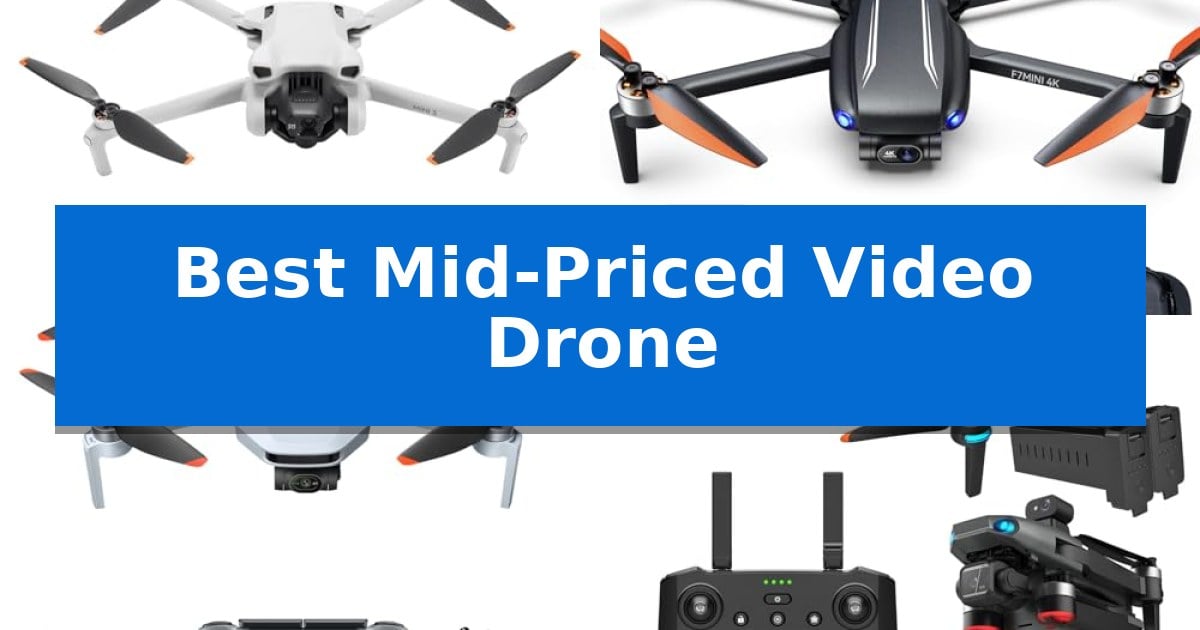
Finding the right aerial platform requires balancing advanced imaging capabilities with flight reliability and ease of operation. Whether you are capturing cinematic landscapes or documenting outdoor adventures, the Best Mid-Priced Video Drone must offer a stable, high-resolution imaging system that does not sacrifice portability or flight safety.
Our guide focuses on identifying models that provide professional-grade features without the complexity of high-end industrial systems. We analyze key performance metrics to ensure you find a reliable tool that fits your specific filming requirements and budget.
You may also want to compare Best Mid-Priced Video Camera, Best Mid-Priced Surround Sound Speakers, and Best Mid-Priced Studio Headphones.
Best Mid-Priced Video Drone
Quick Comparison
| Product | Best For | Key Strength | Score |
|---|---|---|---|
| DJI Mini 3 Camera Drone | Best Overall | Under 249g weight for recreational flight convenience. | 4.9 |
| Bwine F7MINI 4K Camera Drone | Extended Flight Time for Travel | FAA-exempt weight under 249g for hassle-free operation. | 4.3 |
| Potensic Atom 2 Camera Drone | Integrated Screen for Easy Control | Integrated 5.5-inch FHD touchscreen remote eliminates the need for a separate phone. | 4.3 |
| Bingchat Professional 4K Camera Drone | Versatile Payload Release Capability | Payload release function for specialized utility and transport tasks. | 4.6 |
| SJsharp IDEA12GPS Camera Drone | Stable Hovering for Cinematic Shots | Hover-Lock Technology ensures stable flight and prevents drift. | 4.9 |
How We Chose
- Imaging quality, specifically resolution and stabilization technology.
- Flight duration and battery efficiency for extended sessions.
- Transmission range and signal stability in diverse environments.
- Portability and weight, particularly regarding regulatory requirements.
- Safety features, including GPS-assisted return-to-home and obstacle avoidance.
1 DJI Mini 3 Camera Drone — Reliable 4K Choice for Beginners
Capturing aerial footage requires a balance of portability and flight stability, and the DJI Mini 3 Camera Drone addresses this by weighing under 249 grams while incorporating a 3-axis mechanical gimbal. This design choice allows for stable 4K HDR video capture even in wind conditions up to 38kph, making it a capable tool for those who need to transport their gear easily without sacrificing image quality.
The drone is built for accessibility, featuring GPS Return to Home (RTH), precise hovering, and automated takeoff and landing sequences. These safety-focused features assist beginners in managing flight paths, while the True Vertical Shooting capability provides a specialized mode for filming tall structures like skyscrapers or waterfalls, ensuring content is ready for social media platforms without requiring heavy cropping.
Connectivity and control are handled through the included DJI RC, which features a built-in 5.5-inch HD display. This eliminates the need to rely on a separate smartphone for monitoring, allowing for a clearer view in direct sunlight. For data management, the QuickTransfer via Wi-Fi function enables users to move files directly to a mobile device at speeds up to 25Mb/s without needing the remote control.
Operational flexibility is supported by the drone's 10km max HD video transmission range and its ability to take off at altitudes up to 4,000 meters. While the standard flight time is 38 minutes, users can opt for the Intelligent Flight Battery Plus to extend this duration, though doing so increases the total takeoff weight beyond the 249-gram threshold, which may impact local registration requirements.
Best for: Beginners and travelers who need a lightweight, portable drone that offers stable 4K video and simplified flight controls.
Skip if: Users who require a drone under 249g for all flight configurations should avoid the Intelligent Flight Battery Plus, as it exceeds the weight limit.
PROS
- Under 249g weight for recreational flight convenience.
- 3-axis mechanical gimbal for stable 4K HDR imagery.
- True Vertical Shooting for optimized social media content.
- Included DJI RC with a dedicated 5.5-inch HD display.
CONS
- Extended battery weight pushes the aircraft over the 249g limit.
2 Bwine F7MINI 4K Camera Drone — Extended Flight Time for Travel
Capturing professional-grade aerial footage while navigating travel logistics requires a balance of portability and stability. The Bwine F7MINI 4K Camera Drone addresses this by integrating a 3-axis brushless gimbal into an ultra-portable frame that weighs under 249g, eliminating the need for FAA registration for recreational use.
Performance is driven by a 48MP 1/2" CMOS sensor with an F1.8 aperture, capable of recording 4K/30fps video and high-resolution 8K photos. The inclusion of an upgraded 1503 brushless motor allows for a top speed of 31mph, providing the necessary power to maintain steady flight in windy conditions during outdoor explorations.
To address common concerns regarding flight duration, the system includes three high-density batteries, offering a 96-minute total flight time. These batteries support PD 3.0 fast charging, ensuring that users spend more time in the air and less time tethered to a power source. Connectivity is maintained via a 20,000ft (6km) zero-latency transmission system designed for anti-interference.
Safety and ease of use are prioritized through an intelligent GPS system that enables features like auto-cruise, precise hovering, and an auto-return function. For beginners, the drone includes optical flow positioning for stable indoor operation and a 120dB locator buzzer to assist in recovery if the aircraft is lost during a flight.
Best for: Travelers and beginners seeking a lightweight, FAA-exempt drone with extended flight time and professional-grade stabilization.
Skip if: Users requiring professional-grade cinema-standard video codecs or advanced obstacle avoidance sensors found in larger, more expensive enterprise models.
PROS
- FAA-exempt weight under 249g for hassle-free operation.
- 96-minute total flight time via three included batteries.
- 3-axis brushless gimbal for stable, professional-quality video.
- 20,000ft long-range transmission with anti-interference technology.
CONS
- Small sensor size compared to larger, dedicated professional cinematography drones.
- Triple battery management required for maximum flight duration.
3 Potensic Atom 2 Camera Drone — Integrated Screen for Easy Control
Capturing aerial footage with precision is simplified by the Potensic Atom 2 Camera Drone, which features a built-in 5.5-inch FHD touchscreen on its PTD 1 remote controller. This integrated display provides 700 nits of brightness, allowing for immediate takeoff and flight monitoring without needing to tether a separate smartphone.
Equipped with a 1/2-inch Sony CMOS sensor, this drone records 4K/30fps HDR video and captures 48MP photos. The 3-axis gimbal ensures stability during flight, while the F1.8 aperture and 4-in-1 pixel technology are designed to enhance low-light performance and color accuracy. For more advanced cinematic control, users can utilize P-Log mode for realistic imagery.
The Potensic Atom 2 Camera Drone utilizes PixSync 4.0 technology to maintain stable control and live 1080p video transmission at distances up to 10km. The Fly More Combo includes a charging hub that supports full quick-charge for three batteries in 1.3 hours, providing up to 96 minutes of total flight time. The remote controller itself supports 27W fast charging, reaching 90% capacity in 85 minutes.
Designed for portability, the drone weighs under 249g, which eliminates the need for FAA and Remote ID registration. It includes AI-powered tracking modes such as Spotlight, Follow, and Parallel, alongside creative features like Dolly Zoom, Slow Motion, and CineRoll. Safety and ease of use are supported by GNSS positioning, Auto Takeoff and Landing, and Smart Return-to-Home (RTH) functionality.
Best for: The Potensic Atom 2 Camera Drone is best for photographers and hobbyists who want an all-in-one flight system with an integrated screen and long-duration battery kit.
Skip if: Skip this if you require professional-grade obstacle avoidance sensors or a larger sensor size for high-end commercial cinematography.
PROS
- Integrated 5.5-inch FHD touchscreen remote eliminates the need for a separate phone.
- Under 249g design removes the requirement for FAA and Remote ID registration.
- 96 minutes of total flight time with the included three-battery kit.
- AI-powered tracking and diverse cinematic shooting modes like Dolly Zoom.
CONS
- Remote controller compatibility is limited exclusively to the ATOM 2 drone.
4 Bingchat Professional 4K Camera Drone — Versatile Payload Release Capability
The Bingchat Professional 4K Camera Drone offers a specialized approach to aerial utility by integrating a payload release mechanism, which allows the drone to carry and drop items for tasks like fishing or transport. This hardware is supported by a 3-axis gimbal and EIS anti-shake technology, ensuring that the 4K camera remains stable during flight for consistent video capture.
Navigation is managed through 360° laser obstacle avoidance, a safety feature designed to help the drone detect and navigate around environmental hazards. The system includes a unique integrated Android tablet controller that supports Google Play Store apps, allowing users to handle flight controls and media consumption on a single, familiar interface.
Performance in the field is bolstered by a combined 84-minute flight time provided by two included batteries. The airframe is engineered for durability, featuring Level 7 wind resistance and a rainproof design, which helps maintain operational reliability across varied weather conditions.
This model includes a comprehensive suite of intelligent flight modes, such as GPS follow-me, waypoint navigation, and surround shooting. It is certified to comply with FAA Declaration of Compliance standards, providing a clear regulatory framework for operators who require a professional-grade tool for specialized aerial missions.
Best for: Users who require a multi-functional drone with payload delivery capabilities and an integrated tablet-based control system.
Skip if: Pilots who prioritize extreme portability and a lightweight footprint, as the specialized payload hardware and tablet controller increase the overall size of the system.
PROS
- Payload release function for specialized utility and transport tasks.
- 360° laser obstacle avoidance for improved flight safety.
- 84-minute total flight time provided by dual batteries.
- Integrated Android tablet controller for versatile app and media use.
CONS
- Larger physical footprint compared to standard compact camera drones.
- Requires careful pilot attention near trees despite the presence of obstacle avoidance sensors.
5 SJsharp IDEA12GPS Camera Drone — Stable Hovering for Cinematic Shots
Capturing aerial footage requires a balance of stability and ease of use, and the SJsharp IDEA12GPS Camera Drone addresses this with its integrated Hover-Lock Technology. By combining GPS and optical flow positioning, this quadcopter maintains a steady position in the air, allowing users to focus on framing their shots rather than fighting against drift.
Designed for versatility, the drone features a 90° electrically adjustable lens that enables creators to capture diverse perspectives, from sweeping landscapes to detailed cityscapes. The inclusion of high-performance brushless motors provides the necessary propulsion to handle wind resistance, ensuring that footage remains smooth even when flying in elevated or coastal environments.
For those new to piloting, the SJsharp IDEA12GPS Camera Drone simplifies the learning curve with one-touch takeoff and landing and an intuitive foldable, portable frame. The drone also includes a triple safety net system, which automatically triggers a return-to-home sequence if the battery runs low or the signal is lost, providing a reliable failsafe for beginners.
Creative flexibility is supported through several smart flight modes, including Follow Me for tracking movement, Waypoint Flight for custom navigation, and Point of Interest for 360° panoramic circling. With 5G wireless real-time transmission, users can sync high-definition video directly to their devices to review and adjust settings mid-flight.
Best for: Beginner aerial photographers who need a stable, GPS-enabled drone with automated flight modes for capturing cinematic footage.
Skip if: Experienced drone pilots requiring professional-grade camera sensors, obstacle avoidance systems, or long-range transmission capabilities beyond standard FPV needs.
PROS
- Hover-Lock Technology ensures stable flight and prevents drift.
- Brushless motors provide quiet operation and high wind resistance.
- Triple safety net system prevents flyaways with automatic return-to-home.
- 5G wireless transmission allows for smooth, real-time video syncing.
CONS
- Foldable design and lightweight build may be less suited for extreme weather conditions.
- Feature set is optimized for beginners, which may limit advanced manual control options.
Best Mid-Priced Video Drone Buying Guide
Understanding Flight Regulations and Weight
Many drones in this category are designed to weigh under 249g, which is a critical threshold for recreational pilots. Staying below this weight often exempts the user from specific registration requirements in many jurisdictions, making it a primary consideration for casual flyers.
However, always verify your local aviation authority's rules, as regulations can change. A lighter drone is more portable but may be more susceptible to wind, so consider the wind resistance rating if you plan to fly in coastal or mountainous areas.
Camera Stabilization and Imaging
A 3-axis mechanical gimbal is essential for smooth, professional-looking video. Unlike electronic image stabilization, a mechanical gimbal physically compensates for the drone's movement, ensuring your footage remains steady even during rapid maneuvers or windy conditions.
Look for 4K HDR video capabilities and a high-quality sensor. Features like dual native ISO can significantly improve performance in challenging lighting, such as during sunrise, sunset, or in deep shadows.
Battery Life and Range
Flight time is one of the most common limitations for aerial photography. While manufacturers list maximum flight times, these are often based on ideal, windless conditions. Always account for real-world factors that may reduce your actual airtime.
Consider the transmission range if you intend to fly over large landscapes. A robust digital transmission system ensures you maintain a clear, low-latency live feed, which is vital for framing shots accurately and maintaining situational awareness.
Intelligent Flight Modes
Modern drones often include automated flight modes like QuickShots, Waypoint flight, or Follow Me. These features allow the drone to perform complex maneuvers autonomously, which is particularly helpful for solo creators who need to focus on the subject rather than the controls.
Ensure the drone has reliable GPS-assisted return-to-home (RTH) functionality. This safety feature ensures the aircraft can navigate back to its takeoff point if the signal is lost or the battery reaches a critical level.
Controller and Connectivity
The interface between you and the drone is crucial. Some models include a dedicated remote controller with an integrated screen, which eliminates the need to tether your smartphone and provides a more reliable, dedicated connection.
Check for quick-transfer capabilities via Wi-Fi. Being able to move your footage from the drone to your mobile device quickly without needing a computer or a complex cable setup can save significant time during a shoot.
Frequently Asked Questions
Do I need a license to fly these drones?
Many of these drones are under 249g, which often simplifies recreational flying requirements. However, you must always check your local FAA or equivalent aviation authority guidelines as rules vary by country and region.
What is the benefit of a 3-axis gimbal?
A 3-axis mechanical gimbal physically stabilizes the camera, counteracting the drone's tilt, roll, and yaw. This is the gold standard for achieving smooth, cinematic footage compared to digital-only stabilization.
Can I fly these drones in the wind?
Most mid-priced drones are rated for specific wind speeds (often Level 5). While they can handle moderate breezes, flying in high winds can drain the battery faster and increase the risk of losing control.
Are spare batteries worth the investment?
Yes, having extra batteries is highly recommended. Since flight times are typically between 30 and 40 minutes per battery, a multi-battery kit is essential for longer sessions or travel.
What is the difference between 4K and 8K photo modes?
4K refers to video resolution, while 8K photo modes capture higher-resolution still images. For most social media and web-based video projects, 4K video is the industry standard for clarity and detail.
Conclusion: Our Top Pick
Selecting the right drone depends on your specific filming goals and how much you value portability versus specialized features. For most users, the DJI Mini 3 Camera Drone stands out as the most balanced option. Its combination of a high-quality 3-axis gimbal, 4K HDR video, and a design that avoids many registration hurdles makes it an excellent starting point for aerial videography.
While other models offer unique capabilities like payload release or integrated tablet screens, the reliability and software ecosystem provided by the DJI platform ensure a smoother learning curve and more consistent results. If you prioritize ease of use and high-quality output, this model is the most dependable choice in the current market.