
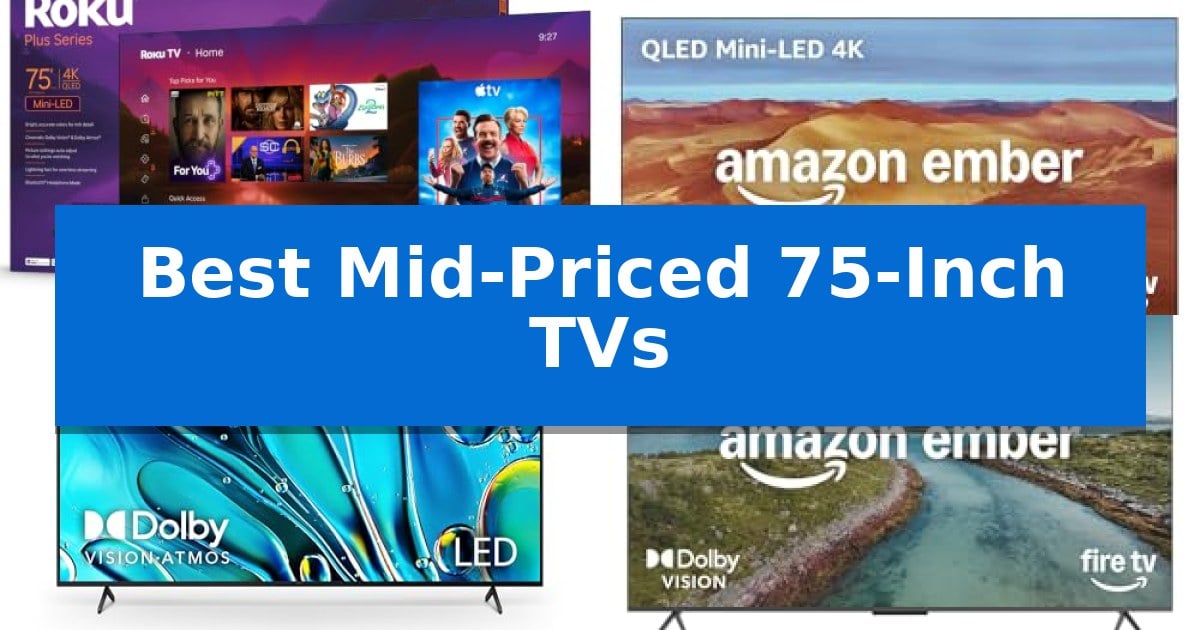
Finding the right balance between screen size and cost can be a challenge when upgrading your home theater. A 75-inch display offers an immersive experience, but navigating the technical specifications like panel types, refresh rates, and smart platforms is essential to ensure you get lasting value.
Our analysis of the Best Mid-Priced 75-Inch TVs focuses on models that deliver high-quality visuals and modern connectivity without the premium price tag of flagship displays. We evaluate how these units perform for everyday streaming, gaming, and cinematic viewing to help you make an informed decision for your living space.
You may also want to compare Best Mid-Priced 65-Inch TVs, Best Mid-Priced 65-Inch LED TV, and Best Mid-Priced 65-Inch HDR TV.
Best Mid-Priced 75-Inch TVs
Quick Comparison
| Product | Best For | Key Strength | Score |
|---|---|---|---|
| Roku Plus Series Smart TV | Best Overall | Mini-LED backlighting provides superior contrast and detail. | 4.9 |
| Amazon Ember Mini-LED Smart TV | Advanced Contrast and Gaming | 144Hz gaming mode with AMD FreeSync Premium Pro certification for smooth motion. | 4.7 |
| Sony BRAVIA 3 Smart TV | Reliable Cinematic Picture | Exclusive PlayStation 5 features for optimized gaming performance. | 4.4 |
| Amazon Ember QLED Smart TV | Fast Performance and Visuals | Omnisense technology for automated wake-up functionality. | 4.4 |
| Sony BRAVIA 3 II Smart TV | Enhanced AI Scene Processing | Anti-Glare Screen technology minimizes distractions in bright rooms. | 4.5 |
How We Chose
- Display Technology: Assessing the use of Mini-LED, QLED, and local dimming for contrast and color accuracy.
- Gaming Performance: Checking for high refresh rates, VRR support, and dedicated game modes for console compatibility.
- Smart Ecosystem: Reviewing the ease of navigation, voice control integration, and app availability.
- Connectivity: Verifying the number and standard of HDMI ports for external devices and sound systems.
- Processing Power: Evaluating AI-driven picture optimization and upscaling capabilities for non-4K content.
1 Roku Plus Series Smart TV — Simplified Streaming Experience
The Roku 75-Inch Plus Series Smart TV centers its performance on Mini-LED backlighting and QLED technology, delivering high-contrast visuals and vivid color reproduction on a large 75-inch display. This model integrates Dolby Vision for enhanced image quality and Dolby Atmos with a built-in subwoofer to provide a more immersive audio experience without requiring external speakers.
Designed for ease of use, the television features an intuitive Roku Home Screen that consolidates streaming services and live entertainment into one interface. The included Enhanced Voice Remote simplifies navigation by allowing users to search across apps using voice commands and includes a lost remote finder feature to help locate the device if it slips between furniture cushions.
Smart home integration is a primary focus, with support for Siri, Alexa, and Google Assistant for hands-free control. Users can also utilize Apple AirPlay to stream content directly from their devices. The TV employs Roku Smart Picture Max, an AI-driven system that automatically optimizes color and sharpness based on the incoming signal, ensuring consistent quality across different types of content.
For those who prefer private listening, the Bluetooth Headphone Mode allows audio to be routed to wireless headphones, while the display can be turned off independently for music playback. The system also simplifies subscription management, allowing users to sign up for and manage over 70 services through a single account, reducing the complexity of handling multiple billing platforms.
Best for: Users seeking a large-screen, all-in-one streaming experience with integrated voice control and simple smart home connectivity.
Skip if: Users who require advanced gaming-specific features like high-refresh-rate VRR or dedicated high-bandwidth HDMI 2.1 ports for professional-grade console performance.
PROS
- Mini-LED backlighting provides superior contrast and detail.
- Enhanced voice remote includes a convenient lost remote finder.
- Built-in subwoofer and Dolby Atmos support improve audio depth.
- AI-powered picture optimization automatically refines signal quality.
CONS
- Large 75-inch footprint requires significant wall or stand space.
- Integrated audio may not match the performance of a dedicated surround sound system.
2 Amazon Ember Mini-LED Smart TV — Advanced Contrast and Gaming
Achieving a cinematic experience in a large living space often requires a display that balances scale with advanced lighting technology. The Amazon Ember 75" Mini-LED Series utilizes a 4K QLED mini-LED display with 512 dimming zones, providing precise contrast and depth that elevates both movies and high-frame-rate gaming.
For gamers, this model offers a 144Hz gaming mode that is AMD FreeSync Premium Pro-certified, ensuring fluid motion and tear-free visuals during fast-paced sequences. The integration of Dolby Vision IQ and HDR10+ Adaptive allows the television to automatically adjust its picture settings based on the ambient light in your room, maintaining consistent detail regardless of the time of day.
Usability is centered around the newest Fire TV experience, which features a modernized interface for faster navigation and personalized content recommendations. The inclusion of Alexa+ enables hands-free control, allowing you to manage smart home devices or search for entertainment without needing the remote. The display also features Omnisense technology, which uses sensors to wake the screen when you enter the room, transitioning seamlessly into an ambient display.
The audio setup includes 2.1 Dolby Atmos support, designed to provide clear dialogue and a wider soundstage. Privacy remains a priority, with a physical switch that electronically disconnects the microphones when you prefer not to use voice features. This combination of high-end display specs and smart home integration makes it a versatile hub for modern media setups.
Best for: Users who want a large-format display that combines advanced gaming features like 144Hz refresh rates with hands-free smart home integration.
Skip if: Users who require a smaller screen size or those who prefer a non-Fire TV smart platform for their media consumption.
PROS
- 144Hz gaming mode with AMD FreeSync Premium Pro certification for smooth motion.
- 512 dimming zones provide enhanced contrast and deep black levels.
- Hands-free Alexa+ control with advanced sensors for automatic wake functionality.
- Privacy-focused design featuring a physical switch to disconnect microphones.
CONS
- Large physical footprint may not fit in smaller entertainment centers or rooms.
- Fire TV ecosystem is the primary interface, which may not suit users preferring other platforms.
3 Sony BRAVIA 3 Smart TV — Reliable Cinematic Picture
The Sony 75 Inch BRAVIA 3 LED 4K HDR Smart Google TV (K-75S30) distinguishes itself with the 4K HDR Processor X1, which performs real-time analysis to boost contrast, color, and clarity across all content. This 75-inch display is engineered for those who prioritize a cinematic experience, utilizing Triluminos Pro technology to render over a billion accurate colors for a more vivid picture.
For users integrating a gaming setup, this model includes dedicated features for PlayStation 5, such as Auto HDR Tone Mapping and Auto Genre Picture Mode. These settings automatically optimize the display output when a console is detected, while the integrated Game Menu provides a centralized interface for adjusting picture settings and gaming-specific assists.
The television functions as a comprehensive media hub, powered by Google TV with built-in Google Assistant for voice-activated navigation. It supports a wide array of streaming services and includes the SONY PICTURES CORE app, providing access to high-bitrate 4K UHD content with included credits. Connectivity is further enhanced by support for AirPlay 2 and Chromecast built-in.
Audio performance is supported by the X-Balanced Speaker design and Dolby Atmos compatibility, intended to deliver clear sound. The unit also features Motionflow XR technology to maintain smooth, blur-free action during fast-paced sports or cinematic sequences, ensuring that the visual performance remains consistent regardless of the source material.
Best for: Users seeking a large-screen display with integrated gaming optimizations for PlayStation 5 and a robust smart interface.
Skip if: Viewers requiring advanced panel technologies like OLED or Mini-LED for deeper black levels and higher peak brightness in challenging lighting conditions.
PROS
- Exclusive PlayStation 5 features for optimized gaming performance.
- 4K HDR Processor X1 for real-time image enhancement.
- Triluminos Pro technology for expanded color accuracy.
- Google TV interface with extensive streaming app support.
CONS
- Standard LED panel may lack the contrast depth of premium OLED or Mini-LED alternatives.
4 Amazon Ember QLED Smart TV — Fast Performance and Visuals
Achieving a cinematic experience in a large living space requires a display that balances scale with responsive processing. The Amazon Ember QLED Smart TV utilizes custom Omnisense technology, which features built-in sensors to wake the display automatically when you enter the room, allowing for immediate access to artwork or streaming content.
This 75-inch model leverages a 4K QLED display paired with full-array local dimming to manage contrast, producing deeper blacks and brighter whites. The inclusion of Dolby Vision and HDR10+ Adaptive ensures that picture quality remains consistent across varying lighting conditions in your home.
Performance is driven by a new quad-core processor and Wi-Fi 6 connectivity, which facilitate faster app loading and smoother navigation within the 2026 Fire TV interface. For those who prioritize gaming, the system supports Amazon Luna and Xbox Game Pass streaming, enabling console-free play directly through the television.
Practicality is integrated through hands-free Alexa+ voice control, which functions even when the screen is off, and a physical privacy switch that electronically disconnects the microphones. With four HDMI inputs and AirPlay support, the unit provides versatile connectivity for external soundbars, gaming consoles, and mobile devices.
Best for: Users seeking a large-format display with integrated smart home voice control and console-free cloud gaming capabilities.
Skip if: Viewers who require specific high-end gaming monitor features like variable refresh rates beyond standard streaming support or those with limited physical wall space for a 75-inch unit.
PROS
- Omnisense technology for automated wake-up functionality.
- Full-array local dimming for improved contrast and HDR performance.
- Hands-free Alexa+ integration with a dedicated privacy microphone switch.
- Cloud gaming support via Amazon Luna and Xbox Game Pass.
CONS
- Large physical footprint requires significant wall or stand space.
- Microphone privacy switch requires manual physical interaction.
5 Sony BRAVIA 3 II Smart TV — Enhanced AI Scene Processing
Achieving a cinematic scale in a living room requires more than just screen size; it demands the processing power to handle high-resolution content and the versatility to manage diverse lighting environments. The Sony BRAVIA 3 II Smart TV addresses these needs with a 75-inch display featuring specialized Anti-Glare Screen technology, which is engineered to minimize reflections from windows and ambient light sources.
At the heart of this display is the XR Processor, which utilizes AI scene recognition to optimize color, contrast, and clarity. This is complemented by XR Triluminos Pro technology, capable of reproducing over a billion colors for natural, lifelike imagery. For those who prioritize fluid motion, the panel supports a 120Hz refresh rate and Motionflow XR, ensuring that fast-paced sports and action sequences remain clear and blur-free.
Gamers are provided with a dedicated suite of tools through HDMI 2.1 connectivity, which supports 4K/120, VRR (Variable Refresh Rate), and ALLM (Auto Low Latency Mode). The integration with PlayStation 5 is particularly notable, offering Auto HDR Tone Mapping and an exclusive Game Menu that consolidates picture settings and assist features into one interface.
Beyond hardware, the device serves as a comprehensive entertainment hub. It includes access to SONY PICTURES CORE with Pure Stream and the IMAX Enhanced collection, plus five movie credits. The interface is powered by Google TV with Gemini, allowing users to browse content or use natural language queries to control smart home devices and find entertainment across 700,000 available movies and episodes.
Best for: This TV is best for users seeking a large-screen home theater experience with specialized gaming optimizations and advanced AI-driven picture processing.
Skip if: Skip this model if you require a smaller screen size, as the specific anti-glare technology is limited to the 65-inch and 75-inch class models.
PROS
- Anti-Glare Screen technology minimizes distractions in bright rooms.
- HDMI 2.1 features including 4K/120 and VRR for high-performance gaming.
- AI-powered XR Processor optimizes picture quality in real time.
- PlayStation 5 exclusive features like Auto HDR Tone Mapping.
CONS
- Anti-glare technology is restricted to 65-inch and 75-inch models only.
- Large physical footprint requires significant space for installation.
Best Mid-Priced 75-Inch TVs Buying Guide
Understanding Display Technologies
When shopping for a large screen, the type of backlighting significantly impacts your viewing experience. Mini-LED technology uses smaller LEDs to provide more precise control over brightness and contrast, which is ideal for high-dynamic-range (HDR) content. QLED panels utilize quantum dots to enhance color vibrancy, ensuring that images appear vivid even in well-lit rooms.
Consider your primary viewing environment when choosing between these technologies. If you frequently watch movies in a dark room, prioritize models with full-array local dimming to achieve deeper blacks. For bright living rooms, look for displays with higher peak brightness levels to combat glare and maintain image clarity.
Gaming Features and Refresh Rates
Modern gaming consoles require specific display features to perform at their best. A 144Hz or 120Hz refresh rate is crucial for smooth motion in fast-paced titles, reducing blur during intense action. Look for certifications like AMD FreeSync Premium Pro or features like Auto Genre Picture Mode to ensure the TV automatically optimizes settings when a console is detected.
Connectivity is equally important for gamers. Ensure the TV includes HDMI 2.1 ports, which support the high bandwidth needed for 4K gaming at high frame rates. These ports also enable features like Variable Refresh Rate (VRR) and Auto Low Latency Mode (ALLM), which help eliminate screen tearing and input lag.
Smart Platform Integration
The smart platform determines how easily you can access your favorite content. Platforms like Roku TV and Fire TV are known for their user-friendly interfaces and extensive app libraries. These systems often include personalized recommendations, making it easier to find new shows without endless scrolling.
Voice control has become a standard expectation. Check if the TV supports your preferred ecosystem, such as Alexa, Siri, or Google Assistant. Some models even offer hands-free voice control, allowing you to search for content or manage smart home devices without needing to reach for the remote.
Audio and Sound Quality
While large TVs offer impressive visuals, built-in speakers often struggle to provide a cinematic soundstage. Look for models that support Dolby Atmos, which creates a more immersive, multi-dimensional audio experience. Some TVs even include built-in subwoofers to add depth to the low-end frequencies.
If you plan to use an external soundbar or home theater system, verify the TV's audio output options. HDMI eARC is the preferred standard, as it allows for high-quality, uncompressed audio transmission from the TV to your sound system, ensuring that your audio setup keeps pace with the high-resolution picture.
Placement and Room Considerations
A 75-inch TV requires significant wall or stand space. Before purchasing, measure your intended location, including the width and height of the unit, to ensure a proper fit. Consider the viewing distance as well; for a 75-inch 4K display, sitting between 6 and 10 feet away is typically recommended for the best balance of immersion and clarity.
Lighting conditions also play a role in placement. If your room has many windows, consider a TV with anti-glare screen technology to minimize reflections. Proper placement relative to ambient light sources will help preserve the contrast and color accuracy of your display, regardless of the time of day.
Frequently Asked Questions
What is the benefit of Mini-LED over standard LED?
Mini-LED backlighting uses significantly smaller LEDs, allowing for more precise local dimming zones. This results in better contrast, deeper blacks, and higher peak brightness compared to standard LED displays.
Do I need HDMI 2.1 for streaming?
No, HDMI 2.1 is primarily beneficial for high-end gaming consoles and high-bandwidth audio systems. For standard streaming, existing HDMI standards are sufficient.
Can I use my existing smart home devices with these TVs?
Most modern smart TVs support integration with major voice assistants like Alexa, Google Assistant, and Siri, allowing you to control your TV and other connected devices through a single ecosystem.
How do I know if a 75-inch TV will fit my space?
Always check the manufacturer's provided dimensions for height, width, and depth. Remember to account for the stand footprint if you are not wall-mounting the unit.
What is the advantage of AI-powered picture processing?
AI processors analyze the incoming signal in real-time to upscale lower-resolution content, reduce noise, and optimize color and sharpness for each scene, resulting in a more consistent viewing experience.
Conclusion: Our Top Pick
When selecting from the Best Mid-Priced 75-Inch TVs, the Roku Plus Series Smart TV stands out for its combination of Mini-LED backlighting, QLED color technology, and an exceptionally intuitive interface. It simplifies the streaming experience while providing the high-end visual features typically found in more expensive models, making it a versatile choice for most living rooms.
While other models offer specialized gaming features or advanced AI processing, the Roku platform's ease of use and the inclusion of Dolby Atmos technology make this unit a reliable, all-around performer. It effectively bridges the gap between premium picture quality and accessible, everyday usability.