
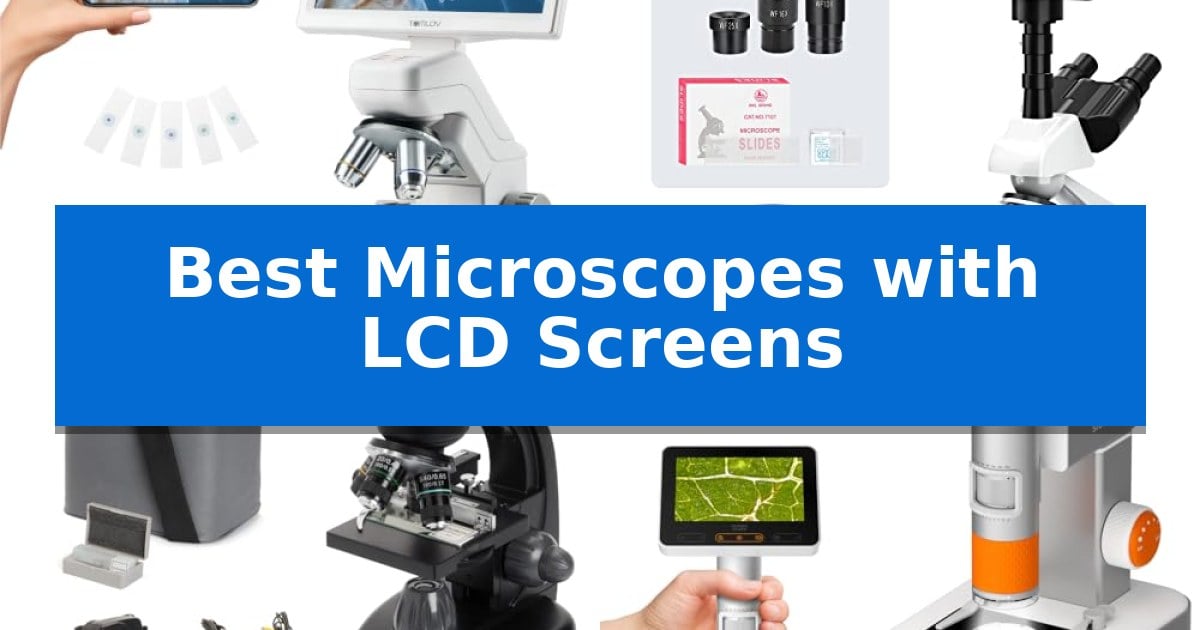
Finding the right magnification tool can transform how you study specimens, inspect coins, or conduct lab research. Traditional eyepieces often cause eye strain during long sessions, which is why many users are switching to the Best Microscopes with LCD Screens for a more ergonomic and collaborative experience.
These digital devices offer high-resolution displays that allow multiple people to view samples simultaneously. Whether you are a student exploring STEM concepts or a professional needing precise, repeatable observations, these microscopes provide the clarity and digital integration necessary for modern scientific work.
You may also want to compare Best Microscopes Under $1000, Best Microscopes Under $300, and Best Microscopes Under $200.
Best Microscopes with LCD Screens
Quick Comparison
| Product | Best For | Key Strength | Score |
|---|---|---|---|
| TOMLOV DM301 Pro Digital Microscope | Best Overall | 7-inch IPS display for clear, comfortable group viewing. | 4.9 |
| Vabiooth Lab Compound Microscope | Advanced Research-Grade Optics | Integrated 7-inch LCD screen for direct viewing and easy collaboration. | 4.6 |
| Celestron TetraView Digital Microscope | Swivel Screen for Easy Viewing | 180° swivel screen for flexible viewing angles. | 4.4 |
| MatataStudio MX2-AS Digital Microscope | Versatile Handheld and Stand Modes | Dual handheld and stand modes for versatile observation environments. | 4.5 |
| Elikliv EDM4 Digital Microscope | Ideal for Coin and Jewelry Inspection | Integrated 4.3-inch LCD screen for ergonomic, real-time viewing. | 4.9 |
How We Chose
- Display clarity and screen size for comfortable, long-term observation.
- Magnification range and lens quality to ensure sharp, detailed imaging.
- Connectivity options including Wi-Fi, USB, and HDMI for data sharing.
- Build versatility, focusing on stand stability and portability for different environments.
- Ease of use for capturing, storing, and measuring digital media.
1 TOMLOV DM301 Pro Digital Microscope — Large Screen for Collaborative Learning
The TOMLOV DM301 Pro Digital Microscope enhances collaborative learning through its large 7-inch IPS display, which features an adjustable viewing angle to allow multiple users to observe specimens simultaneously without the constraints of a traditional eyepiece. By moving beyond the single-user experience, this device facilitates shared discovery in classrooms or home study environments.
Engineered for detailed scientific exploration, the unit utilizes three premium achromatic lenses to provide up to 1200X magnification. This optical capability allows for the examination of microorganisms and cellular structures, supported by a dual LED lighting system with adjustable brightness. This dual-source illumination—positioned for both top and bottom lighting—ensures consistent clarity across various slide types and opaque specimens.
Functionality is further expanded through wireless app support, which enables real-time observation and media capture on mobile devices. For group demonstrations, the microscope connects directly to external monitors, TVs, or projectors via USB or HD output without requiring additional drivers. The integrated 8MP camera records 1080P video, while the measurement scale overlay provides a practical tool for students to learn precise observation techniques.
Designed for portability and extended sessions, the device includes a battery capable of supporting up to 3 hours of use. This makes it a versatile tool for both stationary classroom experiments and field-based discovery. The included set of slides and accessories ensures the system is ready for immediate use, serving as a comprehensive STEM kit for students and educators.
Best for: Students, teachers, and families seeking a collaborative, easy-to-use digital microscope for STEM education and specimen observation.
Skip if: Users requiring professional-grade optical resolution for advanced laboratory research or those who prefer a traditional eyepiece-based microscope experience.
PROS
- 7-inch IPS display for clear, comfortable group viewing.
- Wireless app connectivity for mobile observation and sharing.
- Dual LED lighting system for versatile specimen illumination.
- Direct HD/USB output for easy connection to larger classroom displays.
CONS
- Limited to 3 hours of battery life per charge.
- Not designed for high-end laboratory research applications.
2 Vabiooth Lab Compound Microscope — Advanced Research-Grade Optics
The Vabiooth Lab Compound Microscope simplifies complex biological observation by integrating a 7-inch LCD screen directly into the unit, eliminating the need for external monitors or traditional eyepiece strain. This design choice allows for immediate, high-resolution viewing of specimens, making it a practical tool for environments like labs, farms, and veterinary clinics where sharing visual data is essential.
Equipped with a 5MP electronic eyepiece, this microscope provides a comprehensive field of view that can be captured as still photos or videos when paired with a video capture card. The system includes WF10X, 16X, and 25X glass eyepieces paired with four achromatic objectives—4x, 10x, 40x(s), and 100x(Spring Oil)—offering a magnification range of 40X-2500X to accommodate diverse research needs from algae study to animal husbandry.
Usability is enhanced by a double-layer mechanical stage featuring 1.0mm divisions, which allows for precise X- and Y-axis slide manipulation. Users can lock slides into place and record coordinates to return to specific points of interest. The setup is further supported by LED illumination and a 1.25 NA Abbe condenser with an iris diaphragm, ensuring consistent light control for clear examination.
Designed for portability and protection, the microscope arrives with an aluminum carry case. The ergonomic 30-degree tilt of the head reduces neck strain during extended sessions, while the adjustable interpupillary distance ensures the device can be customized for different users without losing focus.
Best for: Professional and educational environments requiring direct digital viewing and documentation of biological specimens.
Skip if: Users who prefer a traditional optical-only microscope or those with limited desk space for a 7-inch integrated display unit.
PROS
- Integrated 7-inch LCD screen for direct viewing and easy collaboration.
- 5MP electronic eyepiece supports digital photo and video capture.
- Double-layer mechanical stage allows for precise coordinate recording.
- Aluminum carry case included for secure transport and storage.
CONS
- Requires a video capture card to enable video recording functionality.
- Larger footprint compared to standard non-LCD compound microscopes.
3 Celestron TetraView Digital Microscope — Swivel Screen for Easy Viewing
The Celestron TetraView Digital Microscope features a 180° swivel screen that allows for comfortable viewing from multiple angles, making it a functional choice for shared lab or classroom environments. This device integrates a 5MP digital camera directly into the unit, enabling users to capture high-resolution images and 20 fps SD video of specimens without requiring external hardware.
Equipped with a 4.3" TFT LCD screen, the microscope provides immediate visual feedback through its onboard software. It supports a wide magnification range from 40x up to 1600x (using digital zoom), which is suited for observing various cellular specimens on slides. The inclusion of a 2GB micro SD card allows for the storage of over 1200 images, facilitating the documentation of findings for reports or lessons.
The package includes a comprehensive set of accessories, such as a rugged canvas carrying case with a shoulder strap, a dust cover, and 7 prepared slides. For those needing to present to a larger group, an AV out cable is provided to connect the microscope to a TV or projector. Power is managed via a 4-plug international AC adapter, ensuring compatibility across different regions.
Designed for durability and support, the unit is backed by a two-year warranty and access to technical support from US-based experts. While it offers significant versatility for educational use, the physical dimensions of 17 inches in height and a weight of 4.18 pounds should be considered for those with limited desk space or a need for high portability.
Best for: Students and educators requiring a self-contained digital microscope for classroom demonstrations and specimen documentation.
Skip if: Users who require advanced laboratory-grade optics or those who prefer a traditional eyepiece-only microscope without digital screen integration.
PROS
- 180° swivel screen for flexible viewing angles.
- Built-in 5MP digital camera for easy image and video capture.
- Comprehensive accessory kit including a carrying case and prepared slides.
- Two-year warranty backed by US-based support.
CONS
- Physical footprint of 17 inches in height may be bulky for smaller workspaces.
- Fixed digital zoom limitations compared to optical-only systems.
4 MatataStudio MX2-AS Digital Microscope — Versatile Handheld and Stand Modes
The MatataStudio MX2-AS Digital Microscope provides a flexible observation experience by offering both handheld and stand modes, allowing users to transition seamlessly between indoor laboratory-style study and outdoor field exploration. This versatility is supported by a built-in 2600mAh battery, which delivers over 3 hours of continuous operation, ensuring the device remains functional away from power outlets.
Equipped with a 4.3-inch 1080P LCD screen, the microscope enables direct viewing without the need for external monitors. It features a 100X to 1600X digital magnification range with a continuous zoom function, facilitating rapid adjustments when switching between specimens like coins, plant veins, or animal cells. The inclusion of intelligent dyeing technology assists in real-time color adjustment to improve image clarity during use.
For collaborative environments, the MX2-AS supports USB-C and Wi-Fi output, allowing connectivity with mobile phones, tablets, and PCs via the Matataxplore APP. This functionality is particularly useful for classroom demonstrations, as it enables a wider field of view on external displays. The unit is designed for a broad age range, suitable for K-12 students and adults alike.
The package includes a comprehensive set of accessories to support immediate use, such as 5 prepared slides, 2 observation chambers, a USB-C cable, and a storage bag. With its dual incident and transmitted light sources, the microscope is adaptable to various specimen types, providing a balanced tool for educational and hobbyist applications.
Best for: Students and hobbyists who require a portable, multi-mode digital microscope for both classroom learning and outdoor specimen observation.
Skip if: Users who require professional-grade optical glass lenses or higher-resolution laboratory-standard imaging for advanced scientific research.
PROS
- Dual handheld and stand modes for versatile observation environments.
- Integrated 4.3-inch 1080P LCD screen for standalone viewing.
- Wireless and USB-C connectivity for easy image sharing and group learning.
- Long-lasting 2600mAh battery providing over 3 hours of use.
CONS
- Digital-only magnification may lack the clarity of traditional optical systems for fine detail work.
5 Elikliv EDM4 Digital Microscope — Ideal for Coin and Jewelry Inspection
The Elikliv EDM4 Digital Microscope simplifies detailed inspection tasks by integrating a 4.3-inch LCD screen that provides real-time 720P HD imaging, effectively eliminating the neck and eye strain often associated with traditional eyepieces. This design choice makes it a practical tool for users who need to examine small objects like coins, jewelry, or circuit boards for extended periods.
Equipped with 8 adjustable LED fill lights, this device ensures that subjects remain clearly illuminated even in low-light environments. The height-adjustable stand allows for precise control over the distance between the camera and the object, which is essential for achieving the necessary focus and magnification levels required for tasks such as evaluating minting symbols or inspecting intricate patterns on stamps.
For those who require a larger viewing area or need to document their findings, the Elikliv EDM4 Digital Microscope offers PC connectivity compatible with Windows and MacBook systems. This feature facilitates live image sharing and makes it straightforward to organize and save high-quality photos or videos for later analysis.
Portability is supported by a built-in rechargeable battery that provides up to 3 hours of continuous operation, allowing for use in various settings beyond a fixed workstation. While the device supports photo and video storage, users should note that a memory card is required for these functions and is not included in the package.
Best for: Coin collectors and hobbyists who need a portable, all-in-one digital magnification solution for inspecting small items.
Skip if: Users who require professional-grade optical magnification or high-resolution laboratory-standard imaging will find the 720P display insufficient for their needs.
PROS
- Integrated 4.3-inch LCD screen for ergonomic, real-time viewing.
- 8 adjustable LED lights ensure consistent subject illumination.
- PC compatibility allows for larger viewing and digital file management.
- Built-in rechargeable battery supports up to 3 hours of portable use.
CONS
- Memory card not included, requiring an additional purchase for photo and video storage.
- 720P resolution may limit detail compared to higher-end digital microscopes.
Best Microscopes with LCD Screens Buying Guide
Display Quality and Ergonomics
The primary advantage of choosing a digital microscope is the LCD screen, which eliminates the need to squint through a traditional eyepiece. Look for IPS displays that offer wide viewing angles and consistent color reproduction, as these are critical for identifying fine details in biological or industrial samples.
Ergonomics play a significant role in how long you can comfortably work. A screen that tilts or swivels allows you to adjust your posture, reducing neck and eye fatigue during extended inspection sessions.
Magnification and Optical Clarity
Magnification power is often cited, but optical clarity is what truly matters. High-quality achromatic lenses are essential for reducing color fringing and distortion, ensuring that what you see on the screen is an accurate representation of the specimen.
Consider the range of magnification you actually need. While some models boast high digital zoom, the base optical magnification is where the most useful detail is captured. Ensure the microscope provides enough range to cover your specific interests, whether that is cell study or surface inspection.
Connectivity and Data Management
Modern digital microscopes often function as cameras, allowing you to save images and videos for reports or later analysis. Check for SD card slots or USB connectivity to ensure you can easily transfer your findings to a computer.
Some advanced models offer wireless app support, which is highly beneficial for classroom settings or group projects. This feature allows others to view the live feed on their own tablets or smartphones, making the learning process more interactive.
Lighting and Stage Precision
Proper illumination is the foundation of microscopy. A dual LED lighting system—providing both top and bottom light—is vital for viewing both opaque objects like coins and translucent slides. Adjustable brightness settings allow you to fine-tune the light to prevent glare or overexposure.
For those performing precise measurements, a mechanical stage with X and Y-axis controls is indispensable. This allows you to move your slide in tiny, controlled increments, ensuring you can return to a specific area of interest without losing your place.
Portability and Power
If you plan to use your microscope in the field or move it between classrooms, look for a model with a built-in rechargeable battery. This provides the freedom to work away from a power outlet for several hours.
The overall build quality and the inclusion of a protective carrying case are also important for longevity. A sturdy, well-designed stand ensures the camera remains stable, which is crucial for maintaining focus at higher magnification levels.
Frequently Asked Questions
Can I connect these microscopes to my computer?
Yes, most digital microscopes with LCD screens offer USB or HDMI output, allowing you to connect directly to a PC or projector for a larger viewing experience.
Are these suitable for children?
Many models are designed with kids and students in mind, featuring intuitive controls and durable builds. Always check the recommended age range to ensure the device matches the user's skill level.
Do I need special software to view images?
Most models are plug-and-play, meaning they connect as external cameras without requiring complex driver installations. Some models include companion apps for wireless viewing.
What is the difference between optical and digital magnification?
Optical magnification is achieved through the physical lenses, providing true detail. Digital magnification simply enlarges the pixels on the screen, which can lead to a loss of image sharpness if pushed too far.
Can I use these for coin collecting?
Absolutely. Digital microscopes are excellent for coin and jewelry inspection, as they allow you to see fine minting marks and surface details that are invisible to the naked eye.
Conclusion: Our Top Pick
When selecting the right tool for your scientific or hobbyist pursuits, the TOMLOV DM301 Pro Digital Microscope stands out as the most versatile option. Its combination of a large 7-inch IPS screen, wireless app support, and high-resolution imaging makes it an exceptional choice for both collaborative learning and individual research.
While other models offer specialized features like research-grade mechanical stages or swivel screens, the TOMLOV provides the best balance of ease-of-use and technical capability for a wide range of users. It is a reliable, feature-rich investment for anyone looking to explore the microscopic world with clarity and convenience.