
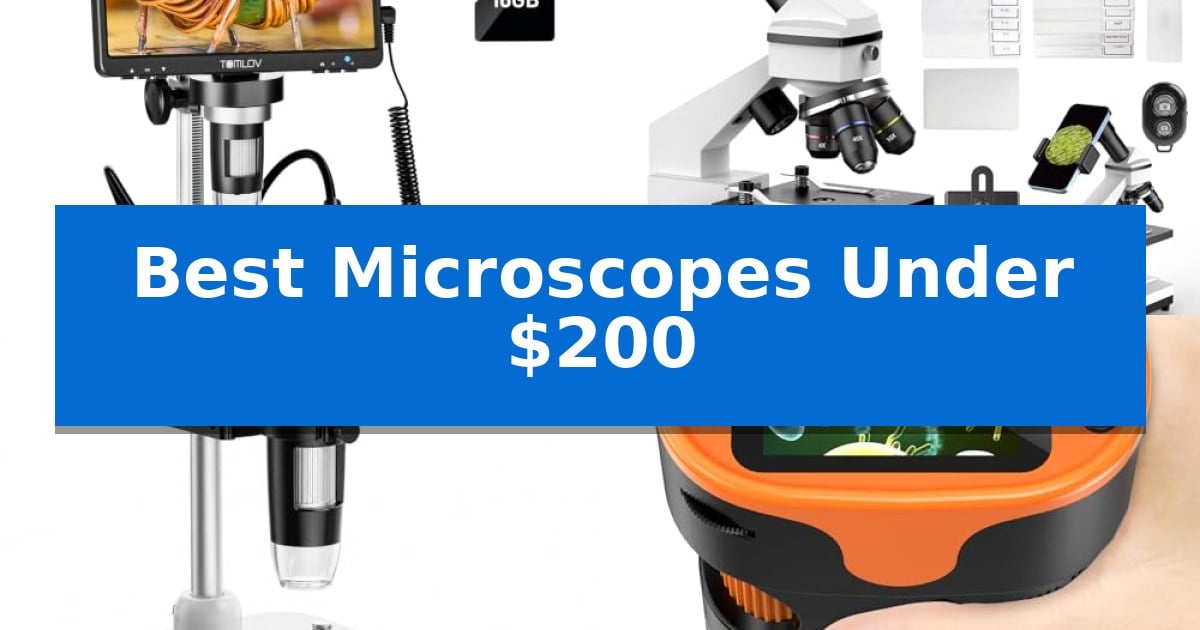
Finding a reliable tool for close-up inspection doesn't require a professional laboratory budget. Whether you are examining intricate coin details, soldering small circuit boards, or exploring biological specimens, the Best Microscopes Under $200 offer impressive clarity and functionality for hobbyists and students alike.
We have evaluated these models based on their specific strengths, from digital screen convenience to optical power for classroom learning. This guide breaks down the essential features to help you select a device that matches your specific project requirements without overspending.
You may also want to compare Best Microscopes Under $100, Best Microscopes for Young Kids, and Best Microscopes for University.
Best Microscopes Under $200
Quick Comparison
| Product | Best For | Key Strength | Score |
|---|---|---|---|
| TOMLOV DM9 Digital Microscope | Best Overall | 7-inch integrated LCD screen for comfortable, real-time viewing. | 4.9 |
| PalliPartners Compound Microscope | Ideal for Student Biology Labs | Wide 100X-2000X magnification range for diverse specimen viewing. | 4.3 |
| Elikliv EDM4 Digital Microscope | Ergonomic Choice for Long Sessions | Ergonomic 4.3-inch display reduces physical strain during long sessions. | 4.4 |
| BEBANG Kids Digital Microscope | Complete Kit for Young Explorers | 32GB memory card included for extensive photo and video storage. | 4.3 |
| Skybasic Wireless Digital Microscope | Best for Mobile Device Connectivity | Dual connectivity via WiFi for mobile devices and USB for computers. | 4.4 |
How We Chose
- Magnification range and optical clarity for specific subjects like coins or biological slides.
- Ease of connectivity for digital models, including PC and mobile device integration.
- Build quality and stability, particularly for stands used in soldering or detailed inspection.
- Included accessories, such as specimen slides, storage cases, or memory cards for documentation.
- Ergonomics and screen quality for extended viewing sessions.
1 TOMLOV DM9 Digital Microscope — Best for Detailed Coin Inspection
The TOMLOV DM9 Digital Microscope simplifies close-up inspection with its 7-inch LCD screen, allowing users to view coins, circuit boards, and hobby projects without needing to squint or lean in. This integrated display provides a clear, real-time view that is particularly beneficial for sharing observations or documenting findings during extended sessions.
Engineered for stability, the unit features a solid metal base and 8.5-inch metal stand that minimizes shaking during precise tasks like soldering or examining mint marks. The 1200X magnification capability, combined with smooth height adjustment, enables users to transition easily between broad views and fine surface details. For those requiring documentation, the device includes a 12MP camera and 1080P video recording, with a 16GB memory card included for immediate storage.
Versatility is a core design choice, as the TOMLOV DM9 Digital Microscope offers both standalone operation and PC connectivity for Windows or Mac users. This allows for a larger viewing area, which is ideal for educational demonstrations or detailed PCB repair. Lighting is managed through 8 built-in LED lights and two flexible gooseneck lights, providing customizable illumination to reduce glare and shadows on reflective surfaces like coins or metal parts.
The package includes a wired remote control to prevent vibrations during capture, along with a light barrier to further enhance image clarity. By combining a sturdy, heat-resistant base with advanced digital features, this microscope provides a comprehensive toolset for collectors and hobbyists looking for reliable, high-detail inspection capabilities.
Best for: Collectors and hobbyists needing a stable, all-in-one digital solution for coin, jewelry, and electronics inspection.
Skip if: Users requiring a portable, handheld microscope for field use will find the fixed metal stand and wired power requirements of this unit restrictive.
PROS
- 7-inch integrated LCD screen for comfortable, real-time viewing.
- Stable metal base and stand designed for hands-on soldering and inspection.
- Adjustable lighting system with 8 LEDs and dual goosenecks to minimize glare.
- 16GB storage included for immediate photo and video documentation.
CONS
- Wired connection requirements limit portability compared to battery-operated handheld models.
2 PalliPartners Compound Microscope — Ideal for Student Biology Labs
The PalliPartners Compound Microscope offers a versatile magnification range from 100X up to 2000X, utilizing 4X, 10X, and 40X objective lenses paired with a WF25X eyepiece and a 2X magnification lens. This configuration provides a significant step up from standard entry-level models, allowing for the inspection of biological cells and plant tissues with high-contrast clarity.
Designed for both home and classroom environments, this unit features a top and bottom LED dual illumination system. The upper light is specifically tailored for opaque solid items, while the bottom light is optimized for translucent biological samples. Users can achieve precise adjustments using the integrated coaxial coarse and fine focus knobs, which offer a more refined control experience than basic monocular setups.
The kit is comprehensive, arriving with 10 pre-prepared specimen slides and 18 blank slides for custom experiments. To facilitate digital documentation, it includes a universal phone clip adapter and a Bluetooth remote camera shutter. The device is SGS certified for non-toxic materials and electrical safety, making it a suitable tool for students aged 8 to 18.
Measuring approximately 9.84 inches in height and weighing roughly 3.6 pounds, this microscope balances portability with a stable, functional design. It serves as a practical bridge for those seeking more capability than a toy microscope without the complexity or cost associated with professional-grade electron equipment.
Best for: Students and hobbyists seeking a versatile, all-in-one biological microscope kit for home education or classroom experiments.
Skip if: Professional researchers requiring advanced digital imaging sensors or specialized laboratory-grade optics beyond the capabilities of a standard compound light microscope.
PROS
- Wide 100X-2000X magnification range for diverse specimen viewing.
- Includes a complete kit with 28 slides and a phone adapter for digital photography.
- Dual LED illumination system supports both opaque and translucent samples.
- SGS safety certified construction suitable for students and teens.
CONS
- Requires manual adjustment of lighting and focus, which may have a learning curve for younger users.
3 Elikliv EDM4 Digital Microscope — Ergonomic Choice for Long Sessions
The Elikliv EDM4 Digital Microscope simplifies detailed inspection through its integrated 4.3-inch display, which provides real-time 720P HD imaging. By eliminating the need for a traditional eyepiece, this device helps reduce eye and neck strain during extended observation sessions.
Equipped with 8 adjustable LED lights, the microscope ensures consistent illumination for examining small objects like coins, jewelry, or circuit boards. The height-adjustable stand allows users to modify the distance between the camera and the subject, facilitating precise focus and varying levels of magnification to capture intricate details.
For those requiring a larger perspective, the unit connects to Windows or MacBook computers, enabling live viewing and the organization of captured images or videos. The built-in rechargeable battery supports up to 3 hours of continuous operation, providing flexibility for both indoor analysis and portable use.
Designed for versatility, this tool serves as a practical solution for hobbyists and professionals alike, from coin collectors evaluating minting symbols to students engaged in STEM education. While it offers robust functionality for close-up work, users should note that a memory card is required for saving media and must be purchased separately.
Best for: Coin collectors and hobbyists needing an ergonomic, portable solution for detailed inspection and digital documentation.
Skip if: Users who require professional-grade laboratory magnification or optical zoom capabilities beyond the limits of a digital sensor-based system.
PROS
- Ergonomic 4.3-inch display reduces physical strain during long sessions.
- Height-adjustable stand allows for precise control over focus and magnification.
- Built-in rechargeable battery provides up to 3 hours of cordless operation.
- PC compatibility enables easy image and video management on larger screens.
CONS
- Memory card not included, requiring an additional purchase to utilize the recording function.
4 BEBANG Kids Digital Microscope — Complete Kit for Young Explorers
Introducing young learners to the microscopic world requires tools that balance ease of use with authentic observation. The BEBANG Kids Digital Microscope simplifies this process by featuring an upgraded 3mm slide viewing slot, which allows glass specimens to pass through more smoothly than standard 2mm designs, reducing frustration for children during setup.
Designed for versatility, this device offers five adjustable magnification levels ranging from 200X to 1000X, enabling exploration of everything from insect anatomy to household objects. The easy focus wheel and integrated LED lighting provide a straightforward interface for beginners to achieve clear images without complex technical adjustments.
Portability is a core strength of this rechargeable unit. Weighing only 0.34 lb, it is built for both indoor classroom use and outdoor nature discovery. The included 32GB memory card allows users to document findings by capturing photos and videos, ensuring that observations can be saved and reviewed later rather than relying on temporary visual inspection.
The kit arrives as a comprehensive, ready-to-use package. It includes 5 lab-grade glass prepared slides, a custom EVA carrying case for protection, and a neck strap for field trips. With a battery life of approximately 2.5 hours per charge, it supports extended independent exploration for children aged 4 to 12.
Best for: Young students and budding scientists aged 4-12 who need a portable, all-in-one kit for documenting biological and everyday specimens.
Skip if: Professional researchers or users requiring high-resolution optical clarity and advanced laboratory-grade magnification beyond 1000X.
PROS
- 32GB memory card included for extensive photo and video storage.
- Upgraded 3mm slide slot improves ease of use for young hands.
- Portable, lightweight design with a protective custom EVA case.
- Rechargeable battery provides 2.5 hours of continuous exploration.
CONS
- Limited to 1000X magnification, which may not satisfy advanced hobbyist needs.
- Fixed battery life requires recharging after 2.5 hours of use.
5 Skybasic Wireless Digital Microscope — Best for Mobile Device Connectivity
The Skybasic Wireless Digital Microscope offers a versatile approach to close-up observation by functioning as both a wireless device for mobile phones and a wired camera for computers. This handheld tool utilizes a 2MP HD CMOS sensor to capture images and videos, providing a practical way to examine plants, minerals, and insects at a magnification range of 50X-1000X.
Designed for portability, the device features 8 adjustable LED lights that help maintain clarity during use. To ensure the best image quality, the manufacturer specifies an optimal focal length range of 3-60 mm. Users can trigger photo and video capture directly through the app when connected via WiFi, or use standard computer software when plugged in via the included USB cable.
Compatibility is a central component of this system, supporting Android and iOS devices through the 'Max-see' app, as well as Windows and Mac computers. The package includes a bracket and base to provide stability during observation. It is important to note that the device is intended for hobbyist exploration and is not designed for professional biological research.
Setting up the microscope requires attention to specific connectivity steps, such as removing the protective film and adjusting camera privacy settings on computers. By following the provided software guidelines, users can integrate the microscope into their existing digital workflow for educational or recreational projects.
Best for: Students and hobbyists who need a portable, budget-friendly tool for casual magnification and digital image capture on mobile devices.
Skip if: Professional biologists or researchers requiring high-precision optics, laboratory-grade stability, or advanced analytical features.
PROS
- Dual connectivity via WiFi for mobile devices and USB for computers.
- Adjustable LED illumination for improved detail in various lighting conditions.
- Portable, lightweight design suitable for outdoor use.
- One-button capture functionality when using the mobile application.
CONS
- Fixed focus design requires manual distance adjustment within a 3-60 mm range.
- Connectivity setup requires specific software and system permission adjustments.
Best Microscopes Under $200 Buying Guide
Digital vs. Compound Microscopes
The primary choice you will face is between a digital microscope and a compound microscope. Digital models, which often feature a built-in screen, are ideal for surface inspection, soldering, and coin collecting because they allow you to view the object on a display rather than through an eyepiece.
Compound microscopes are designed for viewing translucent biological specimens on slides. These use objective lenses and an eyepiece to provide high-power magnification, making them the standard choice for students and those interested in biology or cellular exploration.
Understanding Magnification
Higher magnification is not always better. For surface inspection of coins or electronics, a lower magnification range (often 50X to 500X) is usually sufficient to see details without losing the overall context of the object.
Compound microscopes for biology often reach higher levels, such as 1000X or 2000X. Ensure the microscope you choose provides a range that suits your specific subject matter, as excessive magnification on a low-quality lens can lead to blurry, unusable images.
Connectivity and Documentation
Many modern digital microscopes offer PC connectivity or wireless streaming to smartphones. This is invaluable if you need to document your findings, share images with others, or perform detailed analysis on a larger monitor.
Check if the device supports external storage, such as a micro SD card, which allows you to save photos and videos directly. This feature is a significant time-saver for collectors who need to keep records of their inventory or project progress.
Lighting and Stability
Proper illumination is critical for clear images. Look for models with adjustable LED lights, as these allow you to control glare and shadows, which is particularly important when viewing reflective surfaces like coins or metal components.
A stable metal base and stand are essential for preventing image shake during high-magnification work. If you are performing tasks like soldering, a sturdy stand ensures your hands remain steady and the object stays in focus.
Ease of Use for Beginners
If you are purchasing for a younger student, look for kits that include prepared slides and a protective carrying case. These kits provide an immediate, frustration-free experience that encourages learning and exploration.
Simple, intuitive controls are vital. A microscope that requires complex software or difficult setup may discourage a beginner. Prioritize models that offer 'plug-and-play' functionality or clear, accessible interfaces.
Frequently Asked Questions
Can I use a digital microscope for biological samples?
Digital microscopes are generally designed for surface inspection of opaque objects. While some can view thin specimens, a compound microscope is significantly better for viewing biological cells and tissues.
Do I need a computer to use these microscopes?
Most digital microscopes in this category have built-in screens, allowing them to function independently. PC connectivity is an optional feature for viewing on a larger screen or saving files.
What is the best magnification for coin collecting?
For coin collecting, a range of 50X to 200X is usually ideal. This allows you to see mint marks, errors, and surface textures clearly without the image becoming too dark or unstable.
Are these microscopes suitable for soldering?
Yes, models with a sturdy metal stand and adjustable height are excellent for soldering. They provide the necessary clearance for tools while allowing you to inspect joints in real-time.
What should I look for in a microscope for a child?
Look for durability, simple focus controls, and included accessories like prepared slides. A kit that includes a carrying case is also helpful for keeping all components organized.
Conclusion: Our Top Pick
For most users seeking a versatile and reliable tool, the TOMLOV DM9 Digital Microscope stands out as the top choice. Its combination of a large 7-inch screen, stable metal base, and high-resolution imaging makes it exceptionally well-suited for detailed tasks like coin inspection and electronics repair.
While other models offer specific benefits for biology students or mobile users, the TOMLOV DM9 provides the best balance of build quality and functional features for the price. If your primary goal is detailed surface observation and documentation, this model offers the most consistent performance and ease of use.