
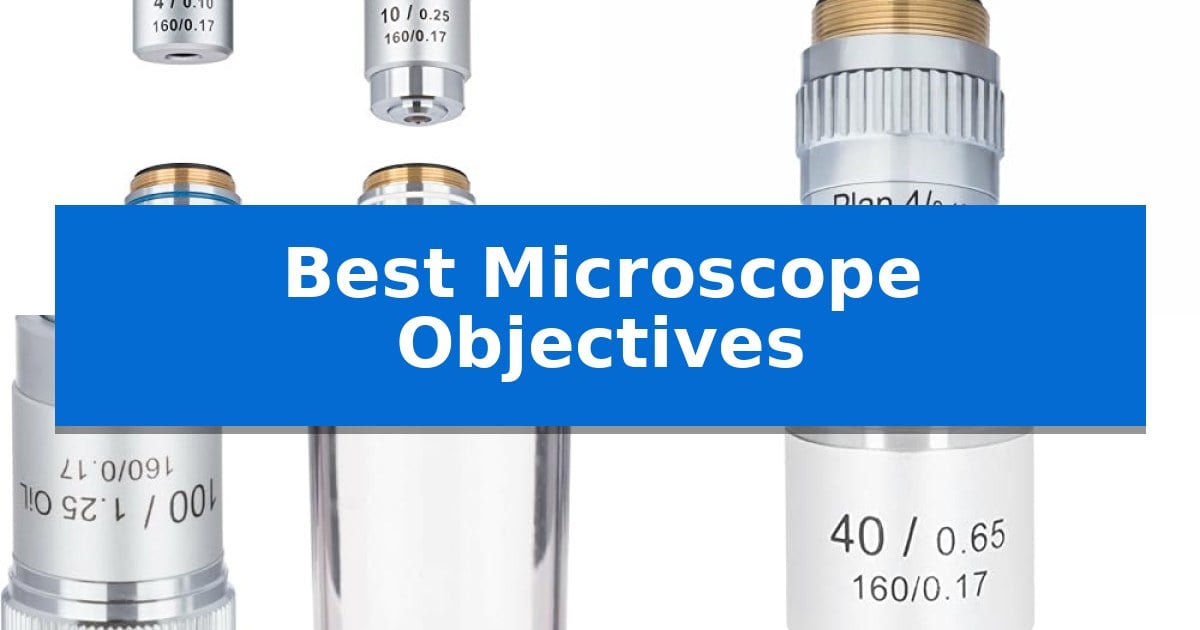
Selecting the right optics is essential for achieving high-resolution imaging in biological and industrial microscopy. Whether you are upgrading a laboratory setup or outfitting an educational microscope, the Best Microscope Objectives must provide the necessary magnification and clarity for your specific specimens.
Our guide examines key optical components, focusing on magnification ranges, flat-field corrections, and standard mechanical compatibility. By understanding how these lenses integrate with your existing hardware, you can ensure precise observations and reliable results across various research applications.
You may also want to compare Best Microscope Magnifications, Best Microscope Magnification for Resolving Power, and Best Microscope Light Source.
Best Microscope Objectives
Quick Comparison
| Product | Best For | Key Strength | Score |
|---|---|---|---|
| AmScope AX-4-V300 Objective Lens Set | Best Overall | Comprehensive 4X-100X range covering essential magnification levels. | 4.9 |
| AmScope PA4XK-V300 Plan Achromatic Objective | Best for Flat-Field Clarity | Plan Achromatic corrections for reduced field curvature and aberration | 4.5 |
| AmScope A100X Oil Immersion Objective | High-Resolution Oil Immersion | High Numerical Aperture (NA) of 1.25 for superior resolution. | 4.9 |
| Dioche 40X High Magnification Objective | Protective Spring-Loaded Design | Spring-loaded mechanism prevents specimen damage. | 4.4 |
| Acogedor 10X Achromatic Objective | Sharp Mid-Range Contrast | Precision-machined aluminum alloy shell for long-term durability. | 4.4 |
How We Chose
- Magnification range and versatility for diverse specimen types.
- Optical correction standards such as achromatic and plan-achromatic designs.
- Mechanical compatibility with DIN and JIS standard microscopes.
- Numerical aperture ratings for light gathering and resolution capabilities.
- Protective features like spring-loaded nosecones for slide safety.
1 AmScope AX-4-V300 Objective Lens Set — Complete Multi-Magnification Kit
Achieving precise magnification for biological study requires reliable optics that integrate seamlessly into your existing lab setup. The AmScope AX-4-V300 Objective Lens Set provides a versatile range of four achromatic lenses—4X, 10X, 40X, and 100X—designed to cover the most common magnification needs for standard microscopy work.
These lenses are engineered for compatibility with DIN standard microscopes, ensuring they fit a wide variety of common laboratory and educational instruments. By offering a comprehensive 4X-100X magnification range, this set allows users to transition from broad specimen overviews to high-resolution detail without needing to source individual components separately.
The achromatic design of these lenses is intended to correct for color fringing, which helps maintain clarity across the field of view. Because they are built to a standardized specification, they offer a straightforward upgrade or replacement path for researchers and students who rely on consistent optical performance during routine biological applications.
While this set is highly functional for standard biological imaging, users should verify that their specific microscope stage and condenser configuration can accommodate the working distance of the 100X oil-immersion objective. The set is compact, measuring 3 inches in height, making it an efficient addition to any microscopy storage kit.
Best for: Students and laboratory technicians requiring a standardized set of achromatic lenses for routine biological microscopy.
Skip if: Users requiring specialized phase-contrast, plan-apochromatic, or non-DIN compatible optical systems.
PROS
- Comprehensive 4X-100X range covering essential magnification levels.
- DIN standard compatibility for broad integration with existing microscopes.
- Achromatic correction to improve image quality by reducing color distortion.
CONS
- Fixed set configuration lacks the flexibility of individual lens selection.
- Requires specific maintenance for the 100X oil-immersion objective.
2 AmScope PA4XK-V300 Plan Achromatic Objective — Best for Flat-Field Clarity
Achieving high-resolution clarity in microscopy often depends on the quality of the optical path, specifically the objective lens. The AmScope PA4XK-V300 4X Plan Achromatic Objective is designed to provide a flat-field image, minimizing the curvature of field often found in standard lenses. This makes it a precise choice for those looking to upgrade or replace a component on a compound microscope.
This objective lens features Plan Achromatic corrections, which are engineered to reduce chromatic and spherical aberrations, resulting in clearer color reproduction and sharper focus across the entire field of view. With a 4X magnification and a numerical aperture (NA) of 0.10, it is optimized for low-power observation where a wide field is necessary for initial sample scanning.
Compatibility is a primary design focus, as the lens is built to fit common DIN/JIS standard compound microscopes. It features a 160mm tube length, ensuring it integrates seamlessly into many standard laboratory and educational microscope setups. The inclusion of a knurled ring provides a tactile grip, making it easier to handle and install the lens securely into the nosepiece.
Measuring 1.4 inches in width and height with a length of 2.4 inches, this lens is a compact addition to any optical setup. By prioritizing optical correction and standard sizing, the AmScope PA4XK-V300 4X Plan Achromatic Objective offers a straightforward path to improving image consistency for routine microscopy tasks.
Best for: Microscopists seeking a flat-field, aberration-corrected 4X objective that fits standard DIN/JIS compound microscopes.
Skip if: Users requiring higher magnification power or specialized infinity-corrected optical systems that are incompatible with a 160mm tube length.
PROS
- Plan Achromatic corrections for reduced field curvature and aberration
- Standard DIN/JIS compatibility for easy integration
- Knurled ring design for improved handling and installation
- Wide 4X field of view ideal for initial sample scanning
CONS
- Fixed 160mm tube length requirement limits use on infinity-corrected systems
3 AmScope A100X Oil Immersion Objective — High-Resolution Oil Immersion
Achieving high-magnification clarity requires precision optics designed for specific mechanical standards. The AmScope A100X 100X Oil Achromatic Microscope Objective is engineered for microscopes with a 160mm mechanical tube length and 45mm parfocal distance, ensuring seamless integration into existing laboratory or research setups.
This objective lens provides 100X magnification enhanced by achromatic corrections, which help deliver sharp, clear, and true-color images. To reach its full potential, the lens utilizes a high Numerical Aperture (NA) of 1.25, which is essential for superior light gathering and resolution during detailed microscopic examination.
Practical design elements prioritize both safety and longevity. The lens features a spring-loaded nosecone that acts as a protective buffer, preventing accidental contact damage to the glass or your microscope slides. As an oil-immersion objective, it is specifically built to maximize detail when used with the appropriate immersion medium.
Compatibility is a core strength of this component, as it is designed to fit common DIN/JIS standard compound and biological microscopes. Whether you are working in an educational, laboratory, or research environment, this objective offers a reliable path to high-resolution imaging, backed by a five-year warranty covering manufacturing defects.
Best for: Researchers and students requiring high-resolution, oil-immersion imaging on standard DIN/JIS compound microscopes.
Skip if: You are using a microscope that does not support a 160mm mechanical tube length or requires dry-lens objectives.
PROS
- High Numerical Aperture (NA) of 1.25 for superior resolution.
- Spring-loaded nosecone prevents slide and lens damage.
- Achromatic corrections ensure color accuracy and image sharpness.
- Broad compatibility with standard DIN/JIS biological microscopes.
CONS
- Requires oil immersion for optimal performance.
- Specific mechanical tube length requirement limits use on non-standard systems.
4 Dioche 40X High Magnification Objective — Protective Spring-Loaded Design
Maintaining specimen integrity during high-magnification observation is a primary challenge in microscopy, often solved by the Dioche 40X High Magnification Objective. This lens features a specialized spring device that automatically rebounds upon contact with a slide, preventing accidental damage to delicate specimens during the focusing process.
Engineered for broad utility, this objective utilizes the international standard RMS interface size, ensuring compatibility with approximately 95% of professional biological microscopes. The construction relies on premium brass material, providing a sturdy and durable build quality intended for long-term use in research or study environments.
Visual clarity is supported by a high transmittance lens coating, which is designed to improve image brightness and maintain a high refractive index. This 40x magnification lens serves as a practical tool for those requiring consistent optical performance across various biological research tasks.
Integrating this objective into an existing setup is straightforward due to its standardized threading. While it offers robust protection and optical clarity, users should ensure their microscope stage and condenser are properly calibrated to accommodate the specific focal length of a 40x objective lens.
Best for: Researchers and students requiring a protective, spring-loaded 40x objective lens compatible with standard RMS-threaded biological microscopes.
Skip if: Users requiring specialized objectives for non-standard microscope mounts or those needing magnification levels other than 40x.
PROS
- Spring-loaded mechanism prevents specimen damage.
- Universal RMS interface fits most professional microscopes.
- High transmittance coating enhances image brightness.
- Durable brass construction for long-term reliability.
CONS
- Fixed 40x magnification limits versatility for varied zoom requirements.
5 Acogedor 10X Achromatic Objective — Sharp Mid-Range Contrast
Achieving high-fidelity microscopic imaging requires precision optics that minimize distortion, making the Acogedor 10X Achromatic Microscope Objective a focused choice for biological observation. This objective lens is engineered to eliminate chromatic aberration, ensuring that the resulting image maintains clear contrast and color accuracy during extended use. By specifically targeting the reduction of unwanted reflections, this component enhances the clarity of specimens, serving as a reliable tool for those who prioritize optical fidelity.
The build quality centers on a precision-machined aluminum alloy shell, which provides the mechanical stability necessary for consistent performance in laboratory or educational settings. With an objective lens length of 31.3mm, it is designed for straightforward integration into standard biological microscopes, allowing for efficient setup without complex calibration requirements. This standardized dimension ensures compatibility with many existing biological microscope configurations.
Choosing the right objective depends on your specific magnification needs and microscope compatibility. This unit is optimized for biological applications where a fixed 10X magnification factor is the primary requirement for detailed, high-contrast viewing. While it offers a balance of mechanical robustness and optical correction, users should ensure their equipment supports the 31.3mm length to maintain proper focus and alignment.
Best for: Biological microscopy applications requiring a 10X magnification with improved contrast and reduced chromatic aberration.
Skip if: You require a different magnification power or your microscope setup is not compatible with standard 31.3mm length achromatic objectives.
PROS
- Precision-machined aluminum alloy shell for long-term durability.
- Achromatic design effectively eliminates chromatic aberration for clearer images.
- Increased contrast by minimizing unwanted reflections during observation.
- Standardized 31.3mm length for easy installation.
CONS
- Fixed 10X magnification limits versatility for varying zoom requirements.
Best Microscope Objectives Buying Guide
Understanding Magnification and Numerical Aperture
Magnification determines how much larger a specimen appears, but it is only half the story. The Numerical Aperture (NA) is a critical specification that defines the light-gathering capacity and the ultimate resolution of the lens. A higher NA allows for finer detail, which is particularly important when working at higher magnifications like 100X.
When choosing an objective, balance your need for magnification with the required resolution. Higher magnification lenses often have a shallower depth of field, requiring more precise focusing and stable stage movement to maintain a clear image.
Optical Corrections: Achromatic vs. Plan
Achromatic lenses are designed to correct for chromatic aberration, ensuring that colors are focused in the same plane to prevent color fringing. This is the standard for most biological applications, providing a sharp, high-contrast image for general study.
Plan-achromatic objectives take this a step further by correcting for field curvature. While standard lenses may lose focus at the edges of the field of view, Plan objectives provide a flat image across the entire viewing area, which is vital for photography and detailed research documentation.
Mechanical Compatibility and Standards
Most objective lenses are built to the DIN (Deutsche Industrie Norm) or JIS standard, which dictates the mechanical tube length and thread size. Before purchasing, verify that your microscope is compatible with these standards to ensure the objective can reach the correct parfocal distance.
The RMS (Royal Microscopical Society) thread size is a common interface for many biological microscopes. Ensuring your objective matches the thread size and tube length of your microscope body is essential for achieving a parfocal setup, where the image remains in focus when you switch between different lenses.
The Role of Oil Immersion
At magnifications of 100X and above, light refraction becomes a significant barrier to image clarity. Oil immersion objectives are designed to be used with a drop of immersion oil between the lens and the slide, which matches the refractive index of the glass.
This process minimizes light loss and scattering, significantly increasing the effective resolution. If your work involves high-power observation of bacteria or fine cellular structures, an oil immersion lens is a necessary upgrade to standard dry objectives.
Protecting Your Equipment
High-magnification lenses often have a very short working distance, meaning the front of the lens sits extremely close to the slide. A spring-loaded nosecone is a valuable feature that allows the lens to retract slightly if it makes contact with a slide, preventing damage to both the specimen and the expensive optical glass.
Always handle objectives with care and store them in protective cases when not in use. Regular cleaning with appropriate optical tissue and lens cleaner is also required to maintain the high transmittance and clarity of the lens coatings over time.
Frequently Asked Questions
What does the 160mm tube length specification mean?
The 160mm tube length is a standard mechanical distance between the objective lens and the eyepiece. It ensures that the image is projected correctly onto the focal plane of the microscope.
Can I use a Plan objective on a non-Plan microscope?
Yes, as long as the thread size and tube length are compatible, you can use a Plan objective. You will benefit from the improved flatness of the field, though the microscope's performance is still limited by its overall optical design.
Do I need special oil for my 100X objective?
Yes, you must use immersion oil specifically designed for microscopy. Using other oils can damage the lens or fail to provide the correct refractive index needed for high-resolution imaging.
What is the difference between DIN and JIS standards?
DIN and JIS are different international standards for microscope dimensions. While they are similar, they may have slight differences in thread pitch or parfocal distance, so it is best to stick to the standard your microscope was designed for.
How often should I clean my objective lenses?
You should clean your lenses whenever you notice dust, oil, or fingerprints that affect image quality. Always use professional-grade lens paper and cleaning solution to avoid scratching the delicate coatings.
Conclusion: Our Top Pick
For those seeking a versatile and reliable optical upgrade, the AmScope AX-4-V300 Objective Lens Set stands out as the most practical choice. By providing a complete range of magnifications from 4X to 100X, this kit ensures that you have the right tool for everything from low-power scanning to high-resolution cellular observation.
This set is particularly well-suited for users who need to standardize their equipment across common DIN-compliant microscopes. While individual specialty lenses like the 100X oil immersion or Plan-achromatic options offer specific advantages for advanced research, this comprehensive kit provides the best foundation for most biological and educational applications.