
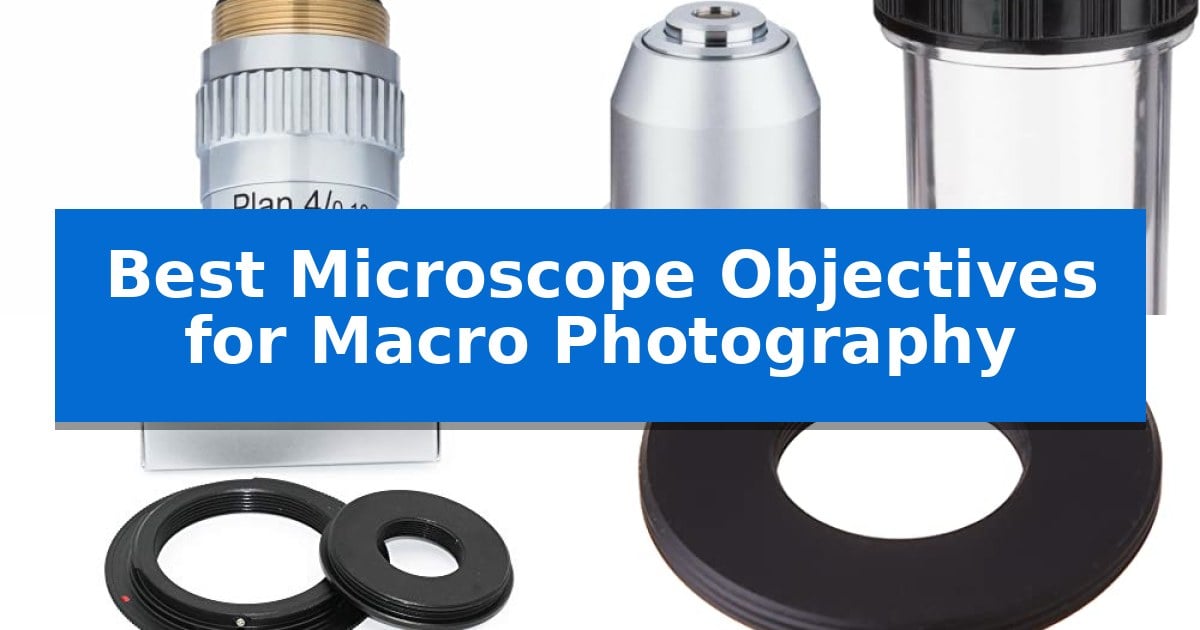
Achieving extreme magnification in macro photography often requires moving beyond standard lenses to specialized optics. By integrating microscope objectives into your camera system, you can capture intricate details that are otherwise invisible to the naked eye, turning tiny subjects into expansive, high-resolution images.
Finding the Best Microscope Objectives for Macro Photography involves balancing optical quality with the mechanical requirements of your specific camera mount. Whether you are a researcher or a creative photographer, selecting the right objective and the necessary adapter is essential for achieving sharp, clear results in your close-up work.
You may also want to compare Best Microscope Objectives, Best Microscope Magnifications, and Best Microscope Magnification for Resolving Power.
Best Microscope Objectives for Macro Photography
Quick Comparison
| Product | Best For | Key Strength | Score |
|---|---|---|---|
| AmScope 4X Plan Achromatic Objective | Best Overall | Plan Achromatic corrections for reduced color fringing and improved field flatness. | 4.9 |
| AmScope 10X Plan Achromatic Objective | Higher detail for close-up work | Plan Achromatic design for improved image field flatness and color correction. | 4.3 |
| FotoHigh Microscope Objective to Canon Adapter | Mount objectives to DSLR cameras | Wide compatibility across the Canon EOS DSLR and film SLR ecosystem. | 4.7 |
| MHADBKH RMS to M42 Objective Adapter | Connects lenses to standard threads | Standardized RMS to C-mount conversion for seamless lens integration. | 4.4 |
| JUIYU RMS to EOS Objective Adapter | Direct fit for Canon systems | Direct compatibility with standard RMS (.8" x 36tpi) microscope objective threads. | 4.3 |
How We Chose
- Optical correction standards, such as Plan Achromatic designs, which minimize field curvature and chromatic aberration.
- Mechanical compatibility, focusing on standard RMS threads and DIN/JIS mounting specifications.
- Adapter build quality, prioritizing durable materials like anodized aluminum for secure camera connections.
- Magnification range, selecting options that provide the necessary detail for various macro photography scales.
- Ease of installation, ensuring that the components allow for straightforward assembly with common DSLR and mirrorless systems.
1 AmScope 4X Plan Achromatic Objective — Sharpness for low-magnification macro
Achieving high-fidelity results in macro photography often requires repurposing precision optics designed for laboratory environments. The AmScope 4X Plan Achromatic Objective provides a specialized solution for photographers looking to adapt professional-grade microscopy components to their camera setups, offering a 4X magnification power that excels at capturing fine details in small subjects.
This objective lens is engineered with Plan Achromatic corrections, which are essential for minimizing chromatic and spherical aberrations across the frame. By utilizing a 160mm tube length standard, it integrates effectively with various bellows or extension tube systems commonly used in macro rigs. The inclusion of a knurled ring improves grip during installation and adjustment, a practical design choice for those frequently swapping lenses in the field or studio.
Compatibility is a primary strength of this unit, as it fits standard DIN/JIS compound microscopes. With an NA (Numerical Aperture) of 0.10, the lens balances light-gathering capability with the depth of field requirements typical of low-magnification macro work. Its compact dimensions, measuring approximately 1.4 inches by 2.4 inches, ensure it remains a manageable addition to even the most complex optical assemblies.
Choosing this objective lens involves balancing its specialized optical design against the need for custom mounting hardware. Because it is built to industrial standards, users must ensure their specific camera adapter or bellows system supports the standard thread size associated with DIN/JIS objectives to achieve proper focus and alignment.
Best for: Macro photographers using bellows or extension tube systems who require professional-grade optical corrections at 4X magnification.
Skip if: Users seeking a standard camera lens with native mount compatibility or those who do not have the necessary adapters to mount DIN/JIS microscope objectives.
PROS
- Plan Achromatic corrections for reduced color fringing and improved field flatness.
- Standard DIN/JIS compatibility for integration with existing microscope or macro rigs.
- Knurled ring design for secure handling and easier mounting.
- Compact and lightweight form factor.
CONS
- Requires specific adapters for use with standard DSLR or mirrorless camera mounts.
- Fixed 4X magnification limits versatility compared to zoom macro lenses.
2 AmScope 10X Plan Achromatic Objective — Higher detail for close-up work
Capturing extreme detail in macro photography often requires specialized optics that go beyond standard camera lenses. The AmScope 10X Plan Achromatic Microscope Objective Lense is built to integrate with compound microscopes, providing a high-magnification solution for those looking to resolve fine structures that are otherwise invisible to the naked eye.
## Best Microscope Objectives for Macro Photography
### 1 AmScope 10X Plan Achromatic Microscope Objective Lense – Higher detail for close-up work
The AmScope 10X Plan Achromatic Microscope Objective Lense is designed to fit standard DIN/JIS compound microscopes, making it a versatile addition for users already working within a microscopy ecosystem. As a Plan Achromatic objective, it is engineered to correct for spherical and chromatic aberrations, which helps in maintaining image clarity across the field of view. With a 10X magnification power and a numerical aperture of 10/0.25, this lens is optimized for a 160/0.17 tube length and cover slip thickness, ensuring precise optical performance when used with compatible equipment.
This objective lens features a compact form factor, measuring approximately 2.4 inches in height and weighing only 0.3 pounds. Its standard mounting thread allows for straightforward installation on most laboratory-grade microscopes. By utilizing this lens, photographers and researchers can achieve the necessary magnification to document minute subjects with enhanced optical correction, provided their existing setup supports the DIN/JIS standard.
Best for: Microscopists and macro photographers using DIN/JIS standard compound microscopes who require high-magnification, aberration-corrected imaging.
Skip if: Users who do not own a compatible DIN/JIS standard compound microscope or those requiring a lens for direct-to-camera mounting without a microscope body.
PROS
- Plan Achromatic design for improved image field flatness and color correction.
- Compatible with standard DIN/JIS microscope mounts.
- Compact and lightweight construction at 0.3 pounds.
- Provides high 10X magnification for detailed observation.
CONS
- Requires specific microscope compatibility (DIN/JIS standard) to function.
- Not intended for standalone use without a compound microscope body.
3 FotoHigh Microscope Objective to Canon Adapter — Mount objectives to DSLR cameras
Expanding the capabilities of a standard DSLR into the realm of extreme magnification requires a precise interface between camera and optics. The FotoHigh Macro and Close-Up Photography Adapter for Microscope Objective to Canon EF EOS Nikon AI DSLR/SLR Camera (for Canon EOS) provides this connection, allowing photographers to mount standard 20mm microscope objectives with a 0.8" x 36tpi thread directly to a Canon EOS camera body.
Constructed from anodized black aluminum, this adapter system is designed for durability while maintaining a lightweight profile of approximately 0.078 pounds. The kit functions as a combination of two adapters, ensuring the objective lens is correctly positioned for macro and close-up photography applications. Its slim design, measuring only 0.3 inches in height, minimizes the added distance between the camera sensor and the objective lens.
Compatibility is a primary focus of this adapter, supporting a wide range of Canon EOS film and digital SLR/DSLR cameras. This includes professional and enthusiast models such as the 1D, 5D, 6D, and 7D series, as well as the 100D, 300D, and the Rebel series. By utilizing this adapter, users can repurpose existing microscope optics for high-magnification imaging without needing proprietary camera-specific microscope systems.
When integrating microscope objectives, users should note that these lenses are typically designed for specific tube lengths and lack the adjustable aperture or focus rings found on standard camera lenses. This adapter serves as a fixed-mount solution, meaning the focus and magnification are primarily determined by the objective lens itself and the extension distance provided by the adapter assembly.
Best for: Photographers looking to repurpose standard 20mm microscope objectives for macro imaging on Canon EOS DSLR or SLR camera bodies.
Skip if: Users who require autofocus, electronic aperture control, or variable magnification, as this adapter provides a purely mechanical, manual-focus connection.
PROS
- Wide compatibility across the Canon EOS DSLR and film SLR ecosystem.
- Durable anodized black aluminum construction.
- Enables the use of standard 20mm microscope objectives for macro photography.
- Lightweight and low-profile design.
CONS
- Requires manual focus and exposure settings due to the lack of electronic communication between the objective and the camera body.
4 MHADBKH RMS to M42 Objective Adapter — Connects lenses to standard threads
The MHADBKH RMS to M42 Objective Adapter provides a specialized mechanical bridge for photographers looking to integrate high-magnification microscopy optics into their macro setups. By converting the standard RMS (Royal Microscopical Society) thread found on many microscope objectives to the more common M42x0.75 mount, this adapter enables the direct attachment of objective lenses to cameras equipped with C-mount industrial interfaces.
Engineered for precision, the adapter features a M20.20.705 internal thread specifically designed to secure the objective lens, while the outer C-mount (M25.40.75) thread ensures compatibility with standard industrial USB cameras. This design facilitates a streamlined workflow for those capturing images directly through the objective lens, bypassing the need for complex custom machining or incompatible mounting hardware.
This component is a practical solution for users who already possess microscope objectives and wish to repurpose them for high-detail macro photography. Its primary utility lies in its ability to maintain a stable, threaded connection between the optics and the imaging sensor, ensuring the objective remains properly aligned during operation.
While this adapter excels at bridging specific thread standards, it is important to note that it is a mechanical interface only. It does not provide electronic communication, autofocus, or aperture control, meaning users must manage focus and exposure manually through their camera system and bellows or extension tube setups.
Best for: Photographers and hobbyists looking to mount microscope objectives with RMS threads onto C-mount industrial cameras for macro imaging.
Skip if: Users who require electronic lens communication, autofocus, or who are using cameras with mounts other than C-mount, as this adapter is strictly a mechanical thread converter.
PROS
- Standardized RMS to C-mount conversion for seamless lens integration.
- Durable threaded construction ensures a secure fit for precision optics.
- Compact design minimizes added distance between the lens and sensor.
CONS
- No electronic communication or autofocus support.
- Limited to C-mount cameras, requiring further adapters for other sensor formats.
5 JUIYU RMS to EOS Objective Adapter — Direct fit for Canon systems
Capturing extreme detail in macro photography often requires repurposing precision optics, and the JUIYU RMS to EOS Objective Adapter provides the necessary bridge for this task. By allowing photographers to mount microscope objective lenses with a standard RMS (.8" x 36tpi) thread directly onto Canon EOS camera systems, this adapter facilitates high-magnification imaging that standard macro lenses may not achieve.
The adapter features a professional and practical design constructed from durable plastic, ensuring it remains lightweight and easy to carry during field or laboratory work. Its primary function is to serve as a mechanical interface, enabling the use of specialized microscope objectives for sample observation or detailed macro photography setups.
While primarily intended for laboratory and educational environments, the JUIYU RMS to EOS Objective Adapter is a straightforward tool for those looking to explore micro-photography. It is designed for simplicity, focusing on providing a secure connection between the objective lens and the camera body without unnecessary complexity.
When integrating this adapter into a photography rig, users should note that it is a manual mechanical component. It does not provide electronic communication between the lens and the camera, meaning all focus and exposure settings must be managed manually by the photographer.
Best for: Canon EOS users who want to mount standard RMS-threaded microscope objectives for high-magnification macro photography.
Skip if: Users requiring electronic aperture control, autofocus, or EXIF data transmission between the lens and camera body.
PROS
- Direct compatibility with standard RMS (.8" x 36tpi) microscope objective threads.
- Lightweight and portable design suitable for various photography environments.
- Professional-grade utility for both laboratory sample observation and creative macro imaging.
CONS
- Manual operation only as there is no electronic communication between the lens and camera.
Best Microscope Objectives for Macro Photography Buying Guide
Understanding Optical Corrections
When choosing an objective, look for Plan Achromatic corrections. This design is crucial for macro photography because it flattens the field of view, ensuring that your subject remains in focus from the center to the edges of the frame.
Achromatic lenses also help reduce chromatic aberration, which is the color fringing that often appears around high-contrast edges. Using these specialized optics ensures that your final images have professional-grade color accuracy and sharpness.
Compatibility and Mounting Standards
Most microscope objectives use the RMS (Royal Microscopical Society) thread standard. Before purchasing, verify that your adapter supports this specific thread size to ensure a secure fit for your lens.
Additionally, consider the DIN or JIS standards for your objective. These standards dictate the tube length and parfocal distance, which are vital for maintaining focus and image quality when mounting the objective to a camera body.
The Role of Adapters in Macro Setups
An adapter acts as the bridge between your camera's sensor and the microscope objective. High-quality adapters, typically made from anodized aluminum, provide the necessary rigidity to prevent vibration during long exposures.
Ensure your chosen adapter is compatible with your specific camera mount, such as Canon EOS or M42 threads. A precise fit is essential to avoid light leaks and to keep the optical axis perfectly aligned with your sensor.
Magnification and Numerical Aperture
The magnification power (e.g., 4X or 10X) determines how large your subject will appear on the sensor. A 4X objective is often ideal for larger macro subjects, while a 10X objective provides the higher detail needed for extremely small specimens.
Pay attention to the Numerical Aperture (NA), which indicates the light-gathering capability of the lens. A higher NA generally allows for better resolution, though it may also result in a shallower depth of field, requiring precise focus stacking techniques.
Practical Handling and Maintenance
Microscope objectives are precision instruments. Always handle them by the knurled ring if available to maintain a secure grip, and store them in a clean, dry environment to prevent dust accumulation on the glass elements.
When cleaning, use only specialized lens tissue or microfiber cloths. Avoid harsh chemicals that could damage the delicate coatings on the lens surface, which are essential for maintaining contrast and clarity in your macro shots.
Frequently Asked Questions
Can I use any microscope objective with my DSLR?
Most objectives can be used if you have the correct adapter. You must ensure the objective uses a standard thread like RMS and that your adapter matches your camera's specific mount.
What is the difference between 4X and 10X objectives?
A 4X objective provides a wider field of view, making it better for larger macro subjects, while a 10X objective offers higher magnification for capturing finer, microscopic details.
Do I need special lighting for these objectives?
Yes, because microscope objectives have a small numerical aperture, they often require significant light. Using a dedicated macro flash or high-intensity LED lighting is recommended.
What does 'Plan Achromatic' mean?
Plan Achromatic refers to an objective design that corrects for field curvature and color fringing, providing a flat, sharp image across the entire frame.
Are these adapters compatible with all camera brands?
No, adapters are usually brand-specific (e.g., Canon EOS, Nikon AI). Always check that the adapter matches your camera's mount type before purchasing.
Conclusion: Our Top Pick
For photographers looking to expand their macro capabilities, the AmScope 4X Plan Achromatic Objective stands out as a versatile starting point. Its Plan Achromatic design ensures excellent edge-to-edge sharpness, making it an ideal choice for capturing detailed textures at lower magnification levels.
While this objective provides the optical foundation, remember that success in macro photography also depends on a stable mounting system. Pairing this lens with a high-quality adapter will help you achieve the precision required for professional-looking results in your close-up work.