
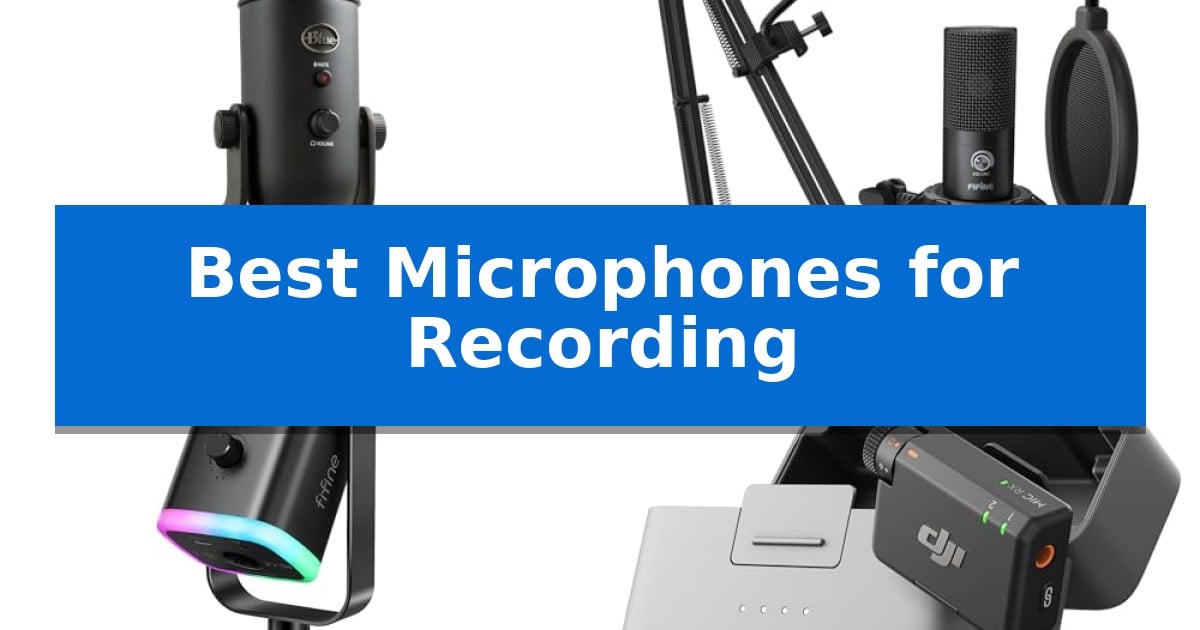
Finding the right audio equipment can feel overwhelming, especially when you need to balance clarity, ease of use, and your specific recording environment. Whether you are launching a podcast, streaming gameplay, or capturing vocal tracks, the Best Microphones for Recording must provide reliable, high-fidelity audio that fits seamlessly into your existing hardware setup.
Our guide focuses on practical solutions that address common recording challenges, such as background noise, connectivity limitations, and the need for versatile pickup patterns. By evaluating these options based on their technical specifications and real-world utility, we aim to help you select a microphone that enhances your production quality without unnecessary complexity.
You may also want to compare Best Microphones for Reading, Best Microphones for Raspy Vocals, and Best Microphones for Raspberry Pi Voice Assistants.
Best Microphones for Recording
Quick Comparison
| Product | Best For | Key Strength | Score |
|---|---|---|---|
| Logitech Blue Yeti USB Microphone | Best Overall | Four selectable pickup patterns for versatile recording applications. | 4.9 |
| FIFINE T669 USB Microphone Kit | Complete All-in-One Starter Bundle | Plug-and-play USB connectivity requires no additional drivers or hardware. | 4.6 |
| FIFINE AmpliGame AM8 Dynamic Microphone | Dual XLR and USB Connectivity | Dual connectivity via USB and XLR for flexible setup options. | 4.6 |
| DJI Mic Mini Wireless Microphone | Ultra-Compact Portable Audio Capture | Ultralight 10g transmitter for discreet, comfortable on-camera wear. | 4.3 |
| ZealSound K66 Podcast Microphone | Intuitive On-Board Audio Controls | Zero-latency monitoring with independent volume control. | 4.9 |
How We Chose
- Connectivity and Compatibility: Assessing whether a microphone offers plug-and-play USB functionality or requires professional XLR interfaces.
- Pickup Patterns: Evaluating the flexibility of polar patterns to determine suitability for solo vocals, interviews, or ambient sound capture.
- On-Board Controls: Checking for physical adjustments like gain, mute, and headphone monitoring that allow for real-time audio management.
- Build Quality and Accessories: Reviewing the inclusion of essential hardware such as shock mounts, boom arms, and pop filters that improve recording stability.
- Noise Management: Identifying features like noise reduction modes or dynamic capsules that help isolate the user's voice from environmental interference.
1 Logitech Blue Yeti USB Microphone — Versatile Multi-Pattern Studio Recording
Achieving broadcast-quality audio for streaming, podcasting, or professional recording requires a versatile tool that adapts to various environments. The Logitech Blue Yeti USB Microphone distinguishes itself with a custom three-capsule array, allowing users to capture clear, powerful sound without the need for complex external audio interfaces.
This microphone offers significant flexibility through four pickup patterns: cardioid, omni, bidirectional, and stereo. These modes enable users to record everything from solo vocal tracks to multi-person podcasts or musical instruments. The Plug 'n Play functionality ensures that creators can begin recording on Mac or PC in seconds, while the included desktop stand provides a stable base for immediate use.
Control is centralized directly on the device, featuring onboard audio controls for headphone volume, pattern selection, instant mute, and mic gain. Users can monitor their voice in real time with no-latency monitoring, ensuring that audio levels remain consistent throughout a session. For those looking to refine their output, the Blue VO!CE software provides advanced modulation, HD audio samples, and clear broadcast vocal effects.
The positionable design allows the microphone to pivot, helping users optimize the angle relative to the sound source. While the unit is robust, its dimensions of 11.61 inches in height and a weight of 3.51 pounds make it a substantial piece of equipment. It is compatible with standard boom arms or mic stands for those who prefer a more permanent studio setup.
Best for: Creators and podcasters who need a versatile, all-in-one USB microphone with multiple pickup patterns for diverse recording scenarios.
Skip if: Users who require a highly portable, ultra-lightweight microphone for mobile recording or those who already possess a professional XLR-based audio interface.
PROS
- Four selectable pickup patterns for versatile recording applications.
- Onboard audio controls for immediate adjustments to gain and monitoring.
- Blue VO!CE software for enhanced vocal effects and audio modulation.
- Plug 'n Play connectivity for quick setup on PC and Mac.
CONS
- Substantial weight and size may require a sturdy boom arm for desk mounting.
- Fixed USB interface limits integration with traditional XLR-based professional studio equipment.
2 FIFINE T669 USB Microphone Kit — Complete All-in-One Starter Bundle
Achieving professional-grade audio for home projects often requires a reliable foundation, and the FIFINE T669 USB Microphone Kit provides a comprehensive starting point by including a dedicated boom arm and shock mount right out of the box. This setup is designed to simplify the recording process for podcasters, streamers, and voice-over artists who need a direct, plug-and-play solution for their computer-based audio.
The core of this kit is a cardioid condenser capsule that focuses on capturing clear audio from the front while minimizing ambient noise. Its ability to handle high sound pressure levels makes it versatile enough for both vocal recordings and instrument tracking. Because it connects via a standard USB interface, it eliminates the need for external audio interfaces or complex driver installations, allowing for immediate use with PCs and laptops.
Physical usability is a primary focus of the included adjustable boom scissor arm. With a 30-inch reach and a heavy-duty C-clamp mount, it allows for flexible positioning without obstructing the user's face during broadcasts or video conferences. The bundle also features a double pop filter designed to dissipate air pressure and reduce plosive sounds, ensuring cleaner vocal tracks during high-intensity recording sessions.
While this kit offers significant utility for home studios, users should note that it is not compatible with Xbox consoles. The all-steel construction of the stand and the inclusion of a studio-grade shock mount emphasize a focus on durability and stability, making it a practical choice for those looking to upgrade their recording environment without purchasing individual components separately.
Best for: The FIFINE T669 USB Microphone Kit is best for beginners or home-studio creators who need an all-in-one, plug-and-play recording solution for PC or laptop.
Skip if: Skip this product if you require a microphone compatible with Xbox consoles or if you need an XLR-based setup for professional audio interfaces.
PROS
- Plug-and-play USB connectivity requires no additional drivers or hardware.
- Comprehensive kit includes a sturdy boom arm, shock mount, and double pop filter.
- Cardioid polar pattern effectively captures front-facing audio while reducing background noise.
- Flexible positioning provided by the 30-inch reach of the adjustable scissor arm.
CONS
- Incompatible with Xbox gaming consoles.
- USB-only connection limits integration with traditional XLR audio equipment.
3 FIFINE AmpliGame AM8 Dynamic Microphone — Dual XLR and USB Connectivity
The FIFINE AmpliGame AM8 Dynamic Microphone provides a versatile recording solution by offering both USB and XLR connectivity in a single unit. This dual-interface design allows users to plug directly into a computer for immediate use or integrate the microphone into a professional audio interface setup for greater fidelity and control.
Designed with an end-addressing cardioid polar pattern, this microphone focuses on capturing sound from the front while rejecting off-axis ambient noise. It features a frequency response of 50Hz-16KHz, which delivers a balanced audio range suitable for podcasting, streaming, and vocal recording. The inclusion of a noise-canceling windscreen further assists in reducing unwanted hum from nearby electrical equipment.
For those utilizing the USB connection, the microphone includes several integrated controls to streamline the recording process. A tap-to-mute button with an LED indicator provides privacy during live sessions, while a dedicated headphones jack allows for real-time monitoring. Users can also adjust the mic gain knob to boost or attenuate their voice, reducing the need for extensive post-production editing.
The physical design incorporates 3/8'' and 5/8'' metal threads, ensuring compatibility with most standard microphone stands without requiring external adapters. Additionally, the unit features controllable RGB lighting with multiple modes and colors, which can be customized to match a gaming setup. These digital features, including the mute function and lighting, are powered through the USB connection and remain inactive when the microphone is used in XLR mode.
Best for: Creators who need a flexible microphone that can transition from a simple USB setup for daily podcasting to an XLR interface for professional audio recording.
Skip if: Users who require advanced features like RGB lighting or onboard gain control while using an XLR connection, as these functions are only available via USB.
PROS
- Dual connectivity via USB and XLR for flexible setup options.
- Integrated tap-to-mute button with LED status indicator.
- Built-in headphone jack for zero-latency real-time monitoring.
- Standard metal threads for broad compatibility with microphone stands.
CONS
- RGB and function keys are inactive when using the XLR connection.
- XLR cable not included in the package.
4 DJI Mic Mini Wireless Microphone — Ultra-Compact Portable Audio Capture
Recording high-quality audio in dynamic environments requires equipment that balances portability with technical precision. The DJI Mic Mini Wireless Microphone addresses this by offering an ultralight 10g transmitter design, ensuring it remains discreet and comfortable for long-duration use during vlogging, interviews, or streaming.
Engineered for versatility, the system supports 48kHz sampling and 120 dB SPL, providing clear, detail-rich sound capture. Users benefit from a 400m maximum transmission range, which maintains a stable connection even in busy outdoor locations. To ensure consistent audio levels, the microphone features automatic limiting to prevent signal clipping during unexpected volume spikes.
The system includes two transmitters and a receiver, complemented by a charging case that extends total battery life to 48 hours. This makes the setup well-suited for intensive, all-day production schedules. Additionally, the integrated 2-level noise cancellation allows for adjustments based on the environment, with a 'Strong' setting designed specifically for noisy surroundings.
Compatibility is a core strength of this system, featuring direct connection to the OsmoAudio ecosystem without needing an external receiver. This allows for seamless integration with devices like the Osmo Pocket 3, Osmo Action 5 Pro, and various Osmo Mobile stabilizers, delivering 24-bit audio quality directly to the hardware.
Best for: Content creators and vloggers who require a lightweight, portable wireless audio solution for mobile devices and action cameras.
Skip if: Users who require professional XLR connectivity or traditional studio-grade microphone interfaces will find this compact wireless system unsuitable for their specific hardware needs.
PROS
- Ultralight 10g transmitter for discreet, comfortable on-camera wear.
- 48-hour total battery life when using the included charging case.
- Direct connection to the DJI OsmoAudio ecosystem for simplified workflows.
- Automatic limiting to prevent audio clipping during high-volume input.
CONS
- Requires specific adapters or modules for compatibility with certain Osmo Mobile series products.
- Limited to wireless operation, lacking traditional wired studio connectivity options.
5 ZealSound K66 Podcast Microphone — Intuitive On-Board Audio Controls
The ZealSound K66 Podcast Microphone distinguishes itself with a 360-degree rotatable top-addressed design and a weighted metal base, providing the stability and flexible positioning required for professional-grade voice capture. This microphone is engineered for creators who demand precise audio control, offering physical knobs for microphone gain, headphone monitoring volume, and echo adjustment directly on the chassis.
Equipped with a high-performance condenser capsule and a cardioid pickup pattern, the K66 focuses specifically on the user's voice while minimizing ambient background noise. For challenging environments, an Intelligent Noise Reduction Mode can be activated via the mute button, effectively suppressing common distractions like PC fan hum or keyboard clicks. The device maintains high-fidelity audio with a 40Hz–18kHz frequency response and a 46kHz sampling rate.
Usability is enhanced through zero-latency monitoring via a dedicated 3.5mm headphone jack, ensuring creators can hear their audio in real time without delay. The instant mute button features a clear red LED indicator, providing immediate privacy control during live streams or meetings. The unit functions as a true plug-and-play device, requiring no additional software or drivers, and includes both USB-C and Lightning adapters for broad compatibility across PC, Mac, and mobile devices.
The included accessory package ensures an immediate setup, featuring a foam windscreen to mitigate plosive sounds and a long 70.87-inch USB cable. While the top-addressed orientation requires the user to speak directly into the microphone for optimal results, the durable metal construction and comprehensive control suite make it a versatile tool for podcasters, streamers, and educators seeking a reliable, all-in-one recording solution.
Best for: Content creators and podcasters who require a versatile, plug-and-play microphone with physical on-board controls for gain, monitoring, and echo adjustment.
Skip if: Users who require a side-address microphone or a specialized XLR-based studio setup will find the top-addressed, USB-only design of this model less suitable for their specific workflow.
PROS
- Zero-latency monitoring with independent volume control.
- Intelligent Noise Reduction Mode for cleaner audio in noisy environments.
- Wide device compatibility including USB-C and Lightning adapters.
- Physical adjustment knobs for gain, volume, and echo.
CONS
- Top-addressed design requires specific positioning for optimal sound capture.
- USB-only connectivity limits integration with professional XLR audio interfaces.
Best Microphones for Recording Buying Guide
Understanding Pickup Patterns
The pickup pattern determines how a microphone captures sound from its surroundings. A cardioid pattern is the most common for solo recording, as it focuses on sound directly in front of the capsule while rejecting noise from the sides and rear.
For more complex setups, such as group interviews or recording ambient room sound, microphones with omni or bidirectional patterns offer greater flexibility. Choosing a model with switchable patterns ensures your equipment can adapt as your recording needs evolve.
USB vs. XLR Connectivity
USB microphones are designed for simplicity, offering a direct connection to your computer without the need for external hardware. They are ideal for beginners or creators who need a fast, portable setup for streaming and podcasting.
XLR microphones provide a more professional path, requiring an audio interface or mixer. This setup allows for greater control over the signal chain and is the standard for high-end studio environments where audio fidelity and signal routing are critical.
The Importance of Real-Time Monitoring
Zero-latency monitoring is a vital feature that allows you to hear your voice through headphones exactly as it is being recorded, without any delay. This helps you maintain consistent volume and tone while speaking or singing.
Look for microphones that include a dedicated 3.5mm headphone jack and volume control. This allows you to adjust your monitoring levels independently of the computer's system settings, ensuring a comfortable and accurate listening experience.
Managing Environmental Noise
Background noise, such as keyboard clicks or air conditioning hum, can compromise the quality of your audio. Microphones with dynamic capsules are naturally better at rejecting off-axis noise compared to sensitive condenser models.
Some modern USB microphones include intelligent noise reduction modes or software-based effects that help clean up your audio signal. These features are particularly useful if you are recording in an untreated room or a busy home environment.
Essential Accessories for Stability
A stable recording environment requires more than just a microphone. Shock mounts are essential for isolating the mic from vibrations transmitted through your desk, such as typing or accidental bumps.
Pop filters and windscreens are equally important for reducing plosive sounds—those harsh 'p' and 'b' sounds that can cause audio clipping. Investing in a kit that includes these accessories often provides better value and immediate performance improvements.
Frequently Asked Questions
Do I need an audio interface for a USB microphone?
No, USB microphones are designed to connect directly to your computer's USB port, acting as their own audio interface.
What is the benefit of a dynamic microphone?
Dynamic microphones are generally more durable and better at rejecting background noise, making them excellent for untreated rooms.
Can I use a professional XLR microphone with my laptop?
Yes, but you will need an external audio interface to convert the analog XLR signal into a digital format your computer can process.
How do I prevent plosives in my recordings?
Using a pop filter is the most effective way to diffuse the rush of air from plosive sounds before they hit the microphone capsule.
Is a higher sampling rate always better?
While higher sampling rates can capture more detail, a standard 48kHz rate is generally sufficient for high-quality podcasting and streaming.
Conclusion: Our Top Pick
For most creators, the Logitech Blue Yeti USB Microphone stands out as the most versatile choice due to its four pickup patterns and intuitive on-board controls. Its ability to adapt from solo podcasting to multi-person interviews makes it a reliable centerpiece for any home studio.
While other options offer specialized features like XLR connectivity or ultra-compact wireless designs, the Logitech Blue Yeti provides the best balance of plug-and-play convenience and professional-grade sound quality for a wide range of recording applications.