
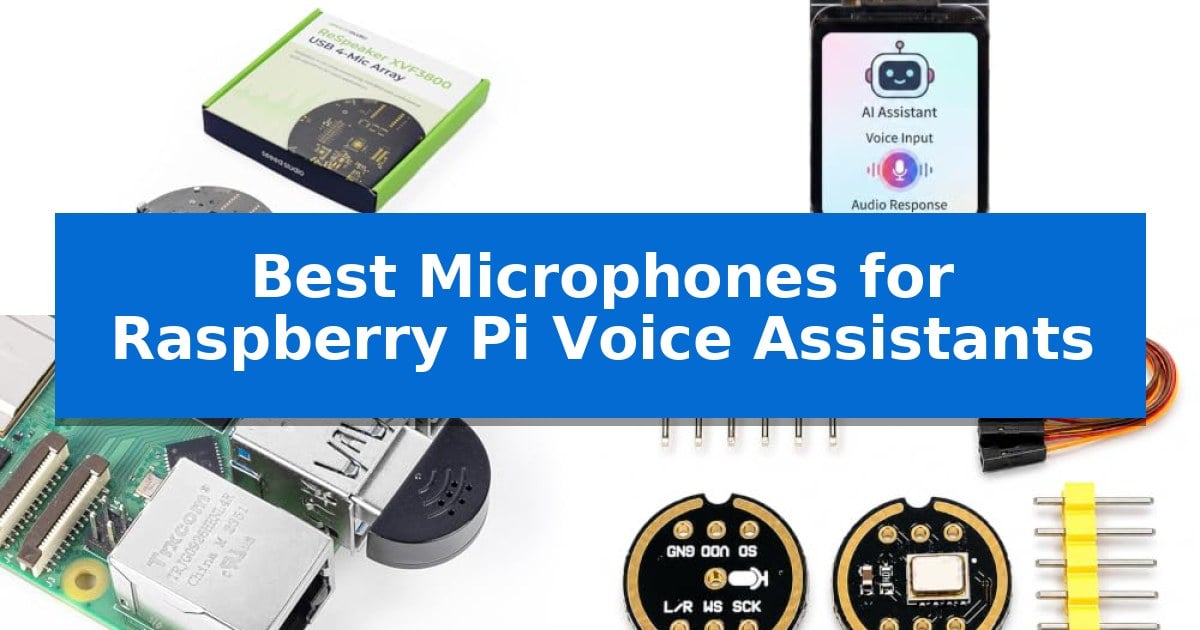
Building a custom voice assistant requires reliable audio input to ensure your commands are captured accurately. Whether you are developing a smart home controller or a robotics project, selecting the right hardware is essential for seamless interaction.
The Best Microphones for Raspberry Pi Voice Assistants range from simple plug-and-play USB modules to advanced I2S arrays designed for far-field capture. This guide evaluates top options to help you choose the ideal audio interface for your specific setup.
You may also want to compare Best Microphones for Rapping Under $200, Best Microphones for Rapping Under $100, and Best Microphones for Rapping and Singing.
Best Microphones for Raspberry Pi Voice Assistants
Quick Comparison
| Product | Best For | Key Strength | Score |
|---|---|---|---|
| Seeed Studio ReSpeaker XVF3800 Microphone Array | Best Overall | Advanced XMOS XVF3800 processor for real-time noise cancellation and beamforming. | 4.9 |
| PiSugar Whisplay HAT Expansion Board | All-in-One Display and Audio | All-in-one integration of display, dual microphones, and speaker. | 4.5 |
| SunFounder USB Mini Microphone | Simple Plug-and-Play Setup | Plug-and-play USB 2.0 connectivity requires no driver installation. | 4.3 |
| Chinveran I2S MEMS Microphone Module | High-Precision Digital Audio Input | I2S digital interface ensures clean, high-precision audio transmission. | 4.7 |
| SuziePi USB Mini Microphone | Compact Multi-Pack Value | Plug-and-play USB 2.0 interface requires no driver installation. | 4.9 |
How We Chose
- Interface Compatibility: Assessing whether the device uses standard USB plug-and-play or requires I2S configuration for custom embedded applications.
- Voice Processing Features: Identifying built-in algorithms like Acoustic Echo Cancellation (AEC) and Automatic Gain Control (AGC) that improve speech recognition accuracy.
- Pickup Range: Evaluating the effective distance for far-field voice capture to ensure reliability in different room sizes.
- Form Factor: Considering the physical footprint and mounting requirements for integration into compact enclosures or custom hardware builds.
- System Versatility: Checking support for various operating systems and development environments like Raspberry Pi OS, Linux, and NVIDIA Jetson.
1 Seeed Studio ReSpeaker XVF3800 Microphone Array — Advanced Far-Field Voice Processing
Integrating advanced audio processing into custom voice projects requires hardware capable of isolating speech from background noise in real-time. The Seeed Studio ReSpeaker XVF3800 Microphone Array addresses this by utilizing the XMOS XVF3800 voice processor to manage complex acoustic challenges directly on the board.
This device features a circular array of four high-sensitivity digital MEMS microphones designed for 360° far-field pickup up to 5 meters. By incorporating Acoustic Echo Cancellation (AEC), adaptive beamforming, and dynamic noise suppression, the array is engineered to maintain clarity even in reverberant or echo-filled environments, which is essential for reliable voice assistant performance.
Designed for ease of integration, the unit functions as a plug-and-play USB microphone without requiring additional drivers or programming. It is fully compatible with Raspberry Pi, NVIDIA Jetson, Linux, macOS, and Windows, making it a versatile choice for developers working on smart home, robotics, or conferencing applications.
For advanced users, the hardware offers a firmware-selectable I2S mode via DFU reflash, allowing for deeper integration with external microcontrollers like Arduino or ESP32. This flexibility, combined with built-in Voice Activity Detection (VAD) and 60dB Automatic Gain Control (AGC), ensures consistent audio input for AI and IoT voice projects.
Best for: Developers and makers requiring high-fidelity, far-field voice capture for Raspberry Pi-based smart home or robotics projects.
Skip if: Users who require a simple, standalone consumer smart speaker with integrated software and speakers, as this is a bare-board component for custom builds.
PROS
- Advanced XMOS XVF3800 processor for real-time noise cancellation and beamforming.
- Plug-and-play USB connectivity compatible with Raspberry Pi and other Linux-based systems.
- 360° far-field pickup effective up to 5 meters.
- Flexible firmware modes supporting both USB and I2S interfaces.
CONS
- Bare board design requires custom housing or mounting for finished projects.
- I2S mode requires DFU reflash, which is more complex than the default USB configuration.
2 PiSugar Whisplay HAT Expansion Board — All-in-One Display and Audio
The PiSugar Whisplay HAT Expansion Board simplifies the creation of voice-controlled interfaces by integrating a 1.69-inch color LCD with a 240×280 resolution and a complete audio system directly onto a single board. Designed with the same 65mm x 30mm form factor as the Raspberry Pi Zero series, it provides a compact solution for developers building smart speakers and voice assistants without requiring complex wiring.
This expansion board features an integrated high-quality audio codec paired with dual microphones and an onboard speaker for accurate voice capture and playback. For projects requiring more power, it includes a PH2.0 expansion interface for connecting external speakers. The hardware is complemented by programmable physical buttons and RGB LEDs, which allow for custom script triggers and visual status indicators.
Compatibility is a primary focus, as the board utilizes the standard 40-pin GPIO header, ensuring it works seamlessly with the Raspberry Pi Zero 2 W, Zero WH, and the Raspberry Pi 5. The installation process is straightforward, requiring zero soldering to get the hardware operational. Developers can leverage the provided full Python drivers and open-source documentation to integrate the board into AI or IoT workflows efficiently.
When implementing this HAT, users should handle the device by the edges of the PCB to protect the fragile glass screen from pressure. While it offers an all-in-one design, the fixed dimensions are tailored specifically for the Raspberry Pi Zero footprint, making it an ideal choice for portable or handheld projects where space is at a premium.
Best for: Developers building compact, portable voice assistant or smart speaker projects using a Raspberry Pi Zero or Pi 5.
Skip if: Users who require a larger display or specific high-end audio output capabilities beyond what the integrated codec and onboard speaker provide.
PROS
- All-in-one integration of display, dual microphones, and speaker.
- Zero-soldering installation via standard 40-pin GPIO header.
- Compact form factor matching the Raspberry Pi Zero series.
- Developer-friendly with Python drivers and open-source examples.
CONS
- Fragile glass screen requires careful handling during installation.
- Fixed hardware footprint may not suit projects requiring modular or off-board component placement.
3 SunFounder USB Mini Microphone — Simple Plug-and-Play Setup
The SunFounder USB Mini Microphone provides a direct, driver-free audio input solution specifically engineered for Raspberry Pi development environments. By utilizing a standard USB 2.0 interface, it eliminates the need for complex software configuration, allowing for immediate integration into projects ranging from AI voice assistants to LLM-based voice recognition systems.
Designed for versatility, this microphone maintains broad compatibility across the Raspberry Pi ecosystem, including the 5, 4B, 3B+, and 3B models. It is physically optimized to fit seamlessly within the SunFounder Pironman series of cases, ensuring a clean, compact setup for developers working on smart robotics or custom voice-controlled hardware.
Beyond its hardware fit, the device offers wide system support, functioning as a standard USB audio input on Raspberry Pi OS, Linux, Ubuntu, and Windows. This makes it a practical choice for various development tasks, such as testing ChatGPT voice interactions, OpenClaw applications, or general VoIP communication.
The SunFounder USB Mini Microphone balances simplicity with functional utility. Because it operates as a plug-and-play device, it removes the barrier of driver installation, making it accessible for both educational projects and rapid prototyping where reliable, consistent audio capture is required for voice-activated commands.
Best for: Developers and hobbyists seeking a simple, driver-free USB audio input for Raspberry Pi-based AI voice projects and smart home assistants.
Skip if: Users requiring high-fidelity studio-grade recording or those who need a microphone with a dedicated physical mute switch or advanced noise-cancellation hardware.
PROS
- Plug-and-play USB 2.0 connectivity requires no driver installation.
- Broad compatibility with Raspberry Pi 5, 4B, 3B+, 3B, and Pironman cases.
- Optimized for AI applications including LLMs and voice recognition software.
- Wide OS support across Linux, Ubuntu, and Windows environments.
CONS
- Lacks physical controls such as gain adjustment or a mute button.
- Compact form factor may limit pickup range compared to larger desktop microphones.
4 Chinveran I2S MEMS Microphone Module — High-Precision Digital Audio Input
Integrating voice control into DIY electronics requires a reliable audio input, and the Chinveran I2S MEMS Microphone Module offers a streamlined solution for hobbyists using platforms like Raspberry Pi. This module utilizes an I2S digital interface, which allows for direct, high-quality audio data transmission to microcontrollers without the signal degradation often found in analog setups.
Designed with an omnidirectional pickup pattern, this sensor captures sound from all directions, making it well-suited for voice assistant projects where the microphone needs to detect commands from various angles within a room. The high-precision MEMS technology ensures clear audio capture while maintaining a low noise floor, which is essential for accurate voice recognition tasks.
The module is built for efficiency, featuring low power consumption that supports battery-powered or portable IoT applications. Its compact form factor—measuring approximately 1.57 by 0.94 inches—allows for easy integration into small enclosures or embedded audio solutions where space is at a premium.
Because this is a digital sensor, it provides a stable and consistent data stream for developers. The Chinveran I2S MEMS Microphone Module is a practical choice for those who need a lightweight, efficient, and easy-to-interface audio component for their smart home or sound analysis projects.
Best for: DIY enthusiasts building voice-controlled smart home devices or sound analysis projects on microcontrollers like Raspberry Pi, Arduino, or ESP32.
Skip if: Users who require an analog microphone interface or those who lack experience with I2S digital protocol configuration.
PROS
- I2S digital interface ensures clean, high-precision audio transmission.
- Omnidirectional pickup is ideal for voice assistant and ambient monitoring.
- Low power consumption design is perfect for portable or battery-operated projects.
- Compact, lightweight form factor fits easily into custom enclosures.
CONS
- Digital-only interface requires specific I2S support on the host microcontroller.
- No included documentation or wiring harness for beginners.
5 SuziePi USB Mini Microphone — Compact Multi-Pack Value
Integrating voice control into a Raspberry Pi setup requires a reliable audio input device that fits within a minimal footprint. The SuziePi USB Mini Microphone offers a specialized solution for this, measuring just 0.9 inches in length and 0.18 inches in height, ensuring it remains unobtrusive when connected to a Raspberry Pi 5, 4 Model B, or earlier iterations.
This hardware is designed for immediate deployment, featuring plug-and-play functionality that eliminates the need for manual driver installation. By utilizing a standard USB 2.0 interface, the microphone functions across various operating systems, making it suitable for tasks ranging from Google voice recognition and gaming to recording applications.
The device utilizes an omni-directional noise-canceling pickup pattern, which is engineered to capture audio from extended distances while automatically filtering out background noise. This capability is particularly useful for voice assistant projects where the microphone may be positioned away from the primary user.
With a two-piece pack included, this set provides redundancy or the ability to equip multiple workstations simultaneously. The compact, lightweight design allows for easy portability, and the unit is backed by a 1-year warranty to support its intended use in continuous voice-capture environments.
Best for: Users seeking a compact, plug-and-play audio input solution for Raspberry Pi-based voice assistant or recording projects.
Skip if: Users requiring high-fidelity studio-grade audio capture or those who need a dedicated stand-mounted microphone for professional broadcasting.
PROS
- Plug-and-play USB 2.0 interface requires no driver installation.
- Omni-directional noise-canceling technology filters background noise.
- Ultra-compact dimensions (0.9 x 0.8 x 0.18 inches) fit tight spaces.
- Two-piece pack provides excellent value for multi-device setups.
CONS
- Fixed form factor lacks adjustable positioning or a flexible gooseneck.
Best Microphones for Raspberry Pi Voice Assistants Buying Guide
Understanding Audio Interfaces
When choosing a microphone, you must decide between USB and I2S interfaces. USB microphones are generally the easiest to implement, as they function as standard audio devices without requiring complex driver installations or additional hardware.
I2S microphones, by contrast, offer a more direct digital connection to the Raspberry Pi's GPIO pins. While these require more technical setup, they are often preferred for custom embedded projects where space is limited or where you need to integrate multiple sensors directly into your circuit.
The Importance of Far-Field Processing
For voice assistants intended to work from across a room, far-field voice processing is critical. Look for hardware that includes features such as Direction of Arrival (DoA) detection and adaptive beamforming to isolate your voice from background noise.
Without these processing features, your assistant may struggle to distinguish commands from ambient sounds like television audio or household appliances. Advanced arrays use multiple MEMS microphones to create a more accurate sound map of the environment.
Acoustic Echo Cancellation (AEC)
If your voice assistant also plays audio, Acoustic Echo Cancellation is a vital feature. This technology prevents the microphone from picking up the sound coming from your speakers, which would otherwise create a feedback loop that confuses the voice recognition software.
High-quality modules handle this processing in real-time on the hardware itself, reducing the computational load on your Raspberry Pi's processor and ensuring a more responsive user experience.
Physical Integration and Mounting
Consider the physical constraints of your project enclosure. Some microphone modules are designed as HATs (Hardware Attached on Top), which provide a clean, stackable solution that includes extra features like displays or buttons.
Standalone USB microphones are more flexible but may require external cabling or mounting brackets to keep them positioned correctly. Always check the dimensions of the module against your planned housing to avoid fitment issues.
Software and Driver Support
Before purchasing, verify the software requirements for your chosen microphone. While most USB devices are recognized automatically by Raspberry Pi OS, some specialized arrays may require specific firmware or Python libraries to unlock their full functionality.
Check the manufacturer's documentation or community GitHub repositories for examples. Access to pre-written drivers and clear setup instructions can significantly reduce the time required to get your voice assistant operational.
Frequently Asked Questions
Do I need to solder components for these microphones?
It depends on the model. USB microphones are typically plug-and-play with no soldering required. I2S modules often require soldering to headers or connecting via jumper wires to the GPIO pins.
Can I use these microphones with a Raspberry Pi Zero?
Yes, many of these options are compatible with the Pi Zero series, though you may need a USB OTG adapter for USB microphones or a HAT that matches the Zero's form factor.
What is the benefit of a 4-mic array over a single microphone?
A 4-mic array allows for beamforming and direction detection, which significantly improves the ability to capture voices in noisy environments compared to a single-microphone setup.
Will these microphones work with ChatGPT voice applications?
Yes, these microphones are designed to provide clear audio input, which is essential for LLM-based voice interactions and AI assistants.
Do I need an external sound card?
USB microphones have built-in audio processing, so they do not require an external sound card. I2S modules connect directly to the Pi's digital interface, effectively bypassing the need for a traditional analog sound card.
Conclusion: Our Top Pick
For most users seeking a balance of performance and ease of use, the Seeed Studio ReSpeaker XVF3800 Microphone Array stands out as the most capable option. Its advanced onboard processing, including AEC and adaptive beamforming, provides a level of audio clarity that is difficult to achieve with simpler, single-microphone solutions.
While it is a more significant investment than basic USB dongles, the Seeed Studio ReSpeaker XVF3800 Microphone Array is the best choice for those building serious voice assistant projects where reliable, far-field voice capture is a requirement. Its plug-and-play USB compatibility ensures it works immediately with your existing Raspberry Pi setup without the need for complex driver configuration.