
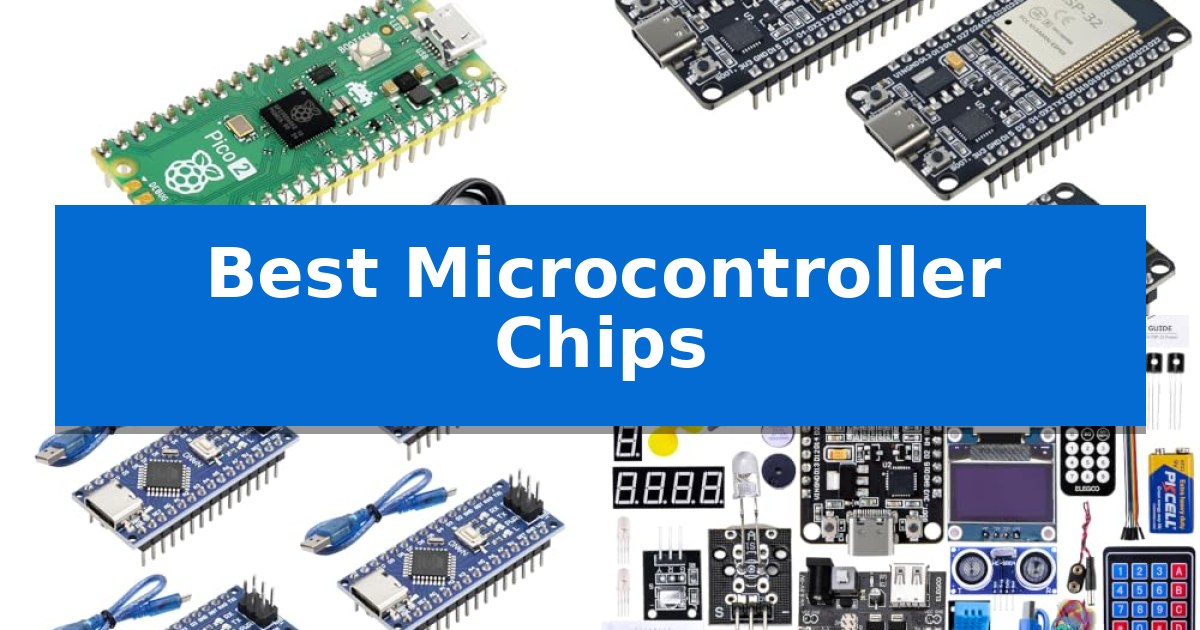
Selecting the right hardware is the foundation of any successful embedded system. Whether you are building a simple sensor node or a complex IoT device, finding the Best Microcontroller Chips requires balancing processing architecture, power efficiency, and available development ecosystems.
Our guide evaluates four distinct platforms, ranging from high-performance dual-architecture boards to beginner-friendly classics. We focus on technical specifications and hardware interfaces to help you determine which board aligns with your specific project requirements and programming environment.
You may also want to compare Best Microcontroller Chip for Modems, Best Microcontroller Boards for Robotics, and Best Microcontroller Boards for Beginners.
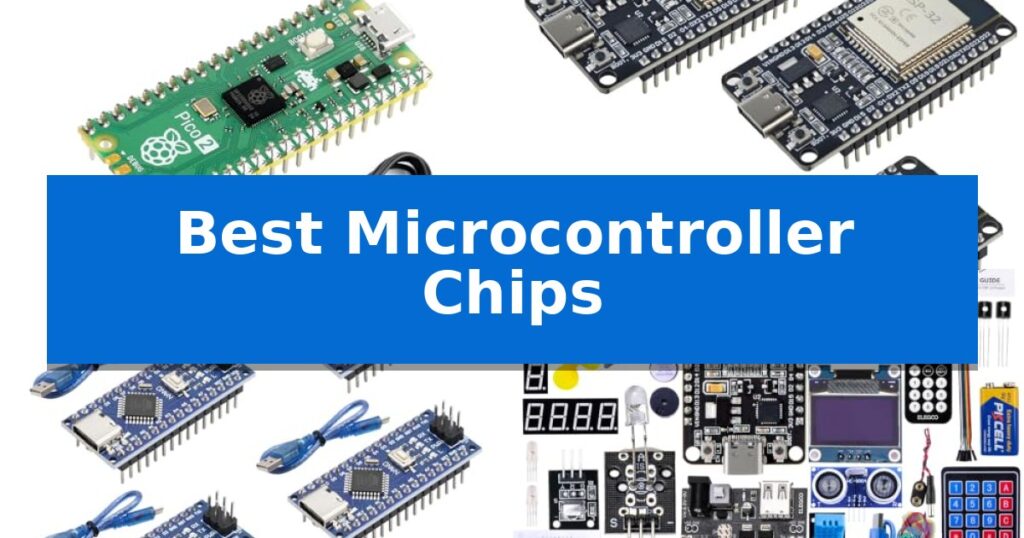
Best Microcontroller Chips
Quick Comparison
| Product | Best For | Key Strength | Score |
|---|---|---|---|
| Waveshare Raspberry Pi Pico 2 | Best Overall | Dual-architecture design featuring both Arm Cortex-M33 and Hazard3 RISC-V cores. | 4.9 |
| Hosyond ESP32 Development Board | Wireless IoT connectivity | High-performance dual-core processor capable of 240MHz operation. | 4.4 |
| LUIRSAY Nano V3.0 Board | Beginner-friendly classic | USB-C power socket for modern connectivity and power delivery. | 4.7 |
| ELEGOO ESP-32 Starter Kit | Complete project ecosystem | Includes a powerful dual-core ESP-32 board with integrated wireless connectivity. | 4.7 |
How We Chose
- Processing Architecture: Evaluating the CPU cores and clock speeds to determine computational capacity.
- Connectivity Options: Assessing built-in wireless protocols like Wi-Fi and Bluetooth for IoT applications.
- Peripheral Interfaces: Checking for GPIO, ADC, PWM, and communication buses like SPI, I2C, and UART.
- Development Ecosystem: Considering compatibility with standard IDEs, SDKs, and the availability of learning resources.
- Form Factor and Integration: Reviewing physical design, such as breadboard compatibility and mounting options.
1 Waveshare Raspberry Pi Pico 2 — Dual-architecture performance
The Waveshare Raspberry Pi Pico 2 distinguishes itself through a unique dual-architecture design, integrating both a dual-core Arm Cortex-M33 and a dual-core Hazard3 RISC-V processor. This combination provides developers with significant flexibility for specialized embedded projects, supported by a clock speed reaching up to 150 MHz.
Engineered for versatility, the board includes 520KB of SRAM and 4MB of on-board Flash memory. Connectivity and peripheral control are handled via 26 multi-function GPIO pins, alongside dedicated interfaces including 2 SPI, 2 I2C, 2 UART, and 24 PWM channels. The integration of 12 Programmable I/O (PIO) state machines allows for the creation of custom peripheral interfaces, making it a robust choice for complex hardware integration.
Usability is enhanced by the inclusion of a pre-soldered header, allowing for immediate prototyping without additional assembly. The board supports USB 1.1 with both device and host functionality, and features drag-and-drop programming via mass storage. For power-sensitive applications, the device offers dedicated low-power sleep and dormant modes.
Developers can utilize the Raspberry Pi C/C++ SDK or MicroPython to interface with the hardware. The castellated module design facilitates direct soldering onto carrier boards, providing a permanent mounting solution for integrated systems. With an onboard temperature sensor and comprehensive documentation, this microcontroller is suited for a wide range of embedded computing tasks.
Best for: Developers requiring a flexible dual-architecture platform for custom embedded hardware and peripheral control.
Skip if: Users who require a simpler, single-architecture microcontroller or those who do not need the specific RISC-V/Arm hybrid capabilities provided by the RP2350 chip.
PROS
- Dual-architecture design featuring both Arm Cortex-M33 and Hazard3 RISC-V cores.
- Pre-soldered header for immediate use in prototyping.
- 12 Programmable I/O (PIO) state machines for custom peripheral support.
- Castellated module design for permanent integration into carrier boards.
CONS
- Complexity of dual-architecture may require a steeper learning curve for beginners compared to single-core alternatives.
2 Hosyond ESP32 Development Board — Wireless IoT connectivity
Embedded system development requires reliable hardware that bridges the gap between prototyping and deployment, and the Hosyond ESP32 Development Board provides this through its integrated dual-core 32-bit CPU. Operating at frequencies up to 240MHz, this board delivers the necessary processing overhead for complex IoT tasks while maintaining a compact form factor.
Connectivity is a core strength of this platform, featuring integrated 2.4GHz Wi-Fi and low-power Bluetooth dual-mode support. This allows developers to implement wireless data transmission and remote control functionality without requiring external modules. The board is designed for versatility, offering a wide array of interfaces including GPIO, UART, SPI, and I2C, alongside support for touch sensing and infrared remote control.
Efficiency is prioritized through a dedicated low-power design that includes multiple power-saving modes, such as deep sleep. This makes the board a practical choice for battery-operated remote monitoring systems where power conservation is critical. The inclusion of a USB-C interface modernizes the connection standard, ensuring compatibility with current development hardware.
Software flexibility is ensured by broad support for major development environments, including Arduino IDE, ESP-IDF, MicroPython, and PlatformIO. This ecosystem compatibility lowers the barrier to entry for beginners while providing the depth required for advanced embedded engineering projects.
Best for: Developers and hobbyists building wireless IoT devices, remote monitoring systems, or embedded applications requiring dual-core processing.
Skip if: Users who require specific industrial-grade certifications, high-speed wired Ethernet connectivity, or a larger number of analog-to-digital converter pins than the standard ESP32 configuration provides.
PROS
- High-performance dual-core processor capable of 240MHz operation.
- Integrated Wi-Fi and Bluetooth for wireless connectivity.
- Comprehensive low-power design with deep sleep modes.
- Broad compatibility with Arduino IDE, MicroPython, and PlatformIO.
CONS
- No warranty provided by the manufacturer.
- Requires familiarity with embedded development environments for optimal use.
3 LUIRSAY Nano V3.0 Board — Beginner-friendly classic
The LUIRSAY Nano V3.0 Board provides a compact, breadboard-friendly solution for electronics projects, utilizing the ATmega328P and CH340G chips to ensure reliable operation. This kit includes five boards and five USB cables, offering a convenient starting point for those integrating microcontrollers into custom hardware setups.
Designed for versatility, the board features 14 digital I/O pins—including 6 PWM outputs—and 6 analog inputs. It is powered by a 16MHz quartz oscillator and supports multiple power sources, including USB-C, 6-12V unregulated external power, or 5V regulated external power. The board is engineered to intelligently switch to the higher voltage source automatically, eliminating the need for manual jumper adjustments.
Compatibility is a core strength of this microcontroller, as it supports the Arduino IDE, ISP programming, and standard USB downloads. It functions across Windows, Mac, and Linux operating systems, making it a flexible choice for diverse development environments. The inclusion of an ICSP port and a dedicated reset button further enhances its utility for complex project configurations.
By replacing the older FT232 with the CH340G chip, this board maintains stable communication with PCs while remaining accessible for beginners. Its small physical footprint and robust feature set allow it to fit into tight spaces while providing the necessary connectivity for sensors, actuators, and other peripheral components.
Best for: Beginners and hobbyists looking for a cost-effective, compact, and breadboard-compatible microcontroller for prototyping and small-scale electronics projects.
Skip if: Users requiring advanced processing power, higher memory capacity, or integrated wireless communication features like Wi-Fi or Bluetooth.
PROS
- USB-C power socket for modern connectivity and power delivery.
- Automatic power source switching between USB and external inputs.
- Breadboard-friendly design ideal for rapid prototyping.
- Full compatibility with Arduino IDE and multiple operating systems.
CONS
- Requires external drivers for the CH340G chip on some operating systems.
- Limited I/O count compared to larger development boards.
4 ELEGOO ESP-32 Starter Kit — Complete project ecosystem
The ELEGOO ESP-32 Starter Kit provides a comprehensive foundation for electronics and IoT development by centering its ecosystem around a powerful dual-core ESP-32 microcontroller. This board integrates Wi-Fi and Bluetooth 4.2 connectivity, enabling the creation of smart devices that interface directly with mobile phones or cloud services.
Beyond the core board, the kit includes over 35 distinct modules and electronic components, such as sensors, motors, and an OLED display. This variety allows users to transition from basic circuit building to complex projects like weather stations or smart home controllers without needing to source individual parts separately.
To support skill development, the package features a step-by-step online tutorial covering more than 30 projects. These guides include complete code, circuit diagrams, and instructions designed to help users understand the ESP-32's capabilities and the fundamentals of programming via the Arduino IDE.
The kit is designed for versatility, catering to students, makers, and engineers alike. By providing a well-organized selection of components and refined code, it minimizes setup friction, allowing users to focus on the practical application of their projects and the exploration of IoT innovation.
Best for: Students, hobbyists, and engineers looking for an all-in-one hardware ecosystem to learn IoT development and microcontroller programming.
Skip if: Users who already possess a large inventory of electronic components or those seeking a standalone microcontroller board without the included learning materials and peripheral modules.
PROS
- Includes a powerful dual-core ESP-32 board with integrated wireless connectivity.
- Comprehensive set of 35+ modules and components for diverse project building.
- Detailed step-by-step online tutorial with 30+ guided projects.
- Full Arduino IDE compatibility for streamlined programming.
CONS
- Contains a large volume of parts that may exceed the needs of experienced users seeking only the microcontroller board.
Best Microcontroller Chips Buying Guide
Understanding Processing Architectures
The core processor dictates how efficiently your code executes. Modern boards often feature dual-core architectures, allowing for parallel task processing where one core handles real-time operations while the other manages communication or background tasks.
Choosing between Arm Cortex and RISC-V cores depends on your familiarity with specific instruction sets and the power requirements of your project. High-frequency operation, often reaching up to 240MHz, is essential for tasks involving signal processing or complex data handling.
Connectivity and IoT Integration
For projects requiring remote monitoring or smart home integration, integrated Wi-Fi and Bluetooth are critical. These features enable your device to communicate with cloud services or mobile applications without the need for external radio modules.
When selecting a board with wireless capabilities, consider the power consumption during transmission. Look for low-power sleep modes if your device will be battery-operated, as this significantly extends the operational life of remote sensors.
Peripheral and I/O Versatility
The number and type of GPIO pins determine how many sensors, displays, and actuators you can connect. Essential interfaces include SPI, I2C, and UART, which serve as the standard communication protocols for most external modules.
Advanced features like Programmable I/O (PIO) state machines provide custom peripheral support, allowing you to interface with unique hardware that standard protocols might not support natively.
Development Environment Compatibility
A board is only as useful as the software tools available for it. Compatibility with the Arduino IDE is a common requirement for hobbyists, while professional developers may prefer C/C++ SDKs or MicroPython for more granular control over hardware resources.
Always check if the manufacturer provides comprehensive documentation, tutorials, and library support. A robust ecosystem reduces development time and helps troubleshoot common integration issues.
Physical Design and Mounting
The physical footprint of the board impacts how it fits into your final enclosure. Breadboard-friendly designs are ideal for prototyping, while castellated modules allow for direct soldering onto custom carrier boards for a permanent, low-profile solution.
Consider the power input options, such as USB-C ports, which offer a more durable and modern connection compared to older micro-USB standards. Ensure the board supports the voltage levels required by your specific project components.
Frequently Asked Questions
What is the main advantage of a dual-core microcontroller?
A dual-core microcontroller allows you to run multiple tasks simultaneously, which improves efficiency by separating real-time control tasks from communication or data processing.
Can I use the Arduino IDE with all these boards?
Most modern ESP32 and ATmega-based boards are compatible with the Arduino IDE, though specific SDKs or plugins may be required for newer architectures like the RP2350.
Why would I choose a board with PIO state machines?
PIO state machines allow you to create custom hardware interfaces, giving you the flexibility to communicate with unique sensors or displays that don't follow standard protocols.
How do I power these boards in a remote location?
Many of these boards feature low-power sleep modes. By utilizing these modes and choosing a board with efficient power management, you can run them on batteries for extended periods.
What is the difference between SPI, I2C, and UART?
These are communication protocols. I2C is typically used for connecting multiple sensors on two wires, SPI is faster for high-speed data transfer, and UART is a standard serial interface for simple device-to-device communication.
Conclusion: Our Top Pick
For those seeking a versatile and high-performance solution, the Waveshare Raspberry Pi Pico 2 stands out due to its unique dual-architecture design. By combining Arm Cortex-M33 and Hazard3 RISC-V processors, it offers significant flexibility for developers looking to experiment with different instruction sets while maintaining high clock speeds.
While other boards in this list excel in specific IoT or beginner-focused applications, the Pico 2 provides a robust foundation for advanced projects. Its inclusion of programmable I/O state machines and extensive memory makes it a powerful tool, provided you are prepared to utilize its specific SDK or MicroPython environment.