
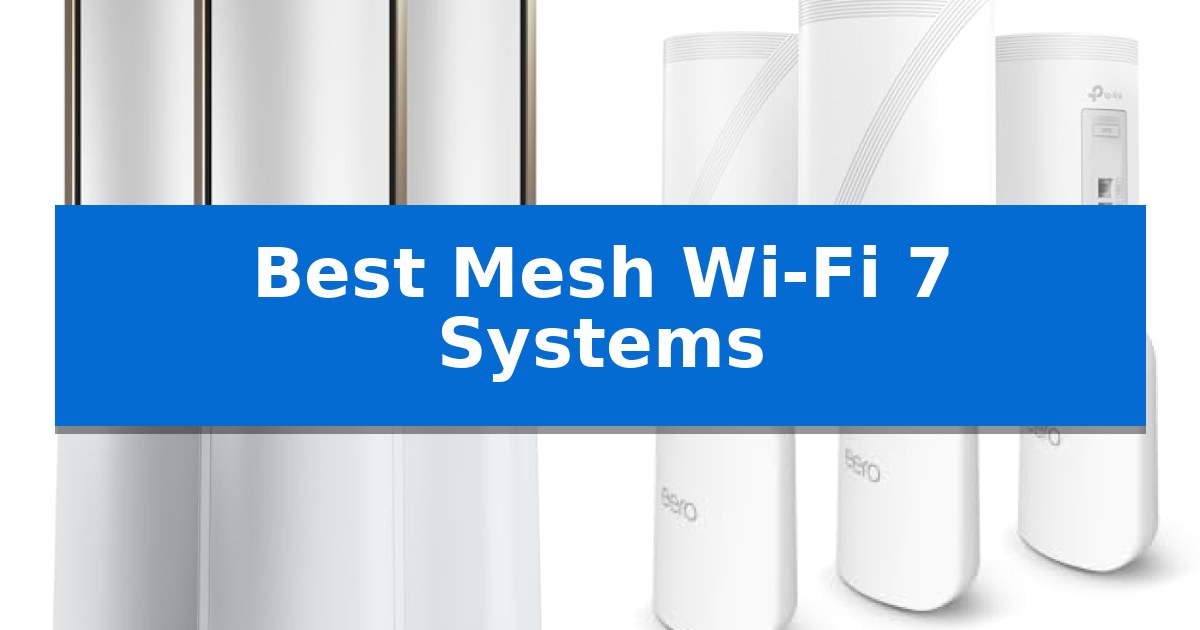
Upgrading your home network to the latest wireless standard can significantly improve how your devices handle high-bandwidth tasks. The Best Mesh Wi-Fi 7 Systems leverage advanced multi-link operation and wider channels to reduce congestion, ensuring that your streaming, gaming, and smart home devices maintain stable connections even when multiple users are active simultaneously.
Selecting the right system requires balancing your home's physical layout with your specific internet service plan. Whether you need massive coverage for a multi-story property or high-speed wired backhaul for a dedicated home office, these systems offer varied configurations to meet your connectivity demands.
You may also want to compare Best Mesh Wi-Fi 6E Router, Best Mesh Wi-Fi 6 Systems, and Best Mesh Wi-Fi 5 Systems.
Best Mesh Wi-Fi 7 Systems
Quick Comparison
| Product | Best For | Key Strength | Score |
|---|---|---|---|
| NETGEAR Orbi 970 Mesh System | Best Overall | Quad-Band technology with dedicated backhaul for consistent performance. | 4.9 |
| TP-Link Deco 7 Pro BE67 Mesh System | Best for High-Bandwidth Gaming | 10 Gbps WAN/LAN ports for multi-gigabit internet support | 4.4 |
| NETGEAR Orbi 770 Mesh System | Balanced Speed for Large Homes | WiFi 7 technology provides high-speed throughput up to 11 Gbps. | 4.5 |
| Amazon eero Pro 7 Mesh System | Reliable Tri-Band Connectivity | Wi-Fi 7 performance with multi-link operation for improved reliability. | 4.3 |
| TP-Link Deco 7 Dual-Band Mesh System | Affordable Whole-Home Coverage | 4-stream BE5000 WiFi 7 for high-speed wireless performance. | 4.4 |
How We Chose
- Wireless throughput and band efficiency using Wi-Fi 7 standards.
- Total square footage coverage and satellite scalability for large homes.
- Availability of multi-gigabit Ethernet ports for wired backhaul and high-speed devices.
- Device capacity and network management tools for traffic prioritization.
- Security features and ease of initial setup via mobile applications.
1 NETGEAR Orbi 970 Mesh System — Ultimate Multi-Gigabit Performance
The NETGEAR Orbi 970 Mesh System leverages Quad-Band technology with an Enhanced Dedicated Backhaul to maintain high-speed connectivity across large environments. By reserving a dedicated lane for satellite traffic, this system ensures that data flow remains consistent even when multiple devices are active simultaneously.
Designed to cover up to 10,000 sq ft, this three-pack configuration provides a seamless network blanket from basements to rooftops. It supports up to 200 devices and utilizes WiFi 7 standards to deliver speeds up to 27 Gbps, which is optimized for bandwidth-intensive tasks such as 8K streaming, VR, and high-definition video conferencing.
Connectivity is a primary focus, featuring a 10 Gig internet port alongside 10 Gig and 2.5 Gig LAN ports on the router and satellites. These wired options provide the necessary throughput for high-performance hardware like gaming PCs and NAS drives, ensuring that your local network infrastructure keeps pace with multi-gigabit internet plans.
Security is integrated directly into the system with Advanced Router Protection and automatic firmware updates enabled out of the box. Users can further enhance their network safety with NETGEAR Armor, which offers tools to defend against malware, identity theft, and unauthorized access, providing a comprehensive layer of protection for all connected home devices.
Best for: Large homes requiring multi-gigabit speeds and extensive wired connectivity for high-performance devices.
Skip if: Users living in smaller apartments or those who do not have high-speed multi-gigabit internet plans may find the capacity and cost of this system excessive.
PROS
- Quad-Band technology with dedicated backhaul for consistent performance.
- Supports WiFi 7 with speeds up to 27 Gbps.
- Includes 10 Gig and 2.5 Gig ports for high-speed wired connections.
- Covers up to 10,000 sq ft with the included three-pack.
CONS
- NETGEAR Armor features require a separate subscription after the trial.
- High-end specifications may exceed the needs of standard home networks.
2 TP-Link Deco 7 Pro BE67 Mesh System — Best for High-Bandwidth Gaming
Modern high-bandwidth home networking requires hardware capable of handling massive data throughput without bottlenecks. The TP-Link Deco 7 Pro BE67 Mesh System addresses this by integrating Wi-Fi 7 technology, featuring 8-stream tri-band connectivity that reaches speeds up to 14 Gbps. This system is engineered to manage demanding tasks like 8K streaming and AR/VR gaming across a footprint of up to 8,100 sq. ft.
Connectivity is a primary strength of this system, which includes a 10 Gbps WAN/LAN port to fully utilize multi-gigabit internet plans. The inclusion of Multi-Link Operation (MLO) allows the system to combine multiple Wi-Fi bands into a single, stable stream, ensuring that high-demand devices like the latest smartphones and gaming consoles maintain consistent performance even while moving through the home.
Beyond raw speed, the system prioritizes network management and security. It utilizes AI-Roaming to automatically direct devices to the optimal unit, maintaining a unified network name throughout the coverage area. For security, the system is built under the CISA Secure-by-Design pledge and includes TP-Link HomeShield for integrated parental controls and network security management.
Setup is streamlined through the dedicated Deco App, which provides step-by-step guidance for installation with various internet service providers. The hardware also supports VPN client and server functionality, allowing connected home devices to access remote VPN servers directly, providing a versatile solution for users requiring enhanced privacy and flexible network configurations.
Best for: This system is best for users with multi-gigabit internet plans who require high-speed, low-latency connectivity for gaming, 8K streaming, and managing over 200 devices simultaneously.
Skip if: Skip this system if you have a smaller home or limited internet bandwidth, as the high-capacity 10 Gbps ports and tri-band Wi-Fi 7 capabilities may exceed your current infrastructure requirements.
PROS
- 10 Gbps WAN/LAN ports for multi-gigabit internet support
- Wi-Fi 7 technology with Multi-Link Operation for stable, high-speed connections
- Extensive 8,100 sq. ft. coverage capacity
- AI-Roaming for seamless device transitions
CONS
- Requires a separate modem for internet connectivity
- High-performance features may be underutilized in standard residential setups
3 NETGEAR Orbi 770 Mesh System — Balanced Speed for Large Homes
Maintaining consistent connectivity across a large residence requires a robust infrastructure capable of handling high-bandwidth demands. The NETGEAR Orbi 770 Mesh System addresses this by utilizing WiFi 7 technology, which provides up to 11 Gbps of throughput to support demanding tasks like 8K streaming, VR, and high-density device environments.
This system features a tri-band architecture with Enhanced Backhaul, designed to maintain performance across the entire network by optimizing traffic between the router and its two satellite extenders. The setup is engineered to cover up to 8,000 sq ft, ensuring that connectivity remains stable from the basement to the rooftop while managing up to 100 devices simultaneously.
Usability is centered around the Orbi app, which provides a guided, step-by-step installation process. The hardware is compatible with existing cable or fiber modems and includes a 2.5 Gig port to accommodate faster internet plans. For network security, the system includes built-in Advanced Router Protection and automatic firmware updates, with an optional subscription available for the NETGEAR Armor suite.
The modular design allows for scalability; users can add additional Orbi 770 Series satellites to extend coverage by 2,750 sq ft per unit. While the system is built for future-ready performance, users should note that real-world speeds are dependent on their specific internet service provider plan and the capabilities of their connected wireless devices.
Best for: Large homes requiring high-capacity, multi-device connectivity and future-proof WiFi 7 performance.
Skip if: Users with smaller living spaces or those who do not have internet plans capable of utilizing 2.5 Gig port speeds.
PROS
- WiFi 7 technology provides high-speed throughput up to 11 Gbps.
- Tri-band system with Enhanced Backhaul minimizes slowdowns.
- Scalable coverage up to 8,000 sq ft with included satellites.
- Advanced Router Protection enabled out of the box.
CONS
- Separate subscription required for full NETGEAR Armor security features.
- Large footprint may require significant placement space for three units.
4 Amazon eero Pro 7 Mesh System — Reliable Tri-Band Connectivity
Managing high-bandwidth home networks requires hardware capable of handling massive device density and multi-gigabit throughput. The Amazon eero Pro 7 Mesh System addresses these demands by leveraging Wi-Fi 7 technology, specifically incorporating multi-link operation (MLO) to optimize data transmission across bands for improved reliability.
This system is designed for expansive environments, with a 3-pack configuration providing coverage up to 6,000 sq. ft. and support for over 600 connected devices. To accommodate high-speed internet plans, each unit features two auto-sensing 5 GbE ports, ensuring that your wired infrastructure does not bottleneck the wireless performance.
Beyond raw speed, the system utilizes patented TrueMesh software, which works in tandem with TrueRoam and TrueChannel to proactively manage connections. This ensures that devices stay on the most stable path, reducing the likelihood of dead spots in larger homes or mixed-use business environments.
Integration is a core strength, as the system remains backward compatible with all previous eero generations and supports eero Built-in on select Amazon Echo devices. For those prioritizing network safety, an optional eero Plus subscription adds advanced security features, including ad blocking, parental controls, and integrated VPN services.
Users are supported by an industry-leading three-year warranty and a dedicated support team, providing a safety net for setup or ongoing network management. The system is built to balance high-performance networking with a straightforward, automated approach to home connectivity.
Best for: Large homes or small businesses requiring high-capacity Wi-Fi 7 coverage for hundreds of devices and multi-gigabit internet plans.
Skip if: Users who do not have high-speed internet plans exceeding 1 Gbps or those who prefer granular, manual control over every aspect of their network configuration.
PROS
- Wi-Fi 7 performance with multi-link operation for improved reliability.
- Dual 5 GbE ports per unit for high-speed wired backhaul or device connection.
- Extensive coverage of up to 6,000 sq. ft. for a 3-pack system.
- Backward compatibility with all previous eero generations.
CONS
- Subscription required for advanced security features like ad blocking and VPN.
- Premium pricing associated with the latest Wi-Fi 7 hardware.
5 TP-Link Deco 7 Dual-Band Mesh System — Affordable Whole-Home Coverage
The TP-Link Deco 7 Dual-Band Mesh System leverages 4-stream BE5000 WiFi 7 technology to provide a robust networking foundation for modern homes. By delivering speeds up to 4324 Mbps on the 5 GHz band and 688 Mbps on the 2.4 GHz band, this system is engineered to handle bandwidth-intensive tasks like 8K streaming and AR/VR gaming across a coverage area of up to 6,600 square feet.
Designed for versatility, the system features 2.5G Ethernet ports that facilitate both wired and wireless backhaul, ensuring stable traffic balancing between units. The inclusion of AI-Roaming technology allows the network to adapt to your movement, maintaining a single unified network name for seamless transitions as you navigate your living space.
Security and ease of use are central to the design. The system is a signatory of the CISA Secure-by-Design pledge and includes TP-Link HomeShield for comprehensive network protection, IoT device identification, and parental controls. Setup is managed through the dedicated Deco App, which also handles firmware updates to keep the system performing optimally.
For users requiring advanced networking features, the system supports both VPN clients and servers, allowing devices to access remote VPN connections without needing individual software installations. Its extensive compatibility ensures that it can integrate with existing Deco units and any standard internet service provider modem, making it a flexible choice for expanding or upgrading a home network.
Best for: Homeowners looking for a high-performance, secure, and easily expandable Wi-Fi 7 mesh network that supports advanced VPN configurations.
Skip if: Users who do not have a separate modem or those who require a tri-band system for more complex, high-density traffic environments.
PROS
- 4-stream BE5000 WiFi 7 for high-speed wireless performance.
- 2.5G Ethernet ports supporting efficient wired backhaul.
- AI-Roaming for seamless connectivity throughout the home.
- Advanced security via CISA Secure-by-Design pledge and HomeShield.
CONS
- Dual-band architecture may be less efficient than tri-band systems for extremely high-density traffic.
- Requires a separate modem for internet connectivity.
Best Mesh Wi-Fi 7 Systems Buying Guide
Understanding Wi-Fi 7 Standards
The transition to Wi-Fi 7 introduces significant improvements in data throughput and latency compared to previous generations. By utilizing wider 320MHz channels and Multi-Link Operation (MLO), these systems allow devices to transmit data across multiple bands simultaneously, which is essential for maintaining speed in crowded wireless environments.
When shopping, ensure your devices are compatible with the latest standard to fully realize these benefits. While these systems are backward compatible with older Wi-Fi 5 and 6 devices, the most significant performance gains are observed when connecting Wi-Fi 7-capable hardware.
Coverage and Placement Strategy
Mesh systems rely on the strategic placement of satellites to eliminate dead zones. For homes with thick walls or multiple floors, a three-pack system is generally more effective than a single high-powered router, as it creates a more uniform signal distribution throughout the living space.
Always consider the backhaul method when planning your network. Systems that support a dedicated wireless backhaul or a wired Ethernet backhaul will provide more consistent speeds to your satellite units, preventing the performance degradation often seen in simpler extender setups.
The Importance of Wired Connectivity
Even in a wireless-first home, wired connectivity remains a critical component of a robust network. Look for systems that include 2.5 Gbps or 10 Gbps Ethernet ports, especially if you subscribe to high-speed fiber or cable internet plans that exceed 1 Gbps.
These high-speed ports are not just for your modem; they are also vital for connecting stationary devices like gaming consoles, NAS drives, or desktop computers. Utilizing a wired connection for these devices frees up wireless airtime for your mobile devices and smart home sensors.
Managing Network Security
Modern mesh systems often include built-in security suites to protect your network from external threats. These tools can provide automatic firmware updates, malware protection, and parental controls, which are essential for managing a household with many connected devices.
While many features are included out of the box, some advanced security services may require a separate subscription. Evaluate whether your household needs these premium features or if the standard security protocols provided by the manufacturer are sufficient for your risk profile.
Scaling Your Network
One of the primary advantages of a mesh system is the ability to expand coverage as your needs change. If you move to a larger home or add an outdoor living space, you can often add compatible satellite units to your existing network without replacing the entire system.
Before purchasing, check the manufacturer's compatibility list to ensure that additional satellites will work with your specific router model. Maintaining a consistent ecosystem within the same brand usually ensures the most seamless roaming experience as you move between rooms.
Frequently Asked Questions
Do I need a new modem for Wi-Fi 7?
Most mesh systems require a separate modem to connect to your internet service provider. While you do not necessarily need a new modem, you should ensure your current modem supports the speeds provided by your ISP to avoid bottlenecks before the signal even reaches your router.
Can I mix different brands of mesh routers?
Generally, it is not recommended to mix brands if you want a seamless mesh experience. Different manufacturers use proprietary software to manage roaming and backhaul, which often results in poor performance or incompatibility if you try to link units from different companies.
How many devices can these systems handle?
Capacity varies by model, but most high-end Wi-Fi 7 mesh systems are designed to support 100 to 200+ devices simultaneously. This is achieved through advanced MU-MIMO and OFDMA technologies that manage data traffic more efficiently than older routers.
What is the benefit of a tri-band or quad-band system?
Additional bands provide more 'lanes' for your data to travel. A tri-band or quad-band system uses one or more of these bands specifically for backhaul traffic between the router and satellites, ensuring that your devices have clear access to the remaining bands for their own data needs.
Is a wired backhaul better than wireless?
Yes, a wired Ethernet backhaul is almost always superior to a wireless one. Connecting your mesh satellites to the main router via Ethernet cables removes the need for the system to use wireless bandwidth for communication between units, resulting in faster and more stable speeds throughout your home.
Conclusion: Our Top Pick
For users seeking the most robust performance, the NETGEAR Orbi 970 Mesh System stands out as the top recommendation. Its quad-band technology and 10 Gig port capabilities provide a future-ready foundation for high-bandwidth households, ensuring that your network remains fast and responsive even under heavy load.
While it represents a significant investment, the system's ability to maintain high speeds across a large footprint makes it a reliable choice for those who prioritize consistent connectivity for gaming, 8K streaming, and professional home office requirements.