
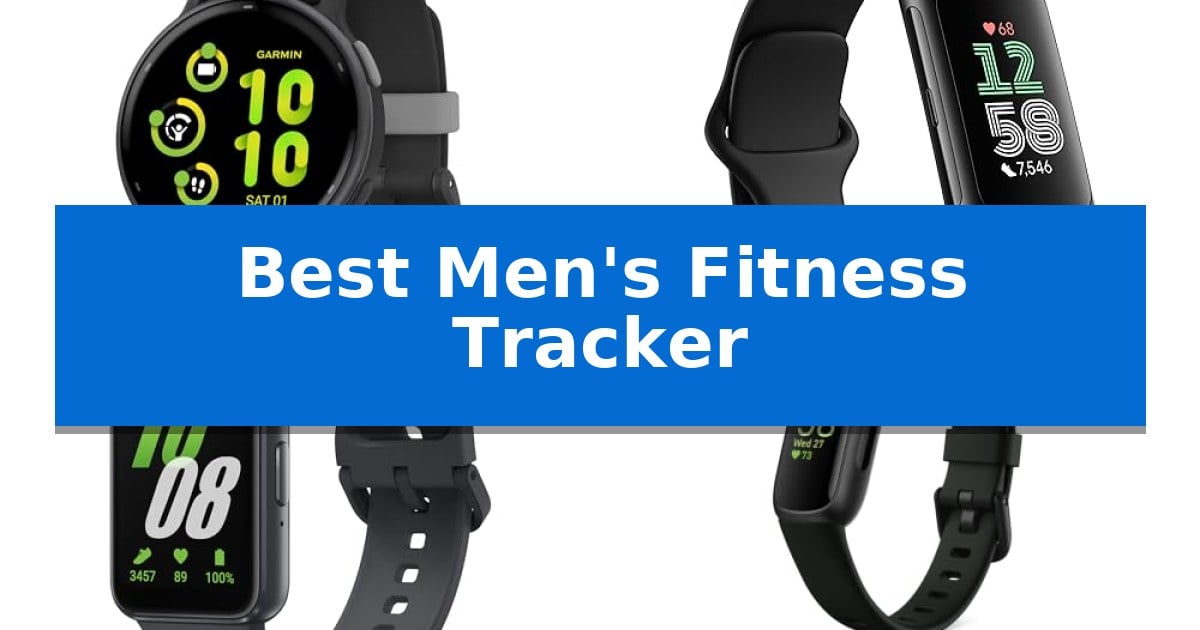
Finding the right wearable to monitor your health goals requires balancing advanced sensor technology with your personal daily routine. Whether you are training for a marathon or simply looking to increase your daily step count, the Best Men's Fitness Tracker should provide actionable insights without becoming a burden to wear.
Our selection focuses on devices that offer reliable health metrics, such as heart rate monitoring and sleep analysis, while considering factors like display quality and battery longevity. By evaluating how these trackers integrate into your existing lifestyle, you can choose a device that effectively supports your fitness journey.
You may also want to compare Best Men's Automatic Watches, Best MemoScan Scanner, and Best Memory Tablets for Students.
Best Men's Fitness Tracker
Quick Comparison
| Product | Best For | Key Strength | Score |
|---|---|---|---|
| Garmin Vivoactive 5 Fitness Smartwatch | Best Overall | Advanced recovery metrics including sleep coaching and HRV status. | 4.9 |
| Google Fitbit Charge 6 Tracker | Best for Google Ecosystem Integration | Built-in GPS for accurate distance and pace tracking without a phone. | 4.4 |
| Samsung Galaxy Fit 3 Tracker | Large Display for Easy Tracking | 1.6-inch AMOLED display for clear navigation | 4.7 |
| Google Fitbit Inspire 3 Tracker | Lightweight Design for Daily Wear | Lightweight design optimized for 24/7 comfort. | 4.4 |
| Google Fitbit Air Activity Tracker | Screenless Focus for Minimalists | Screenless design for a discreet, stylish aesthetic. | 4.5 |
How We Chose
- Health and biometric sensor accuracy for heart rate and sleep tracking.
- Battery performance and charging efficiency for consistent, long-term use.
- Display clarity and interface responsiveness during active movement.
- Compatibility with existing smartphone operating systems and health platforms.
- Physical design, including weight and comfort for 24/7 wearability.
1 Garmin Vivoactive 5 Fitness Smartwatch — Advanced Recovery and Training Metrics
The Garmin vívoactive® 5, Health & Fitness GPS Smartwatch distinguishes itself through a comprehensive suite of recovery-focused metrics, including personalized sleep coaching and Body Battery™ energy monitoring. This 42mm device integrates advanced health tracking with a bright AMOLED display, providing a detailed overview of your physical readiness based on stress, workouts, and daily activity levels.
Designed for versatility, the watch features more than 30 built-in sports apps that cover activities from HIIT and cycling to golf and swimming. It introduces a dedicated wheelchair mode that tracks pushes rather than steps, while also offering preloaded workouts for strength, cardio, and Pilates. Users can further refine their training with Garmin Coach adaptive plans or by creating custom routines within the smartphone app.
Beyond activity tracking, the device serves as a daily health companion with features like automatic nap detection and morning reports. It monitors heart rate, HRV status, and fitness age to help users understand their recovery needs. For those who prefer to train without a phone, the watch supports music downloads from platforms like Spotify and Amazon Music, allowing for direct connection to wireless headphones.
The Garmin vívoactive® 5 balances its extensive feature set with a battery life of up to 11 days in smartwatch mode. While it provides deep insights into workout benefits and recovery times, potential users should note that all health metrics are intended as close estimations rather than clinical data. This model is a practical choice for individuals seeking a balance between daily wellness monitoring and structured fitness guidance.
Best for: Individuals seeking a comprehensive health and fitness tracker with advanced recovery insights and multi-sport support.
Skip if: Users who require a device with a larger display or those who prefer a rugged, adventure-focused watch with physical buttons for extreme environments.
PROS
- Advanced recovery metrics including sleep coaching and HRV status.
- Bright AMOLED display for clear visibility.
- Long battery life lasting up to 11 days in smartwatch mode.
- Dedicated wheelchair mode with specialized activity tracking.
CONS
- Estimated health metrics are not intended for clinical or medical use.
- 42mm size may not suit users preferring larger or smaller watch faces.
2 Google Fitbit Charge 6 Tracker — Best for Google Ecosystem Integration
Tracking daily health metrics requires a device that balances comprehensive data collection with seamless integration into existing digital routines. The Google Fitbit Charge 6 Tracker distinguishes itself by offering built-in GPS and 24/7 heart rate monitoring, allowing for precise activity tracking without needing to carry a phone during outdoor workouts.
Beyond basic step counting, this tracker provides advanced insights including Active Zone Minutes, Daily Readiness scores, and personalized sleep analysis. Users can monitor their physiological response to stress through a dedicated stress management score and utilize the Smart Wake alarm to optimize their morning routine based on sleep quality.
The device excels in gym environments by allowing users to link directly to compatible exercise machines like treadmills and ellipticals to view real-time heart rate data. For those integrated into the Google ecosystem, the tracker supports Google Maps for turn-by-turn navigation and Google Wallet for contactless payments, ensuring convenience during active days.
While the hardware provides robust tracking, users can further enhance their experience with a 3-month Google Health Premium membership, which includes personalized coaching adapted to individual life patterns. The device is designed for versatility, featuring 40+ exercise modes and automatic activity detection to capture movement across diverse fitness disciplines.
Best for: Users deeply integrated into the Google ecosystem who require a compact, feature-rich tracker with built-in GPS and seamless payment capabilities.
Skip if: Individuals who prefer a larger, full-color touchscreen display or those who do not use Google services and would prefer a platform-agnostic health tracking interface.
PROS
- Built-in GPS for accurate distance and pace tracking without a phone.
- Direct heart rate streaming to compatible gym equipment.
- Google ecosystem integration including Maps and Wallet.
- Comprehensive health metrics including stress and sleep scoring.
CONS
- Premium features require a subscription after the initial trial period.
- Small form factor may limit the amount of data visible at a glance compared to a smartwatch.
3 Samsung Galaxy Fit 3 Tracker — Large Display for Easy Tracking
The Samsung Galaxy Fit 3 Tracker centers on a vibrant 1.6-inch AMOLED display, providing a high-resolution interface designed for clear visibility and smooth touch navigation during daily use. This device serves as a dedicated health and fitness companion, offering comprehensive tracking capabilities in a compact, lightweight form factor.
Engineered for active environments, the tracker features 5ATM and IP68 water resistance, making it suitable for swimming and resistant to dust exposure. Users can monitor their physical activity through 101+ workout modes that include automatic detection for common exercises, ensuring consistent data collection without manual input.
Beyond movement tracking, the device integrates advanced health monitoring tools such as heart rate sensing, SpO2 measurement, sleep coaching, and snore detection. Powering these features is a 208mAh battery capable of providing up to 14 days of battery life on a single charge, reducing the frequency of downtime.
Compatibility is a key consideration for this model, as it is designed exclusively for Android devices and does not support iOS or iPhone connectivity. Additionally, this international model does not include Samsung Pay functionality and lacks a US warranty, which should be factored into the purchase decision for those seeking regional support or specific mobile payment features.
Best for: Android users seeking a lightweight fitness tracker with a large display and long battery life for daily health and workout monitoring.
Skip if: Users who rely on an iPhone or require Samsung Pay functionality, as this model is incompatible with iOS and does not support the payment service.
PROS
- 1.6-inch AMOLED display for clear navigation
- Up to 14 days of battery life on a single charge
- 5ATM and IP68 water resistance for swim-ready durability
- 101+ workout modes with automatic activity detection
CONS
- No iOS or iPhone compatibility
- Samsung Pay not supported
- No US warranty for this international model
4 Google Fitbit Inspire 3 Tracker — Lightweight Design for Daily Wear
Tracking your daily activity and well-being requires a device that balances unobtrusive design with comprehensive health metrics. The Google Fitbit Inspire 3 Tracker features a lightweight design intended for continuous wear, ensuring that monitoring your movement, heart rate, and sleep quality remains a seamless part of your routine.
This tracker provides a suite of wellness tools, including 24/7 heart rate monitoring, SpO2 tracking, and a daily Stress Management Score. It supports over 40 exercise modes with automatic activity detection, helping you stay motivated through Active Zone Minutes and personalized Daily Readiness Scores. For those focused on recovery, the device offers automatic sleep tracking and a detailed Sleep Score to help analyze rest quality.
Designed for versatility, the unit includes both small and large bands to accommodate different wrist sizes. It maintains connectivity with Apple iOS 16.4 or higher and Android OS 11.0 or higher, allowing for integrated data management. Users also gain access to a 3-month Google Health Premium membership to further analyze their health trends.
While the device excels at tracking fitness and wellness, it is important to note that its compact form factor prioritizes portability over a large display area. It is a practical choice for those who prefer a low-profile wearable that focuses on core health insights rather than a full-featured smartwatch experience.
Best for: Individuals seeking a lightweight, unobtrusive wearable for consistent daily activity, sleep, and stress monitoring.
Skip if: Users who require a large, high-resolution screen for reading detailed notifications or complex apps on their wrist.
PROS
- Lightweight design optimized for 24/7 comfort.
- Comprehensive health and wellness tracking including heart rate, SpO2, and stress.
- Includes 40+ exercise modes with automatic tracking capabilities.
- Comes with small and large bands for a flexible fit.
CONS
- Compact display size may limit the amount of information visible at a glance.
- Requires smartphone compatibility with specific OS versions for full functionality.
5 Google Fitbit Air Activity Tracker — Screenless Focus for Minimalists
The Google Fitbit Air Activity Tracker prioritizes a distraction-free experience by utilizing a screenless design, allowing the device to function as a seamless, minimalist accessory that transitions from a workout band to a bracelet. This focus on form factor ensures the tracker remains lightweight and unobtrusive during daily activities and sleep.
Equipped with advanced sensors and new algorithms, the tracker provides 24/7 health monitoring, including heart rate and sleep tracking. Users can access personalized, AI-powered coaching through a Google Health Premium membership, which adapts to individual lifestyle needs. The device is designed for a micro-adjustable fit, accommodating wrist sizes from 130 to 210 mm.
Practicality is central to the hardware, featuring a battery life of up to 7 days on a single charge. For those needing a quick boost, the fast charging capability provides one day of battery life from just a five-minute charge. The modular design allows users to change the look of the tracker by simply clicking the pebble into different bands.
Compatibility is broad, as the device works with both iOS and Android platforms. While the tracker excels at continuous health monitoring, the absence of a display means users must rely on the connected smartphone application to view specific data metrics, making it a specialized choice for those who prefer an understated aesthetic over immediate on-wrist feedback.
Best for: Minimalists who want continuous health and sleep tracking without the visual distraction of a digital screen.
Skip if: Users who require immediate access to real-time data, notifications, or workout statistics directly on their wrist.
PROS
- Screenless design for a discreet, stylish aesthetic.
- Long battery life lasting up to one week.
- Fast charging provides a full day of use in five minutes.
- Micro-adjustable fit for comfort during sleep and exercise.
CONS
- No integrated display for viewing real-time data or notifications.
- Premium features require a separate subscription after the trial period.
Best Men's Fitness Tracker Buying Guide
Understanding Health and Activity Metrics
Modern fitness trackers rely on advanced sensors to provide data on your heart rate, sleep quality, and daily movement. Look for devices that offer 24/7 heart rate monitoring and sleep score analysis, as these metrics provide the most comprehensive view of your recovery and overall physical readiness.
Advanced features like Body Battery energy monitoring or Daily Readiness scores help you understand when to push your limits and when to prioritize rest. These insights are essential for preventing burnout and ensuring your training remains sustainable over time.
Battery Life and Charging Convenience
The utility of a fitness tracker is often limited by how frequently it requires a charge. A device that lasts several days or even over a week allows for continuous tracking, which is crucial for accurate sleep and recovery data.
Consider the charging speed as well; some models offer fast charging capabilities, providing a full day of battery life in just a few minutes. This is particularly beneficial if you have a busy schedule and cannot afford long downtime for your device.
Display Technology and Visibility
The type of display significantly impacts your ability to read metrics during a workout. AMOLED displays are known for their bright, vibrant colors and high resolution, making them easy to read even in direct sunlight.
If you prefer a more minimalist aesthetic, some trackers opt for smaller screens or even screenless designs. These models prioritize comfort and discretion, ensuring the device remains unobtrusive during work or sleep.
Ecosystem Integration and Smart Features
Compatibility with your smartphone is a primary factor in the user experience. Ensure the tracker supports your specific mobile operating system, whether it is Android or iOS, to take full advantage of app-based coaching and data syncing.
Some trackers offer deeper integration with specific ecosystems, allowing for features like contactless payments, music control, or turn-by-turn navigation. These smart additions can simplify your daily routine beyond just fitness tracking.
Design, Comfort, and Durability
Since you will likely wear your tracker throughout the day and night, the physical design is paramount. Look for lightweight, ergonomic builds that do not irritate the skin or interfere with your clothing.
Durability is equally important, especially if you engage in swimming or high-intensity outdoor activities. Check for water resistance ratings (such as 5ATM) to ensure your device can withstand sweat, rain, and submersion without failure.
Frequently Asked Questions
Do I need a subscription for these fitness trackers?
Many trackers offer basic functionality out of the box, but some advanced features, such as personalized AI-powered coaching or detailed long-term health reports, may require a premium membership.
Are these trackers compatible with both iPhone and Android?
Most modern fitness trackers are compatible with both major mobile operating systems, though some specific features may be restricted to certain platforms or devices.
How accurate is the sleep tracking on these devices?
Fitness trackers use sensors to estimate sleep stages and quality. While they provide useful insights and trends, the data is intended to be a close estimation rather than a clinical diagnosis.
Can I wear my fitness tracker while swimming?
Many of the trackers listed feature water resistance ratings like 5ATM or IP68, making them suitable for swimming and exposure to water, but always check the specific manual for depth limitations.
How often should I charge my fitness tracker?
Battery life varies significantly by model and usage patterns. Some devices last up to 14 days, while others with more power-intensive displays may require charging every few days.
Conclusion: Our Top Pick
Choosing the right fitness tracker depends on your specific goals, whether you prioritize advanced recovery metrics or a seamless, lightweight design. The Garmin Vivoactive 5 Fitness Smartwatch stands out as our top recommendation due to its comprehensive suite of health monitoring features, including Body Battery energy tracking and personalized sleep coaching, all housed in a vibrant AMOLED display.
While other options offer unique benefits like ecosystem-specific integrations or minimalist form factors, the Garmin Vivoactive 5 provides a robust balance of training depth and daily usability. Its ability to track a wide variety of sports and provide actionable recovery insights makes it an excellent choice for those looking to gain a deeper understanding of their health.