
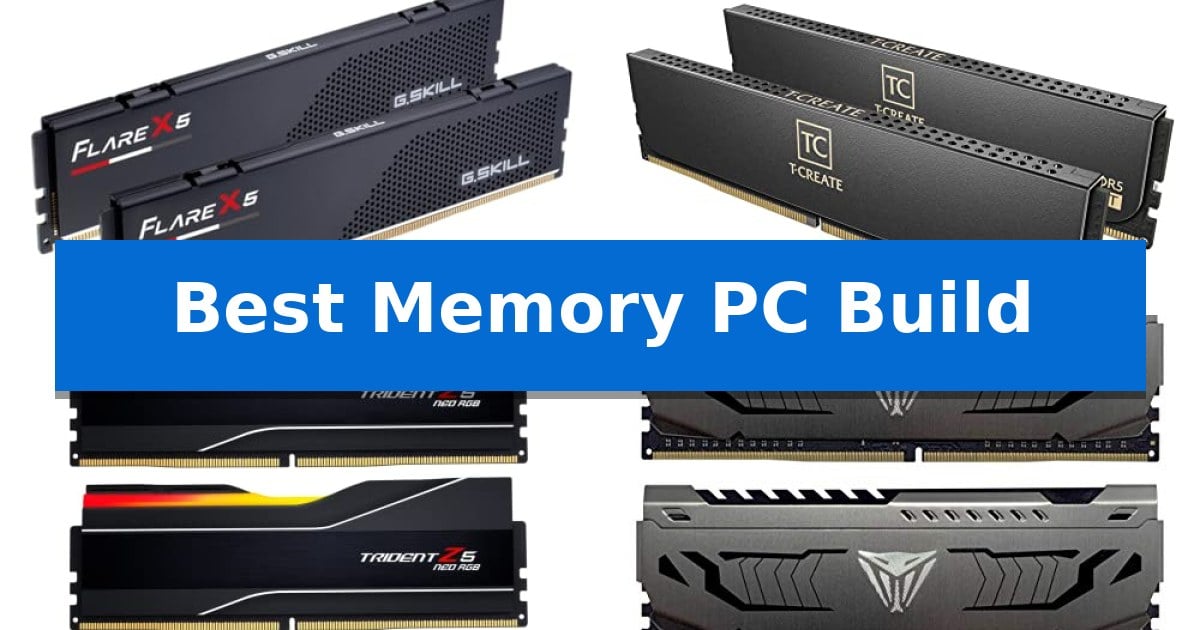
Building a high-performance computer requires careful selection of components, and finding the Best Memory PC Build is a critical step in ensuring system stability and speed. Whether you are upgrading an existing rig or assembling a new machine from scratch, your choice of RAM directly impacts how effectively your CPU handles demanding tasks, gaming, and multitasking.
The market currently features a mix of high-speed DDR5 modules and reliable DDR4 options, each serving different platform requirements. Our guide focuses on identifying the right balance of capacity, frequency, and compatibility to help you make an informed decision for your specific hardware configuration.
You may also want to compare Best Memory Latency for RAM, Best Memory for iMac Retina, and Best Memory Foam Gaming Headsets.
Best Memory PC Build
Quick Comparison
| Product | Best For | Key Strength | Score |
|---|---|---|---|
| G.SKILL Flare X5 DDR5 Memory | Best Overall | Optimized for AMD EXPO for simplified overclocking on supported platforms. | 4.9 |
| TEAMGROUP T-Create Expert DDR5 Memory | Optimized for Stable Overclocking | Stable overclocking support via Intel XMP 3.0 and AMD EXPO profiles. | 4.8 |
| G.SKILL Trident Z5 Neo RGB Memory | Aesthetic Build with AMD Optimization | AMD EXPO support for simplified overclocking on compatible platforms | 4.5 |
| Patriot Viper Steel DDR4 Memory | Reliable High-Capacity DDR4 Option | 64GB high-capacity kit for intensive multitasking. | 4.4 |
| CORSAIR Vengeance LPX DDR4 Memory | Low-Profile Clearance for Compact Builds | Low-profile 34mm height ensures compatibility with most compact cases and large CPU coolers. | 4.6 |
How We Chose
- Platform Compatibility: Verifying support for AMD EXPO or Intel XMP profiles to ensure seamless integration with your motherboard and CPU.
- Frequency and Latency: Evaluating rated MT/s speeds and CAS latency timings to balance raw throughput with responsive system performance.
- Form Factor and Clearance: Assessing physical dimensions, including heat spreader height, to ensure compatibility with various cooling solutions and case sizes.
- Build Quality and Thermal Management: Reviewing the design of heat spreaders and material construction for consistent heat dissipation during intensive workloads.
- Capacity and Configuration: Selecting kits that offer sufficient overhead for modern applications while maintaining stable dual-channel operation.
1 G.SKILL Flare X5 DDR5 Memory — High-Speed AMD Platform Performance
Selecting the right hardware for a high-performance system requires balancing speed with platform stability, and the G.SKILL Flare X5 Series DDR5 RAM is engineered specifically to meet these demands on modern AMD platforms. By integrating AMD EXPO memory overclocking profiles, this kit provides a streamlined path to achieving higher data rates on compatible X870, X670, B850, B840, and B650 motherboards.
This 32GB (2x16GB) DDR5 U-DIMM kit is designed for users who prioritize reliable, high-speed memory performance. It operates at speeds up to 6400MT/s with CL32-39-39-102 timing, though users should note that reaching these maximum speeds requires manual overclocking or BIOS adjustments. Performance is inherently tied to the capabilities of the specific CPU and motherboard paired with the kit.
The G.SKILL Flare X5 Series DDR5 RAM features a low-profile, matte black design that fits easily into most desktop builds without interfering with large air coolers. As a non-ECC memory solution, it is optimized for desktop PC and gaming environments. The kit includes a JEDEC default profile, ensuring the system will boot at standard speeds before any performance tuning is applied.
To maintain system integrity, it is essential to avoid mixing memory kits, as these are sold as matched sets designed for synchronized operation. Users should consult the official G.SKILL memory QVL or the RAM Configurator tool to verify hardware compatibility before installation. With a Limited Lifetime Manufacturer Warranty, this memory provides a stable foundation for demanding computing tasks.
Best for: Users building high-performance AMD-based desktop systems who want optimized memory profiles for easier overclocking.
Skip if: Users with Intel-based motherboards or those who prefer a plug-and-play experience without needing to enter the BIOS to configure overclocking profiles.
PROS
- Optimized for AMD EXPO for simplified overclocking on supported platforms.
- Low-profile matte black design ensures broad compatibility with large CPU coolers.
- Includes a Limited Lifetime Manufacturer Warranty for long-term peace of mind.
- High-speed 6400MT/s capability for demanding gaming and productivity workloads.
CONS
- Requires BIOS adjustments to reach advertised maximum speeds.
- Performance is strictly dependent on motherboard and CPU compatibility.
2 TEAMGROUP T-Create Expert DDR5 Memory — Optimized for Stable Overclocking
Maintaining system stability during demanding creative projects or intensive multitasking requires reliable, high-speed memory. The TEAMGROUP T-Create Expert DDR5 Memory is engineered specifically for these high-performance environments, utilizing a 32GB kit (2 x 16GB) configuration to provide the headroom necessary for modern professional workflows.
Built for precision, this DDR5-6000 memory operates at a CL30 latency. This low-latency specification is vital for responsiveness, as it minimizes the time the system spends waiting for data, which can be a significant advantage during complex rendering or data-heavy tasks. The module is fully compatible with Intel XMP 3.0 and AMD EXPO profiles, allowing users to achieve stable overclocking performance through straightforward BIOS adjustments.
The TEAMGROUP T-Create Expert DDR5 Memory utilizes a dual-channel architecture to maximize data throughput between the memory and the processor. Its physical design is notably compact, with a height of approximately 1.26 inches. This low-profile form factor ensures it fits comfortably in most standard desktop cases without interfering with large CPU air coolers, a common hurdle in high-end builds.
Backed by a lifetime warranty, this memory kit is a practical choice for users who prioritize long-term system integrity. Whether you are assembling a workstation for professional editing or a high-end gaming rig, the focus on stable overclocking ensures that your system remains consistent under load, providing a dependable foundation for your PC build.
Best for: Professional creators and power users requiring stable, high-speed DDR5 memory for intensive multitasking and overclocked workloads.
Skip if: Users with older motherboards that do not support DDR5 memory standards or those requiring specific aesthetic lighting features not present in this module.
PROS
- Stable overclocking support via Intel XMP 3.0 and AMD EXPO profiles.
- Low-latency CL30 performance for improved system responsiveness.
- Lifetime warranty provides long-term peace of mind.
- Dual-channel 32GB kit capacity suitable for modern demanding applications.
- Compact 1.26-inch height ensures broad compatibility with large CPU coolers.
CONS
- DDR5-only compatibility prevents use in older DDR4-based systems.
3 G.SKILL Trident Z5 Neo RGB Memory — Aesthetic Build with AMD Optimization
Building a high-performance system requires memory that balances speed with platform-specific stability. The G.SKILL Trident Z5 Neo RGB Series DDR5 RAM is engineered specifically for AMD platforms, featuring AMD EXPO memory overclocking profiles to streamline the tuning process on compatible motherboards. This 32GB kit provides a foundation for demanding tasks and gaming, utilizing a CL30-38-38-96 latency configuration to maintain efficient data throughput.
Designed for modern desktop builds, this DDR5 U-DIMM memory kit operates at speeds up to 6000MT/s. It is validated for use with a wide range of AMD platforms, including the X870, X670, B850, B650, and A620 chipsets. The module includes a JEDEC default profile, ensuring the system boots reliably at standard settings before users apply the optimized overclocking profile through the BIOS.
The physical design incorporates a matte black finish with integrated RGB lighting, allowing for aesthetic customization within a PC chassis. As a matched kit, these modules are designed to function as a unified set; the manufacturer explicitly advises against mixing kits to avoid stability issues or potential system failure. The memory is backed by a Limited Lifetime Manufacturer Warranty, providing long-term support for the build.
Achieving the rated performance requires proper BIOS configuration, as maximum speeds are dependent on the specific motherboard and CPU combination. Users should consult the G.SKILL memory QVL or the online configuration tool to verify compatibility with their specific hardware before installation. Proper setup ensures the memory operates within manufacturer specifications to prevent instability.
Best for: Users building an AMD-based desktop PC who want optimized memory performance through EXPO profiles.
Skip if: Users with Intel-based motherboards or those who do not intend to access the BIOS to enable overclocking profiles.
PROS
- AMD EXPO support for simplified overclocking on compatible platforms
- Tight CL30 latency for efficient data processing
- Matched kit design ensures stability when used as a set
- Integrated RGB lighting for aesthetic customization
CONS
- Requires BIOS adjustments to reach advertised speeds
- Performance is heavily dependent on specific CPU and motherboard compatibility
4 Patriot Viper Steel DDR4 Memory — Reliable High-Capacity DDR4 Option
High-capacity memory is a cornerstone for demanding workstations and multitasking environments, where system responsiveness hinges on available headroom. The Patriot Viper Steel DDR4 RAM 64GB (2X32GB) 3200MHz CL16 Desktop Memory offers a substantial 64GB total capacity, designed to provide the necessary overhead for memory-intensive applications and complex data sets.
Engineered with a focus on thermal management, the module features a specialized aluminum heat spreader that aids in dissipating heat during extended operation. This design choice ensures the memory maintains stability while handling heavy workloads, which is essential for maintaining system integrity in a high-performance Best Memory PC Build.
For users seeking simplified performance tuning, the kit includes XMP 2.0 support, allowing for automatic overclocking to reach its rated speeds without manual BIOS configuration. The modules are built as UDIMM units and have been rigorously tested across both Intel and AMD platforms to ensure broad compatibility and reliable operation.
With tested timings of 16-20-40 and a standard operating voltage of 1.35v, this memory kit balances speed with power efficiency. The Patriot Viper Steel DDR4 RAM provides a straightforward upgrade path for users looking to maximize their system's multi-tasking capabilities through a high-density, reliable memory solution.
Best for: Users requiring high-capacity memory for professional workstations, content creation, or heavy multitasking environments.
Skip if: Users with older motherboards that do not support DDR4 memory or those whose systems have limited physical clearance for heat spreaders.
PROS
- 64GB high-capacity kit for intensive multitasking.
- XMP 2.0 support for easy automatic overclocking.
- Aluminum heat spreader for effective thermal management.
- Broad compatibility tested across Intel and AMD platforms.
CONS
- DDR4 standard may not be compatible with newer DDR5-only motherboards.
- Heat spreader height may interfere with some low-profile CPU coolers.
5 CORSAIR Vengeance LPX DDR4 Memory — Low-Profile Clearance for Compact Builds
Building a compact system requires components that prioritize space efficiency without sacrificing performance, which is exactly where the CORSAIR Vengeance LPX DDR4 Memory excels. With a low-profile height of just 34mm, these modules are specifically engineered to fit into small-form-factor builds where larger, bulkier RAM sticks often encounter clearance issues with CPU coolers or chassis panels.
Beyond its physical footprint, this 32GB kit provides the necessary capacity for modern multitasking and demanding applications. The solid aluminum heatspreader is designed to dissipate heat efficiently, allowing the modules to maintain high clock speeds consistently during operation. This thermal management is crucial for maintaining system stability under sustained workloads.
The CORSAIR Vengeance LPX DDR4 Memory is built for reliability, featuring hand-sorted memory chips that offer generous overclocking headroom for users looking to push their system further. It is optimized for wide compatibility across the latest Intel and AMD DDR4 motherboards, simplifying the integration process for various PC configurations.
While the kit is rated for high performance, it is important to note that achieving maximum speed requires manual PC BIOS adjustments or the use of XMP profiles. This ensures that the memory operates at its full potential based on the specific capabilities of your motherboard and CPU combination.
Best for: Users building compact or small-form-factor PCs who need high-capacity memory with guaranteed physical clearance.
Skip if: Users who prioritize aesthetic features like integrated RGB lighting or those who require DDR5 memory for newer motherboard platforms.
PROS
- Low-profile 34mm height ensures compatibility with most compact cases and large CPU coolers.
- Solid aluminum heatspreader provides efficient thermal management for consistent performance.
- Hand-sorted memory chips offer reliable overclocking headroom.
- Wide compatibility with modern Intel and AMD DDR4 motherboards.
CONS
- Manual BIOS configuration is required to reach maximum rated speeds.
- DDR4 interface is not compatible with newer motherboards requiring DDR5.
Best Memory PC Build Buying Guide
Understanding Memory Standards
The most important decision in your Best Memory PC Build is choosing between DDR4 and DDR5. These standards are not interchangeable; your motherboard must have the specific slots required for the type of RAM you purchase. DDR5 is the current standard for modern platforms, offering higher bandwidth and improved power efficiency, while DDR4 remains a cost-effective, reliable choice for older or budget-conscious builds.
Always check your motherboard's Qualified Vendor List (QVL) to ensure the specific memory kit you choose has been validated for your board. This step is essential for achieving the advertised speeds and avoiding boot issues or system instability.
The Role of Frequency and Latency
Memory speed, measured in MT/s (MegaTransfers per second), determines how quickly data can be accessed. However, speed must be balanced with CAS Latency (CL), which represents the delay between a command being sent and the data being available. A kit with high frequency but very loose timings may not perform better than a slightly slower kit with tighter, more responsive timings.
For most users, finding the 'sweet spot'—where the frequency is high enough to satisfy the CPU's memory controller without sacrificing stability—is the goal. Modern platforms often have a specific frequency range where they perform most efficiently.
Thermal Management and Physical Fit
High-performance memory generates heat, especially when running at overclocked profiles like AMD EXPO or Intel XMP. A robust aluminum heat spreader is vital for dissipating this heat and maintaining performance during prolonged heavy usage. Without adequate cooling, memory can throttle, leading to reduced performance or system crashes.
Physical clearance is another often-overlooked factor. If you are using a large air cooler for your CPU, ensure your memory modules are low-profile enough to fit underneath the fan assembly. Low-profile memory is specifically designed to prevent these clearance conflicts in compact cases.
Capacity for Your Workload
For a modern gaming or general productivity PC, 32GB (2x16GB) is currently the recommended capacity. It provides enough headroom for multitasking, background applications, and modern titles without the need for immediate upgrades. While 16GB may suffice for basic tasks, it can become a bottleneck in more intensive environments.
If you are involved in professional video editing, 3D rendering, or running virtual machines, you may consider 64GB or more. Always prioritize installing memory in matched kits to ensure the modules are tested to work together, which significantly reduces the risk of compatibility errors.
Stability and Overclocking
Memory kits rarely run at their advertised speeds automatically; they typically default to a slower JEDEC speed upon first boot. To reach the rated performance, you must enable the XMP or EXPO profile in your BIOS. This process applies the manufacturer's tested settings for voltage, frequency, and timings.
Stability is paramount. If you experience crashes or blue screens, it may be due to the memory profile being pushed beyond what your CPU's memory controller can handle. Always update your motherboard's BIOS to the latest version, as this often includes improved memory compatibility and stability patches.
Frequently Asked Questions
Can I mix different memory kits?
It is strongly recommended to avoid mixing memory kits, even if they have the same brand and model. Memory kits are sold as matched sets tested for stability together. Mixing them can lead to system instability or failure to boot.
What is the difference between AMD EXPO and Intel XMP?
These are both memory overclocking profiles. AMD EXPO is specifically optimized for AMD Ryzen platforms, while Intel XMP is designed for Intel Core processors. Using the correct profile for your platform ensures the best compatibility.
Does higher RAM speed always mean better performance?
Not necessarily. While higher speed increases bandwidth, it must be balanced with latency. Additionally, your CPU's memory controller has a limit; if you exceed that limit, the system may become unstable or revert to slower speeds.
What happens if I don't enable XMP/EXPO in the BIOS?
If you do not enable the profile, your memory will run at its default JEDEC speed, which is usually significantly lower than the speed advertised on the box. You must enter the BIOS to activate the profile for full performance.
Why is my memory height important?
Memory height is critical if you are using a large air-cooled CPU heatsink. If the RAM modules are too tall, they may physically interfere with the CPU cooler, making it impossible to install the fan or close the case properly.
Conclusion: Our Top Pick
Selecting the right memory is a foundational part of any PC build. By prioritizing platform compatibility, thermal management, and the correct capacity for your specific workload, you ensure that your system runs reliably and efficiently for years to come.
For those seeking a balance of high-speed performance and platform-specific optimization, the G.SKILL Flare X5 DDR5 Memory stands out as an excellent choice. Its design is specifically tailored for AMD platforms, ensuring that you can easily leverage its high-speed capabilities through the AMD EXPO profile. While it requires a compatible motherboard and CPU to reach its full potential, it provides the stability and performance necessary for a high-end build.