
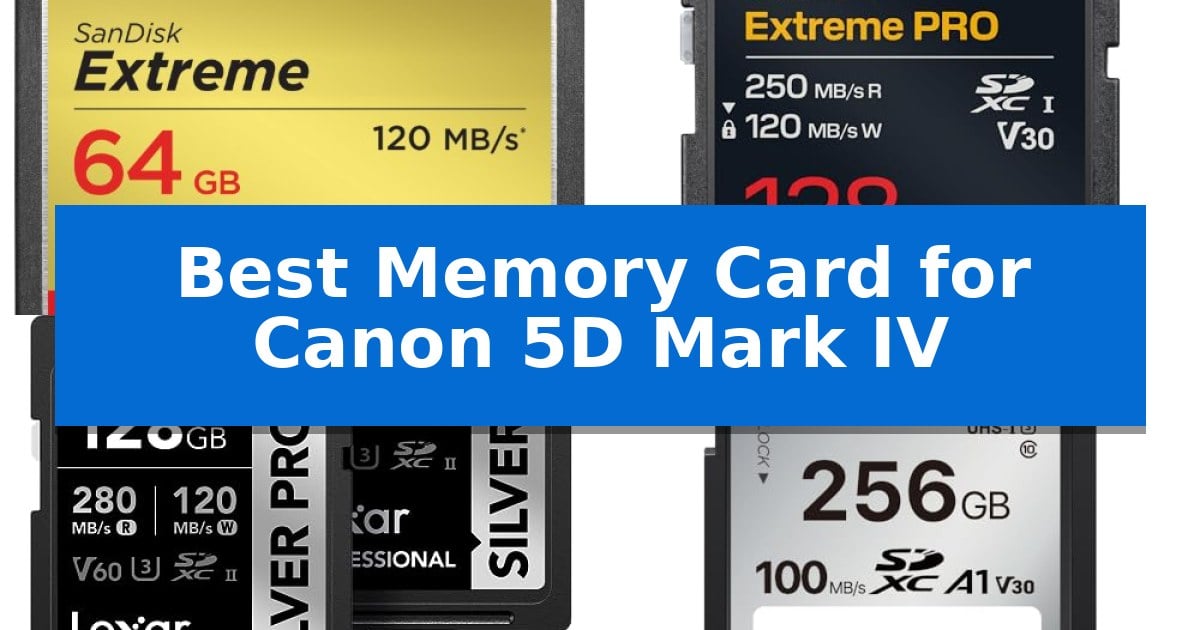
Selecting the right storage media is critical for maintaining the performance of your camera during demanding shoots. The Best Memory Card for Canon 5D Mark IV must balance high-speed data transfer with the reliability required for capturing high-resolution RAW files and 4K video footage without interruption.
Our guide examines five storage solutions that cater to the specific interface requirements of the 5D Mark IV. By understanding how different cards handle buffer clearing and sustained write speeds, you can ensure your equipment remains ready for the next shot, whether you are in the studio or out in the field.
You may also want to compare Best Memory Card for Canon 5D Mark II, Best Memory Card for Canon 5D, and Best Memory Card for Canon 1DX.
Best Memory Card for Canon 5D Mark IV
Quick Comparison
| Product | Best For | Key Strength | Score |
|---|---|---|---|
| SanDisk Extreme CompactFlash Memory Card | Best Overall | UDMA 7 interface for high-speed data transfer | 4.9 |
| SanDisk Extreme PRO SD UHS-I Card | Reliable secondary slot performance | U3 and V30 speed class ratings for reliable 4K UHD video capture. | 4.6 |
| Lexar SILVER PRO SD Card | Fast offloading for professional workflows | Blazing-fast read speeds up to 280MB/s for rapid workflow acceleration. | 4.9 |
| Gigastone 4K Camera Pro SD Card | Budget-friendly high-capacity option | High-capacity 256GB storage suitable for extensive photo and video sessions. | 4.4 |
| HSANYIUR UDMA CF Card | Alternative high-speed buffer support | 128GB high-capacity storage for extended shooting sessions. | 4.5 |
How We Chose
- Interface Compatibility: Ensuring the card matches the CF (UDMA 7) or SD (UHS-I) slots of the camera.
- Sustained Write Performance: Evaluating the card's ability to handle high-bitrate video and rapid burst photography.
- Data Transfer Efficiency: Assessing read speeds to minimize downtime when offloading files to a computer.
- Environmental Resilience: Checking for built-in protections against shock, vibration, and temperature fluctuations.
1 SanDisk Extreme CompactFlash Memory Card — Essential for primary high-speed storage
The SanDisk 64GB Extreme CompactFlash Memory Card is engineered for high-performance photography, utilizing the UDMA 7 interface to achieve read speeds of up to 120MB/s and write speeds of up to 85MB/s. This card is specifically built to handle the rigorous demands of professional-grade imaging, ensuring that your camera can keep up with rapid-fire shooting sequences without bottlenecking.
For videographers, the card features VPG-20 (Video Performance Guarantee) support, which maintains a sustained data recording rate of 20MB/s. This ensures a smooth and unbroken video stream, preventing dropped frames during critical recording sessions. The card is designed with a durable construction, including an RTV silicone coating that provides enhanced protection against shock and vibration, making it a reliable choice for field work.
When using this card with a Canon 5D Mark IV, you benefit from the balance of high-speed data transfer and physical resilience. The UDMA 7 standard is well-suited for the file sizes generated by high-resolution sensors, allowing for efficient workflow from the camera to your computer. Its robust build quality is intended to withstand the stresses of frequent handling and environmental factors encountered during professional shoots.
While the card provides substantial performance, it is important to note that it is a CompactFlash format. Users should ensure their specific camera body supports this interface, as it is distinct from modern SD or CFexpress standards. With a 64GB capacity, it offers a practical middle ground for photographers who need sufficient storage for high-resolution RAW files without requiring constant swapping.
Best for: Professional photographers and videographers requiring reliable, high-speed storage for demanding shooting environments.
Skip if: Users who require the faster transfer speeds and different physical form factors of CFexpress or SD-based storage systems.
PROS
- UDMA 7 interface for high-speed data transfer
- VPG-20 certification for consistent video recording
- RTV silicone coating for shock and vibration resistance
CONS
- CompactFlash form factor is not compatible with SD-only or CFexpress-only camera slots
2 SanDisk Extreme PRO SD UHS-I Card — Reliable secondary slot performance
Reliable storage is essential for the Canon 5D Mark IV, particularly when handling high-resolution stills and 4K video. The SanDisk 128GB Extreme PRO SD UHS-I Card provides a robust solution for photographers who prioritize data integrity and consistent performance during demanding shoots. Its design is engineered to be unrelentingly resilient, ensuring that the card performs reliably in extreme conditions, even when subjected to rough handling or constant use in the field.
With video speed class ratings of U3 and V30, this card is optimized for capturing 4K UHD brilliance, ensuring your camera's buffer can keep pace with high-resolution workflows. These ratings guarantee a minimum sustained write speed, which is critical for preventing dropped frames during video recording. For photographers, the 128GB capacity offers a practical balance between storage space and portability, allowing for extended shooting sessions without the need for frequent card swaps.
The card supports read speeds up to 250MB/s, which significantly streamlines the process of transferring large files to a desktop or laptop. This efficiency is further supported by the SanDisk Memory Zone desktop app, which helps users organize and back up data effectively. Whether you are using an integrated SD slot or an external card reader, the card is designed to integrate seamlessly into professional workflows.
Backed by a Lifetime Limited warranty, this card provides long-term assurance for professional and enthusiast gear setups. It serves as a dependable tool for those who require consistent performance and durability from their storage media, ensuring that your captured content remains secure throughout your creative process.
Best for: Photographers and videographers using the Canon 5D Mark IV who require a durable, high-capacity storage solution for 4K video and high-resolution still photography.
Skip if: Users who require the absolute fastest write speeds for continuous high-speed burst shooting may find a UHS-II card more suitable for their specific workflow.
PROS
- U3 and V30 speed class ratings for reliable 4K UHD video capture.
- Resilient design engineered to perform in extreme conditions.
- Fast read speeds up to 250MB/s for efficient file transfers.
- Lifetime Limited warranty for long-term peace of mind.
CONS
- UHS-I interface may be a bottleneck for users requiring the extreme write speeds of UHS-II cards.
3 Lexar SILVER PRO SD Card — Fast offloading for professional workflows
Capturing high-resolution media with a Canon 5D Mark IV requires a storage solution that keeps pace with demanding data rates. The Lexar 128GB 2-Pack SILVER PRO SD Card utilizes the UHS-II interface to provide the necessary throughput for professional workflows where efficiency is paramount.
These cards feature transfer speeds of up to 280MB/s read and 120MB/s write. This capability allows photographers and videographers to offload large files to computers or editing software in seconds, significantly reducing downtime between shoots. The high-speed performance is specifically engineered to handle high-resolution 4K UHD and 1080p Full-HD video, ensuring consistent data recording without dropped frames or buffering.
The V60 and U3 speed classes provide the sustained performance required for reliable video capture, making these cards a dependable choice for mirrorless and DSLR cameras. For photographers who use multiple devices, these cards offer hassle-free compatibility; they are backwards-compatible with UHS-I devices, ensuring they function across a range of existing camera gear and card readers.
Each card is backed by a lifetime limited warranty and includes access to the Lexar Recovery Tool for added peace of mind. By choosing this 2-pack, professionals can maintain a reliable backup or expand their storage capacity for extended field sessions, ensuring that high-capacity, high-speed SDXC storage is always available when needed.
Best for: Professional photographers and videographers who require high-speed, reliable UHS-II storage for 4K video capture and rapid file offloading.
Skip if: Users who only require basic storage for low-resolution photography and do not need the high-speed benefits or the UHS-II interface.
PROS
- Blazing-fast read speeds up to 280MB/s for rapid workflow acceleration.
- V60 and U3 rated for stable 4K UHD video capture.
- Backwards-compatible with UHS-I devices for versatile use.
- Lifetime limited warranty included for long-term reliability.
CONS
- Higher cost compared to standard UHS-I cards that may suffice for casual use.
4 Gigastone 4K Camera Pro SD Card — Budget-friendly high-capacity option
Capturing high-resolution imagery with the Canon 5D Mark IV requires a reliable storage medium capable of handling intensive data throughput. The Gigastone 4K Camera Pro SD Card provides a robust solution for photographers, offering UHS-I A1 V30 performance standards that ensure consistent write speeds for demanding 4K UHD video recording and rapid-fire burst photography.
Engineered for versatility, this 256GB SDXC memory card is designed to withstand harsh environments. Its construction is waterproof, temperature-proof, x-ray-proof, shock-proof, and magnetic-proof, providing peace of mind when shooting in unpredictable outdoor conditions. The inclusion of a protective mini case further aids in keeping the card secure during transit between shoots.
With data transfer speeds reaching up to 170 MB/s, this card facilitates efficient workflow management, allowing for faster offloading of large files to a PC. It is fully compatible with a wide range of devices, including HD camcorders and DSLR cameras, making it a flexible addition to any professional or enthusiast kit.
To support long-term reliability, the product includes a 5-year limited warranty. This coverage reflects the manufacturer's commitment to quality, ensuring that your investment in storage remains protected for years of regular use.
Best for: Photographers and videographers needing a high-capacity, durable storage solution for 4K video and high-resolution burst shooting.
Skip if: Users requiring the extreme write speeds of UHS-II or CFexpress cards for specialized professional cinema workflows should consider higher-tier alternatives.
PROS
- High-capacity 256GB storage suitable for extensive photo and video sessions.
- Ruggedized design featuring waterproof, shock-proof, and x-ray-proof protection.
- UHS-I V30 rating ensures stable performance for 4K UHD video recording.
- 5-year limited warranty provides long-term manufacturer support.
CONS
- UHS-I interface may be a bottleneck for users requiring the fastest possible clearing times for massive RAW file buffers.
5 HSANYIUR UDMA CF Card — Alternative high-speed buffer support
Capturing high-bitrate 4K video and rapid burst sequences requires a storage medium that can keep pace with your camera's buffer. The HSANYIUR UDMA CF Card is engineered specifically for these demanding professional workflows, offering read speeds up to 160MB/s to ensure your data transfers are efficient and your shooting remains uninterrupted.
With a generous 128GB capacity, this card allows for extended sessions without the need to swap media, making it a practical choice for weddings, travel, and long-form events. It is built to be a reliable companion in the field, featuring waterproof, shockproof, and extreme temperature resilience to protect your footage against environmental challenges.
The card complies with the VPG standard, which supports consistent video performance and sustained write speeds. This prevents the slowdowns that can occur during high-bitrate recording, ensuring that your Canon 5D Mark IV maintains its performance during intensive tasks. Its design also allows for seamless switching between different professional camera ecosystems.
When integrating this card into your setup, it is important to verify your specific device’s compatibility with 128GB CompactFlash cards. By utilizing premium materials, the card provides a stable foundation for data transfer, helping you focus on the composition rather than the technical limitations of your storage.
Best for: Professional photographers and videographers who need high-capacity, durable storage for 4K video and rapid burst photography.
Skip if: Users whose specific camera model or firmware does not support 128GB CompactFlash card capacities.
PROS
- 128GB high-capacity storage for extended shooting sessions.
- VPG standard compliance for consistent video write speeds.
- Ruggedized design including waterproof and shockproof protection.
- 160MB/s read speeds for efficient file offloading.
CONS
- Compatibility verification required for older camera firmware.
Best Memory Card for Canon 5D Mark IV Buying Guide
Understanding Memory Card Interfaces
The Canon 5D Mark IV features dual card slots: one for CompactFlash (CF) and one for SD cards. The CF slot supports UDMA 7 technology, which is essential for maximizing the camera's burst rate and handling large RAW files efficiently. Using a card that does not meet these standards can lead to a bottleneck in your workflow.
The SD slot is compatible with UHS-I standards. While these cards are versatile and widely available, they generally offer lower write speeds compared to high-end CF cards. It is often best to use the CF slot for primary, high-speed storage and the SD slot for secondary backups or overflow.
The Importance of Sustained Write Speeds
Sustained write speed is the minimum speed at which a card can write data without dropping frames or pausing. This is particularly important for video recording, where a drop in speed can cause the camera to stop recording abruptly. Look for cards with VPG (Video Performance Guarantee) ratings to ensure consistent performance.
For photographers, high write speeds are necessary to clear the camera's buffer quickly during continuous shooting. A faster card allows you to keep shooting longer before the camera slows down to write the data to the card, which is vital for sports, wildlife, and event photography.
Evaluating Durability and Reliability
Professional photography often takes place in unpredictable environments. Memory cards should be engineered to withstand physical stress, including shock, vibration, and extreme temperatures. Cards with protective coatings or reinforced housings provide an extra layer of security for your captured data.
Reliability also extends to data recovery. Some manufacturers include proprietary software or recovery tools that can help salvage files in the event of accidental deletion or card corruption. Always verify the warranty terms and support services offered by the brand.
Capacity Considerations
Choosing the right capacity depends on your file format and shooting volume. Shooting in RAW format generates large files that fill cards quickly, while 4K video consumes storage at an even faster rate. A 64GB or 128GB card is often a balanced choice for many professionals.
Using multiple smaller cards is a common strategy to mitigate the risk of data loss. If one card fails, you only lose a portion of your work rather than the entire shoot. However, ensure that all cards you carry meet the minimum speed requirements for your camera's settings.
Workflow Efficiency
The time spent transferring files from your card to your computer is a significant part of the post-production process. Cards with high read speeds significantly reduce this time, allowing you to start editing or backing up your images sooner.
Investing in a high-quality card reader that matches the interface of your memory card is just as important as the card itself. A slow reader can negate the benefits of a fast card, creating a bottleneck that slows down your entire post-processing workflow.
Frequently Asked Questions
Can I use an SD card for 4K video on the 5D Mark IV?
Yes, but ensure the SD card meets the necessary speed class requirements, such as U3 or V30, to handle the data rate of 4K video recording.
Why is my camera buffer filling up so quickly?
This usually happens when the memory card's write speed is slower than the camera's data output. Using a faster CF card with UDMA 7 support can help clear the buffer more efficiently.
Are all CF cards compatible with the 5D Mark IV?
The camera is designed for UDMA 7 CF cards. While older cards might work, they will not provide the performance needed for high-resolution bursts or 4K video.
Should I use the SD or CF slot for primary storage?
The CF slot is generally recommended for primary storage because it supports faster UDMA 7 speeds, which are better suited for the camera's high-performance requirements.
How often should I format my memory cards?
It is best practice to format your memory cards in the camera after you have successfully backed up your files to a computer to ensure the file system remains clean and compatible.
Conclusion: Our Top Pick
## Conclusion: Our Top Pick
For photographers seeking the most reliable performance, the SanDisk Extreme CompactFlash Memory Card stands out as the essential choice for primary high-speed storage. Its support for UDMA 7 and VPG-20 ensures that it can handle the demanding write requirements of the Canon 5D Mark IV, providing the stability needed for both rapid burst photography and consistent video recording. Its durable design, backed by rigorous testing, makes it a dependable tool for professional workflows where data integrity is paramount.