
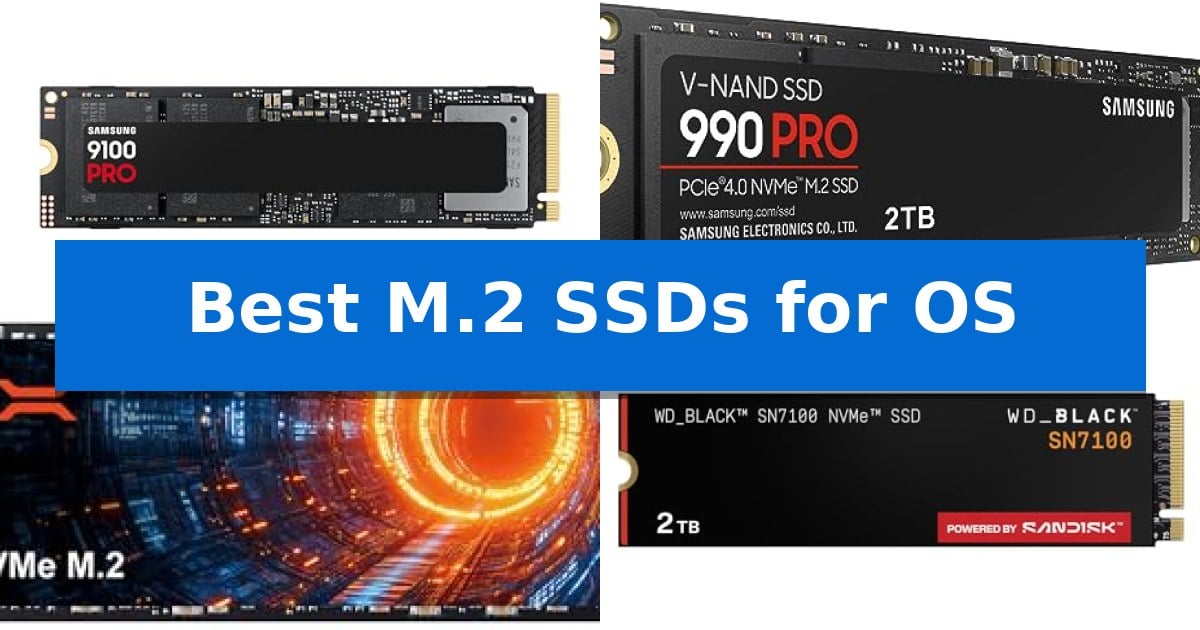
A slow operating system can bottleneck even the most powerful hardware, turning simple tasks into frustrating waits. Choosing the Best M.2 SSDs for OS is the most effective way to ensure rapid boot times, snappy application launches, and a fluid computing experience.
Whether you are building a high-performance workstation for creative projects or upgrading a gaming rig, the right drive makes a measurable difference. We have analyzed current NVMe options to help you select a storage solution that balances interface speed, thermal management, and long-term system stability.
You may also want to compare Best M.2 SSDs for NAS, Best M.2 SSDs for Gaming, and Best M.2 SSDs.
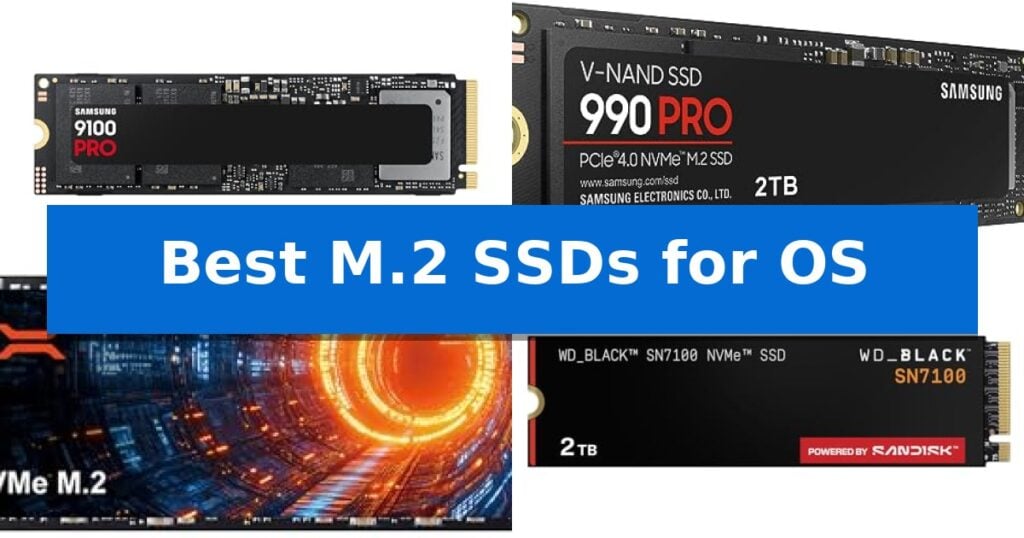
Best M.2 SSDs for OS
Quick Comparison
| Product | Best For | Key Strength | Score |
|---|---|---|---|
| Samsung 9100 PRO NVMe SSD | Best Overall | Industry-leading PCIe 5.0 performance with speeds up to 14,700 MB/s. | 4.9 |
| Samsung 990 PRO NVMe SSD | Reliable High-Performance Standard | High-speed PCIe 4.0 performance with read/write speeds up to 7,450/6,900 MB/s. | 4.7 |
| SIX X7400 NVMe SSD | Fast Bootups for Gamers | High-speed PCIe Gen4x4 interface reaching up to 7350MB/s. | 4.3 |
| SANDISK WD_Black SN7100 NVMe SSD | Power-Efficient System Drive | High-speed PCIe Gen4 interface for rapid data transfer. | 4.7 |
| fanxiang S501Q NVMe SSD | Budget-Friendly System Upgrade | Includes graphene heat dissipation stickers for thermal management. | 4.8 |
How We Chose
- Interface Compatibility: Verifying PCIe generation support to ensure the drive matches your motherboard's capabilities.
- Sequential Throughput: Assessing read and write speeds to determine how quickly the OS handles large file operations.
- Thermal Management: Evaluating integrated heat dissipation features or controller efficiency to prevent performance throttling.
- Reliability Metrics: Considering manufacturer-stated endurance and warranty coverage for long-term data integrity.
- Power Efficiency: Analyzing power consumption profiles for compatibility with laptops and compact desktop builds.
1 Samsung 9100 PRO NVMe SSD — Unmatched Gen5 Speed for OS
The Samsung 9100 PRO NVMe SSD utilizes cutting-edge PCIe 5.0 technology to deliver sequential read speeds up to 14,700 MB/s, offering a significant leap in data throughput for demanding system environments. By integrating a 5nm controller, this drive achieves up to 49% better power efficiency than its predecessor, ensuring that high-speed operation remains thermally stable during intensive tasks like AI processing or heavy-duty workstation workflows.
Designed for versatility, the drive supports capacities up to 8TB, providing substantial headroom for expansive game libraries and massive creative project files. The inclusion of Samsung Magician Software allows users to maintain optimal drive health through firmware updates, encryption management, and real-time monitoring, ensuring the hardware remains reliable over its lifespan.
This drive is engineered for those who require consistent, high-speed performance for their operating system and primary applications. Its compatibility spans across desktop PCs and PS5 consoles—provided an appropriate heatsink is utilized—making it a flexible choice for users looking to eliminate storage bottlenecks in their current setup.
While the Samsung 9100 PRO NVMe SSD offers industry-leading speeds, users should ensure their motherboard supports the PCIe 5.0 interface to fully realize the drive's potential. Those operating on older systems with PCIe 3.0 or 4.0 slots may not see the full performance benefits, making this a specialized choice for modern, high-performance builds.
Best for: Power users, AI developers, and gamers who require maximum PCIe 5.0 throughput for their operating system and high-demand applications.
Skip if: Users with older motherboards lacking PCIe 5.0 support or those who do not require extreme sequential read/write speeds for their daily computing tasks.
PROS
- Industry-leading PCIe 5.0 performance with speeds up to 14,700 MB/s.
- High power efficiency via an advanced 5nm controller.
- Massive storage capacity options reaching up to 8TB.
- Comprehensive drive management through Samsung Magician Software.
CONS
- Requires PCIe 5.0 compatibility to achieve advertised maximum speeds.
- Thermal management considerations necessary for peak performance.
2 Samsung 990 PRO NVMe SSD — Reliable High-Performance Standard
Optimizing system responsiveness often begins with the storage drive, and the Samsung 990 PRO NVMe SSD is engineered to handle demanding OS tasks through its high-performance PCIe 4.0 interface. By leveraging advanced flash memory technology, this drive achieves read and write speeds up to 7,450/6,900 MB/s, providing the bandwidth necessary for heavy-duty workstations and high-end computing environments.
Beyond raw speed, this drive emphasizes efficiency, delivering up to 50% improved performance per watt compared to its predecessor. This power efficiency allows the drive to maintain sustained performance during intensive data analysis or video editing sessions without excessive consumption, making it a practical choice for users who prioritize both speed and thermal management in their primary OS drive.
The Samsung 990 PRO NVMe SSD is available in capacities ranging from 1TB to 4TB, offering flexibility for various storage requirements. Its standard M.2 2280 form factor ensures compatibility with most modern motherboards, while the inclusion of a 5-year manufacturer warranty provides long-term support for your primary system storage.
While the drive is designed for high-performance scenarios, users should ensure their motherboard supports PCIe 4.0 to fully realize the potential transfer speeds. This drive is a robust solution for those seeking a reliable, high-speed foundation for their operating system and critical applications.
Best for: High-end computing, gaming, and heavy-duty workstations requiring fast OS boot times and high-performance data throughput.
Skip if: Users with older motherboards limited to PCIe 3.0 or those primarily performing light office tasks where the performance benefits of Gen4 speeds are not required.
PROS
- High-speed PCIe 4.0 performance with read/write speeds up to 7,450/6,900 MB/s.
- Improved power efficiency offering up to 50% better performance per watt.
- Versatile capacity options ranging from 1TB to 4TB.
- 5-year manufacturer warranty for long-term reliability.
CONS
- Requires PCIe 4.0 compatibility to reach maximum rated speeds.
- Premium positioning may exceed requirements for basic system builds.
3 SIX X7400 NVMe SSD — Fast Bootups for Gamers
Upgrading your primary drive is one of the most effective ways to improve system responsiveness and game load times. The SIX X7400 NVMe SSD is engineered to handle these high-demand tasks by utilizing a PCIe Gen4x4 interface, which enables read speeds of up to 7350MB/s.
Designed for versatility, this drive is compatible with laptops, desktop PCs, and the PlayStation 5. Its inclusion of a dedicated heatsink is a notable design choice, helping to manage thermal output during intensive data operations or prolonged gaming sessions. This ensures that the drive maintains consistent performance without the risk of thermal throttling.
Beyond raw speed, the SIX X7400 NVMe SSD is built to support heavy-duty applications, including data analytics and content creation. The manufacturer claims up to a 40% increase in performance for these demanding workloads compared to standard storage solutions, making it a practical choice for users who require reliable, high-bandwidth storage.
Installation is straightforward, as the package includes all necessary components such as screws, screwdrivers, and the heatsink. To provide long-term peace of mind, the drive is backed by a 5-year limited warranty, covering the hardware against defects and ensuring the longevity of your storage investment.
Best for: Gamers and power users looking to expand their storage capacity on a PS5, desktop, or laptop with high-speed PCIe 4.0 performance.
Skip if: Users with older systems limited to PCIe 3.0 interfaces will not be able to utilize the full speed potential of this Gen4 drive.
PROS
- High-speed PCIe Gen4x4 interface reaching up to 7350MB/s.
- Includes a pre-installed heatsink for thermal management.
- Broad compatibility with PS5, desktop, and laptop systems.
- Comprehensive 5-year limited warranty for long-term reliability.
CONS
- Requires a PCIe 4.0 compatible slot to achieve advertised speeds.
4 SANDISK WD_Black SN7100 NVMe SSD — Power-Efficient System Drive
The SANDISK WD_Black SN7100 NVMe SSD is engineered for users who require high-performance storage for operating systems, specifically within laptops and handheld gaming devices. By utilizing a PCIe Gen4 interface and next-generation TLC 3D NAND, this drive provides a significant upgrade path for systems demanding faster data access and improved power efficiency.
Designed with portability in mind, this 2TB drive focuses on balancing speed with power consumption. It delivers read speeds up to 7,250 MB/s and write speeds reaching 6,900 MB/s, which helps reduce load times for demanding applications. The inclusion of up to 100% more power efficiency compared to previous generations makes it a practical choice for battery-operated hardware where thermal management and energy usage are critical.
To maintain peak performance, the drive integrates with the WD_BLACK Dashboard software, allowing Windows users to monitor drive health and optimize settings. The M.2 2280 form factor ensures broad compatibility with most modern laptops and handheld consoles that support standard NVMe storage upgrades.
While this drive offers substantial performance gains, users should note that the WD_BLACK Dashboard is limited to Windows environments. As a high-performance Gen4 component, it is best suited for devices that can fully leverage the PCIe Gen4 interface to avoid potential bottlenecks in legacy systems.
Best for: Serious gamers and mobile users looking to upgrade their laptop or handheld gaming device storage with a power-efficient, high-speed Gen4 NVMe SSD.
Skip if: Users operating non-Windows systems or devices that do not support the PCIe Gen4 interface, as they will not be able to utilize the drive's full speed potential or the WD_BLACK Dashboard software.
PROS
- High-speed PCIe Gen4 interface for rapid data transfer.
- Significant power efficiency improvements for better battery life in mobile devices.
- Robust 2TB capacity using next-gen TLC 3D NAND technology.
- Optimized management via the WD_BLACK Dashboard software.
CONS
- WD_BLACK Dashboard software is exclusive to Windows.
- Performance benefits are dependent on PCIe Gen4 hardware compatibility.
5 fanxiang S501Q NVMe SSD — Budget-Friendly System Upgrade
Upgrading your primary storage to an M.2 NVMe drive is one of the most effective ways to improve system responsiveness, and the fanxiang S501Q NVMe SSD offers a balanced entry point for this transition. By utilizing 3D NAND technology and an intelligent SLC cache, this drive is engineered to accelerate boot times, program launches, and file transfers for both laptops and desktops.
The fanxiang S501Q NVMe SSD prioritizes thermal management through the inclusion of graphene heat dissipation stickers. This design choice helps maintain consistent performance during sustained workloads, contributing to an endurance rating of up to 320TBW. Because it lacks internal mechanical parts, it also provides improved shock resistance compared to traditional hard drives.
Compatibility is a primary focus for this drive, as it supports Windows 7, 8, 10, 11, and Mac OS 10.9 or later. Installation is straightforward, with the manufacturer including the necessary installation screws and screwdrivers in the package. The drive is backed by a 3-year manufacturer warranty, providing long-term support for your OS drive upgrade.
When selecting an M.2 drive for an operating system, balancing speed with thermal stability is essential. The fanxiang S501Q NVMe SSD delivers read speeds up to 3200 MB/s and write speeds up to 1750 MB/s, making it a practical choice for users looking to replace aging storage without requiring complex cooling setups.
Best for: Users seeking a reliable, budget-friendly NVMe M.2 upgrade for general computing and OS installation.
Skip if: Users requiring high-end PCIe 4.0 or 5.0 speeds for intensive professional video editing or large-scale data production.
PROS
- Includes graphene heat dissipation stickers for thermal management.
- High-speed performance with intelligent SLC cache technology.
- Includes installation tools for immediate setup.
- Reliable 3D NAND technology with 320TBW endurance.
CONS
- Limited to PCIe 3.0×4 interface speeds.
Best M.2 SSDs for OS Buying Guide
Understanding PCIe Generations
The PCIe interface is the primary determinant of your SSD's speed. PCIe 5.0 drives offer the highest theoretical bandwidth, making them ideal for heavy-duty workstations, while PCIe 4.0 remains the standard for most gaming and productivity systems.
Before purchasing, check your motherboard's specifications. While most M.2 slots are backward compatible, you will only achieve the advertised speeds if your system supports the specific PCIe generation of the drive.
Capacity for OS Drives
For an operating system drive, capacity impacts more than just storage space. Modern NAND flash memory often performs better with more available room, as it allows the controller to manage wear leveling and background tasks more effectively.
We recommend at least 1TB for a primary OS drive to accommodate the OS, essential applications, and a buffer for system updates. If you work with large media files, 2TB or higher is preferable to avoid frequent cleanup.
Thermal Control and Heatsinks
High-speed NVMe drives generate significant heat during sustained operations. Many modern drives include integrated heatsinks or thermal-conductive labels to maintain stable performance.
If your motherboard lacks built-in M.2 heatsinks, prioritize drives that come with a factory-installed cooling solution. Proper thermal management prevents the drive from slowing down during intensive tasks like system updates or large file transfers.
Endurance and Longevity
The lifespan of an SSD is often measured in TBW (Total Bytes Written). This metric indicates how much data can be written to the drive before the flash memory cells reach their expected limit.
For an OS drive, which constantly performs background read/write operations, a higher TBW rating is a strong indicator of long-term reliability. Always check the manufacturer's warranty to understand the level of support provided.
Form Factor Compatibility
The M.2 2280 form factor is the industry standard for most desktops and laptops. It refers to the physical dimensions of the drive, specifically 22mm wide by 80mm long.
Ensure your device has an available M.2 slot and sufficient clearance for the drive's thickness, especially if you are using a drive with an aftermarket or bulky heatsink.
Frequently Asked Questions
Can I use a PCIe 5.0 SSD in a PCIe 4.0 slot?
Yes, M.2 SSDs are generally backward compatible. However, the drive will be limited to the maximum speed supported by your motherboard's PCIe 4.0 slot.
Do I need a heatsink for my OS drive?
If your motherboard does not have a built-in M.2 heatsink, it is highly recommended to use a drive that includes one, especially for high-performance PCIe 4.0 or 5.0 models to prevent thermal throttling.
How much storage do I need for Windows 11?
While Windows 11 requires less than 100GB, we recommend at least 500GB to 1TB for an OS drive to ensure smooth performance and enough room for software and future updates.
What is the difference between NVMe and SATA M.2 SSDs?
NVMe drives use the PCIe bus for much faster data transfer speeds compared to the older SATA interface, which is significantly slower and less efficient for modern operating systems.
Does the SSD speed affect boot time?
Yes, a faster NVMe SSD will significantly reduce the time it takes for your operating system to load, as it allows the system to read boot files and drivers much more quickly.
Conclusion: Our Top Pick
For users seeking the absolute highest performance for their operating system, the Samsung 9100 PRO NVMe SSD stands out due to its cutting-edge PCIe 5.0 interface and advanced thermal control. It provides the necessary speed for demanding AI applications and heavy-duty workstations while maintaining power efficiency.
While this drive is an excellent choice for future-proofing your system, ensure your motherboard supports PCIe 5.0 to fully utilize its capabilities. For those on older platforms, a high-quality PCIe 4.0 drive remains a reliable and highly effective upgrade for daily computing.