
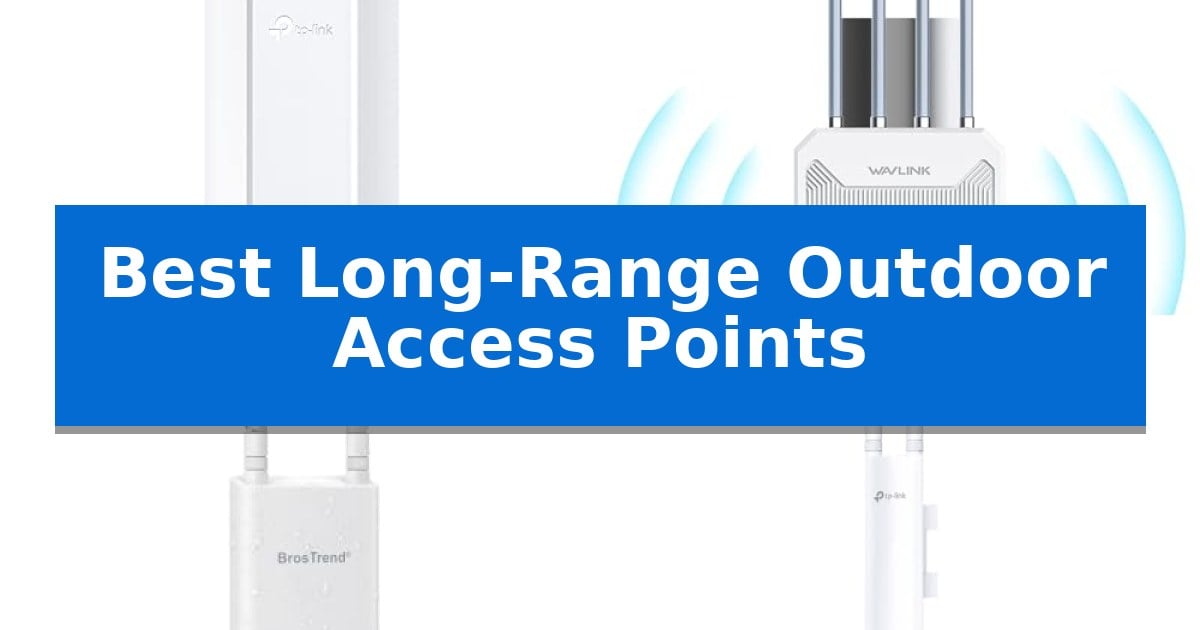
Expanding your home network to a backyard, garage, or remote property requires hardware specifically engineered to withstand environmental exposure while maintaining signal integrity. Standard indoor routers often fail to penetrate exterior walls or survive temperature fluctuations, making the selection of Best Long-Range Outdoor Access Points essential for consistent connectivity.
These devices utilize high-gain antennas and robust, weather-resistant enclosures to bridge the gap between your interior network and distant outdoor spaces. Whether you are managing a large estate or simply need reliable coverage for outdoor security cameras and smart devices, choosing the right hardware ensures your connection remains stable regardless of the weather.
You may also want to compare Best Long-Range Optical Zoom Cameras, Best Long-Range Off-Grid Walkie Talkies, and Best Long-Range NVRs with Two-Way Audio and Night Vision.
Best Long-Range Outdoor Access Points
Quick Comparison
| Product | Best For | Key Strength | Score |
|---|---|---|---|
| TP-Link Omada EAP650-Outdoor Access Point | Best Overall | IP67 weatherproof rating ensures protection against harsh outdoor elements. | 4.9 |
| WAVLINK AX1800 Outdoor Access Point | Best for Rural Property Coverage | IP67 weatherproof rating for reliable operation in harsh outdoor conditions. | 4.5 |
| BrosTrend AX3000 Outdoor Access Point | Reliable Wired Uplink Performance | Wired Ethernet uplink ensures more consistent speed and lower latency than wireless extenders. | 4.9 |
| TP-Link Omada EAP225-Outdoor Access Point | Budget-Friendly Long Range Option | IP65-rated weatherproof construction for harsh environments. | 4.9 |
| WAVLINK AX3000 Outdoor Access Point | High-Gain Antennas for Penetration | IP67-rated weatherproofing for reliable outdoor durability. | 4.3 |
How We Chose
- Wireless Standard and Throughput: We prioritized devices supporting Wi-Fi 6 or higher to ensure efficient data handling for multiple connected devices.
- Environmental Durability: We assessed the IP rating of each enclosure to confirm its resistance to moisture, dust, and temperature extremes.
- Coverage and Penetration: We analyzed antenna gain specifications and reported coverage capabilities to determine suitability for large, open-air environments.
- Management and Integration: We reviewed the software control options, including SDN compatibility and standalone modes, to ensure ease of network administration.
- Power Delivery: We verified support for Power over Ethernet (PoE) to facilitate flexible installation in locations without nearby power outlets.
1 TP-Link Omada EAP650-Outdoor Access Point — Fast Wi-Fi 6 for Large Yards
Extending reliable wireless coverage to outdoor spaces requires hardware built to withstand environmental exposure while maintaining high-speed data throughput. The TP-Link Omada EAP650-Outdoor Access Point addresses this by combining an IP67 weatherproof enclosure with Wi-Fi 6 technology, ensuring stable connectivity in demanding conditions. Its design allows for both wall and pole mounting, providing flexibility for deployment in large yards or commercial exterior areas.
Performance is driven by dual-band Wi-Fi 6 capabilities, supporting speeds up to 2976 Mbps through features like 1024-QAM and HE60. To maintain network efficiency, the device incorporates Beamforming, Band Steering, and Airtime Fairness, which help manage traffic when multiple devices are connected simultaneously. The inclusion of a PoE injector simplifies installation by delivering both power and data over a single Ethernet cable.
Integration into the Omada Software Defined Networking (SDN) platform is a core feature, allowing for centralized management via hardware, software, or cloud-based controllers. This ecosystem supports Mesh WiFi and Seamless Roaming, enabling users to create a unified network across multiple access points without manual handoffs. The system is managed through the Omada app, providing remote visibility and control over network settings.
While the unit is built for durability, it is important to note that advanced features like Omada Mesh and Seamless Roaming require the use of an Omada SDN controller to function. The 2-year warranty provides coverage for the hardware, and the discreet aesthetic allows it to blend into various environments, whether mounted on an exterior wall or positioned in an indoor setting.
Best for: Users seeking a scalable, centrally managed outdoor Wi-Fi 6 network for large residential or commercial properties.
Skip if: Those who do not have an Omada SDN controller or do not require advanced mesh and roaming features for their outdoor setup.
PROS
- IP67 weatherproof rating ensures protection against harsh outdoor elements.
- Wi-Fi 6 performance provides high-speed dual-band connectivity.
- Centralized management via the Omada SDN platform simplifies network administration.
- PoE support allows for flexible installation with a single cable.
CONS
- Controller dependency for advanced features like seamless roaming and mesh networking.
- Requires SDN firmware verification for full compatibility with existing network hardware.
2 WAVLINK AX1800 Outdoor Access Point — Best for Rural Property Coverage
Expanding your network to remote areas or large open spaces requires hardware that can withstand the elements while maintaining a reliable connection. The WAVLINK AX1800 Outdoor Access Point addresses this with its IP67 weatherproof casing, which protects internal components from moisture, dust, and temperature extremes ranging from -20°C to 50°C.
Equipped with four high-gain 8dBi omni-directional detachable fiberglass antennas, this device is engineered to provide extensive coverage in line-of-sight environments. It supports WiFi 6 AX1800 speeds, delivering up to 1201 Mbps on the 5GHz band and 574 Mbps on the 2.4GHz band, making it suitable for bandwidth-intensive tasks like 4K streaming or monitoring outdoor security cameras.
Installation is simplified through flexible PoE power options, supporting both 802.3 AF/AT active PoE and passive PoE. This allows users to power the unit via a single Ethernet cable, which is particularly useful for setups in gardens, farms, or garages where power outlets are not readily available. The system is also compatible with Starlink Gen 2 and Gen 3 hardware when using the appropriate Ethernet adapter.
The unit offers significant versatility through its multiple operating modes, including Mesh, AP, Router, and Repeater configurations. This adaptability allows it to function as a standalone access point or as part of a larger network extension strategy. Users should note that the included PoE adapter is not waterproof and must be installed in a protected indoor location to ensure longevity.
Best for: This device is best for users needing to extend high-speed WiFi 6 coverage to large outdoor areas like farms, estates, or remote properties.
Skip if: Skip this product if you require a simple plug-and-play indoor solution, as it requires professional-style PoE installation and outdoor mounting.
PROS
- IP67 weatherproof rating for reliable operation in harsh outdoor conditions.
- Four high-gain 8dBi antennas for extended signal range.
- Flexible PoE power support allows for installation without nearby power outlets.
- WiFi 6 AX1800 performance provides high-speed connectivity for up to 256 devices.
CONS
- Non-waterproof PoE adapter requires indoor placement.
- Requires Ethernet cabling for power and data, which may necessitate complex installation.
3 BrosTrend AX3000 Outdoor Access Point — Reliable Wired Uplink Performance
Extending a reliable internet connection to outdoor spaces requires hardware built to withstand the elements while maintaining consistent data throughput. The BrosTrend AX3000 Outdoor Access Point addresses this by utilizing a wired Ethernet uplink, which provides a more stable foundation for wireless signals compared to traditional range extenders that rely on repeating potentially weak signals.
Engineered for durability, this device features IP65 waterproof and dustproof protection, ensuring it remains functional in varied weather conditions. It is rated for operation in temperatures ranging from -22 °F to 140 °F and includes 6 kV lightning protection and 8 kV ESD protection, making it a robust choice for yards, barns, or RV setups.
The unit supports AX3000 WiFi 6 technology, offering combined speeds of up to 2402 Mbps on the 5 GHz band and 574 Mbps on the 2.4 GHz band. With support for UL/DL MU-MIMO and up to 80 connected devices, it is designed to manage high-traffic environments, such as outdoor security camera systems or multiple mobile devices, with reduced latency.
Installation is straightforward for those with existing wired infrastructure, as the device functions as a dedicated access point rather than a signal repeater. By connecting it directly to a main router via an Ethernet cable, users can establish a fresh, high-performance wireless network in previously unreachable outdoor areas.
Best for: Users who have a wired Ethernet connection available outdoors and need a durable, high-capacity WiFi 6 access point for yards, farms, or outbuildings.
Skip if: Users who lack the ability to run an Ethernet cable to their outdoor location, as this device requires a wired uplink for operation.
PROS
- Wired Ethernet uplink ensures more consistent speed and lower latency than wireless extenders.
- IP65 weatherproofing and wide operating temperature range for year-round reliability.
- WiFi 6 technology supports up to 80 devices with MU-MIMO efficiency.
- Integrated lightning and ESD protection for enhanced outdoor safety.
CONS
- Requires a wired Ethernet connection to the main router, which may necessitate professional installation or cable routing.
4 TP-Link Omada EAP225-Outdoor Access Point — Budget-Friendly Long Range Option
Extending reliable network coverage to outdoor spaces requires hardware built for environmental resilience and consistent signal propagation. The TP-Link Omada EAP225-Outdoor Access Point is engineered with an IP65-rated weatherproof enclosure, ensuring the internal components remain protected against rain, dust, and extreme temperature fluctuations ranging from -30 to 70 degrees Celsius.
This device utilizes 802.11ac Wave 2 MU-MIMO technology to manage multiple client connections simultaneously, supporting dual-band Wi-Fi speeds up to 1200 Mbps. Its design focuses on long-range connectivity, with rated coverage reaching over 200 meters on the 2.4GHz band and 300 meters on the 5GHz band, making it suitable for expansive outdoor areas.
Integration into the Omada Software Defined Networking (SDN) platform allows for centralized management via hardware, software, or cloud-based controllers. This ecosystem supports advanced wireless features including Mesh WiFi, Seamless Roaming, Band Steering, and Airtime Fairness, which help maintain stable connections as users move between access points.
Installation is simplified through support for both 802.3af/at PoE and Passive PoE, providing flexibility for mounting in locations where power outlets are not readily available. The unit also features a discreet aesthetic, allowing it to function effectively in both outdoor environments and indoor settings where a low-profile design is preferred.
Best for: Users needing a centrally managed, weather-resistant outdoor Wi-Fi solution for large properties or commercial spaces.
Skip if: Users who do not have an existing Omada SDN-compatible network or who require Wi-Fi 6 performance standards.
PROS
- IP65-rated weatherproof construction for harsh environments.
- Long-range coverage up to 300m+ on the 5GHz band.
- Flexible PoE power options for easier installation.
- Centralized management via Omada SDN platform.
CONS
- Requires SDN-compatible hardware for full feature integration.
5 WAVLINK AX3000 Outdoor Access Point — High-Gain Antennas for Penetration
Reliable outdoor connectivity requires hardware that can withstand environmental extremes while maintaining consistent signal distribution across large areas. The WAVLINK AX3000 Outdoor Access Point is engineered for such demanding conditions, featuring an IP67-rated waterproof enclosure that protects internal components against rain, snow, and wind. This robust build is complemented by 15kV ESD protection and 6kV lightning protection, ensuring the device remains operational in harsh weather environments ranging from -20 to 50 degrees Celsius.
At the core of its performance are 6 x 7dBi omnidirectional antennas paired with two built-in amplifiers. This configuration supports dual-band Wi-Fi 6, reaching speeds up to 2402Mbps on the 5GHz band and 573Mbps on the 2.4GHz band. The device is designed to handle high-density environments, with the capacity to support up to 256 devices simultaneously, making it a practical solution for farms, yards, or large outdoor commercial spaces.
Versatility in deployment is provided through multiple operational modes, including Mesh, AP, Router, and Repeater configurations. For power management, the unit supports active and passive PoE (Power over Ethernet), allowing for flexible installation using a single cable for both data and power. This simplifies setup in locations where traditional power outlets are unavailable, provided the installation uses CAT5E or higher cabling within a 100-meter range.
The system integrates seamlessly into existing networks, including compatibility with Starlink setups. Users can manage the network through a unified name and password when utilizing the Mesh technology feature. With a two-year free replacement warranty and ongoing technical support, this access point offers a structured approach to extending high-speed wireless coverage beyond the confines of indoor walls.
Best for: Large outdoor properties, farms, or commercial spaces requiring high-capacity, weather-resistant Wi-Fi 6 coverage.
Skip if: Users who require a simple plug-and-play indoor router or those who lack the infrastructure to support PoE or outdoor mounting requirements.
PROS
- IP67-rated weatherproofing for reliable outdoor durability.
- Supports up to 256 simultaneous devices for high-density needs.
- Flexible PoE power support simplifies outdoor installation.
- Wi-Fi 6 dual-band performance with high-gain antennas.
CONS
- PoE converter is not waterproof and requires protected placement.
- Requires ground wire installation to prevent static or lightning damage.
Best Long-Range Outdoor Access Points Buying Guide
Understanding Weatherproof Ratings
The IP rating (Ingress Protection) is the most critical specification for any outdoor networking hardware. An IP67 rating indicates that the device is fully protected against dust ingress and can withstand immersion in water, making it ideal for areas prone to heavy rain or snow.
Devices with an IP65 rating offer protection against water jets and dust, which is generally sufficient for sheltered outdoor locations like covered patios or garages. Always ensure your chosen access point meets the specific environmental demands of your installation site to prevent premature hardware failure.
The Role of High-Gain Antennas
Outdoor access points utilize high-gain antennas to focus wireless signals over greater distances compared to the omnidirectional antennas found in indoor routers. These antennas are often detachable or integrated into a fixed housing to provide the necessary signal penetration for large yards or rural properties.
When installing these devices, consider the line-of-sight environment. Obstacles like trees, metal sheds, or thick walls can significantly degrade signal strength, so mounting the access point in an elevated, unobstructed position is key to maximizing its effective range.
Power over Ethernet (PoE) Benefits
Power over Ethernet (PoE) is a standard that allows both data and electrical power to be transmitted over a single Ethernet cable. This is a game-changer for outdoor installations, as it eliminates the need to run separate power lines to remote locations.
Ensure your network switch supports the required 802.3af/at PoE standard, or use the included PoE injector. Using high-quality, outdoor-rated Ethernet cabling is also recommended to prevent signal loss and protect the cable from UV degradation over time.
Mesh Networking vs. Standalone APs
Many modern outdoor access points support Mesh networking, which allows multiple devices to communicate wirelessly to create a single, seamless network name (SSID). This is ideal for large estates where a single access point cannot cover the entire area.
If you only need to extend coverage to one specific area, a standalone access point connected via a wired Ethernet uplink is often more reliable. Wired backhaul provides lower latency and more consistent speeds than wireless mesh extensions, which can lose bandwidth with each additional hop.
Compatibility and Management
Centralized management platforms, such as Software Defined Networking (SDN), allow you to control multiple access points from a single interface. This is particularly useful if you are deploying multiple units across a large property or managing both indoor and outdoor networks simultaneously.
Always verify that your access point is compatible with your existing router or controller firmware. Some devices offer a standalone mode for simple setups, while others require specific controller hardware to unlock advanced features like seamless roaming and load balancing.
Frequently Asked Questions
Can I use an indoor router outdoors?
No, indoor routers are not designed to withstand humidity, temperature fluctuations, or direct exposure to the elements. Using them outdoors will likely lead to hardware failure and potential safety hazards.
Do I need a special cable for outdoor installation?
Yes, you should use outdoor-rated, UV-resistant Ethernet cabling (often marked as CMX or outdoor-rated) to ensure the cable jacket does not crack or degrade when exposed to sunlight and moisture.
How far can these access points reach?
Coverage depends on the environment and line-of-sight. In ideal conditions, many outdoor access points can provide a radius of 200-300 meters, but physical obstacles will significantly reduce this distance.
Is the PoE injector waterproof?
Generally, no. Most PoE injectors are designed for indoor use. You should install the injector inside your home or a weather-protected enclosure and run the Ethernet cable out to the access point.
Can these devices connect to Starlink?
Yes, most outdoor access points can be connected to a Starlink router via an Ethernet adapter, allowing you to extend your satellite internet signal to your yard or outbuildings.
Conclusion: Our Top Pick
For those seeking the most robust and versatile solution, the TP-Link Omada EAP650-Outdoor Access Point stands out as the premier choice. Its combination of Wi-Fi 6 technology, IP67 weatherproofing, and integration with the Omada SDN platform makes it highly adaptable for both large residential yards and demanding outdoor environments.
While other models offer specific advantages like higher antenna gain for penetration, the EAP650-Outdoor provides the best balance of speed, management features, and long-term reliability. It is an excellent investment for anyone looking to establish a professional-grade outdoor network with minimal maintenance.