
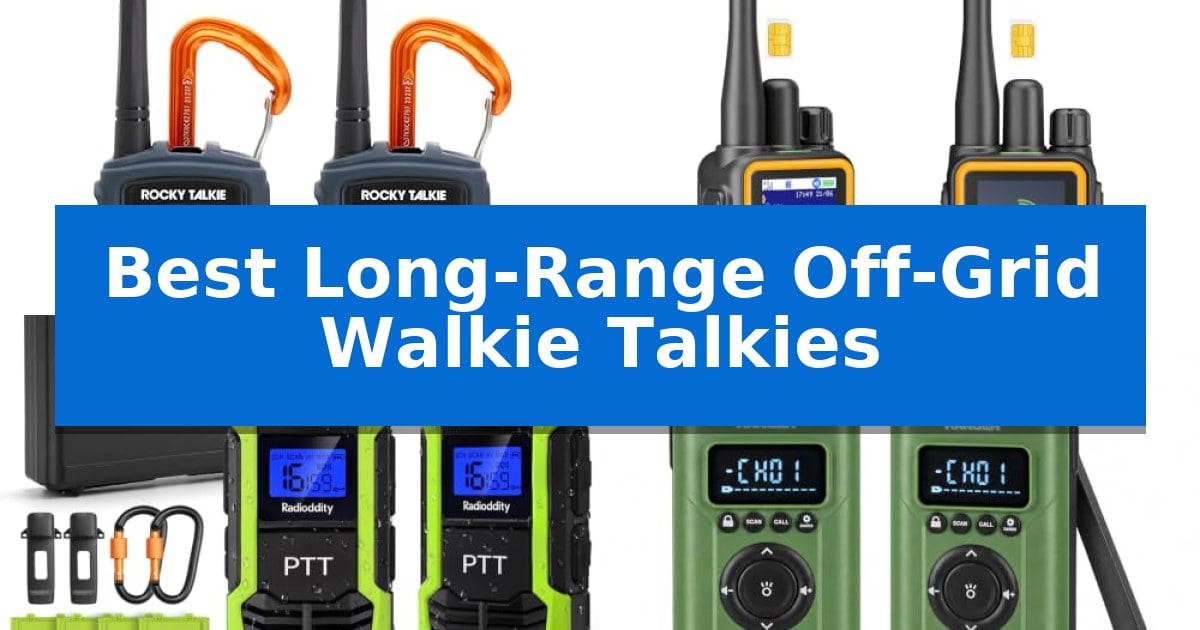
When you venture beyond the reach of cellular towers, maintaining contact with your team is essential for safety and coordination. Finding the Best Long-Range Off-Grid Walkie Talkies requires balancing signal reliability in rugged terrain with the power management needed for extended excursions.
Whether you are navigating deep backcountry or managing a remote jobsite, these devices provide a critical communication link without relying on infrastructure. We have analyzed current market options to help you identify which radio features—from manual power generation to weather-resistant housing—best suit your specific off-grid requirements.
You may also want to compare Best Long-Range NVRs with Two-Way Audio and Night Vision, Best Long-Range Netgear WiFi Extender, and Best Long-Range Motorcycle Intercoms.
Best Long-Range Off-Grid Walkie Talkies
Quick Comparison
| Product | Best For | Key Strength | Score |
|---|---|---|---|
| Rocky Talkie Mountain Radio | Best Overall | 4-day battery life specifically optimized for cold weather performance. | 4.9 |
| KaYoTom D22 Dual-Mode Radio | Unlimited Range Hybrid | Dual-mode flexibility combining PoC and GMRS in one device. | 4.8 |
| Radioddity HD-2 Walkie Talkie | Rugged Terrain Specialist | IP67-rated waterproof and dustproof construction | 4.8 |
| Kaito Voyager Ranger Radio | Infinite Hand-Crank Power | Infinite power via high-efficiency hand crank. | 4.7 |
| DEWALT DXFRS800 Walkie Talkie | Heavy-Duty Jobsite Reliable | IP67-rated water and dust protection for reliable outdoor use. | 4.6 |
How We Chose
- Signal Range and Transmission Power: Evaluating the legal transmission limits and real-world range expectations in obstructed environments.
- Power Independence: Assessing battery longevity, cold-weather performance, and the availability of manual or emergency charging methods.
- Environmental Durability: Prioritizing IP-rated protection against water, dust, and impact to ensure operation in harsh weather.
- Ease of Use and Interface: Considering the simplicity of channel management and the accessibility of controls for gloved or rapid-response operation.
- Emergency Functionality: Identifying integrated features like NOAA weather alerts and SOS beacons that enhance safety during off-grid travel.
1 Rocky Talkie Mountain Radio — Best for Extreme Cold
Maintaining reliable communication in remote backcountry environments requires gear that prioritizes durability and power efficiency. The Rocky Talkie Mountain Radio is engineered specifically for these conditions, featuring a specialized lithium-ion battery that provides over 4 days of operation, even in extreme cold.
This FRS handheld radio operates at the maximum legal limit of 2-watts, balancing signal reach with regulatory compliance. While terrain significantly impacts performance, the device is built to handle the rigors of outdoor use with a shatterproof LED screen and a rugged thermoplastic protective covering. It is rated IP56, ensuring it remains functional when exposed to splashes or snow.
Usability is a core focus, as the unit is designed to be ready to use out of the box with no complex configuration required. Users interact with a simple 5-button interface. For secure transport, it replaces fragile plastic clips with an ultra-light, climbing-rated carabiner and a metal-reinforced back-up leash, making it suitable for attachment to backpacks or harnesses.
The system is backed by a two-year warranty covering defects in material and workmanship, providing long-term support for your off-grid setup. By focusing on essential features like extended battery life and physical resilience, this radio offers a straightforward solution for groups needing consistent contact in challenging environments.
Best for: Backcountry adventurers and climbers who need a rugged, long-lasting communication device that performs reliably in cold temperatures.
Skip if: Users requiring advanced programmable features, GMRS capabilities, or long-distance communication beyond the limitations of FRS power regulations.
PROS
- 4-day battery life specifically optimized for cold weather performance.
- Enhanced durability with a shatterproof screen and climbing-rated carabiner attachment.
- Simple, no-configuration design for immediate out-of-the-box use.
- IP56 waterproof rating for protection against snow and water splashes.
CONS
- Limited to FRS power levels, which may restrict range in dense or mountainous terrain.
2 KaYoTom D22 Dual-Mode Radio — Unlimited Range Hybrid
Maintaining connectivity in remote environments requires a versatile approach, and the KaYoTom D22 Dual-Mode Radio addresses this by integrating 4G LTE PoC (Push-to-Talk over Cellular) with traditional GMRS analog radio capabilities. This hybrid design allows users to switch between global communication via cellular networks and direct, off-grid analog transmission, ensuring that teams remain connected whether they are in urban centers or deep in signal dead zones.
The device is engineered for high-stakes operational environments, offering 100% off-grid analog communication with a direct-link range of up to 3 miles. It features 30 preset GMRS channels that require no manual frequency tuning or pairing, facilitating immediate team coordination. For broader operations, the PoC mode leverages cellular technology to provide nationwide and global connectivity without distance limitations.
Usability is prioritized through a one-touch smart side key that enables rapid mode switching and cycling through CTCSS/DCS sub-tones without navigating complex menus. The keypad also supports efficient group and member selection for private calling. Furthermore, the unit includes a built-in global SIM solution that eliminates recurring subscription costs and data contracts, providing a plug-and-play experience out of the box.
This heavy-duty radio system is designed for professional use in construction, security, and outdoor fleet management. By combining the reliability of analog radio for local tasks with the expansive reach of cellular networks, it provides a flexible communication solution that adapts to varying infrastructure availability.
Best for: Professional teams and outdoor groups requiring both local off-grid communication and long-distance cellular-based connectivity.
Skip if: Users who operate exclusively in areas without any cellular coverage or those who prefer a traditional, non-hybrid radio system.
PROS
- Dual-mode flexibility combining PoC and GMRS in one device.
- Zero monthly fees for the built-in global SIM service.
- Instant off-grid communication with no setup or pairing required.
- Intuitive side-key controls for rapid mode and sub-tone adjustments.
CONS
- Limited analog range of up to 3 miles in off-grid mode.
- Reliance on cellular networks for the unlimited-range PoC feature.
3 Radioddity HD-2 Walkie Talkie — Rugged Terrain Specialist
Reliable communication in remote environments requires equipment that can withstand extreme conditions, and the Radioddity HD-2 Waterproof Walkie Talkies are engineered specifically for this purpose. Featuring an IP67-rated housing with rubber gaskets, these radios are built to survive 30-minute submersion in water and exposure to mud, dust, and snow, making them a practical choice for kayaking, fishing, or winter sports.
Performance in the field is supported by a 2500mAh cold-resistant battery capable of operating in temperatures as low as -22°F (-30°C). Beyond standard communication, the device includes a USB-C emergency power output, allowing users to charge mobile phones or GPS units when away from traditional power sources. The unit also integrates NOAA weather alerts for real-time updates and a one-key SOS beacon for emergency signaling.
The Radioddity HD-2 Walkie Talkie provides a tested signal range of up to 4 miles in open spaces, with performance reaching 1.5 to 4 miles in rural hills and 1.5 miles in urban environments. To ensure usability while wearing thick gloves, the design incorporates dual large PTT buttons and hands-free VOX activation. The included clip and carabiner carry system allows for versatile attachment to backpacks or vests, while the hard-shell carrying case with impact-absorbing foam ensures secure transport.
Flexibility is a core design element, offering features such as group call, vibration alerts, and a dedicated whisper mode for quiet communication. These radios arrive as a ready-to-use kit, providing a comprehensive solution for those requiring rugged, off-grid connectivity without the need for additional accessories.
Best for: Outdoor enthusiasts and professionals needing reliable, weather-resistant communication in extreme cold or wet environments.
Skip if: Users who require long-range communication beyond 4 miles or those looking for a lightweight, ultra-compact radio for casual urban use.
PROS
- IP67-rated waterproof and dustproof construction
- Cold-resistant battery functional down to -22°F
- USB-C emergency power output for charging external devices
- NOAA weather alerts and built-in SOS beacon
CONS
- Heavier and bulkier design compared to standard consumer walkie-talkies
- Range limitations in dense urban or complex terrain environments
4 Kaito Voyager Ranger Radio — Infinite Hand-Crank Power
Reliability in remote environments often hinges on power independence, a core capability of the Kaito Voyager Ranger Radio. This 2-pack set integrates dual-crank technology, allowing users to generate manual power on demand when traditional electricity or batteries are unavailable. By simply operating the high-efficiency hand crank, you can maintain communication and access critical updates during extended off-grid stays.
Beyond its manual power generation, the system is designed for emergency preparedness with built-in AM/FM and NOAA Weather Channels. These provide 24/7 real-time alerts for environmental hazards, ensuring you stay informed even if the power grid fails. The units also feature dual-power versatility, functioning on a high-capacity rechargeable battery or the manual crank, making them a practical fail-safe for survival kits.
Engineered for rugged use, the Kaito Voyager Ranger Radio features an impact-resistant housing that protects the internal components during outdoor activities like hiking or deep-woods hunting. The units include an integrated high-intensity LED flashlight and an SOS siren to assist in signaling for help. Advanced interference filtering is built into the transceivers to support clear voice transmission across open terrain.
The compact design, measuring 5.5 inches in height and weighing one pound, ensures these radios remain portable for bug-out bags or camping gear. While they offer robust emergency features, the reliance on manual cranking for extended power means users should plan for active maintenance of the unit during long-term use.
Best for: Outdoor enthusiasts and emergency preppers requiring a communication tool that functions without access to a power grid.
Skip if: Users who prioritize lightweight, ultra-compact communication devices for casual short-distance use where manual power generation is unnecessary.
PROS
- Infinite power via high-efficiency hand crank.
- Integrated NOAA weather alerts for emergency awareness.
- Rugged, impact-resistant construction for harsh environments.
- Includes LED flashlight and SOS siren for signaling.
CONS
- Requires manual effort to generate power during extended outages.
5 DEWALT DXFRS800 Walkie Talkie — Heavy-Duty Jobsite Reliable
The DEWALT DXFRS800 Walkie Talkie is engineered for demanding environments, utilizing a 2-watt output that provides reliable communication across up to 300,000 square feet or 25 floors. This capability makes it a practical choice for maintaining coordination among dispersed teams in large-scale settings.
Built with an IP67 weatherproof rating, these radios are designed to resist water and dust ingress. The housing features an anti-slip grip and is constructed to withstand drops from heights of up to 2 meters, ensuring durability during active use on a jobsite.
To manage busy radio environments, the system includes 22 FRS channels and 121 privacy codes, which work to block interference from other signals. The inclusion of auto-squelch technology further assists in maintaining clear audio quality by filtering out background noise.
The units are powered by an 18-hour battery, supporting extended shifts without frequent recharging. Practical features such as VOX hands-free operation, vibration alerts, and a roger beep provide additional utility for workers who need to communicate while keeping their hands free for tasks.
The package includes a dual-port dock charger, ensuring both radios can be replenished simultaneously. With holsters provided for each unit, the system is configured for immediate, portable deployment in professional or rugged field conditions.
Best for: Professional crews and field teams operating in large, multi-level, or rugged environments who require durable, hands-free communication.
Skip if: Casual users or hikers who do not require industrial-grade weatherproofing or the specific 2-watt power output for large-scale site coverage.
PROS
- IP67-rated water and dust protection for reliable outdoor use.
- 2-watt output provides significant range for large facilities.
- Dual-port charging dock allows for simultaneous battery maintenance.
- VOX hands-free functionality supports efficient multitasking.
CONS
- Heavier build compared to standard consumer-grade walkie talkies.
- Limited to FRS frequencies, which may not suit all specialized professional radio requirements.
Best Long-Range Off-Grid Walkie Talkies Buying Guide
Understanding Transmission Range
While manufacturers often cite maximum range, the actual performance of the Best Long-Range Off-Grid Walkie Talkies is heavily influenced by topography. In flat, open areas, signals travel much further than in dense forests, canyons, or urban environments where physical obstructions cause signal attenuation.
Most license-free FRS radios utilize a 2-watt power limit. Understanding that 1 to 5 miles is a typical expectation in broken terrain helps manage communication planning, ensuring you don't rely on unrealistic distance claims during critical operations.
Power Management in Cold Climates
Battery chemistry is a significant factor for off-grid users, particularly in winter conditions. Lithium-ion batteries are generally preferred for their energy density, but their performance can degrade in sub-zero temperatures.
Look for radios specifically rated for cold-weather operation or those that offer alternative power sources, such as hand-crank dynamos. These features ensure that your communication device remains functional even when standard charging infrastructure is unavailable for days at a time.
Durability and Ingress Protection
An off-grid radio must withstand more than just accidental drops. IP67 or IP56 ratings indicate that a device is sealed against dust and moisture, which is vital if you are kayaking, hiking in rain, or working in dusty construction zones.
Beyond internal sealing, the physical housing and attachment methods matter. Reinforced thermoplastic shells and metal-backed clips or carabiner systems prevent the radio from being lost or damaged during high-activity movement.
Emergency and Safety Features
The most effective radios for remote use often include integrated safety tools. NOAA weather alerts are a standard requirement for outdoor enthusiasts, providing early warnings for incoming storms or severe weather patterns.
Additional features like dedicated SOS beacons or whisper modes allow for discreet or emergency signaling. These tools transform a standard communication device into a comprehensive safety asset for your survival or emergency kit.
Dual-Mode Flexibility
Some modern radios offer hybrid functionality, combining traditional analog direct-link communication with cellular-based push-to-talk (PoC) capabilities. This dual-mode approach provides the ultimate flexibility, allowing for unlimited range when a network is available and reliable, off-grid direct communication when you are in a signal dead zone.
Choosing a hybrid system is ideal for users who transition between urban and remote environments, as it eliminates the need to carry multiple devices for different communication needs.
Frequently Asked Questions
Do I need a license to use these walkie talkies?
Most consumer-grade FRS (Family Radio Service) walkie talkies do not require a license for operation. However, always verify the specific frequency bands and power output of your chosen model to ensure compliance with local regulations.
How does terrain affect the range of my radio?
Radio waves travel in line-of-sight. Physical barriers like mountains, dense foliage, and concrete buildings absorb or reflect these waves, significantly reducing the effective range compared to open-field testing.
Are all these radios waterproof?
No. Look for an IP rating, such as IP67 or IP56. An IP67 rating means the device can withstand submersion in water up to 1 meter for 30 minutes, whereas lower ratings may only protect against light splashes or rain.
Can I charge these radios with a power bank?
Many modern off-grid radios feature USB-C charging ports, making them compatible with standard portable power banks. Always check the specific charging requirements of your model before heading out.
What is the benefit of a hand-crank radio?
A hand-crank radio provides an infinite power backup. If your primary battery dies and you have no access to electricity or solar chargers, the manual crank allows you to generate enough power for emergency calls and weather updates.
Conclusion: Our Top Pick
For those prioritizing reliability in harsh, cold environments, the Rocky Talkie Mountain Radio stands out as the most capable choice. Its combination of a 4-day battery life, cold-weather resilience, and a rugged, carabiner-based attachment system makes it a dependable tool for backcountry travel where equipment failure is not an option.
While other models offer hybrid cellular features or hand-crank power, the simplicity and durability of this radio ensure it remains ready to use out of the box. It effectively balances the need for maximum legal transmission power with a design that survives the rigors of extreme outdoor use.