
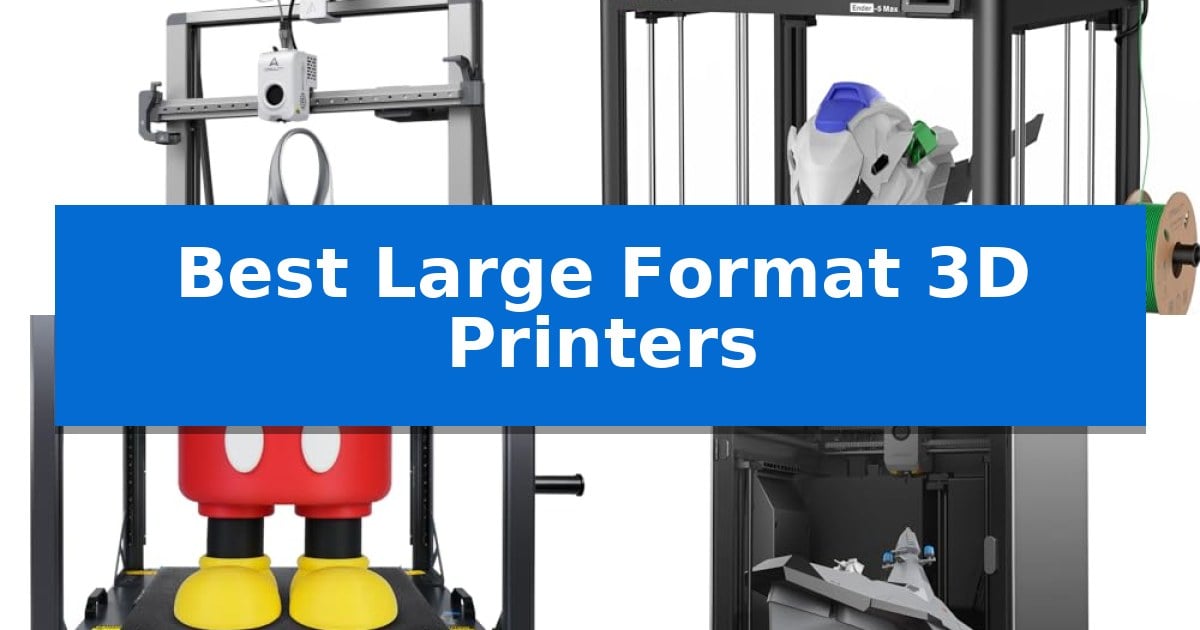
When your projects outgrow standard desktop machines, you need a reliable solution that maintains precision across a larger build area. Finding the Best Large Format 3D Printers requires balancing massive print volumes with the structural stability needed to prevent warping or layer shifting during long, complex jobs.
Whether you are producing full-scale industrial prototypes, cosplay props, or functional enclosures, the right machine can eliminate the need for splitting and gluing parts. We have evaluated these high-capacity systems to help you determine which model best fits your specific production workflow and material requirements.
Best Large Format 3D Printers in 2026
Quick Comparison
| Product | Best For | Key Strength | Score |
|---|---|---|---|
| Creality Ender 3 V3 Mega 3D Printer | Best Overall | Massive 420mm³ build volume reduces the need for splitting large models. | 4.9 |
| Creality Ender 5 Max 3D Printer | Built for High-Volume Production | Expansive 400mm³ build volume for large-scale projects | 4.7 |
| Sovol SV08 Max 3D Printer | Blazing Fast Large-Format Speed | Massive 500x500x500mm build volume for large-scale projects. | 4.6 |
| Anycubic Kobra S1 Max Combo 3D Printer | Expansive Workspace for Prototypes | Massive 350x350x350mm build volume for large-scale prototypes. | 4.9 |
| QIDI Max4 Combo 3D Printer | Industrial-Grade Heated Chamber | Ultra-large 390×390×340mm build volume for industrial-scale parts. | 4.8 |
How We Chose
- Build Volume: We prioritized machines offering significant X, Y, and Z dimensions to accommodate large, single-piece prints.
- Thermal Management: We assessed the presence of heated chambers and high-temperature hotends necessary for engineering-grade materials.
- Motion System Stability: We evaluated frame rigidity and motion kinematics, such as CoreXY, which are essential for maintaining accuracy at scale.
- Automation Features: We looked for advanced leveling systems and filament management tools that reduce the risk of failure during long-duration prints.
- Material Versatility: We considered the ability of each printer to handle diverse filaments, including flexible TPU and abrasive carbon-fiber composites.
1 Creality Ender 3 V3 Mega 3D Printer — Massive 420mm Build Volume
Scaling up your production capacity requires a machine capable of handling substantial geometry without the constant need for assembly. The Creality Ender 3 V3 Mega 3D Printer addresses this demand with a massive 420 × 420 × 420mm build volume, allowing for the creation of large-scale prototypes, cosplay props, and functional parts in a single print run.
Engineered for versatility, this large-format machine supports 85A–95A TPU flexible filaments alongside standard materials, supported by an optimized extrusion system. To maintain precision during high-speed operations, it features vibration compensation and is rated for print speeds up to 500mm/s with an acceleration of 8,000mm/s².
Operational efficiency is bolstered by smart filament management, which includes an automatic relay to switch spools when one runs out, as well as integrated runout and tangle detection. These features are designed to minimize manual intervention during lengthy, complex print jobs.
Maintenance and setup are streamlined through 81-point auto leveling, which ensures a consistent first layer across the expansive build plate. The inclusion of a quick-swap hotend further simplifies routine upkeep, making the system suitable for workshops and small-batch production environments.
Best for: Makers and small-batch production workshops requiring a large build volume for printing functional parts, cosplay props, and flexible TPU components.
Skip if: Users with limited workspace or those who primarily print small, high-detail objects that do not require a 420mm build area.
PROS
- Massive 420mm³ build volume reduces the need for splitting large models.
- High-speed printing capabilities up to 500mm/s with vibration compensation.
- Smart filament management system prevents interruptions during long prints.
- Flexible material support for 85A–95A TPU filaments.
CONS
- Large physical footprint requires significant dedicated workspace.
2 Creality Ender 5 Max 3D Printer — Built for High-Volume Production
Scaling production for large-scale prototypes or batch-manufacturing requires a machine that balances speed with a substantial build area. The Creality Ender 5 Max 3D Printer addresses this by offering an extra-large 400×400×400 mm build volume, allowing for the creation of oversized models or multiple parts in a single print run without the need for splitting designs.
Engineered for high-throughput environments, the printer utilizes an ultra-efficient CoreXY system capable of reaching speeds up to 700 mm/s. This performance is supported by a rigid all-metal frame and a precision X-axis linear rail, which work together to minimize vibration and maintain accuracy even during rapid, high-speed production cycles.
Reliability in continuous operation is managed through a direct-drive dual-gear extruder designed for 24/7 stability, effectively reducing the risk of clogging. The system also features a 1000W rapid-heating bed that reaches operating temperatures in minutes, ensuring compatibility with a wide range of materials including PLA, PETG, ABS, ASA, and PA.
For professional workflows, the unit integrates WLAN multi-printer control and grouped management, enabling users to oversee entire print farms from a single interface. Calibration is streamlined via a 64-point auto-leveling system with an automatic Z-offset, ensuring consistent first-layer adhesion and reducing the time required for manual setup.
Best for: Professional creators and small businesses managing print farms or requiring high-speed, large-format production capabilities.
Skip if: Users with limited workspace or those who only require small-scale, hobbyist-level printing may find the footprint and industrial feature set of this unit unnecessary.
PROS
- Expansive 400mm³ build volume for large-scale projects
- High-speed output up to 700 mm/s via CoreXY structure
- WLAN-enabled multi-printer management for print farms
- 64-point auto-leveling and auto Z-offset for consistent calibration
CONS
- Large physical footprint requires significant dedicated workspace
- High-power 1000W heating system necessitates stable power infrastructure
3 Sovol SV08 Max 3D Printer — Blazing Fast Large-Format Speed
Scaling up additive manufacturing requires hardware that balances massive build volumes with the precision necessary for intricate geometry. The Sovol SV08 Max 3D Printer addresses this by offering a substantial 500x500x500mm print space, allowing for the production of large-scale industrial parts, oversized props, and full-scale prototypes in a single session.
Engineered with CoreXY kinematics, the printer utilizes a compact design and optimized motion path to minimize moving mass and vibration. This architecture supports high-speed operation, reaching performance levels of up to 700mm/s with 40,000 mm/s² acceleration. To maintain consistency at these speeds, the system integrates a 50mm³/s high-flow nozzle, ensuring reliable material extrusion for complex, large-format models.
Precision is managed through an advanced Eddy Current Sensor system, which performs high-speed, contactless bed leveling to detect surface deviations before every print. This automation simplifies the setup process, helping to ensure a consistent first layer. For oversight, the unit includes a built-in 1280×720 HD camera, which supports remote monitoring and integration with cloud-based control platforms like Obico for failure detection.
The Sovol SV08 Max 3D Printer features a hotend capable of reaching 300°C, providing compatibility with a wide range of filaments including PLA, TPU, PETG, ABS, ASA, PA, PC, and various carbon-fiber composites. Users looking to further expand their material capabilities can utilize the reserved interface for a separately purchased Heated Chamber module, which is designed to support high-temperature printing requirements.
Best for: Users requiring a high-speed, large-format printing solution for industrial parts, oversized props, and full-scale prototypes.
Skip if: Users with limited workspace or those who do not require a 500mm build volume will find the footprint of this machine unnecessarily large.
PROS
- Massive 500x500x500mm build volume for large-scale projects.
- High-speed CoreXY kinematics supporting up to 700mm/s.
- Automated Eddy Current Sensor for precise bed leveling.
- High-temperature 300°C hotend compatible with diverse filaments.
CONS
- Large physical footprint requires significant dedicated workspace.
- Heated Chamber module must be purchased separately for advanced high-temp material support.
4 Anycubic Kobra S1 Max Combo 3D Printer — Expansive Workspace for Prototypes
Engineers and industrial designers requiring expansive, single-piece output will find the Anycubic Kobra S1 Max Combo 3D Printer a significant tool due to its massive 350x350x350mm build volume. This machine removes the need for splitting or gluing large prototypes, allowing for the creation of full-scale industrial parts in a single, continuous print cycle.
The printer utilizes a fully-enclosed CoreXY structure, which provides a stable, all-metal frame designed to minimize shaking and wobbling during high-speed operation. This structural rigidity is paired with an impressive 600mm/s print speed and 20,000mm/s² acceleration, enabling users to reduce project timelines by up to 80% compared to standard printing methods.
For complex, multi-material projects, the system includes the ACE 2 Pro, which enables native 4-color printing. This capability can be expanded to 16 colors by daisy-chaining additional units, effectively automating the filament-swapping process. The inclusion of a 65°C heated chamber and a 350°C hotend ensures compatibility with a wide range of engineering materials, including ABS, ASA, and TPU, while preventing warping during the cooling process.
Usability is enhanced by the Smart LeviQ 3.0 auto-leveling system, which uses a 49-point grid to calibrate the print bed. Combined with real-time flow dynamics calibration, this feature is intended to ensure consistent first-layer adhesion without the need for manual adjustments, streamlining the setup process for professional workflows.
Best for: Engineers and designers who need to print large-scale, multi-color industrial prototypes in a single piece.
Skip if: Users with limited workspace or those who only require small-format printing will find the large footprint of this machine unnecessary.
PROS
- Massive 350x350x350mm build volume for large-scale prototypes.
- 600mm/s high-speed printing for rapid project turnaround.
- Native 4-color support with the included ACE 2 Pro system.
- 65°C heated chamber for advanced engineering materials.
CONS
- Large physical footprint requires significant dedicated workspace.
- Complex setup involving the ACE 2 Pro system for multi-color functionality.
5 QIDI Max4 Combo 3D Printer — Industrial-Grade Heated Chamber
The QIDI Max4 Combo 3D Printer distinguishes itself with an ultra-large 390×390×340mm build volume, providing a 55% increase in space over its predecessor to accommodate industrial-grade parts and complex prototypes in a single print. This machine is engineered for high-speed production, utilizing closed-loop motors on the X and Y axes to support a maximum printing speed of 800mm/s and acceleration of 30,000mm/s².
Reliability during long-duration prints is supported by a 65℃ active heated chamber, which maintains the thermal environment necessary for high-temperature materials like ABS-CF, PC, and PPS-CF. The 40mm³/s high-flow hotend features a hardened steel nozzle, ensuring consistent extrusion when working with abrasive, carbon fiber-reinforced filaments. A full-surface silicone heated bed is integrated to provide uniform heat distribution and minimize warping.
Precision is maintained through dual Z lead screws and anti-backlash nuts, which work to reduce vertical gaps and improve surface quality. For operational oversight, the device includes a built-in AI camera that monitors for printing abnormalities, such as spaghetti-like failures, and can automatically pause the process to prevent material waste. The interface is managed via a large touch screen designed for streamlined control.
For users requiring multi-material or multi-color capabilities, the system is compatible with the QIDI BOX, enabling up to 16-color printing and intelligent filament management. While the printer is equipped for advanced workflows, potential buyers should note that the Polar Cooler system is sold separately and is not included in the base package.
Best for: Professionals and enthusiasts requiring a large-format, high-speed printer capable of handling industrial-grade, high-temperature materials.
Skip if: Users who do not require an industrial-sized build volume or those who prefer a smaller, more compact footprint for basic hobbyist projects.
PROS
- Ultra-large 390×390×340mm build volume for industrial-scale parts.
- 65℃ active heated chamber for high-temperature material compatibility.
- High-speed performance with 800mm/s maximum print speed.
- AI-powered monitoring to detect and prevent print failures.
CONS
- Polar Cooler system must be purchased as a separate accessory.
- Large physical footprint requires significant dedicated workspace.
Best Large Format 3D Printers Buying Guide
Understanding Build Volume Requirements
The primary advantage of these machines is the ability to print large objects without splitting them into smaller, assemblable pieces. When choosing, consider the maximum dimensions of your typical parts; a 400mm cube offers significantly more usable space than a standard 220mm printer, allowing for larger functional prototypes.
However, larger build volumes require more space on your workbench. Ensure your facility can accommodate the printer footprint and the necessary clearance for doors or panels, especially if the machine features a fully enclosed design.
The Importance of Thermal Control
Printing with advanced materials like ABS, ASA, or carbon-fiber-reinforced filaments often requires a heated chamber to prevent warping and cracking. A stable, elevated ambient temperature inside the build area ensures that large parts cool uniformly, which is critical for structural integrity.
If you primarily print PLA or PETG, a heated chamber may be less critical, but it remains a valuable feature for future-proofing your workflow if you plan to transition to more demanding engineering plastics.
Kinematics and Motion Precision
Large-format machines are prone to vibration and inertia-related artifacts. CoreXY kinematics and high-quality linear rails are essential for maintaining print quality at higher speeds. These systems minimize the moving mass of the print head, allowing for faster acceleration without sacrificing detail.
Look for machines that utilize closed-loop motors or reinforced frames, as these components directly contribute to the machine's ability to produce consistent, repeatable results over long production runs.
Automation and Reliability Features
Long print times increase the risk of failure due to filament exhaustion or first-layer issues. Automatic bed leveling (such as 81-point or 64-point systems) is non-negotiable for large beds, as it compensates for minor surface deviations across the entire print area.
Additionally, filament runout detection and automatic spool relay systems are vital for large-format printing. These features allow the printer to pause or switch to a new spool, ensuring that a multi-day print does not fail due to a simple lack of material.
Material Compatibility and Extrusion
Not all extruders are created equal. For flexible materials like TPU, a direct-drive dual-gear extruder is preferred to prevent filament buckling. Ensure the hotend can reach the necessary temperatures for your specific material, such as 300°C or higher for advanced composites.
Consider the nozzle diameter options as well. While 0.4mm is standard, many large-format printers support 0.6mm or 0.8mm nozzles, which can significantly reduce print times for large, non-detailed parts.
Frequently Asked Questions
Do I need a heated chamber for all large-format prints?
No, a heated chamber is primarily required for high-temperature materials like ABS, ASA, and PC that are prone to warping. For PLA and PETG, an open or semi-enclosed design is usually sufficient.
How does build volume affect print time?
Larger build volumes allow for larger parts, but printing a massive object takes longer regardless of the machine's speed. High-speed kinematics and high-flow hotends help mitigate this by allowing for faster extrusion rates.
Is auto-leveling necessary on a large bed?
Yes, it is essential. Even a slight tilt or unevenness across a 400mm+ bed will cause the first layer to fail, leading to wasted material and time. Multi-point auto-leveling is critical for success.
Can I print flexible filaments on these large printers?
Many large-format printers are equipped with direct-drive extruders specifically designed to handle flexible filaments like TPU. Always check the specific hardness range (e.g., 85A–95A) supported by the manufacturer.
What is the benefit of a CoreXY system?
CoreXY systems keep the motors stationary and reduce the moving mass of the print head, which allows for higher speeds and accelerations while maintaining better precision compared to traditional bed-slinger designs.
Conclusion: Our Top Pick
Selecting the right machine depends on your specific production needs, such as the material types you use and the size of your typical prototypes. For those prioritizing a massive build volume and reliable performance with flexible materials, the Creality Ender 3 V3 Mega 3D Printer stands out as a highly capable solution.
Its 420mm build volume and support for a wide range of TPU filaments make it an excellent choice for creators and small workshops. While other models offer specialized features like active heated chambers or higher speeds for industrial production, the balance of features offered by the Creality Ender 3 V3 Mega makes it a versatile and dependable foundation for large-format projects.