
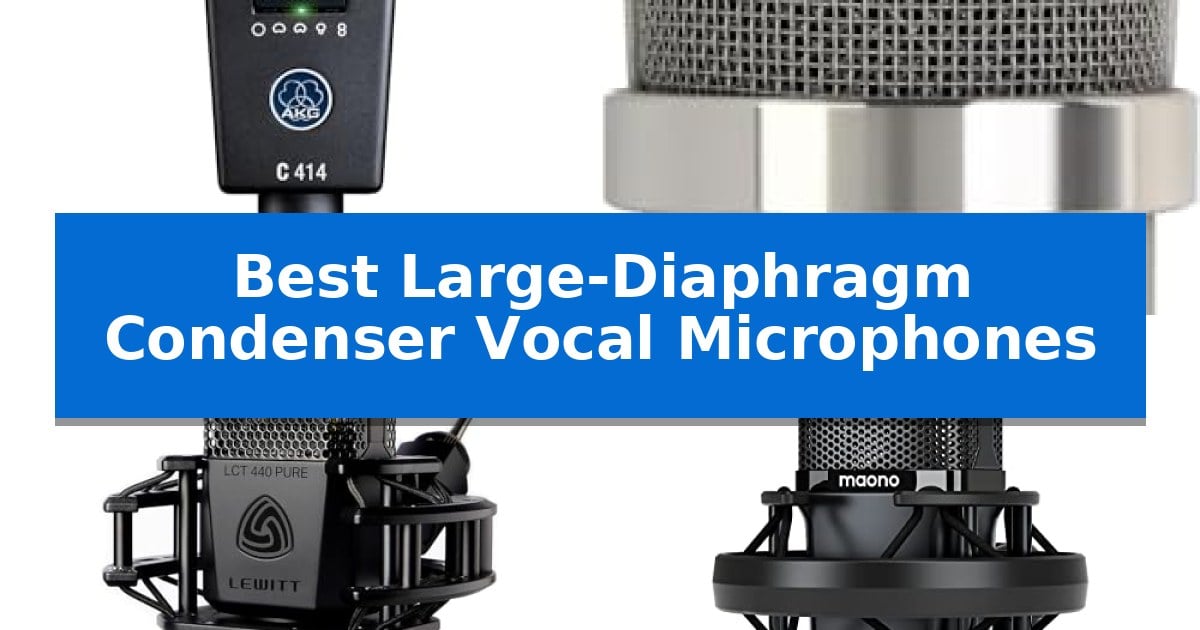
Achieving a professional vocal sound in your home or project studio starts with selecting the right transducer for your voice. The Best Large-Diaphragm Condenser Vocal Microphones are engineered to capture the nuanced details, breath, and warmth that define high-quality recordings, making them the primary choice for vocalists and voice-over artists alike.
Whether you are building your first signal chain or upgrading your current setup, choosing between various polar patterns, sensitivity levels, and build qualities is essential. We have analyzed the leading options on the market to help you identify which microphone aligns with your specific recording environment and sonic requirements.
Best Large-Diaphragm Condenser Vocal Microphones in 2026
Quick Comparison
| Product | Best For | Key Strength | Score |
|---|---|---|---|
| AKG C414 XLS Condenser Microphone | Best Overall | Nine selectable polar patterns for unmatched versatility in recording. | 4.9 |
| Neumann TLM 102 Condenser Microphone | Professional studio sound signature | Transformerless circuit design for clean signal output. | 4.4 |
| Lewitt LCT 440 PURE Condenser Microphone | Exceptional depth and detail | 1” true condenser capsule for high-depth audio capture | 4.8 |
| MAONO PM500 Condenser Microphone | High sensitivity for clean vocals | 34 mm large diaphragm gold capsule for detailed and warm sound reproduction. | 4.4 |
| Mackie EM-91C Condenser Microphone | Budget-friendly professional performance | Cardioid polar pattern for focused sound capture | 4.4 |
How We Chose
- Capsule design and diaphragm size for frequency response accuracy.
- Polar pattern versatility to manage room acoustics and off-axis rejection.
- Self-noise levels and maximum sound pressure level (SPL) handling for clean signal integrity.
- Build quality and included accessories such as shock mounts and pop filters.
- Compatibility with standard 48V phantom power and professional audio interfaces.
1 AKG C414 XLS Condenser Microphone — Industry standard for vocal clarity
Achieving professional-grade audio fidelity requires a microphone capable of capturing nuance without coloration, a task for which the AKG Pro Audio C414 XLS Studio Grade Professional Large Diaphragm Vocal and Instrument Condenser Microphone is engineered. This microphone stands out by offering nine selectable polar patterns, including Cardioid, Figure of eight, Hypercardioid, Omnidirectional, and Wide Cardioid, providing the flexibility needed for diverse studio environments.
The AKG C414 XLS is built for high-precision recording, featuring an audio frequency bandwidth of 20-20000 Hz and an exceptionally low equivalent noise level of 6 dB-A. These specifications ensure that the signal remains clean and detailed, whether recording delicate vocal performances or complex acoustic instruments. Its 88 dB-A signal-to-noise ratio and 23 mV/Pa sensitivity further contribute to its reputation for maintaining high linearity.
For demanding recording sessions, the microphone includes a peak hold LED that monitors for overload, allowing engineers to maintain optimal signal integrity. Users can also utilize the preattenuation pad (-6, -12, -18 dB) and bass cut filter (160, 80, 40 Hz) to tailor the response to specific source requirements. The ability to disable all controls makes it a practical choice for live sound installations where consistency is paramount.
Designed for longevity, the microphone features a robust construction capable of withstanding the rigors of professional use. It connects via a standard XLR connector and comes with an aluminum carrying case for secure transport. When sourced from an authorized North American dealer, it includes the official manufacturer’s warranty, ensuring professional support for studio owners and recording artists.
Best for: Professional studio engineers and recording artists requiring a versatile, neutral-sounding microphone for vocals and acoustic instruments.
Skip if: Users who require a simple, plug-and-play microphone without the complexity of multiple polar patterns and advanced signal controls.
PROS
- Nine selectable polar patterns for unmatched versatility in recording.
- Extremely low noise floor of 6 dB-A for pristine signal capture.
- Comprehensive onboard controls including bass cut filters and preattenuation pads.
- Robust build quality designed for professional studio and live performance demands.
CONS
- Advanced feature set may be excessive for casual users or simple home setups.
2 Neumann TLM 102 Condenser Microphone — Professional studio sound signature
Achieving a professional studio sound signature often requires equipment that balances sensitivity with a compact form factor. The Neumann TLM 102 Large-Diaphragm Condenser Microphone – Nickel is engineered for those who need high-quality audio capture in a space-conscious environment, utilizing a transformerless circuit design to maintain signal integrity.
This cardioid condenser microphone features a large-diaphragm capsule, which is specifically designed to handle high sound pressure levels, making it versatile for both vocal and instrumental applications. Its compact build allows for easy placement in smaller home studios or crowded recording setups where bulky gear might be impractical.
The Neumann TLM 102 is built with a focus on durability and precision, weighing approximately 1.1 pounds with dimensions of 2.8 inches in height. It includes a 1-year warranty, providing a baseline of support for its professional-grade components.
When integrating this microphone into an existing chain, the transformerless output stage ensures a clean signal path, which is a significant benefit for users prioritizing sonic clarity. It is a specialized tool that favors a streamlined, high-performance workflow over multi-pattern complexity.
Best for: The Neumann TLM 102 is best for vocalists and instrumentalists who require a professional-grade, compact microphone for high-pressure sound environments.
Skip if: Skip this microphone if you require multiple polar patterns, as it is strictly a cardioid-only device.
PROS
- Transformerless circuit design for clean signal output.
- Compact dimensions ideal for small studio spaces.
- Large-diaphragm capsule capable of handling high sound pressure levels.
- Professional-grade build quality from a reputable manufacturer.
CONS
- Fixed cardioid polar pattern limits versatility for specialized recording techniques.
- Compact size may require specific mounting considerations compared to larger, heavier studio mics.
3 Lewitt LCT 440 PURE Condenser Microphone — Exceptional depth and detail
Achieving professional-grade audio capture often hinges on the precision of your transducer, and the LEWITT LCT440PURE Large Diaphragm Condenser Mic is engineered to prioritize signal purity. Built around a 1” true condenser capsule, this microphone is designed to capture the nuanced depth of vocal performances and acoustic instruments with high fidelity.
The LEWITT LCT440PURE Large Diaphragm Condenser Mic utilizes a cardioid polar pattern, which provides effective rear rejection to isolate your sound source from ambient room noise. This makes it a versatile tool for various environments, ranging from dedicated studio spaces to home recording setups where background isolation is essential.
Beyond its core sonic capabilities, the microphone includes a shock mount to minimize mechanical vibrations and a magnetic pop filter to address plosive sounds during vocal tracking. These included accessories ensure that the hardware is ready for immediate use across a wide array of applications, including drums, cymbals, amplifiers, and piano recordings.
With a compact form factor, this microphone balances professional performance with a streamlined design. The inclusion of essential mounting and filtering hardware directly in the package provides a practical solution for creators looking to maintain a clean, high-quality signal chain without the need for additional aftermarket accessories.
Best for: This microphone is best for vocalists and instrumentalists seeking a versatile, high-clarity recording solution for studio or home environments.
Skip if: Skip this if you require a multi-pattern microphone, as this unit is strictly limited to a cardioid polar pattern.
PROS
- 1” true condenser capsule for high-depth audio capture
- Cardioid polar pattern provides effective rear rejection
- Included shock mount and magnetic pop filter for immediate setup
- Versatile application range suitable for both vocals and instruments
CONS
- Fixed cardioid polar pattern limits flexibility for non-directional recording needs
4 MAONO PM500 Condenser Microphone — High sensitivity for clean vocals
Achieving professional-grade audio capture requires a tool capable of handling diverse sound sources with precision. The MAONO PM500 Condenser Microphone utilizes a custom-designed 34 mm large diaphragm gold condenser capsule to deliver a detailed, full, and warm sound profile suitable for studio vocal work, podcasting, and instrument recording.
Engineered for versatility, this microphone features a cardioid pickup pattern that excels at off-axis sound suppression. By effectively reducing noise from the sides and rear, it ensures that your primary audio source remains the focus, making it a practical choice for environments where background distraction is a concern.
The internal architecture is built for high-fidelity performance, incorporating a tailor-made permalloy audio signal transformer and premium components to maintain low self-noise. Its extremely high SPL handling allows users to record loud sound sources, such as guitar cabinets or drums, without compromising the clarity of the signal.
Constructed with a durable zinc alloy body and finished with multi-layer coatings, the microphone is designed for longevity and structural stability. The included upgrade accessories—a metal pop filter, shock mount, and desktop stand—provide an immediate, vibration-isolated setup for professional content creation.
As an XLR-based device, this microphone requires an external power source such as a 48V phantom power supply, audio mixer, or interface. This balanced output design ensures a clear, rich, and stable audio signal, provided the user has the necessary hardware to support its power requirements.
Best for: This microphone is best for vocalists, podcasters, and musicians who already own an audio interface or mixer and require a high-sensitivity, studio-grade recording solution.
Skip if: Skip this product if you do not have an audio interface or mixer capable of providing 48V phantom power, as it cannot connect directly to standard computer ports without additional hardware.
PROS
- 34 mm large diaphragm gold capsule for detailed and warm sound reproduction.
- Excellent off-axis sound suppression via the cardioid pickup pattern.
- High SPL handling allows for recording loud instruments and vocals.
- Comprehensive accessory kit including a shock mount and metal pop filter.
CONS
- Requires external 48V phantom power and an audio interface for operation.
- Not a plug-and-play USB device, necessitating additional hardware investment.
5 Mackie EM-91C Condenser Microphone — Budget-friendly professional performance
Capturing clear, professional-grade vocal recordings often requires a reliable foundation, and the Mackie EM-91C Condenser Microphone is built to serve as that primary tool for both home and large-scale studio environments. By utilizing a large-diaphragm condenser design, this microphone is engineered to provide the sensitivity needed to capture nuanced vocal performances with accuracy.
The Mackie EM-91C Condenser Microphone features a cardioid polar pattern, which focuses on sound sources directly in front of the capsule while helping to reject off-axis noise. This directional focus is essential for maintaining clarity in untreated rooms or busy studio spaces where background interference can compromise a recording.
Durability is a core aspect of its design, featuring a rugged, reliable construction intended to withstand the rigors of frequent use. This build quality ensures that the microphone remains a stable component of your recording chain over time, whether you are tracking vocals, podcasts, or acoustic instruments.
To facilitate immediate setup, the package includes a shock mount and an XLR cable. The shock mount is critical for isolating the microphone from mechanical vibrations and handling noise, while the standard XLR connectivity ensures compatibility with professional audio interfaces and mixing consoles.
Best for: This microphone is best for vocalists and podcasters seeking an affordable, professional-quality entry point into studio-grade recording.
Skip if: Skip this model if you require a USB-based microphone for direct computer connection, as this unit requires an XLR-equipped audio interface.
PROS
- Cardioid polar pattern for focused sound capture
- Rugged, reliable construction for long-term durability
- Includes essential shock mount and XLR cable
- Affordable professional-quality performance
CONS
- XLR-only connectivity requires an external audio interface
Best Large-Diaphragm Condenser Vocal Microphones Buying Guide
Understanding Polar Patterns
The polar pattern dictates how a microphone captures sound from different directions. A cardioid pattern is the most common for vocalists, as it focuses on the sound directly in front of the capsule while rejecting noise from the rear, which is ideal for untreated rooms.
Some advanced models offer multi-pattern capabilities, including omnidirectional or figure-eight settings. These are particularly useful if you need to record duets, acoustic instruments, or require a more natural, open sound in a controlled acoustic environment.
Sensitivity and SPL Handling
Sensitivity refers to how well a microphone converts acoustic energy into an electrical signal. High-sensitivity microphones are excellent for capturing quiet, breathy vocals, but they may also pick up more ambient room noise.
Maximum SPL (Sound Pressure Level) is critical if you plan to record loud sources. While vocals are generally not as loud as drums, having a high SPL threshold ensures the microphone can handle dynamic performances without introducing unwanted distortion.
Self-Noise and Signal Integrity
Equivalent noise level is a measurement of the microphone's internal electronic noise floor. A lower number is always better, as it allows you to record quiet passages without a distracting hiss, which is vital for professional-grade vocal tracks.
High-quality components, including the pre-attenuation pad and bass cut filters, help maintain signal integrity. These features allow you to manage proximity effect and prevent clipping before the signal even reaches your audio interface.
Build Quality and Mounting
A rugged metal construction is not just about aesthetics; it protects the delicate internal capsule from physical damage and electromagnetic interference. Durability is a key factor for microphones that will be moved frequently between studio sessions.
The inclusion of a shock mount is essential for isolating the microphone from low-frequency vibrations transmitted through the mic stand. This simple accessory can significantly improve the clarity of your vocal recordings by reducing rumble.
Interface Compatibility
Most large-diaphragm condensers require 48V phantom power to operate. Ensure that your audio interface or standalone preamp provides this voltage, as the microphone will not function without it.
Consider the XLR connector quality and the overall impedance of the unit. Matching the microphone's output impedance to your interface's input requirements ensures optimal frequency response and signal transfer.
Frequently Asked Questions
Do I need a pop filter for these microphones?
Yes, a pop filter is highly recommended. Large-diaphragm condensers are very sensitive to plosives (the 'p' and 'b' sounds), which can cause harsh peaks in your recording.
Can I use these microphones for instruments?
Absolutely. Many of these microphones are designed to be versatile and perform exceptionally well on acoustic guitars, pianos, and percussion in addition to vocals.
What is the difference between a condenser and a dynamic microphone?
Condenser microphones use a lightweight diaphragm to capture high-frequency detail and transient response, whereas dynamic microphones are generally more robust and better suited for loud, high-SPL sources.
Do I need a special preamp?
While a dedicated high-end preamp can add character, any standard audio interface with a clean gain stage and 48V phantom power will provide excellent results.
How should I store my microphone?
When not in use, store your microphone in its protective case in a cool, dry place. This prevents dust from settling on the capsule and protects it from accidental drops.
Conclusion: Our Top Pick
For those seeking the most versatile and reliable tool for professional studio work, the AKG C414 XLS Condenser Microphone stands out as the premier choice. Its nine selectable polar patterns and exceptional linearity make it an industry standard that can adapt to virtually any vocal style or acoustic environment.
While other options offer specific benefits for budget-conscious users or those seeking a particular sound signature, the C414 XLS provides the consistent, neutral performance required for high-stakes recording. Its ability to handle both delicate vocals and loud instruments ensures it remains a centerpiece of your studio for years to come.