
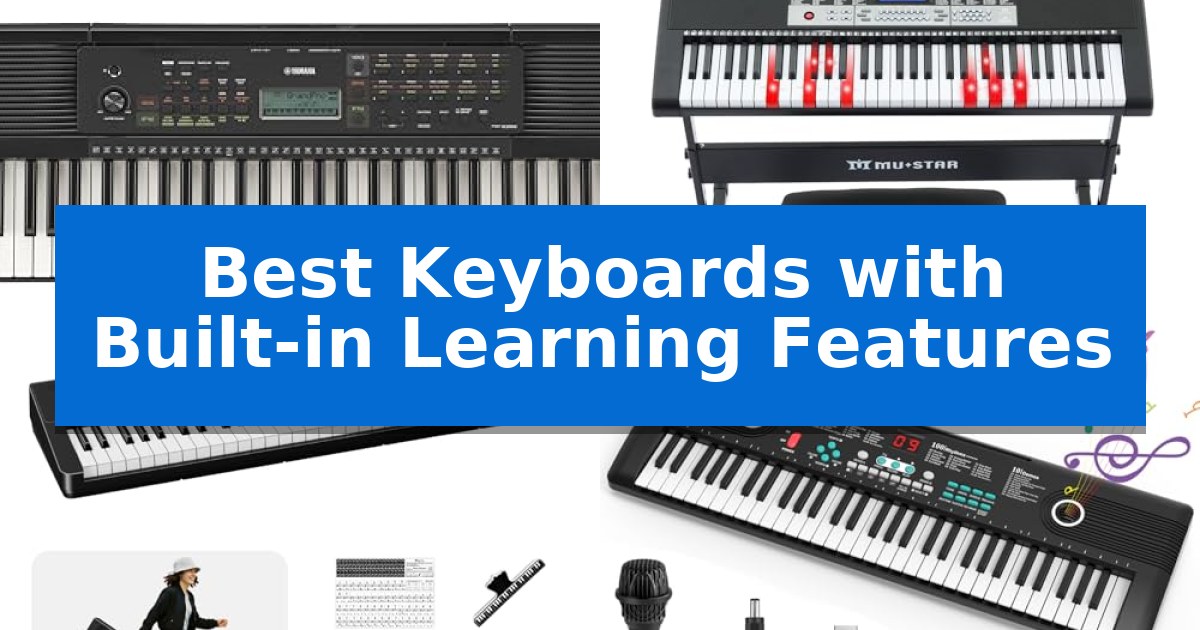
Learning to play the piano can often feel like a daunting task, especially when you are trying to coordinate complex finger movements with musical theory. Fortunately, modern technology has simplified this process by integrating educational tools directly into the instrument itself.
Our selection of the Best Keyboards with Built-in Learning Features focuses on instruments that provide real-time feedback, visual guidance, and structured practice modes. These keyboards are designed to help you build confidence and muscle memory, whether you are a complete beginner or looking to refine your technique.
Best Keyboards with Built-in Learning Features in 2026
Quick Comparison
| Product | Best For | Key Strength | Score |
|---|---|---|---|
| Yamaha PSR-E283 Portable Keyboard | Best Overall | Quiz Mode provides interactive ear-training games for skill development. | 4.9 |
| MUSTAR MEKS-800 Keyboard Piano | Visual Guidance for Rapid Learning | Light-up key guidance system for intuitive learning. | 4.4 |
| Rhymo EK61Q Keyboard Piano | Touch-Sensitive Keys for Dexterity | Touch-sensitive keys provide essential dynamic control for developing finger strength. | 4.9 |
| Ugrfw 61-Key Keyboard Piano | Color-Coded Interface for Beginners | Color-coded interface for intuitive navigation | 4.9 |
| VEVOR BD-663 Keyboard Piano | Versatile Tones for Creative Practice | Includes 61 standard-sized keys with helpful piano stickers for beginners. | 4.6 |
How We Chose
- Instructional Systems: We prioritized models offering step-by-step guidance, light-up keys, or interactive ear-training games.
- Key Action and Feel: We assessed the physical design of the keys, focusing on full-size dimensions and touch-sensitivity for proper technique development.
- Connectivity and Versatility: We looked for built-in recording, MIDI support, and headphone jacks for private, distraction-free practice sessions.
- Included Learning Accessories: We favored bundles that provide essential tools like stands, stools, and instructional stickers to get you started immediately.
- Sound Quality and Variety: We evaluated the range of built-in tones and rhythms to ensure a diverse and engaging practice experience.
1 Yamaha PSR-E283 Portable Keyboard — Best for Interactive Ear Training
Developing musical technique requires consistent practice, and the Yamaha PSR-E283 Portable Keyboard is built to facilitate this through integrated educational tools. Featuring 61 full-sized keys, this instrument provides a standard layout for beginners to build proper finger dexterity and technique.
The keyboard distinguishes itself with a dedicated Quiz Mode, which offers two distinct ear-training games. These exercises help players connect specific sounds to keys, effectively strengthening melodic memory through active engagement rather than passive repetition. For those looking to master chords, the Smart Chord feature simplifies the process, allowing users to play complex jazz or simple pop triads with a single finger.
Accessing high-quality sound is streamlined via the Portable Grand Piano Button, which instantly configures the instrument to a rich, expressive piano tone. The inclusion of hundreds of built-in songs—ranging from children's classics to popular hits—provides a library of material for players of all levels to practice and memorize at their own pace.
Designed for portability and ease of use, the unit measures approximately 37 inches in width and weighs 8.8 pounds. It comes equipped with a music rest and a power adapter, ensuring that the setup is ready for immediate use. This model is backed by a 1-year manufacturer warranty from Yamaha Corporation of America, providing support for the craftsmanship of the instrument.
Best for: Beginners seeking an interactive, guided learning experience through built-in ear training and chord-simplification tools.
Skip if: Advanced musicians or professional performers who require weighted hammer-action keys, MIDI connectivity, or professional-grade sound synthesis.
PROS
- Quiz Mode provides interactive ear-training games for skill development.
- Smart Chord technology enables one-finger chord playback.
- 61 full-sized keys offer a standard physical layout for developing technique.
- Portable Grand Piano Button allows for instant access to a primary piano sound.
CONS
- Limited to 61 keys, which may restrict range for advanced classical repertoire.
- Non-weighted keys do not simulate the resistance of an acoustic piano.
2 MUSTAR MEKS-800 Keyboard Piano — Visual Guidance for Rapid Learning
Learning to play the piano requires consistent practice, and the MUSTAR MEKS-800 Keyboard Piano simplifies this process with an integrated light-up key guidance system. By illuminating the keys as you play, this 61-key instrument acts as a visual tutor, helping beginners identify notes and rhythm without needing to constantly look at sheet music.
The device is powered by a next-generation sound chip that supports 255 distinct voices and 255 rhythms, providing a wide range of sonic options for practice. Users can utilize the 3-step learning method—which includes Single Key, Follow, and Ensemble modes—to build muscle memory progressively. Four memory settings (M1-M4) allow players to save their progress and track improvement over time.
Designed for versatility, the keyboard features audio input/output, headphone jacks, and microphone connectivity, enabling both private practice and group performances. A split-tone feature is included to facilitate duet play, allowing two people to perform simultaneously on the same keyboard.
The package includes a comprehensive beginner kit consisting of a microphone, headphones, a piano stool, an adjustable keyboard stand, a music stand, and instructional stickers. The stand is adjustable between 25.4 and 30.1 inches, accommodating players of various ages and heights.
Best for: Beginners who benefit from visual, light-based guidance to learn piano notes and rhythms.
Skip if: Experienced pianists requiring weighted keys or a full 88-key range for advanced performance.
PROS
- Light-up key guidance system for intuitive learning.
- Comprehensive starter kit includes stand, stool, and microphone.
- Versatile connectivity with headphone and microphone ports.
- Split-tone mode supports duet playing.
CONS
- Batteries not included for portable power operation.
- Fixed 61-key layout may limit advanced repertoire.
3 Rhymo EK61Q Keyboard Piano — Touch-Sensitive Keys for Dexterity
Developing finger strength and dexterity is a primary goal for any beginner, and the Rhymo EK61Q Keyboard Piano addresses this with 61 full-size keys featuring touch-sensitive response. Unlike non-weighted alternatives, these keys provide dynamic volume control, allowing learners to practice the nuances of expression and force that define acoustic piano playing.
The instrument includes a massive sound library consisting of 300 tones and 300 accompaniment rhythms, which can be layered or split to create complex arrangements. For those focused on skill-building, the one-key teaching mode and built-in metronome provide structured guidance, while USB-MIDI connectivity ensures the keyboard can interface with computers and tablets for expanded learning software or music production.
Versatility in performance is supported by the percussion design, which includes five dedicated panel pads for drum beats and a mode that transforms the entire keyboard into a percussion set. This allows for improvisation and rhythmic experimentation, giving players tools to build arrangements beyond simple melodic practice.
Designed for shared living spaces, the unit features dual 10W stereo speakers for clear audio, alongside a dedicated headphone jack that enables silent practice at any hour. Its slim, lightweight 6.6 lb frame supports both AC power and battery operation, making it a practical choice for students who need to move between practice locations.
Best for: Beginners and students who require a portable, touch-sensitive keyboard with integrated teaching tools and silent practice capabilities.
Skip if: Experienced pianists seeking weighted hammer-action keys or professional-grade stage performance features will find this entry-level model insufficient for their needs.
PROS
- Touch-sensitive keys provide essential dynamic control for developing finger strength.
- USB-MIDI connectivity allows for integration with digital learning software and production tools.
- Silent practice mode via the headphone jack is ideal for apartments and shared spaces.
- Portable, lightweight design supports both AC and battery power for flexible use.
CONS
- Battery power requires 6 x 1.5V AA batteries, which are not included.
- Entry-level key action lacks the weighted feel of a traditional acoustic piano.
4 Ugrfw 61-Key Keyboard Piano — Color-Coded Interface for Beginners
The Ugrfw 61-Key Keyboard Piano simplifies early musical development through a color-coded interface that pairs 61 white keys with distinct red and blue function controls. This design choice provides immediate visual guidance, helping beginners navigate complex settings without needing to memorize every button placement.
Beyond its layout, the instrument offers a comprehensive suite of 100 demonstration tracks, 100 timbres, and 10 rhythms to assist in ear training and genre exploration. The inclusion of rhythm programming and multi-finger chord systems allows learners to move beyond simple melodies into structured composition and accompaniment.
Practicality for the developing musician is supported by dual power compatibility, allowing the unit to run on an adapter or 4 AA batteries for mobile practice. The slim-profile, lightweight design ensures the keyboard can be moved between rooms or taken to rehearsals without significant effort, while the durable ABS material ensures the chassis can withstand frequent handling.
The keyboard also features built-in microphone integration and recording/playback functionality, enabling users to capture their performances in real-time. These tools are essential for self-critique, allowing students to listen back to their playing and refine their articulation and timing as they build confidence.
Best for: Beginners and students seeking an accessible, portable instrument with integrated teaching aids and recording tools.
Skip if: Professional musicians or those requiring weighted keys, MIDI connectivity, or high-fidelity sound output will find this entry-level model insufficient for their needs.
PROS
- Color-coded interface for intuitive navigation
- Portable design with dual power options
- Integrated recording and playback functionality
- Rich teaching content including 100 demo tracks
CONS
- Batteries not included for mobile operation
- Limited to 61 keys, which may restrict advanced repertoire
5 VEVOR BD-663 Keyboard Piano — Versatile Tones for Creative Practice
Developing musical proficiency requires consistent practice, and the VEVOR BD-663 Keyboard Piano simplifies this process with its 61-key layout and included piano stickers designed to help beginners master finger placement. This unit provides a comprehensive suite of tools, including 200 standard tones, 200 international rhythms, and 60 demo songs, offering a wide range of sound profiles for daily practice or social gatherings.
The device features dual built-in speakers that deliver clear audio output for home use. For those seeking a more focused session, the keyboard includes an audio output for headphones, allowing for private practice without external noise. Connectivity is further supported by microphone and audio inputs, enabling users to integrate external speakers or audio sources to enhance their setup.
Designed for portability and ease of use, the VEVOR BD-663 Keyboard Piano weighs approximately 5.07 pounds and comes with a durable music stand that accommodates sheet music or tablets. While the unit does not include proprietary learning software, it is compatible with third-party applications like POP PIANO to facilitate advanced practice functions.
This keyboard is a practical choice for students or adults beginning their musical journey. By offering a variety of built-in rhythms and tones alongside essential accessories like headphones, it provides a functional, ready-to-play environment for skill development.
Best for: Beginners and students looking for an all-in-one, portable keyboard solution with a wide variety of built-in tones and rhythms for practice.
Skip if: Users who require weighted keys, professional-grade MIDI controller functionality, or built-in, proprietary interactive learning software.
PROS
- Includes 61 standard-sized keys with helpful piano stickers for beginners.
- Versatile 200 tones and 200 rhythms provide extensive variety for practice.
- Includes headphones and a music stand for an immediate, ready-to-use setup.
- Features multiple connectivity options including audio and microphone inputs.
CONS
- Does not include built-in proprietary learning software.
- Requires third-party apps for specific advanced practice features.
Best Keyboards with Built-in Learning Features Buying Guide
Understanding Learning Modes
Most modern keyboards feature a 3-step learning system that breaks songs down into manageable parts. These modes typically allow you to practice the melody, rhythm, and accompaniment separately before combining them into a full performance.
Look for instruments that offer visual guidance, such as light-up keys or LCD displays, which help you map notes to the keyboard without needing to constantly look at sheet music.
The Importance of Key Size and Action
For beginners, 61 full-sized keys are generally considered the standard for developing correct hand positioning. Smaller, non-standard keys can lead to poor habits that are difficult to correct later.
Some advanced models feature touch-sensitive keys, which respond to the force of your touch. This is crucial for learning dynamic control, allowing you to play softer or louder depending on your expression.
Connectivity for Modern Practice
Modern keyboards often include USB-MIDI connectivity, enabling you to connect your instrument to tablets or computers. This opens up a world of third-party learning apps and music production software.
Always check for a headphone jack, which is essential for practicing at any time of day without disturbing others in your home or apartment.
Evaluating Sound and Tones
A wide variety of built-in tones and rhythms keeps practice sessions fresh and exciting. Having access to different instrument sounds, such as organs, strings, or synthesizers, encourages creative exploration.
Ensure the keyboard has built-in speakers that provide clear, vibrant sound, as this directly impacts your ability to hear the nuances of your own playing.
Portability and Power Options
If you plan to practice in different rooms or take your keyboard to lessons, consider the weight and power options. Many portable models support both AC adapters and battery power for maximum flexibility.
A slim, lightweight design is ideal for students in dorms or smaller living spaces where storage is at a premium.
Frequently Asked Questions
Are light-up keys effective for learning?
Yes, light-up keys provide immediate visual feedback, helping beginners identify the correct notes quickly and reducing the frustration often associated with reading sheet music.
Do I need a stand and stool?
While not strictly necessary for the sound, a stand and stool are highly recommended to ensure proper posture, which is essential for long-term comfort and technique development.
Can I use these keyboards with learning apps?
Many models with USB-MIDI or audio input can be connected to tablets or computers, allowing you to use popular music learning apps to supplement your practice.
What is the difference between touch-sensitive and standard keys?
Touch-sensitive keys respond to how hard you press them, allowing for volume and expression changes. Standard keys produce the same volume regardless of how hard they are struck.
Is a 61-key keyboard enough for beginners?
A 61-key keyboard is the standard size for most beginners, offering enough range to learn the fundamentals of music theory and technique without the bulk of a full 88-key piano.
Conclusion: Our Top Pick
Choosing the right instrument is the first step toward musical proficiency. The Yamaha PSR-E283 Portable Keyboard stands out as our top recommendation due to its sophisticated Quiz Mode and high-quality sound engine, which are specifically tailored to help beginners develop their ear and melodic memory.
While other models offer excellent visual aids like light-up keys, the Yamaha provides a robust foundation for serious practice. Its combination of full-sized keys, intuitive learning tools, and reliable build quality makes it an ideal choice for students of all ages looking to build lasting musical skills.